Dave Allen: Every Force Evolves a Form
I can’t remember the first time I heard Gang of Four, but I do distinctly remember a lot of things making sense once I did. Their jagged and angular bursts of guitar, funky rhythms, deadpan vocals, and overtly personal-as-political lyrics predated so many other bands I’d been listening to. Dave Allen was the man behind the bass, and now he’s the man behind Pampelmoose, a Portland-based music and media blog. Read more
The Contextual Modality of Culture
I used to work as a juvenile rehab counselor at a maximum security facility in Washington state. There were third-generation gang members locked up there, caught in the crossfire where the rules and mores they’d grown up with clashed with those of the larger society. Read more
3 commentsMind Wide Shut: Recent Books on Mind and Metaphor
Scientists have used metaphors to conceptualize and understand phenomena since early Greek philosophy. Aristotle used many anthropomorphic ideas to describe natural occurrences, but the technology of the time, needing constant human intervention, offered little in the way of metaphors for the mind. Since then, theorists have compared the human mind to the clock, the steam engine, the radio, the radar, and the computer, all of increasing complexity. Read more
2 commentsSound Unbound is out!
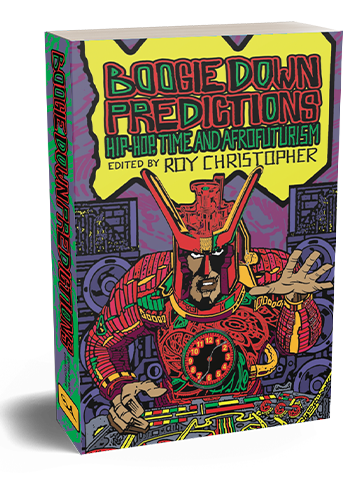
Sound Unbound is now available! I recently served as Assistant Editor to Paul D. Miller a.k.a. DJ Spooky on his essay collection, Sound Unbound: Sampling Digital Music and Culture. Contributors include Erik Davis, Manuel De Landa, Cory Doctorow, Chuck D, Brian Eno, Dick Hebdige, Vijay Iyer, Jaron Lanier, Jonathan Lethem, Moby, Steve Reich, Simon Reynolds, Scanner aka Robin Rimbaud, Bruce Sterling, Lucy Walker, and Saul Williams, among many others — and now it’s out. Read more
No commentsBuilding a Mystery: Taxonomies for Creativity
In a 2005 Daniel Robert Epstein interview, Pi director Darren Aronofsky likened writing to making a tapestry: “I’ll take different threads from different ideas and weave a carpet of cool ideas together.” In the same interview, he described the way those ideas hang together in his films, saying, “every story has its own film grammar so you have to sort of figure out what the story is about and then figure out what each scene is about and then that tells you where to put the camera.” Read more
1 commentAn Inconvenient Youth, Part Two
Remember when music was good — when bands stood for something and the music they created was from the heart? Remember when music was real? Read more
I Check The Mail Only When Certain It Has Arrived
The mailbox at my parents’ house in Alabama is at the end of winding asphalt strip, the only interruption in acres of sporadic deciduous trees, save their house of course. One day almost exactly twenty years ago, some of the best mail I ever received happened upon that mailbox. Read more
4 commentsThe Just Noticeable Difference
Marié Digby was lauded as the internet’s next big find, a phenomenon that had grown organically through digital word-of-mouth, but the media’s multi-roomed echo chamber told on itself. Maybe it was too much, too quickly, but just after Digby’s couple of homey, simple YouTube videos started spreading online, she was featured on radio stations, MTV, iTunes, announcing that she’d been signed to Disney’s Hollywood Records. The official press release headline read, “Breakthrough YouTube Phenomenon Marié Digby Signs With Hollywood Records.” What didn’t come out until later was that her name appeared on that dotted line a year and a half previous. Her online “discovery” was orchestrated from around long, conference-room tables. Read more
2 commentsJonah Lehrer: The Third Culture
In 1959, C. P. Snow lamented a chasm between what he called the Two Cultures: artsy types on one side and stuffy science folks on the other. Well, Jonah Lehrer has been trying to bring them back together. His book Proust was a Neuroscientist (Houghton Mifflin) makes large strides toward their collusion by showing how the insights of several artists, musicians, writers, and one chef were a step ahead of the science of their time. In spite of Sir Karl Popper’s insistence that “real” science be falsifiable (though even he respected the authority of the artist), art often tells us more about ourselves. Read more