
Not Great Men: The Human Microphone Effect

The passing of Steve Jobs has sent millions of people into reflection and reverie, and begs questions of the possibilities of repeating his vision and success. “Will there ever be another Steve Jobs?” asks one publication. While another contrarily claims that he “was not god,” still others iconize him, call him a tech-messiah, and lament his passing with something just short of worship. As agnostic as I’ve been computer-wise, I’ve always been a fan of the man, but does the death of Steve Jobs mark the end of a human era, the end of the singular genius, the lone visionary, the thought leader? In some ways, I am compelled to answer affirmatively, but to give Jobs all the credit is to do him and others like him a disservice. As Bonnie Stewart put it, “I fully agree that Steve Jobs left us a legacy. But it is not to be him.” We are the reason he was the last of his kind.

The connectivity of the web has all but killed the archetype of the singular visionary leader. Online, we connect to share with each other, not to listen to a single voice. It’s not necessarily the death of the grand narrative and the birth of postmodernism, it’s more the onset of postMODEMism. Ever since we started modulating and demodulating our ideas, information, and identities, our heroes have been in harm’s way. The web is more about processes and projects than products. The web is inherently a collaborative space. Authorship does not equal ownership. We’re in this together.

In spite of recent reports, the creative class is very real, and, as Scott Smith pointed out, is the larger part of the masses currently occupying Wall Street. The creative class is still here, but like the creative genius, no one owes us a living. We have to make our own way, and we will.

Unlike others, I don’t think the Big Idea is dead either. I think our collaborative, networked thinking makes it more difficult to see the collaborative origins of the singular innovation. If ideas are networks, then big ideas are big networks. Even Jobs brought to market what were previously existing, networked ideas: “He saw what technologies were on the verge of being possible — and what technologies consumers were ready to accept,” Josh Bernoff wrote when Jobs stepped down as Apple CEO in August. “There could have been no iPhone without the habits created by iPods and Blackberry, no Mac without Apple and IBM PCs embraced by those who came before… Apple doesn’t make flash memory, microprocessors, touchscreens, or, for the most part, websites. It just puts them all together.” Toward the end of this 1996 interview with Steve Jobs on Wall Street Week with Louis Rukeyser [runtime: 4:32], Jobs talks about the sheer openness of the internet and how no one single company can ever contain it [the internet bit starts around 3:15]. “We’re going to see innovation contain it,” he says.

SaJp66ArJVI

No weak men in the books at home
The strong men who have made the world
History lives on the books at home
The books at home

It’s not made by great men

The past lives on in your front room
The poor still weak the rich still rule
History lives in the books at home
The books at home

It’s not made by great men
— Gang of Four, “Not Great Men”

It’s downright eerie watching these ideas collide in realtime on the choppy live-feed of Slavoj Žižek addressing the protestors of Occupy Wall Street today, as they respond in unison: “You don’t need a genius to be your leader.” This call-and-response is called “The Human Microphone” and is used due to restrictions on amplified sound in the public space of New York City. In an ironic mix of collaborative leadership, collective allegiance, communication technology, and lacks thereof, The Human Microphone is the perfect metaphor for the death of the hero. There is no “one for all” anymore. History’s not made by great men. As Bonnie Stewart concludes, “So maybe in this new world order, we should stop touting those who are ‘crazy enough to be geniuses’, — which is a romantic notion, even if it is sometimes true, like with Jobs — and reward those who are best able to share and innovate in teams.”

The good news for all is that collaboration makes each of us bigger. Find the folks that empower you to do more, to be more, and avoid the ones who don’t. As the Hopi once put it, “We are the ones we’ve been waiting for.”

————

Here’s a clip of an odd yet amazing cover of Gang of Four’s “Not Great Men” by an appropriately all-female Japanese percussion group [runtime: 4:09]:

K19jPwpP5XY

————

Many thanks to my friend Dave Allen for sharing links and the Japanese Gang of Four cover clip, to Mike Schandorf for sharing the Žižek live-feed, and to my friend and collaborating champion Heather Gold for sharing the Steve Jobs clip. Onward together.

Drawing Lines in Time: The Advent Horizon

Significant advances in technology are disruptive. They are beginnings. They are bifurcations. They are the initial conditions from which our media is born. As Jean Cocteau once put it, “The public does not like dangerous profundities; it prefers surfaces” (1972, p. 316). Feared and disparaged at first, technological contrivances are eventually welcomed in and change our world. They literally change our minds. They change our relationship with our world and with each other. Not unlike learning new words, every new advance is a new addition to our media lexicon. Our media vocabulary includes those technologies with which we feel facile or familiar. Cocteau continues, “As a matter of fact, the public likes to ‘recognize’ the familiar. It hates to be disturbed. It is shocked by surprises” (p. 315), and no one states the matter more clearly than Barry Brummett:

Every new technology is feared, is compared unfavorably to the one before, and is misunderstood, especially in the early years of its inception. We simply have fewer anxieties about computers, for instance, now than we did during their introduction into the global market and culture (p. 172).

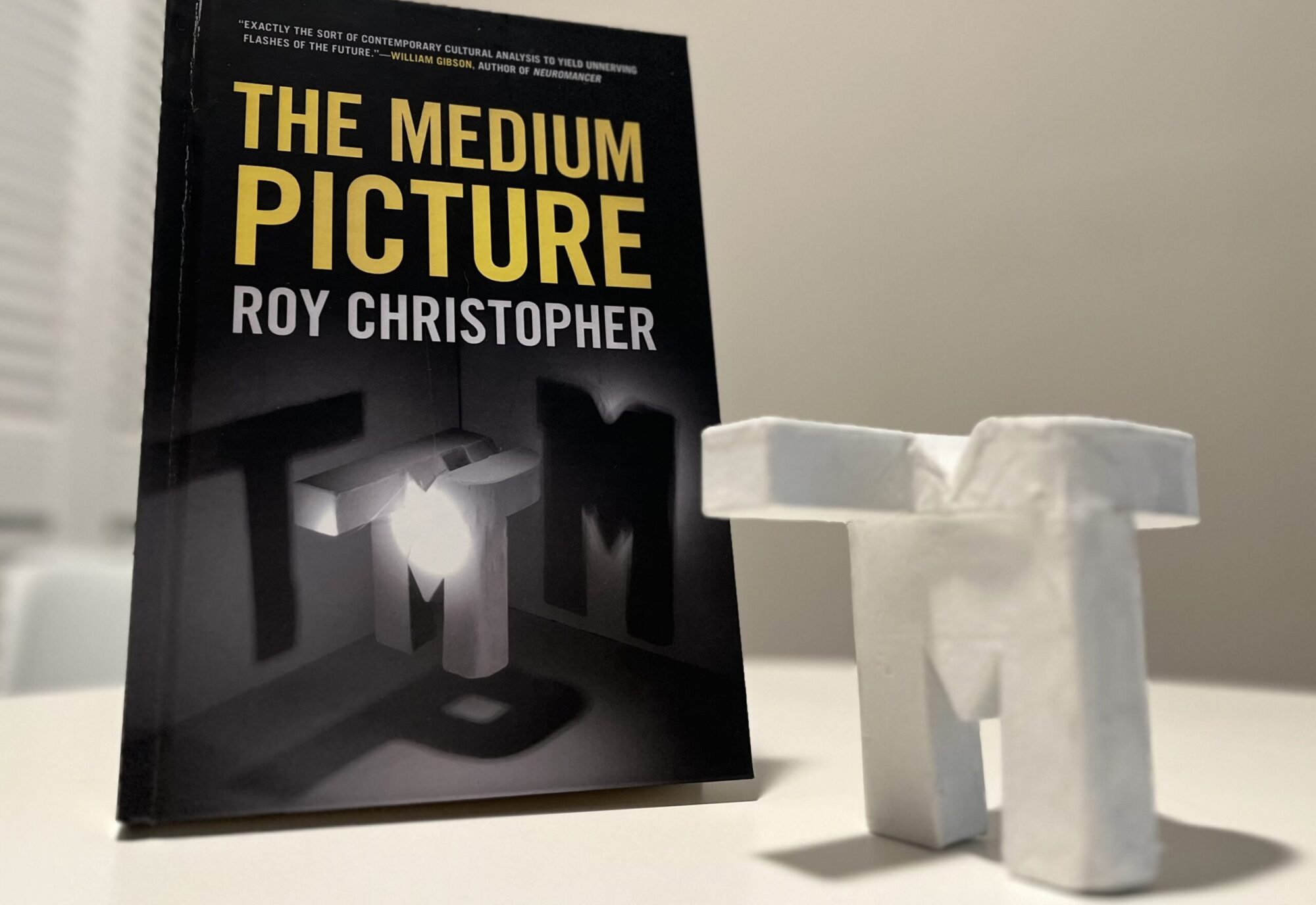
One of the ideas in my talk “Disconnecting the Dots: How Our Devices are Divisive,” as well as in my book-in-progress The Medium Picture is the line we draw at the edge of our comfort zone with new technologies. It’s a line we draw as individuals as well as a society at large. I call it the Advent Horizon. I was pushed to explain it further by David Burn:

@davidburn Two key phrases from #Geekend presentations this week: Advent Horizon and Interchange Zero c/o @RoyChristopher and @sethpriebatsch#brainy

We feel a sense of loss when we cross one of these lines. From the Socratic shift from speaking to writing (see Wolf, 2007), to the transition from writing to typing, we’re comfortable — differently on an individual and collective level — in one of these phases. As we adopt and assimilate new devices, our horizon of comfort drifts further out while our media vocabulary increases. Any attempt to return to a so-called “Natural State” is a futile attempt to get back across the line we’ve drawn for ourselves.

Evidence that we’ve crossed one of these lines isn’t difficult to find. Think about the resurgence of vinyl record sales, or the way we teach computer animation. The former is an analog totem from a previous era, the latter is analog scaffolding for the digital world (what Bob Greenberg calls “analog drudgery“). Fans of vinyl records are either clinging to their youth or celebrating the only true music format that ever mattered. A vinyl record is a true document of a slice of time.

I visited Full Sail University in Orlando, Florida last summer. In their animation and game design programs, students take illustration (with pencils and paper), flipbook-style animation (with paper and lightboxes), and 3D modeling (real-world 3D, sculpture with clay and other materials) before they ever sit down at a computer. Clinging to a previous era and having to back up to learn something new: These are evidence that an Advent Horizon has been crossed.

Each generation is born during a certain technological era, between these lines we draw. We are imprinted by the media technology with which we grow up. For instance, there has always been a television in my world. When I was born, it was there. In contrast, my parents remember when the first TV arrived in their house. William Gibson tells the story.

The only memory I have of a world prior to media is of standing in a peanut field on a farm in Tennessee, looking down the hill at a black, 1950s, sort of, late ’40s panel truck, driving along the road.

One of the next earliest memories is of my father bringing home this wooden, box-like thing, with a cloth grille on the front, and a little round, circular television screen, which, I believe, we had for some time prior to there actually being any broadcast to receive.

And then there was a test pattern. I think the test pattern preceded any actual broadcast for several weeks, and the test pattern itself was only available briefly, at scheduled times. And people… neighbors, would come, and they would look at this static, non-moving pattern on the screen that… promised something.

And then television came.

As Alan Kay once said, “Technology is anything that was invented after you were born” (quoted in Kelly, 2010, p. 235). I have never known a world without television, and my students have never known — or don’t remember — a world without computers, the web, or cellular phones. Perhaps they will cross a line of comfort when implants become the norm for their children, but the world before wireless connectivity means nothing to them.

————
Here’s the relevant clip from my talk in Boston, thanks to David Burn [runtime: 1:37]:

JZuKwpU8PtQ

By the way, the “L” and “B” story at the beginning of this clip was a secret message to my girlfriend, who became my fiancé on this trip to Boston. Here’s to connecting our dots, Lily Brewer.

————

Many thanks to Sloane Kelley, Jake and Miriam Hodesh, and the rest of my Geekend family, as well as David Burn for the push on this idea.

References:

Brummett, Barry. (2008). A Rhetoric of Style. Carbondale, IL: Southern Illinois Press.

Cocteau, Jean. (1972). Cocteau’s World: An Anthology of Writings by Jean Cocteau. Margaret Crosland (Ed.). New York: Dodd, Mead & Company.

Kelly, Kevin. (2010). What Technology Wants. New York: Penguin.

Neale, Mark. (director). William Gibson: No Maps for These Territories [Motion picture]. London: Docurama.

Wolf, Maryanne. (2007). Proust and the Squid: The Story and Science of the Reading Brain. New York: Harper.

Will Brooks: Build and Destroy

“I remember distinctly my first impression of him,” Henry Miller once described his first meeting beat writer and poet Kenneth Patchen, “It was that of a powerful, sensitive being who moved on velvet pads.”  My first meeting Will Brooks gave me a similar impression. Miller continues,

I feel that it would give him supreme joy to destroy with his own hands all the tyrants and sadists of this earth together with the art, institutions and all the machinery of everyday life which sustain and glorify them. He is a fizzing human bomb ever threatening to explode in our midst… There is almost an insanity to his fury and rebellion.

Brooks embodies these two extremes of Patchen: sensitive to a fault, deeply feeling the pain of his people, but ready to deliver retribution with no quarter and no question. Their poetry comes from the same place, a place of pure protest, pure passion.

For the past decade and a half, Brooks has been the center of one of my favorite bands, the noisy Hip-hop crew dälek. He and Brother Oktopus have roamed the globe, destroying expectations and eardrums. Their blend of drones, feedback, and banging beats often buried the vocals in the mix. Theirs was a united front, as much wall-of-sound as it was words-of-wisdom.

This year, Will Brooks emerged for dolo. Under the name iconAclass, he’s been making mad noise in his own right, but this time around the focus is on the lyrics. The beats are still banging, and the grooves are still deep, but the vocals are given center stage.

Henry Miller called Kenneth Patchen, “a sort of sincere assassin,” and I would say the same of Brooks. Allow him to reintroduce himself.

Roy Christopher: Tell me about iconAclass. How does this project differ from dälek? What’s the goal?

Will Brooks: Basically, iconAclass is my solo project. Written, produced, and mixed by my own hand. Shit, I even directed, filmed, and edited the videos! (see below) The only thing I didn’t do were the cuts. Those duties fell to long time collaborator DJ Motiv. This project something I wanted to do for a while now. I wanted to do a very stripped-down Hip-hop project where the lyrics were front and center. I also wanted the challenge of doing a project completely on my own. It was a lot of work, but I am very proud of the final result. The goal, as always, was to make the best possible songs I can make. This is a project that is representative of where my head is at, at this moment. It’s that plate of rice and beans, you know? It was that nourishment, that truth that I needed.

RC: Lyrically, you’re still keeping things rough and rugged, exploring similar themes to previous projects. Is this just more of a straight-up Hip-hop vibe?

WB: Yeah, definitely more “traditional,” I guess, but of course the lyrics got to be truth. I really don’t know any other way to approach music. Again, I definitely wanted to make the lyrics a focal point, where as in the group dälek, the lyrics were more of an instrument and under layers of sonics. In today’s musical climate I wanted to remind heads what Hip-hop is all about. I feel that production is very innovative in today’s music, but there isn’t a premium placed on lyricism. Don’t get me wrong there are heads that are still killing it on the mic — Random Axe, Slaughterhouse, Joell Ortiz on his own, Immortal technique, Pete Rock with Smiff n Wesson, Shabazz Palaces, Doh Boi, LONESTARR, John Morrison, just to name a few. I’m just proud to be a part of that Hip-hop underground that still has love for the culture and the craft.

RC: So, I have to ask: What’s the status of dälek the group?

WB: We are currently on hiatus. After fourteen years of doing it, I think both Okotpus and myself needed a break. We are still working on film scores together (we just finished one for a flick called Lilith) and running the recording studio together, but will be focusing on our respective projects (iconAclass and MRC Riddims) for the time being.

RC: I’m stoked on the book. What made you finally put your lyrics to paper for mass consumption?

WB: Back in 2002, William Hooker first suggested I put my lyrics in book form. I guess that planted the seed. While working on this project, graphic artist and long time friend, Thomas Reitmayer, who worked on the iconAclass album art, approached me with the idea of doing a book of my lyrics with some of his work. I thought it would be a cool thing to press up and have for the first iconAclass tour. It kind of built from there. Adam Jones from Tool was gracious enough to write the foreword, and we got some heads like Prince Paul and Joachim Irmler from Faust to contribute quotes. I was really humbled to have those guys be involved. I’m really proud of the final product. I just wish there were still book stores these days! [Laughs]

RC: Will you be blessing the States with a tour?

WB: We are hoping to at least set up East and West coast runs in the US in 2012. Would also love to play SXSW next year and Chicago. The logistics of a full US tour are very daunting, but we will make something happen for sure.

RC: What else is coming up?

WB: Been running the deadverse recordings record label with my label manager JR Fritsch. We released the deadverse massive TakeOver album. We got an iconAclass enhanced EP coming out in November, along with new releases by Oddateee, Dev-One, MRC Riddims, and EPs from Gym Brown, D.L.E.MM.A, and Skalla slated for 2012 and 2013. We are also planning on re-releasing Negro, Necro, Nekros (1998) in time for its fifteen year anniversary. I have also been DJing on deadverseTV as well as Mixcloud. I’ve been running a monthly deadverse night at a spot in Brooklyn called Don Pedros. It’s been a l lot of fun. Basically just the crew and affiliates DJing and performing everything from Hip-hop to House and Electro beats. Okto and I got a couple more film scores in the works to look out for. I’m definitely hitting the road heavy in support of iconAclass… And in the midst of all that, I did a couple of remixes (Black Heart Procession and Zombi), as well as some guest appearances and collaborations. Some of the collabs that are in the works are a project with Interpol drummer Sam Fogarino, a possible project with myself, Oktopus, Adam Jones from Tool and Heitham Al-Sayed, and I also might work on something with Joachim Irmler from Faust and Alec Empire. So, I’ve been a little busy…

———–

Here’s the iconAclass video for “Long Haul” [runtime: 3:33]:

ov2VhFyTKYE

And here’s the clip for “I Got It” [runtime: 4:34]:

OlPPKXi5hi0

————

Henry Miller quotations from  Morgan, Richard G. (Ed.), (1977). Kenneth Patchen: A Collection of Essays. New York: AMS Press, p. 33.

William Gibson and the City: A Glitch in Time

Though he’s better known as the paragon of paraspace, in the Sprawl of his numerous novels, William Gibson has explored the future of cities as much as any urban theorist, expanding upon the topography of late 20th-century exurban development with astute accuracy. “The record of futurism in science fiction is actually quite shabby,” Gibson says in an interview in the Paris Review. “Novels set in imaginary futures are necessarily about the moment in which they are written. As soon as a work is complete, it will begin to acquire a patina of anachronism.” While this might seem so statistically, Gibson’s visions of cities’ possible futures have come closer to reality than most others, and he regularly cites Tokyo as the human-made stone for sharpening his edge: “It’s hard to beat, these nameless neon streets swarming with every known form of electronic advertising, under a misting rain that softens the commercials playing on façade screens of quite surreal width and clarity. The Japanese know this about television: Make it big enough and anything looks cool.” In No Maps for These Territories: Cities, Spaces, and Archeologies of the Future in William Gibson (Ropopi, 2011), Karin Hoepker attempts to canonize Gibson’s excursions into our future urbs.

The suburbs are much more dangerous because in the city someone might come up and take your money, but in the suburbs they’ll take your soul. — William Gibson

Hoepker’s book extracts Gibson’s urban theory from his many novels. First, she establishes what she calls an “Archeology of Future Spaces,” then contextualizes Gibson’s work within 1980s science fiction. Next, she explores the future urban landscapes of his books in turn, illustrating not only the impossibilities of mapping these spaces via traditional means, but the invisible politics thereof as well. The gerrymandering of space for political gain is as much a part of the postmodern condition as advertising on every available surface.

Gibson’s tendency toward Tokyo notwithstanding, Los Angeles is widely considered The City of the Future, “nearly unviewable save through the scrim of its mythologizers,” as Michael Sorkin put it. Its metro myth-makers include Gibson, Norman M. Klein, Mike Davis, James Howard Kunstler, Ridley Scott, and Philip K. Dick, among others. The built environment shapes our lives like the dreamscapes in Inception shaped its ontology, but unlike Nolan’s metropolitan mazes, Gibson’s city of bits is the one we have come to inhabit: cities that connect us and reflect us like the hives of insects. Sleepily stretching out in “a vast generic tumble,” our cities and their limbs divide us even as they bring us together (see Shepard, 2011). More and more, this paradox includes the expanding matrix of cyberspace, which didn’t yet exist when Gibson first wrote about it in the July, 1982 issue of Omni Magazine. “Gibson’s influence is evident in everything from the Matrix movies to Jennifer Egan’s A Visit from the Goon Squad, which won this year’s Pulitzer prize for fiction,” writes Thomas Jones. Hoepker’s book exposes and explores Gibson’s continuing and consistent influence — on the blacktop rather than the laptop.

Exploring well beyond William Gibson, Miles Orvell and Jeffrey L. Meikle have put together a must-have compendium of of essays on urban spaces. Public Space and the Ideology of Place in American Culture (Rodopi, 2009) is rife with observations and theories. The idea that public space in America is regarded as little more than a waste of resources resonates with the rejection of the commercialization of everything here, as well as with the projections of Gibson’s stories mentioned above. There is an entire piece on desire lines and public space in Chicago, a chapter on Starbucks’ shilling of so-called “public” space (i.e. the illusion thereof, a “Third Place” in Howard Schultz-speak), one on urban communities including a bit on bum-proof benches, and another on designed space vs. social space, among many other things.

Technologist David E. Nye chimes in on public space as transformed by New York blackouts, arguing that they’re not an instance of technological determinism, a topic Nye has explored in depth previously (See chapter 2 of his Technology Matters, 2006). His take seems to flip the script on one of William Gibson’s well-worn aphorisms: The street finds its own use for things. If the technological use is culturally determined, then the use finds its own street for things. The line between a glitch in the grid and a glitch in The Matrix is in your head. Nye writes,

By the beginning of the twenty-first century, blackouts were recognized as more than merely latent possibilities. They were unpredictable, but seemed certain to come. Breaks in the continuity of time and space, they opened up contradictory possibilities. From their shadows might emerge a unified communitas or a riot. The blackout shifted its meanings, and achieved new definitions with each repetition. For some, it remained a postmodern form of carnival, where they celebrated an enforced cessation of the city’s vast machinery (p. 382).

While architecture and urban planning are tangential to my usual topics of interest, smart and expansive writing like this, writing that uses the same strokes and colors as science fiction, reminds me why I find the cumulative concerns of the built environment so fascinating. I recommend seeking out these titles. Also, it would be remiss of me not to mention that these two books are entries in two series from Rodopi. No Maps for These Territories is #12 in one called “Spatial Practices: An Interdisciplinary Series in Cultural History, Geography, and Literature,” and Public Space… is #3 in the “Architecture, Technology, Culture” series. This small sampling bodes well for two rich veins of new spatial knowledge, speculative theory, and stimulating writing.

————

Here’s a clip from Mark Neale’s William Gibson: No Maps for These Territories (2000) in which Gibson discusses our post-geographical, prosthetic nervous system [runtime: 2:02]:

poQwVguZeBg

————

References:

Eshun, Kodwo. (1996, November). William Gibson in Dialogue with Kodwo Eshun: The Co-evolution of Humans and Machines. Unpublished outtake from Paul D. Miller (ed.) Sound Unbound: Sampling Digital Arts and Culture. Cambridge, MA: The MIT Press.

Gibson, William. (1982, July). Burning Chrome. Omni Magazine.

Gibson, William. (2001, September). My Own Private Tokyo. WIRED Magazine, 9.09.

Hoepker, Karin. (2011). No Maps for These Territories. New York: Rodopi.

Jones, Thomas. (2011, September 22). William Gibson: Beyond Cyberspace. The Guardian.

Neale, Mark. (director). (2000). William Gibson: No Maps for These Territories [Motion picture]. London: Docurama.

Nye, David E. (2006). Technology Matters: Questions to Live With. Cambridge, MA: The MIT Press.

Orvell, Miles & Meikle, Jeffrey L., editors. (2009). Public Space and the Ideology of Place in American Culture. New York: Rodopi.

Shepard, Mark, editor. (2011). Sentient City: Ubiquitous Computing, Architecture, and the Future of Urban Space. Cambridge, MA: The MIT Press.

Sorkin, Michael. (1992). Variations on a Theme Park: The New American City and the End of Public Space. New York: Hill and Wang.

Wallace-Wells, David (2011, Summer). William Gibson Interview: The Art of Fiction No. 211. The Paris Review, No. 197.

Matthew Shipp / Knives From Heaven: Heavy Meta

In the 1980s, professional skateboarder Mark Gonzales used to disappear from media coverage for months at a time and every time he would return, he’d introduce the next, new trick. Once it was the kickflip, once the the stalefish, but he always set off a new trend. Antipop Consortium have cut a similar path. Their records are few and far between, but they always bump the bar a bit higher than it was before. Their 2002 record Arrhythmia (Warp) set the tone for 21st century metaphysical Hip-hop, and after a seven-year hiatus, Fluorescent Black (Big Dada, 2009) re-established what had been lost on heads in the meantime. Oddly abrasive to your expectations and undeniably smart in their creation are the way they work. Intelligent, innovative, and insightful are the watchwords.

The same can be said for Matthew Shipp, William Parker, and Thirsty Ear Recordings. The latter’s Blue Series, which includes collaborations with the former, as well as El-P, DJ Spooky, Dave Lombardo, Guillermo E. Brown, Vijay Iyer, and Mike Ladd, among many others, has consistently pushed the boundaries of Jazz, Hip-hop, and the expectations of all those involved. In 2003, it was as a part of this series that Matthew Shipp, William Parker, and Antipop Consortium previously met. Their aptly titled Antipop Consortium vs Matthew Shipp record sounds more like tension than balance, and it is on this tension that the grooves on their self-titled second outing, a collaboration with William Parker as well as Beans and High Priest from Antipop Consortium, Knives From Heaven, rely. Sometimes it sounds like the jostling of traffic swirling around you. Sometimes it sounds like dishes tumbling down stairs. Sometimes it sounds like the incessant churn of machinery. Sometimes it sounds like planets locked in wobbly orbit. No matter: It always sounds just like the future.

I first heard Shipp on the David S. Ware Quartet’s Dao (Homestead, 1995). I’d gotten review copies of that, William Parker’s Compassion Seizes Bed-Stuy (1996), and Williaw Hooker’s Armageddon (1995), which I was planning to review together for Pandemonium! Magazine of which I was then editor. Though I submerged myself in these three records and several similar releases, The Rocket‘s Steve Duda beat me to the review, and I never wrote mine. My taste for the fringes of progressive Jazz had been expanded though, and I’ve checked in with these folks on a regular basis since.

@vijayiyer “old music good! new music bad! except for mine!” — some jazz musician, every other damn day

Matthew Shipp not only plays, composes, and collaborates on Jazz’s edges, but he also thinks deeply about all of the above. When I heard Knives From Heaven, I knew it was time to get the man on the line.

Roy Christopher: This isn’t the first time you’ve been in the studio with these guys. How’d you end up working with Antipop Consortium in the first place?

Matthew Shipp: Beans use to work at a record store here in New York City, and I use to talk to him. He approached me before I had ever heard them. Of course when I heard them, I was blown away by their forward-looking aesthetic.

RC: What is it about their work that attracts you to collaborate?

MS: There is nothing cliché about how they go about it, and it has the feel of the same modern, New York zeitgeist that informs my own work.

RC: Are there any other Hip-hop acts you’d like to work with?

MS: Not really… I use to want to do something with Madlib, and I use to want to work with Kool Keith/Dr. Octagon, but I am completely involved in my own Jazz universe now.

RC: Hip-hop has flirted with Jazz regularly over the past twenty years, but the opposite hasn’t been the case. Knives From Heaven (again) illustrates the untapped potential of their mating. How do you see elements from the two genres working together?

MS: well first I am not sure if Knives From Heaven is Hip-hop flirting with Jazz or Jazz flirting with Hip-hop—

RC: I’d say it’s both.

MS: Well, first, music is music, and if you melt down the particulars there is room for dialogue between the various so-called genres. I think the so-called freedom of Jazz can be a point of inspiration for certain Hip-hop artists of a certain mental bent, and both musics have their own particular swing: The pulse of Free Jazz is a vortex of information, and all electronic musics thrive off of information, therefore it is up to the imagination and talent of the producer to cook a good meal. The palettes of both musics are different in some respects and similar in some ways so a good cook will figure out a blend that makes sense.

RC: Your work blends the architecture of composition with the spontaneity of improvisation. How does your process manifest songs? How do you decide where to start versus where to stop?

MS: I am always working or thinking about my musical language, so how do you start a sentence when you talk? Well, you know the language so well that you just start with the faith that words will come to you that match some internal imagery and the words will match whatever vague emotions and feelings you want to get across to the person you are talking to. It is very similar in this. Also, the deeper you get into your language the deeper the merger between form and content is which means if you have a deep organic concept. The architecture of composition and the spontaneity of improvisation will merge because they come from the same matrix, and form and content are one actuality, so there is some impetus that grows the structure of the piece or improvisation together with the content. And as far as stopping, that is instinct: If you know your language and your phrasing and your flow, you know when the ideas have played themselves out, therefore you know when to shut the fuck up.

RC: You bend time by mixing tradition with futurism. Do you see music in terms of eras?

MS: Yes and no. I see music as vibration that emits pulse and coheres in different ways. I see eras as each time period has its own constructs and organizational worldview… I don’t really believe in linear time so eras are an illusion to me, but a very real illusion: Every so-called time period has its own questions it asks of vibrations… But I do melt down all so-called time periods in Jazz to find some language that I can proceed to move into timeless period in.

RC: You’ve been making music long enough to have seen the changes in the technologies of recording and releasing, as well as listening and consuming. Are things getting better or are they getting worse?

MS: Worse. The world is too complex for its own good. There are too many possibilities and with the proliferation of all the technology and possibilities that we have, with all that, people are no smarter. In fact, you could argue that they are dumber and operate with less focus and concentration about what is really real.

—————

Check out the Knives From Heaven collaboration, and look for the new record called Elastic Aspects from the Matthew Shipp Trio out on Thirsty Ear in 2012.

Here’s a clip of Matthew Shipp, William Parker, Beans, and Priest working on the Knives from Heaven record at Spin Recording Studios [runtime: 3:06]:

HENFu0u3NbM

… and here’s Part 2 with Shipp and Priest [runtime: 2:50]:

XMjRMWiJ8aY

SF MusicTech Summit 2011: Discovery is Disruptive

In 1986, Tony James’ post-Generation X outfit Sigue Sigue Sputnik released a record that included advertisements between its songs (If you haven’t heard it, you probably should. It’s called Flaunt It). James explained the move saying, “Commercialism is rampant in society. Maybe we’re a little more honest than some groups I could mention… Our records sound like adverts anyway.” Though it was taken with the appropriate amount of irony twenty-five years ago, the idea was disruptive. Well, my good friend Dave Allen invited me to join him on a panel at SF MusicTech Summit this year where I heard someone propose — nay they had a business based on — the same idea as the Sigue Sigue Sputnik farce, designed for streaming online… The topic of our panel? The Lack of Disruption in Music Technology.

The "Lack of Disruption" Panel (l to r): Dave Allen, Roy Christopher, Corey Denis, David Ewald, Alex Ljung, and Jesse von Doom.

Audio streaming sites and services seem to be all the rage this year, and whenever he starts a new project with a client as Digital Strategist at NORTH, Dave always asks “What does it solve?” In our panel meetings we added “Who does it serve?” to that. Streaming services have become what Dave calls “the mechanics of consensus.” That is, they all use the same outmoded model (i.e., draw up business plan, acquire venture capital, launch service, place advertising on the free part, charge for premium service without advertising, etc.) as if it’s the only way to do things. This model follows and barely updates the broadcast radio model of the 1920s. As Dave says, “There’s nothing new in digital!” In his pre-talk post, “What happened to the Big Idea in music technology?” he points out that

…when FM radio became homogenized and the US radio stations formed into conglomerates such as Clear Channel, they neutered the DJ. When Wolfman Jack was programming his own rock shows in the USA, and across the Atlantic in London John Peel was exposing young people’s ears to music they’d never heard, they were just two examples of the extraordinary power DJs had on the music business. They were tastemakers, influencers, and filters of music culture. When the conglomerates did away with the role of the DJ in favor of automated playlists they ruined everything. The DJ was the voice of the station and he or she was considered dangerous to the bottom line if they were to offend their advertisers – they had to play nice, or go. The music streaming companies didn’t see the problem that needed solving – the lack of authentic DJs who programmed their own shows – because they thought “interactivity” was the answer.

The streams on these services are controlled by algorithms, and they’re similar on every service. If you like one Norwegian Black Metal band, you’re soon to be recommended every Norwegian Black Metal band. Discovery comes from difference, and these algorithms are based on similarities. They all serve up sameness. How about some Swedish Black Metal for a change? The DJs at KEXP (or whomever), as well as Wolfman Jack, or John Peel might keep you in a stable groove, but they also know when to yank you out of a rut. Dave says that getting up from his desk to flip over a record on the turntable is about as interactive an experience as he can imagine while at home listening to music. Either way: The human element cannot be replaced with playlists.

Dave wondering why he invited me.

RT @rebeccagates: read a comment from #sfmusictech about “need to make music more participatory”. uhhh…how about going to a live show?

It’s not all about interactivity though. There is also a mounting wave of social-media fatigue — on both sides. TAG Strategic’s Corey Denis pointed out that some artists don’t want or like to engage with their fans. We often say that a 21st-century art inherently involves multimedia, and while that might be true more often than not, it doesn’t mean every artist wants or needs to tweet. There are as many kinds of artists, performers, and entertainers as there are arts, performances, and entertainment. Some of them don’t require status updates. Social media killed the video star. Where companies and consultants are still pursuing interactivity and engagement, Dave often pushes for more passivity. People are tired of engaging with you, and sometimes there’s just no reason for you to “be social.” From the other side of the fourth wall, my man Tim Baker just posted this piece at SYFFAL about how social media kills fandom. He writes,

As for artists, I can’t tell you how many have destroyed their legacies and turned me off to their works completely based soley on their Twitter accounts. Artists and Twitter should be a match made in heaven but time and time again it is used as a sounding off board for the most idiotic, self absorbed and generally dickish thoughts, or recaps of the minutiae that only someone on the autism spectrum would need to share. Additionally most artists are not smart in the sort of way that translates into short form quick bursts. It comes off much more as indulgent at best, and idiotic at worst. Gone are the days of artists being interesting because they were mysterious and unobtainable and here are the days where modern artists are overexposed and not even remotely interesting. It is sad really that the tool that when used sparringly is so effective, is abused to such a level.

David Ewald calls this phenomenon the “erosion of trust,” and it happens at every intersection: artists to labels, labels to radio, labels to technology, everyone to “social media experts,” fans to everyone, artists to everyone, etc. Why should they trust you with something they can do themselves? But also, why should they trust you with something that don’t want to do and don’t necessarily care about in the first place? Artists should concentrate on their art. As fans, we’ve bought and replaced every format out just trying to hear the artists we love. If the music is good, we will find it and support it. We don’t need your help. As a lifelong music fan and someone who doesn’t use any of the online services, I can honestly say that my experience with music is better right now than it ever has been. Anyway, by design our panel asked more questions than it answered — and definitely more than we could answer sufficiently in an hour. Here are my thoughts from SF MusicTech Summit, collected in web-ready, low-bandwidth blurbs:

  • Solve real problems and serve real people. Artists and fans are real people. We don’t care where your money comes from.
  • Discovery is disruptive. Discovery comes from difference. Stop seeking and serving sameness.
  • The human element cannot be replaced with playlists. Just because technology can curate doesn’t mean that it should or that it does it well.
  • Social media killed the video star. Be social when it makes sense. Shut up when it doesn’t.
  • Music will take care of itself. Stop acting like music needs you to save it. It doesn’t.

—————-

Many thanks to Dave for inviting me, Lily for going with me, my fellow panelists for the great talk, and to Brian and Shoshana Zisk, Cass Philipps, and all at SF MusicTech Summit for putting this thing together. Also, props to Luke Williams for getting us stoked on this idea in the first place. Onward.

[photos by Lily Brewer]

Expanding Minds: Books on Hacking Your Head

Thinking about our own minds often seems so pataphysically impossible as to be useless and silly, but, to paraphrase Steven Johnson (again), trying to understand the brain is trying to understand ourselves. By contrast, trying to expand and enhance it seems much easier. You can expand your mind without really understanding how it happens. There are many ways to make your brain feel bigger, and these three new books provide many steps in that direction.

Upgrade your grey matter because one day it may matter.
— Deltron 3030

Mindhacker: 60 Tips, Tricks, and Games to Take Your Mind to the Next Level by Ron Hale-Evans and Marty Hale-Evans (Wiley, 2011), the “unofficial sequel” to Ron’s previous book, Mind Performance Hacks: Tips & Tools for Overclocking Your Brain (O’Reilly, 2006; which I mentioned previously). From the sublime to the silly, extensive lists of mental activities, experiments, and games comprise these books, and they’re as fun as they are fertile.

Many of the hacks here take advantage of the fact that the way you see your mind and your world are often radically related, if not often the same thing. What I mean is that a lot of these are not just mental exercises, but tricks for productivity, ways to communicate better, hacks for breaking bad habits, tips for time management, and creative ways to be more creative. It’s not just about the hacks though. Mindhacker is also stocked with other (re)sources: Relevant URLs, books, and articles are listed on every page, along with the stories of the hacks’ origins, and the book’s website has even more, including pieces of code as well as complete programs.

Speaking of programs, Andy Hunt’s Pragmatic Thinking and Learning (Pragmatic Bookshelf, 2008) tackles maximizing the mind from a programmer’s point of view, and it overlaps and complement’s the books mentioned above nicely. Maps, models, recipes, and other scripts and schedules are a part of Hunt’s push, but you don’t have to be code nerd to get plenty out of this book. It has helpful tips for everyone. Chapter four, “Get in Your Right Mind,” even suggests rock climbing, which I regularly use to clear my mind’s cache.

From the grounded to the grandiose, Supersizing the Mind: Embodiment, Action, and Cognitive Extension by Andy Clark (Oxford University Press, 2011) stretches the mind in multiple manners, also blurring the line between the brain and the world. Clark’s extended mind thesis posits the mind beyond the body… Sometimes. That is, sometimes we perform a Dawkinsian flip, seeing the biosphere as an endless network of DNA regardless of organismal boundaries; sometimes our brains and the brains of others are emphatically embodied. It’s a simple but sizable distinction. Where we draw those lines changes everything about how we see the mind and the world.

Other than a few minor missteps (e.g., In his conclusion, Clark unfortunately defines the mind as a “mashup,” when really he just means that it’s extremely diverse, infinitely adaptable, and ultimately mysterious), Supersizing the Mind is one of the better books I’ve seen in the neurosciences in a while.

If you want a brain book that’s handy and fun, I definitely recommend Mindhacker and Pragmatic Thinking and Learning. Those two, along with Dan Pink‘s book, A Whole New Mind (Riverhead, 2006), will get you a long way toward optimizing your cognitive output. If you want something a bit more theoretical, check out Supersizing the Mind. Either way, get to mining and minding your mind. It is still legal.

Party Down: Your Subtlety is Served

Upon the recommendation of my friend Chase, I decided to check out the Starz series Party Down. Unbeknownst to me, the show was created by many of the folks responsible for one of my favorite shows of all time, Veronica Mars. Realizing this, I blazed through the two seasons of Party Down in short order.

Party Down‘s namesake is the catering company for which the main characters work. Aside from the Team Leaders (Ron in Season 1 and Henry in Season 2), no one seems to care much about the job as they all have other more pressing concerns. Catering is the perfect slacker job for actors, comedians, and writers on their way up or on their way down, and Party Down is burdened and blessed with both. Each episode centers on an event they’re catering, a premise that allows the show to stay fresh even though its themes tend toward the familiar struggles of show business. Though there aren’t many changes, it also allows flexibility in the cast. Jennifer Coolidge and the inimitable Megan Mulally step in during seasons 1 and 2 respectively to cover Jane Lynch’s absence due to her Glee obligations. The show’s episodic nature also makes room for its many cameos and plot surprises.

The series casts Adam Scott as the failed actor Henry, Marin Starr as the condescending Sci-Fi writer-nerd Roman, Lizzy Caplan as the aspiring comedienne Casey (and Henry’s love-interest and impediment for most of the show), and Veronica Mars almuni Ryan Hansen as cool Hollywood bro Kyle, Ken Marino as bumbling bossman Ron, and Jane Lynch as aloof actress Constance. Other Mars regulars who make cameo appearances include Steve Guttenberg, Joey Lauren Adams, Enrico Colantoni, Jason Dohring, Martin Yu, Michael Kostroff, Alona Tal, Ed Begley, Jr., Daran Norris, Ryan Devlin, and Veronica herself, Kristen Bell.

Watching this show in conjunction with Veronica Mars highlights not only the strengths and differences of the cast but the writers as well. Rob Thomas, Jon Enbom, and Dan Etheridge had major hands in both, and the series each require a light touch in different ways. Party Down hovers around hearty issues but mostly deals in hilarity. Veronica Mars flirts with funny at times, but the overall focus is firmly serious.

While the entire cast is stellar, special mention is due of Ken Marino. His depiction of the smarmy Vincent Van Lowe in Veronica Mars was one of that show’s many great performances. In Party Down, he plays the insecure Team Leader, Ron Donald. The characters are as similar as they are different, and his shift from one to the other is remarkable. Whereas Vinnie was a cocksure, legend-in-his-own-mind P.I., Ron is chasing the dream of being his own boss by running a “Soup ‘R Crackers” restaurant franchise. The shift is worth mentioning because Marino pulls it off so effortlessly. The two characters are similar enough that a lesser actor could have played them both without much changing, but Marino plays them both with such subtlety that distinguishes the two with slight but noticeable differences.

All of this good stuff in another cancelled show… Will television ever allow shows of such cunning complexity to grow into their own?

———–

Here’s a clip in which Constance (Jane Lynch), Roman (Martin Starr), and Kyle (Ryan Hansen) discuss why Baretta was called “Baretta” [runtime: 1:33]:

d8aaywjS85s

Boombox Apocolypse: From Mixtapes to Mash-ups

The turntable is easily the most iconic cultural artifact associated with Hip-hop, but the advent and adoption of the boombox had as much to do with its spread and tenacity. Before raps were on the radio, they were on the tapes. Think of the turntable and the microphone as the senders and the boombox and the cassette as the receivers: without recording and playback, Hip-hop wouldn’t have lasted long. The already choked socioeconomic conditions from which it sprang could’ve buried it like so much tape hiss. Two recent books explore the technology of Hip-hop beyond the turntable.

Never put me in your box if your shit eats tapes. — Nas

When Hip-hop migrated to the middle spaces between the coasts and big cities, it did so via cassettes. Mixtapes were such an integral part of its spread that I felt weird when I first bought a “Rap” CD (The same could be said for any other underground movement of the time: punk, hardcore, metal, etc.). When it was shared and heard, it was done so on scratchy cassettes. Sometimes these tapes were played in cars, home stereo systems, and Walkmans, but they were more importantly played in giant boomboxes, each occasion allowing producers taking advantage of different aspects of sample-based recording (for a full discussion of these differences, see Schloss, 2004). Unlike today’s iPods, the presence of the boombox was also a public presence. Just as we gather around some screens and stare at others alone, we once gathered around the speakers of boomboxes. When I got my first Walkman and stopped lugging around my Sony boombox, it was a blessing to my back and the sanity of those around me (most notably my parents), but boomboxes remain a part of the iconography of Hip-hop.

Lensman Lyle Owerko set out to document this aspect of the culture with The Boombox Project: The Machines, the Music, and the Urban Underground (Abrams Image, 2010), which is not only a visual history of early Hip-hop street technology, but an oral one as well. Everyone from the usual suspects like LL Cool J, the Beastie Boys, Adisa Banjoko, and Malcolm McLaren, to the less-than-usual like DJ Spooky, The Clash, Chad Muska, and David Byrne display and discuss their boomboxes.

The Boombox Project illustrates that the reception of Hip-hop is as important as its inception, and that the boombox played a major role in its early days. It was the site and the sight of the sound in the streets. Here is the book trailer for The Boombox Project [runtime: 0:40]:

JLCx8IPlCoU

From mixtapes to mash-ups, Hip-hop is the blueprint to 21st century culture (This is the crux of my Hip-hop Theory — much more on that soon). What used to be done via mixers, faders, and turntables is done via software, iPods, and the internet. In the hands of the indolent and uncreative, sampling is dull at best and disturbing at worst — but so is guitar-playing. The tools are neutral. It’s what you do with them that counts. Can I get a witness?

Yes! No one has explored this undulating landscape more than Aram Sinnreich. His Mashed Up: Music, Technology, and the Rise of Configurable Culture (University of Massachusetts Press, 2010) is one half theory, one half practice and establishes an argument that sampling is the latest legitimate form of musical expression, an argument that seems silly to both sides of the debate. Busting a sextet of binaries, Sinnreich makes quick work of complex terrain, mixing media theory and musicology, as well as copyright and counterculture. Mashed Up is the most complete book I’ve seen on our current culture of convergence.

In honor of the boombox, indulge me for a few more minutes and check out this video from The Nonce. It’s “Mix Tapes” from their 1995 debut World Ultimate (Check for cameos from members of Project Blowed) [runtime: 3:34]. Dope:

QyuHuEg8auA

References:

Oworko, L. (2011). The Boombox Project: The Machines, the Music, and the Urban Underground. New York: Abrams Image.

Schloss, J. G. (2004). Making Beats: The Art of Sample-based Hip-hop. Middletown, CT: Wesleyan University Press.

Sunnreich, A. (2010). Mashed Up: Music, Technology, and the Rise of Configurable Culture. Amherst, MA: University of Massachusetts Press.

————–

Apologies to the late, mighty Hangar 18 for stealing their title for this post.

The Sibling Point: Unrelated Familial Success

Having grown up with a kid sister, I have often been fascinated with our similarities and differences. There are myriad examples of both, but our ways in the world and the way we see them are very different. When siblings emerge from the same nature and nurture to much different ends, the multifinality of their paths begs investigation. When they go on to excel in completely different fields, questions abound. The Baldwins, Cusacks, Gyllenhaals, and Arquettes are interesting, but less so.

Richard Patrick was the guitarist in Trent Reznor’s first incarnation of Nine Inch Nails. After differences of one stripe or another, he went on to form the band Filter, who had a handful of mid-1990s hits themselves. His brother Robert Patrick was the T-1000 in 1991’s Terminator 2: Judgment Day and ten years later, he went on to replace David Duchovny on The X-Files. These two were brothers whose successes in very different fields were not dependent upon one another.

Here are a few more examples:

  • During the mid-1990s female singer-songwriter boom, Poe had a hit with “Angry Johnny.” Her follow-up five years later, Haunted (2000), was a soundtrack of sorts to her brother Mark Z. Danielewski’s debut novel, House of Leaves, which pushed the limits of the modern novel and changed the way books were not only written but read and thought about as well.

Frances Bay as Mrs. Tremond

  • Frances Bay plays the creepy grandmother, Mrs. Tremond, in David Lynch’s Twin Peaks series (1990) and prequel movie, Fire Walk with Me (1992). She’s also had minor but memorable roles on Seinfeld, and in such movies as Blue Velvet, Wild at Heart, and Happy Gilmore. Her younger brother was sociologist Erving Goffman, author of The Presentation of Self in Everyday Life (1959), In 2007, he was the sixth most-cited scholar in the social sciences.
  • Henry James wrote acclaimed novels, including The Portrait of a Lady (1881) and The Turn of the Screw (1890), which challenged the conventions of literature up to that point. His brother, William James, co-founded both the field of psychology and the American pragmatism philosophical movement.
  • Ari Emanuel is a Hollywood talent agent who has inspired on-screen parodies by Jeremy Piven (Ari Gold on Entourage) and Bob Odenkirk (Stevie Grant on The Larry Sander’s Show). His brother, Rahm Emanuel, is the fifty-fifth mayor of Chicago.
  • Brad Carvey is an engineer responsible for the Video Toaster, as well as the inspiration for his brother, Dana Carvey’s character Garth Algar from the Wayne’s World movie (1992) and Saturday Night Live skits of the same name.

While there are many factors that could contribute to these dual, unrelated successes, I wonder if there are one or two initial conditions that contributed to the achievements of these siblings. I’ve only done Wikipedia-level research here, but it’d be fun to investigate further. There’s at least a Malcolm Gladwell-style book here. I think it would be fun and interesting to write — and to read. Call it The Sibling Point.

————-

Special thanks to Cecy Correa for additional input on this idea.