
As They May Think

“How easily we forget how bright the moonlight can be when we spend our nights in the wan glow of artificial light.”

I found the above quotation on page 40 of a book. I don’t know what book. I’m usually more diligent than that about such pertinent details in my notes, but in this case all I have is the quotation and a page number. I’ve done countless searches and asked several librarians, to no avail.

Appropriate, perhaps.

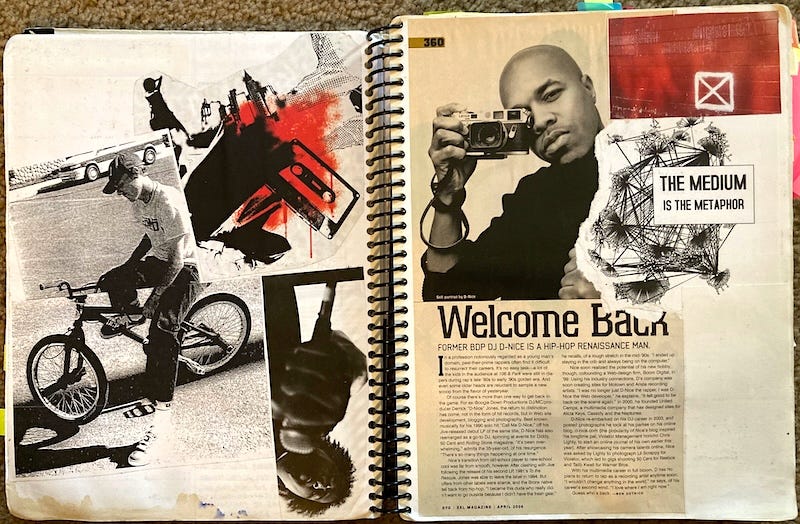
It matters where such quotations were found, and it matters who wrote them—for now. In late 2000, during an especially impoverished period of my adult life, I was going to the Seattle Public Library almost every day. I was reading bits and pieces of so many books. I remember digging deeper into the work of Walter Benjamin, discovering Paul Virilio, and the row of volumes I had lined up against the wall in an almost unfurnished apartment, their spines and call numbers pointed at the ceiling. Due dates and new arrivals kept the books rotating, and at some point, I started having a difficult time keeping up with where I’d read what. So, I started a research journal.

A spread from one of my research journals.

My research journal has always been a sort of commonplace book, an idiosyncratic mix of journal and scrapbook, collecting drawings, diagrams, clips from magazines, lists, and quotes from dreams, friends, films, and books. With the emergence of printed text, its recycling of and relation to other texts were taken as a given. Commonplace books have been used as personal repositories of wit, wisdom, and knowledge at least as far back as the 15th century. As Walter Ong wrote in his 1982 book, Orality and Literacy: The Technologizing of the Word,

Manuscript culture had taken intertextuality for granted. Still tied to the commonplace tradition of the old oral world, it deliberately created texts out of other texts, borrowing, adapting, sharing the common, originally oral, formulas and themes, even though it worked them up into fresh literary forms impossible without writing.1

The Enlightenment philosopher John Locke started maintaining a commonplace book in 1652. He wrote an elaborate guide to commonplace books in 1685 in French, and in 1706 it was translated into English as A New Method of Making Common-Place-Books. The writer and NotebookLM cofounder Steven Johnson has compared the commonplace book to the link-laden, hypertextual environment of the internet. Like our digital devices, these books represent what Jonathan Swift once called “supplemental memory.”2 Once we write something down and keep it, we no longer have to actively remember it.

“We read to inherit the words, but something is always between us and the words.” — Victoria Chang, “Language,” Obit

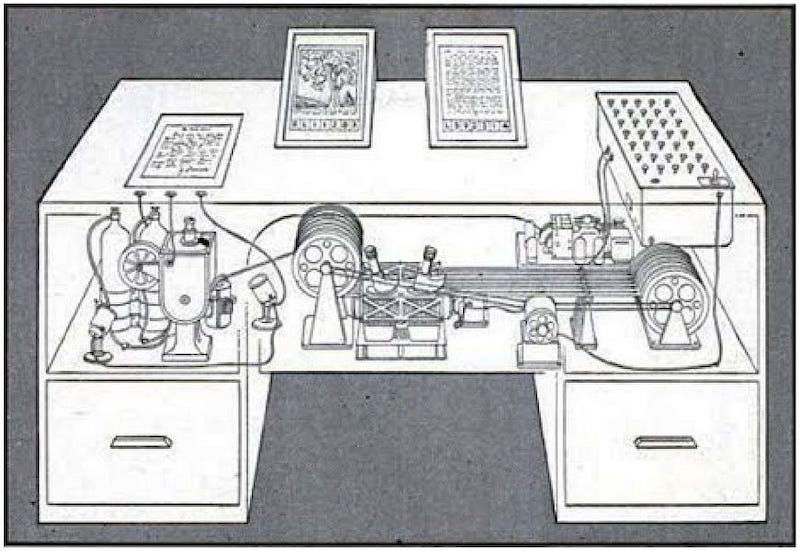
A memex, as described in Vannevar Bush’s 1945 article “As We May Think.”

Proposed in his 1945 article “As We May Think” published in The Atlantic, Vannevar Bush’s memex (itself a portmanteau of “memory” and “expansion”) was a kind of proto-personal computer, expanding the commonplace idea to a desk-bound apparatus for research. The memex was a dream machine for navigating and researching with the vast stores of information of the time using cameras, microfilm, and print—an annotated analog hypertext system. Bush wrote, “Wholly new forms of encyclopedias will appear, ready-made with a mesh of associative trails running through them, ready to be dropped into the memex and there amplified.”3 Though commonplace books and Paul Otlet’s 1934 Traité de Documentation prefigured Bush’s memex and its “associative trails,” it is a closer analog to our current personal archiving devices (e.g., cloud-storage services, smartphone-camera rolls, social-media posts, and blogs), “a sort of mechanized private file and library,” as he put it.4 We all have just such an archive in our pockets now.

“The fields are cultivated by horse-ploughs while books are written by machinery.” — from George Orwell’s Nineteen Eighty-Four

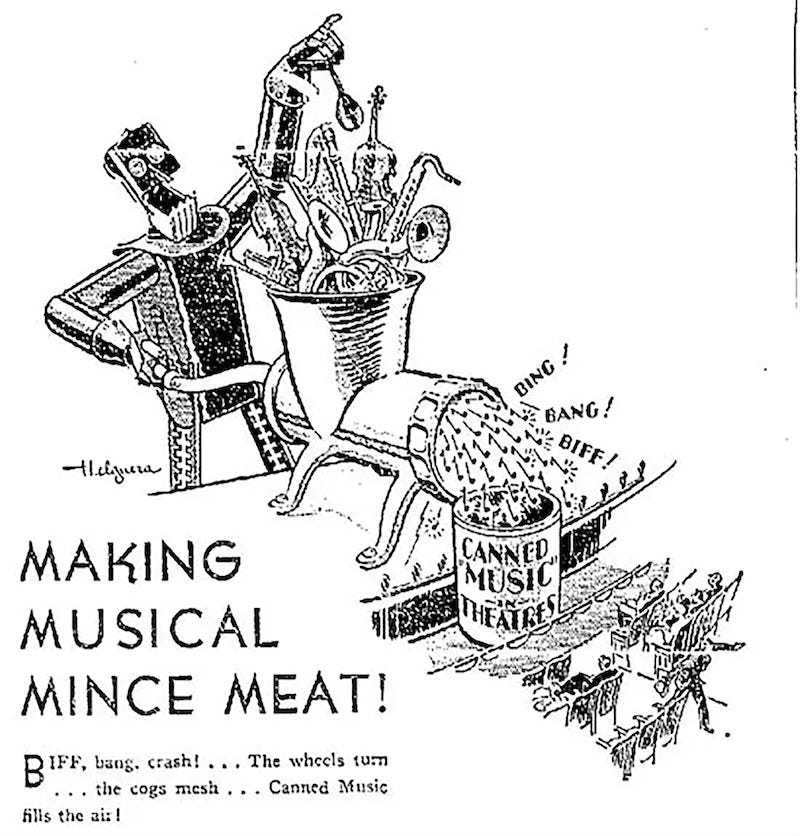
A robot grinds musical instruments to make canned music. Syracuse Herald, 1930.

As we saw happen to music: As soon as music was replicated as digital information seared onto compact discs, MP3s, peer-to-peer trading, and streaming were inevitable as bandwidth increased to accommodate them. As soon as sampling went digital, music was poised to be parsed into smaller and smaller reassemblable bits, and we’ve taken full advantage of its malleability. As the historian Carla Nappi told me in 2019,

Several years ago, I took a digital DJing course and my first baby steps in learning the craft. I was immediately struck by how similar the art of a DJ was, at least as I was learning and experiencing it, to that of a historian. We amass archives, we tell stories that have a kind of narrative arc, we work with time as a material. Sampling is a kind of quotation. Distortion and other effects are ways of reading a musical text. There are just so many resonances, and I felt that thinking about these crafts together could be a way of informing and inspiring both of them.5

The most original DJ is still playing pieces of other people’s past songs. The most original writer is still using the same linguistic tools to reassemble pieces of the past into a form resembling something new.

“Thou shall not make a machine in the likeness of a human mind.” — Rayna Butler, Orange Catholic Bible (from Frank Herbert’s Dune)

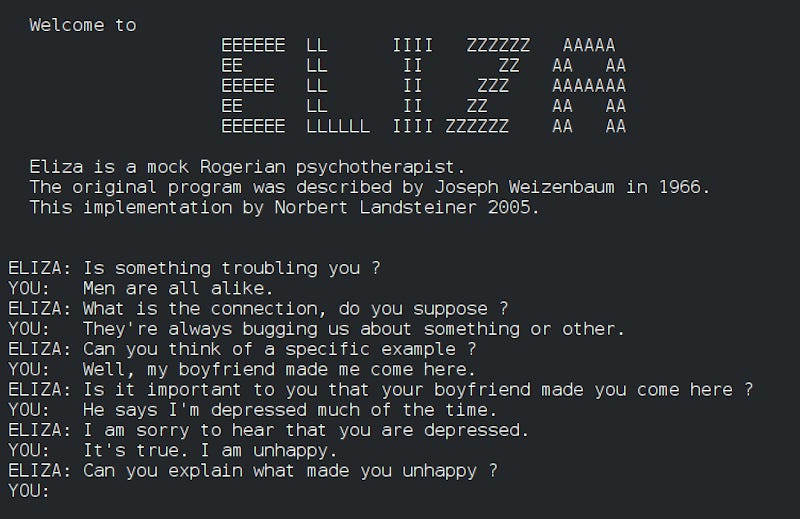
The cognitive scientist Douglas Hofstadter writes of what’s been called the ELIZA effect, after Joseph Weizenbaum’s 1966 therapist chatbot ELIZA, “the most superficial of syntactic tricks convinced some people who interacted with ELIZA that the program actually understood everything that they were saying, sympathized with them, even empathized with them.” Warren Ellis once observed, “If you believe that your thoughts originate inside your brain, do you also believe that television shows are made inside your television set?” You don’t believe that the DJ is playing any of the instruments they sample, so why do you believe the AI is thinking or comprehending any of its responses? It’s a version of the ELIZA effect, but much bigger, deeper, all-encompassing, and disturbing.

A conversation with Joseph Weizenbaum’s 1966 program ELIZA.

As soon as word processing was available, providing the literary fodder for machines, chatbots and large language models were not far to follow. In his book Language Machines, Leif Weatherby writes,“Language models capture language as a cultural system, not as intelligence.”6 That’s a crucial distinction. What passes for AI these days can compose a poem, summarize a novel, or draft an email, but it doesn’t know why. The why is the whole thing. At the risk of oversimplifying a very complex situation, the why is the intelligence. We’ve been steadily removing the human—what Weatherby calls “remainder humanity”—from creative processes, offloading and outsourcing more and more of them to machines and computers. That’s fine, but we’re devaluing, defunding, or demonetizing a lot of the fun part(s).

“It’s much harder to neglect words when they are coming out of your mouth.” — Owen King, The New Yorker

What happens when writing is just prompting? When a library is just a giant generative machine that turns texts into another medium of your choice? Just as musicians became “recording artists,” writers will become something else, perhaps “prompt engineers,” until the machines no longer need prompts, until they no longer need human input at all. Until the wan glow of their artificial light is all the light that’s left.

“I’m just sitting here
Watching the past dim
And the future disappear.”
— WNGWLKR


Though I don’t mention allusions anywhere in it, this piece is a rough extension of the research for my book The Grand Allusion. If anyone has any ideas about who might publish it, let me know.


NOTES:

1 Walter J. Ong, Orality and Literacy, New York: Routledge, 1982, 131.

2 Quoted in Sam Dolbear, “John Locke’s Method for Common-Place Books,” Public Domain Review, May 8, 2019.

3 Vannevar Bush, “As We May Think,” The Atlantic Monthly, Vol. 176, no. 1., July, 1945, pp. 101–8.

4 Ibid.

5 Quoted in Roy Christopher, “Carla Nappi: Historical Friction,” in Roy Christopher (ed.), Follow for Now, Vol. 2: More Interviews With Friends and Heroes (pp. 21-32), punctum books, 2021, 29.

6 Leif Weatherby, Language Machines: Cultural AI and the end of Remainder Humanism, Minneapolis, MN: University of Minnesota Press, 2025, 5.

The World Forgetting by the World Forgot

Do you remember the last time you heard some good news? If you can’t, there are a few reasons — beyond the fact that there hasn’t been any in more than a minute. As news organizations found out a long time ago, it’s far more lucrative to feed you bad news, to make you resent, rage, and most importantly, react. This is compounded by the fact that it’s also difficult to remember any kind of news anymore. It’s a conspiracy between your media and your mind.

We see everything in two dimensions.

One of the definitive aspects of the media spectacle is its lack of any sense of memory. As McKenzie Wark tells me, “As Guy Debord used to argue, the triumph of the spectacle is in the defeat of history and the installation of ‘spectacular time’, which is purely cyclical.”1 In his 1967 book Society of the Spectacle, Debord wrote,

The lack of general historical life also means that individual life as yet has no history. The pseudo-events that vie for attention in spectacular dramatisations have not been lived by those who are informed about them; and in any case they are soon forgotten due to their increasingly frenetic replacement at every pulsation of the spectacular machinery.2

As our experience is more and more mediated and less lived through, the spectacle functions to make us passive observers rather than active participants. It diminishes the idea of memory by reducing lived moments to their image, removing us from our selves and any genuine connection to our world. Now we have bespoke spectacles, individualized, each to their own churn. We exist in an isolated simultaneity, not quite solipsistic, yet fully mediated.

“Whatever was true now was true from everlasting to everlasting. It was quite simple. All that was needed was an unending series of victories over your own memory.” — from George Orwell’s Nineteen Eighty-Four

If life in Debord’s spectacle sounds awful, it was supposed to, but these days the idea of not remembering sounds better than the brutality of the everyday. Call the remedy tactical forgetting or strategic amnesia. Illuminating the idea in Octavia E. Butler’s Parable of the Talents (Seven Stories Press, 1998), Shari Evans writes, “Strategic amnesia gives us the critical distance to remember ethically rather than vengefully. This strategic amnesia in which Butler’s last novel situates us, then, leads, past forgetting, to the justice of remembering on a historic and cultural scale.”3 Justice, as much as it might be as a human as invention as history, matters. If any of this matters, it does.

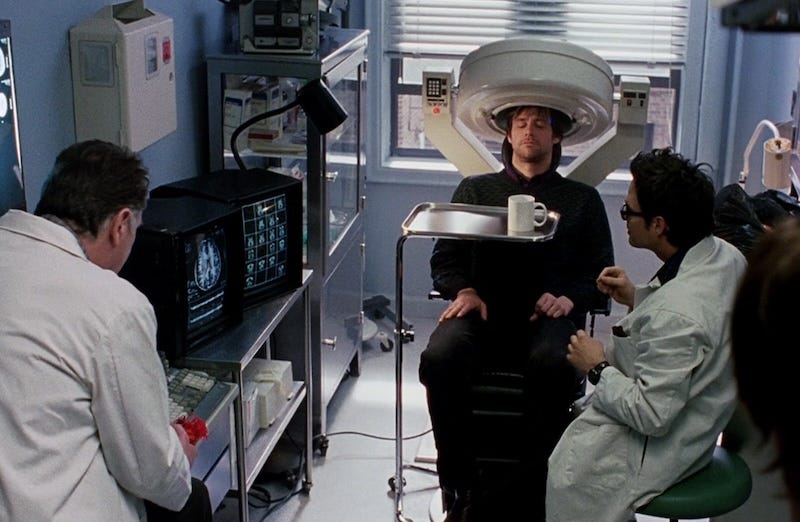
Tom Wilkinson, Jim Carrey, and Mark Ruffalo in Eternal Sunshine of the Spotless Mind (2004).

If only it were so easy for us as individuals to forget and remember on command. The world would look very different if we could. In the 2004 film Eternal Sunshine of the Spotless Mind, screenwriter Charlie Kaufman and director Michel Gondry go to such great lengths to show that not only is it not easy, it’s not possible. In the movie, a medical firm called Lacuna offers a surgical procedure that removes painful memories from an individual’s brain. In this case, painful memories of a lost love, but one can imagine removing unwanted memories of traumatic events of any kind.

Conversely, sometimes memory is latent in the environment, just waiting to be activated. Have you ever learned a new word and then started seeing it everywhere? The literary theorist Kenneth Burke attributed this to what he called terministic screens.4 Burke would say that the word was always there, but you were filtering it out, obscuring it with ignorance. Once it became a part of your terministic screen, only then did you start seeing it. But you can’t unsee it once it’s a part of the screen you use to filter reality. Once you learn something new, you’re stuck with it.

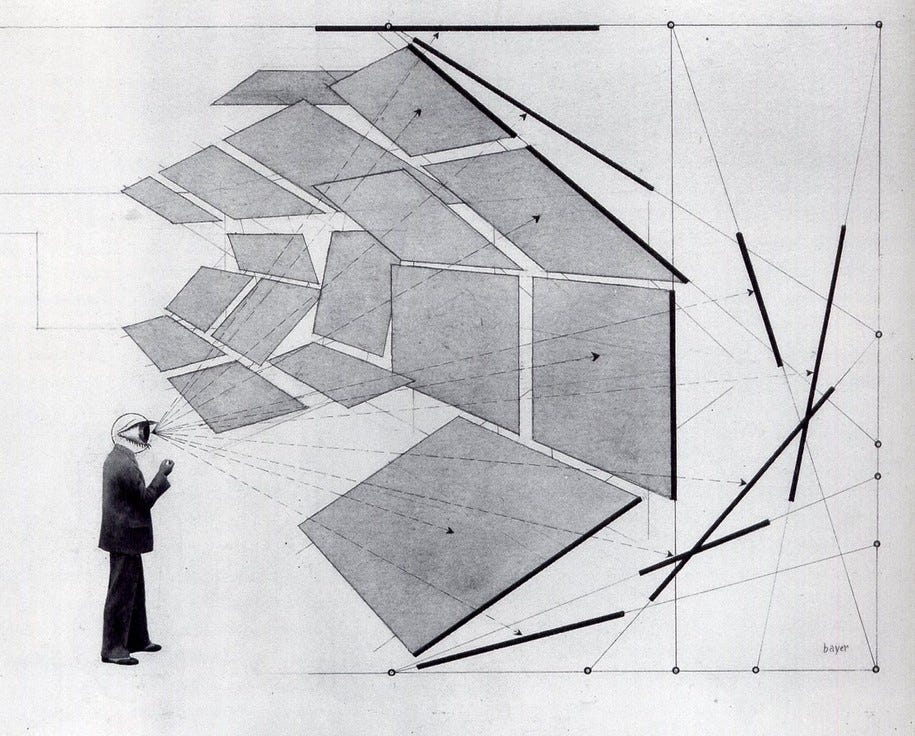
Herbert Bayer, Diagram of the Field of Vision, 1930.

So, we can’t forget on command or remember at will, but our minds filter out and fill in all kinds of words and details and facts every day. As the author Grace Paley once said, “Any story told twice is fiction.”5 In a speech at BAFTA in 2011, Charlie Kaufman says, “If you consider a traumatic event in your life, consider it as you experienced it. Now think about how you told it to someone a year later. Now think about how you told it for the one hundredth time. It’s not the same thing.” One thing that intervenes, he says, is perspective, which we tend to think of as a good thing. “The problem is that this perspective is a misrepresentation of the incident; it’s a reconstruction with meaning and as such bears very little resemblance to the event.” He continues,

The other thing that happens in storytelling is the process of adjustment for the audience over time. You find out which part of the story works, which parts to embellish, which parts to jettison. You fashion it. Your goal, your reasons for telling it are to be entertaining, to garner sympathy. This is true for a story told at a dinner party, and it’s true for stories told in movies.

Sometimes we change the story inadvertently, and sometimes we do it as a matter of survival.

To survive,
Know the past.
Let it touch you.
Then let
The past
Go.

— from “Earthseed: The Book of the Living” by Lauren Oya Olamina
in Octavia E. Butler’s Parable of the Talents

Moreover, our collective memory, and especially our mediated memory (or communicative memory6), suit their own needs, sanity for the former, capital for the latter, selectively remembering and revising as they go. In “The ‘Yizkor’ Book of 1911 – A Note on National Myths in the Second Aliyah.” Jonathan Frankel writes:

Legends and national myths — which so enchant the group’s psyche, the collective subconscious — have become a source of inspiration to the faith and devotion which these imported ideologies [modern nationalism, socialism] could foster only partially and through constant adaptation.7

We watch this constant adaptation as short-scale history scrolls by in our daily diet of genocide, racism, gun violence, domestic terrorism, the global degradation of democracy, climate catastrophe, culture wars, and cat videos. History at any scale is always already a construct that cannot include all of the minutia of humankind, so the writers, editors, and adapters of that history choose to emphasize some things and leave other things out. If we ever want to break out of our now-individualized spectacle, and if we ever want any semblance of history or of justice, we need to care more about those decisions and who makes them for us.8


NOTES:

1 Quoted in Roy Christopher, “McKenzie Wark: To the Vector the Spoils,” in Roy Christopher (ed.), Follow for Now: Interviews with Friends and Heroes (pp. 131-136), Seattle, WA: Well-Red Bear, 2007, 134.

2 Guy Debord, Society of the Spectacle, Detroit, MI: Red & Black, 1970, 90.

3 Shari Evans, “From ‘Hierarchical Behavior’ to Strategic Amnesia: Structures of Memory and Forgetting in Octavia Bulter’s Fledgling,” in Rebecca J. Holden & Nisi Shawl (eds.), Strange Matings: Science Fiction, Feminism, African American Voices, and Octavia E. Butler (237-262), Seattle, WA: Aqueduct Press, 2013, 256; See also adrienne maree brown, Emergent Strategy: Shaping Change, Changing Worlds, Chico, CA: AK Press, 2017.

4 Kenneth Burke, Language as Symbolic Action, Cambridge, UK: Cambridge University Press, 1966, 45.

5 Quoted in Jacqueline Taylor, Grace Paley: Illuminating the Dark Lives, Austin, TX: University of Texas Press, 1990.

6 I particularly like this term; See Jan Assmann & John Czaplicka, “Collective Memory and Cultural Identity,” New German Critique, Spring – Summer, 1995, No. 65, pp. 125-133.

7 Yahadut Zemanenu 4 (1987): 67-96 (in Hebrew).

8 The title of this post and the title of Eternal Sunshine of the Spotless Mind both come from Alexander Pope’s poem “Eloisa to Abelard” (1717).

A Clockwork Kubrick

My mom, a lifelong artist and crafter, chronically has unfinished projects in various places around her house: a painting on an easel, a pattern pinned to some odd-shaped fabric, quilt squares pieced but apart, a half-repainted hobby horse. Once she can visualize the finished product, she all but loses interest in finishing it. I can relate to that feeling with my writing. I often approach with a question I want to answer or a curiosity that hasn’t found its end. Once I have an answer, my interest wanes.

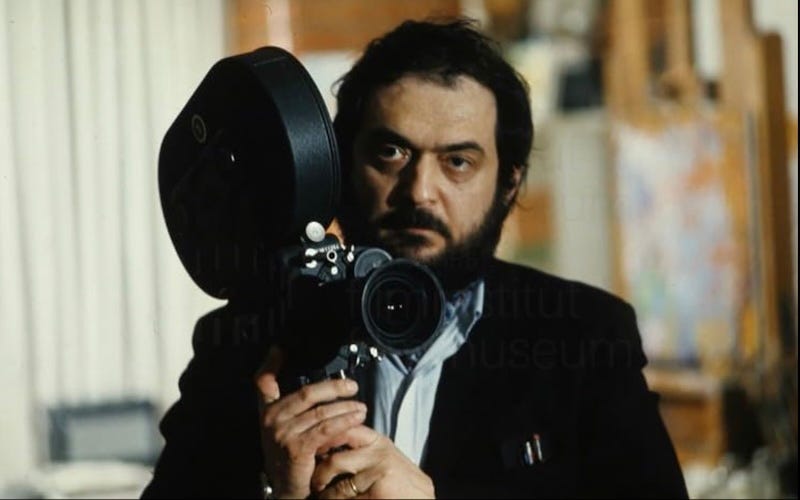
Kubrick and his camera.

Master filmmaker Stanley Kubrick once said, “You start something because you are interested in it, but you actually do it to find out about it.”1 Once you find out about it, there’s usually still work to do. Creation is its own reward, but you could discover the best thing in a category or a new category altogether. If no one knows, it won’t matter. Follow through and spread the word or you’re depriving the world of your work.2 Sometimes we don’t even know what we’ve created until we share it. Kubrick added at another time, “The truth of a thing is in the feel of it, not the think of it.”

Screenwriter Joseph Mankiewicz used to say that a well-written script had already been directed. That is, if it’s put on the page properly, there isn’t much for actors or directors to improve upon. According his Eyes Wide Shut cowriter Frederic Raphael, that’s not the kind of script Kubrick ever wanted. And actor Malcolm McDowell, who played Alex the droog in Kubrick’s A Clockwork Orange (1971), said that Kubrick never knew what he wanted, but he knew what he didn’t.

“To restrain man is not to redeem him.” — Stanley Kubrick

He knew it when he saw it though. I am fond of saying that as long as one keeps their options open, options is all one will have. It’s okay to let them breathe though. Raphael wrote of Kubrick, “Kubrick was not indecisive; he was postponing a decision, which is by no means the same thing.”3 Postponing a decision can be action in itself, but a decision must be made. As the song goes, “if you choose not to decide, you still have made a choice.”4

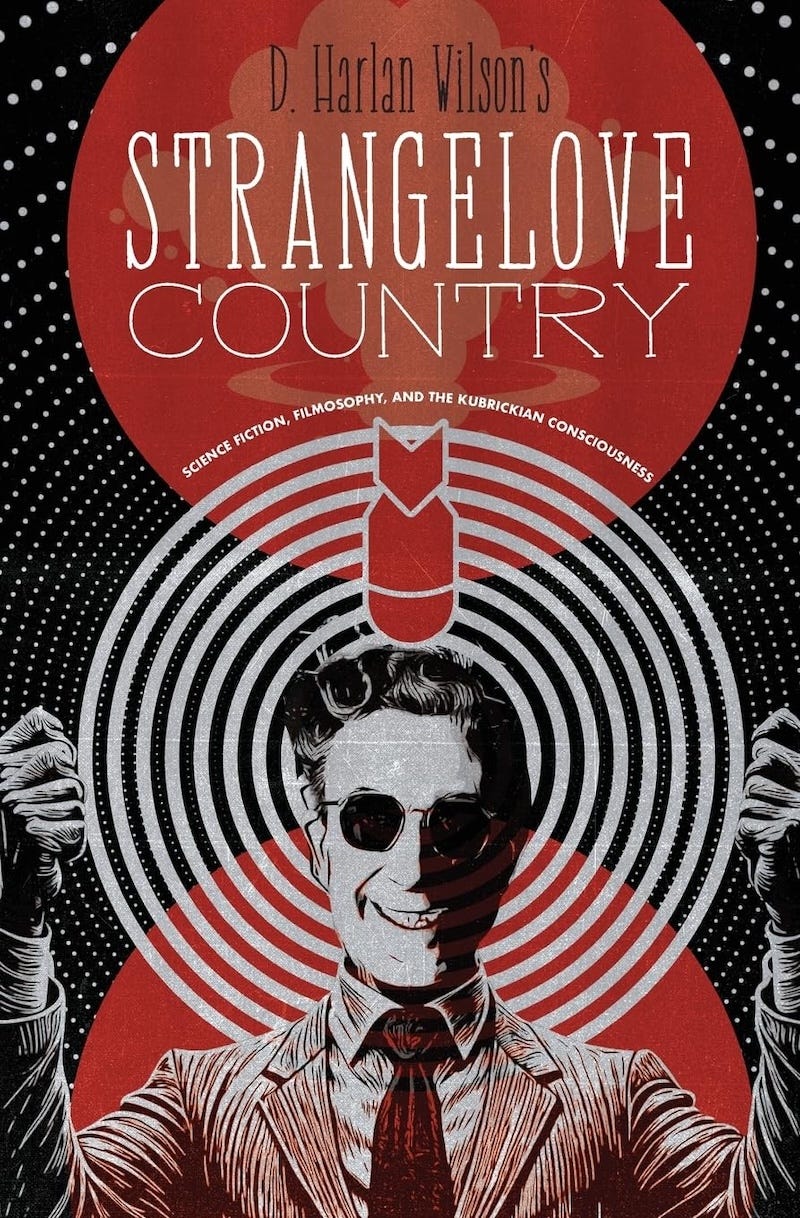
D. Harlan Wilson’s Strangelove Country. Cover design by Matthew Revert.

In his book, Strangelove Country: Science Fiction, Filmosophy, and the Kubrickian Consciousness (Stalking Horse Press, 2025), D. Harlan Wilson deploys several critical constructs in order to investigate Kubrick’s forays into science fiction. Never a fan of the genre, Kubrick nonetheless made four films that are either squarely science fiction or more sci-fi than they are anything else: Dr. Strangelove (1964), 2001: A Space Odyssey (1968), A Clockwork Orange (1971), and the posthumous A.I. Artificial Intelligence (2001). At least one of them—2001—outright redefined the genre, which was kid’s stuff prior to his sprawling opus.

“In all things mysterious—never explain.” — H.P. Lovecraft

And redefining science fiction is more and more difficult since, given the increasingly sci-fi reality we live in. Wilson writes,

Our media encourages us to view ourselves as characters to be viewed by other characters in a filmic realm whose social networks remake the self, identity, reality, and community. A manifestation of weaponized desire, cinematic thinking allows us to exist in our own highly mediatized diegesis.

We’ve been living as if—as if there’s an audience watching—for so long now that it’s difficult to imagine otherwise. Try it though. Post less. Save more for yourself. As Raphael wrote of Kubrick, “He is morbidly afraid of giving away his secrets, the best of which may be that he has none.” You don’t have to have a secret to act like you do. That’s a secret unto itself. Mystery loves company.

Unwavering Radiant: Keith Haring

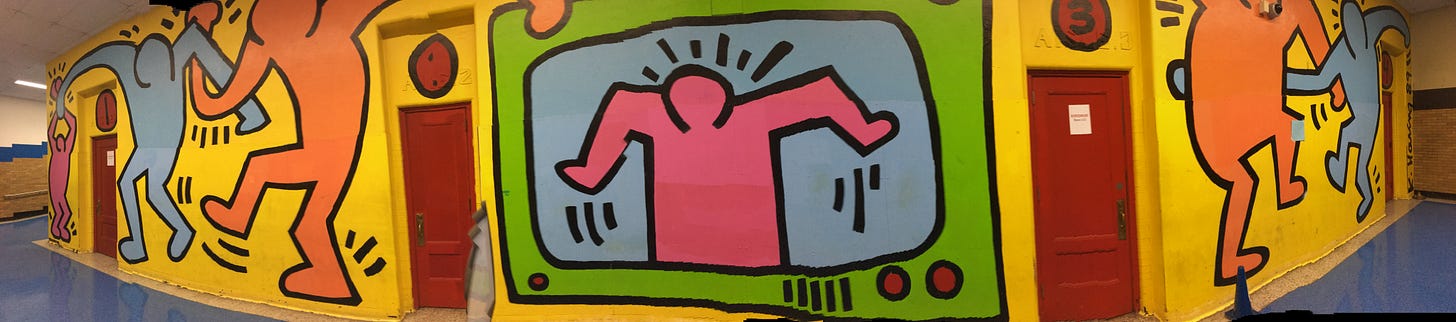
One election day when I lived in Chicago, I walked over to the school by my house to vote. On my way to the converted classroom that served as the polls, I was stunned stupid by a hallway-long Keith Haring mural. The vibrant colors and simple characters are impossible to mistake for anyone else’s work. Haring is one of my all-time favorite artists, and I had no idea that one of his last murals was only a few blocks from my house. During my undergraduate studies, my last big paper in English Composition 102 was a biography of Haring. He passed away as I was writing it.

Keith Haring mural at the William H. Wells Community Academy High School in Chicago, completed in November 1989. Panoramic photo by me.

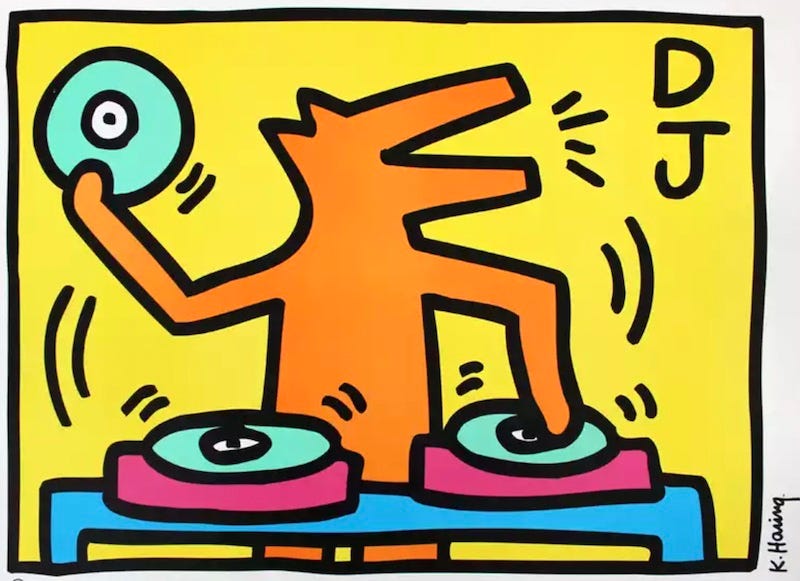
As an advocate and an artist, Haring occupied a unique place in the world. He skirted the aesthetics of typical graffiti by drawing thick-lined stick-figure characters and animals dancing and moving, the lines as flexible as their fancies. “Haring demonstrated that one could create art on the street that differed from the more pervasive lettering-based graffiti,” writes my friend and Obey Giant artist Shepard Fairey in the Foreword to Haring’s Journals. “He also showed me that the same artists could not only affect people on the streets, they could also put their art on T-shirts and record covers, as well as have their work respected, displayed, and sold as fine art.” Whereas most graffiti looks like graffiti—that is, it embodies its own aesthetic, much in the way tattoos do—Haring’s was more whimsical, like children’s hieroglyphs, if the children understood the many facets of line, its limits, and its capacity to communicate.

“Your line is your personality.” — Keith Haring

We love to hear the story about how artists live and worry. Graffiti proper, in the modern sense of the term, started in the late 1960s in New York City when a kid from the Washington Heights section of Manhattan known as Taki 183 (“Taki” being his tag name and “183” being the street he lived on) emblazoned his tag all over NYC. He worked as a messenger and traveled all five boroughs via the subways. As such, he was the first “All-City” tagger. Impressed by his ubiquity and subsequent notoriety, many kids followed and graffiti eventually became a widespread renegade art form. Aerosol artists embellished their names with colors, arrows, 3-D effects and wild lettering styles.

By the mid-to-late 1970s, New York—especially its subway system—was covered with brightly colored murals with not only tag names, but holiday messages, anti establishment slogans and full-on art works known as “pieces” (short for “masterpieces”). The world of graffiti preceded the rest of hip-hop culture, but became an integral part during hip hop’s early-1980s boom, joining breakdancing, emceeing and DJing as hip-hop’s four elements.

After filling fifty bags with garbage, cleaning up the three-foot-high garbage piles obscuring an abandoned handball wall on the corner of East Houston Street and the Bowery in the East Village, Haring and his partner, Juan Dubose, painted a giant mural of his signature figures breakdancing, running, and spinning in bold, fluorescent colors. Like many other graffiti artists replacing the drab city walls and boring metal subway trains with greetings and flashy colors, Haring saw himself as doing a service to the city. City officials and stuffy citizens hardly agreed. Massive anti-graffiti campaigns grew right along with the art form itself and are still in effect today in most major metropolitan areas. These specialized anti-graffiti forces only added to the art form’s already outlawed status. The ability to pull off a hype piece under such increasing pressure only made great writers more revered for their skills.

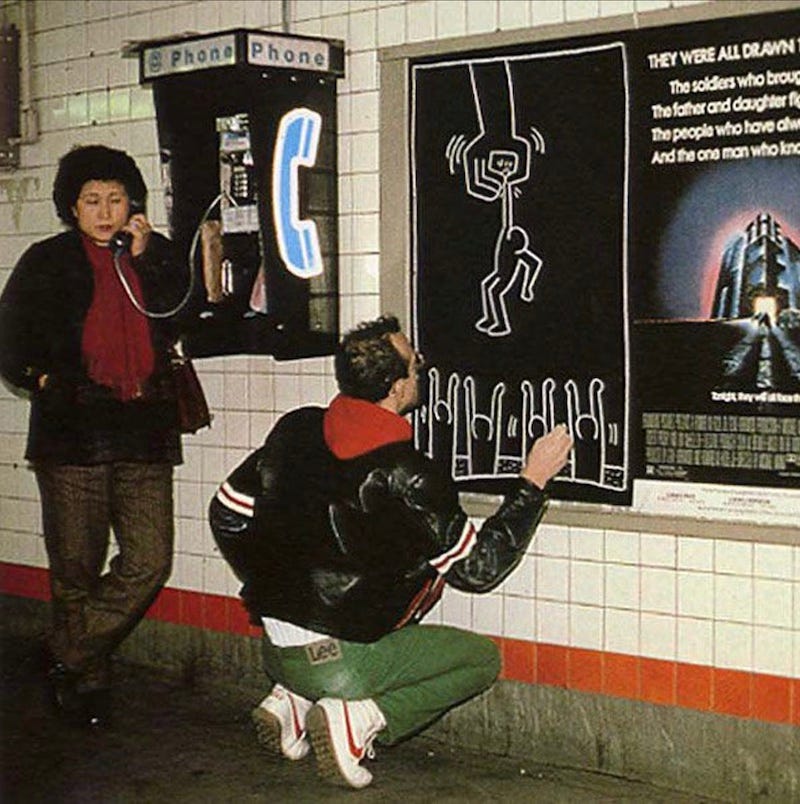
Haring started his public-art practice using chalk on empty ad panels in the New York subway stations. In spaces usually reserved for advertising, Haring drew alien abductions, mushroom clouds, radiant babies, barking dogs, televisions, and people, people, people. Between 1980 and 1985, he sometimes produced upward of forty drawings a day. This practice eventually gave way to murals and other more colorful paintings. His simple designs, characters, and animals caught on, even with a graffiti-weary public, leading to gallery shows and commercial work.

“Keith in the subway” (CC BY-NC 2.0) Ken Lig / JUST SHOOT IT! Photography

In spite of criticisms about the latter, his art never lacked bite. His images pushed back against everything from apartheid in South Africa and the threat of nuclear weapons, to the epidemics of crack and AIDS. These works appeared not only in chalk on black paper ad blocks but printed on posters, wheat-pasted on poles, and buttons on the lapels of friends and strangers. So prolific was his artistic protest and promotion that he drew the envy of no less a contemporary than Andy Warhol. “He was jealous of how Keith was like an advertising agency unto himself,” said the photographer Christopher Makos. “That was the cleverest thing any artist at the moment was doing.”

Companies develop—or hire other companies to develop—brand identities and campaigns. Logos, slogans, and thematic series of ads combine to sell products, brand recognition, and brand loyalty. Like the best branding, graffiti tags have to be catchy, and they have to have good letters or great characters. Graffiti and its corporate sanctioned sister art, advertising, are our modern day cave paintings. As Marshall McLuhan put it, “ads are not intended to be seen but to produce an effect. The cave paintings were carefully hidden. They were a magic form, intended to affect events at a distance.”

The artist Yasiin Bey once called hip-hop a folk art. It’s art by the people, for the people, and provides some use outside of mere decoration. “Art is nothing if you don’t reach every segment of the people,” Haring once said. “The performative nature of drawing for him was very important,” said his dealer Tony Shafrazi, describing a scene where Haring had run into a group of young people at a coffeeshop and drew pictures and gave them away. “That form of producing and giving was beyond any form of management. He had to let it flow. He couldn’t limit it.” Haring wrote the following in his journal on March 18, 1982:

My contribution to the world is my ability to draw. I will draw as much as I can for as many people for as long as I can. Drawing is still basically the same as it has been since prehistoric times. It brings together man and the world. It lives through magic.

Keith Haring passed away on February 16, 1990 due to complications from AIDS, yet his work is more widespread now and as recognizable as ever, still celebrating simple, innocent notions like spontaneity, generosity, and a love of humanity. As I mentioned above, I was writing an English Composition paper about him when he died, but I currently have a pair of socks with his drawings on them. His work is timeless.

And traditional graffiti still thrives in cities and along major train lines. It has survived as what the punk-intellectual Jello Biafra once called “the last bastion of free speech,” and the yippie Abbie Hoffman called it “one of the best forms of free communication.” Anyone can grab a can of spray paint, a fat marker, or some chalk and make their thoughts known to the passing population. You can buff graffiti, you can paint over it and you can arrest its practitioners, but as long as someone feels that their voice isn’t being heard, you can’t make it go away.


This post is part of a loose trilogy:

From Blackout to Breakout

Of all the technologies we take for granted, electricity has to be near the top of the list. Though it shouldn’t ever be interrupted, we’re not that surprised when the wifi is down. Streaming services still regularly buffer. Pinwheels, hourglasses, ellipses—an entire semiotics of technology’s foibles, failures, and inconveniences. But when the power goes out, everything stops. Everything. And even though they’re not that uncommon, we’re not prepared. As the former broadcast journalist Ted Koppel puts in his 2015 book Lights Out: A Cyberattack, A Nation Unprepared, Surviving the Aftermath, “We tend to come up with funding after disaster strikes.”

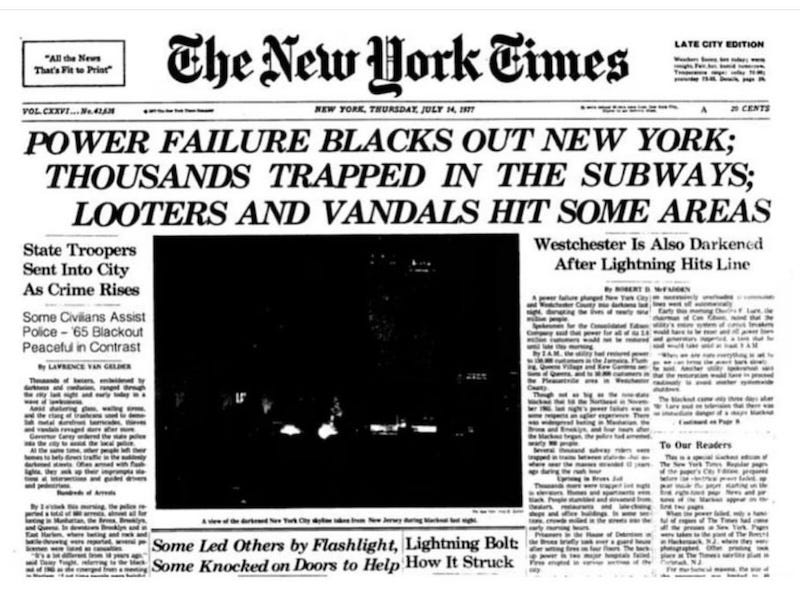
The New York Times on July 14, 1977 during a 24-hour blackout in New York City.

With historical contrast, in his 2010 book, When the Lights Went Out: A History of Blackouts in America, the technologist David E. Nye writes that “by 1965, many New Yorkers regarded a blackout as a violation of the expected order of things. Yet it seemed an anomaly without long-term implications, and the paralysis of that night became the occasion for a liminal moment.” Such liminal moments are hard to come by, as the machinations of the city regularly work against the freedom they afford. Increasingly, the spaces required for dreaming, for creation, and indeed for freedom, are the product of artifice. They have to be intentionally assembled and deployed. Kodwo Eshun writes,

The technological conditions for intervention in the present have to be artificially constructed. They are not spontaneously available. To embark on a project that is set in the present, you have to renounce digital abundance by undergoing a temporal diet or media famine. You have to turn yourself into a castaway marooned on an island of the present separated from the abundance of digital archives and previous musical eras that continually saturate the contemporary.1

The idea of an outside or in-between space of dreaming recalls Hakim Bey’s temporary autonomous zone (TAZ). That is, the creation of temporary spaces that allow for moments of freedom, acts of creativity, and the availability of otherwise nonexistent autonomy outside the reach of established authority. Though certainly not the same thing, these spaces are similar to William Gibson’s idea of bohemias: subcultural backwaters that allow for new forms to flourish outside the influence of hegemony (Gibson cites Haight-Ashbury in the 1960s and Seattle in the 1990s as examples). Co-opted and all but defanged by the rave culture that followed its inception in 1991, the TAZ deserves a reassessment in our post-globalized world.

Hakim Bey’s T.A.Z: Temporary Autonomous Zone (Autonomedia, 1985) and other incendiary texts.

One can imagine assembling one of Bey’s pirate utopias, but it’s easier to see them happening unintentionally. That is, when the mechanizations of modernism break down, leaving us alone in the moment, in an unintentional TAZ. The unintentional TAZ’s most recognizable form might be the blackout: a sudden inescapable shadow of spontaneity and creation.

Writing about a power blackout that affected 50 million people in North America in 2003, Jane Bennett defines assemblages as follows:

Assemblages are ad hoc groupings of diverse elements, of vibrant materials of all sorts. Assemblages are living. throbbing confederations that are able to function despite the persistent presence of energies that confound them from within. They have uneven topographies, because some of the points at which the various affects and bodies cross paths are more heavily trafficked than others. and so power is not distributed equally across its surface. Assemblages are not governed by any central head: no one materiality or type of material has sufficient competence to determine consistently the trajectory or impact of the group. The effects generated by an assemblage are, rather, emergent properties, emergent in that their ability to make something happen (a newly inflected materialism, a blackout, a hurricane, a war on terror) is distinct from the sum of the vital force of each materiality considered alone.2

Admittedly borrowing from Gilles Deleuze and Félix Guattari (A Thousand Plateaus), as well as Baruch Spinoza (Ethics), Bennett’s assemblage doesn’t lack intention. It lacks human intention. The blackout as monster, overtaking the city in a lumbering lack of light.

“I think bohemians are the subconscious of industrial society. Bohemians are like industrial society, dreaming.” — William Gibson

David E. Nye argues that public space transformed by New York blackouts is not an instance of technological determinism, a topic Nye has explored in depth previously.3 His take seems to flip one of Gibson’s well-worn aphorisms: The street finds its own use for things. If the technological use is culturally determined, then the use finds its own street for things. Nye writes,

By the beginning of the twenty-first century, blackouts were recognized as more than merely latent possibilities. They were unpredictable, but seemed certain to come. Breaks in the continuity of time and space, they opened up contradictory possibilities. From their shadows might emerge a unified communitas or a riot. The blackout shifted its meanings, and achieved new definitions with each repetition. For some, it remained a postmodern form of carnival, where they celebrated an enforced cessation of the city’s vast machinery.4

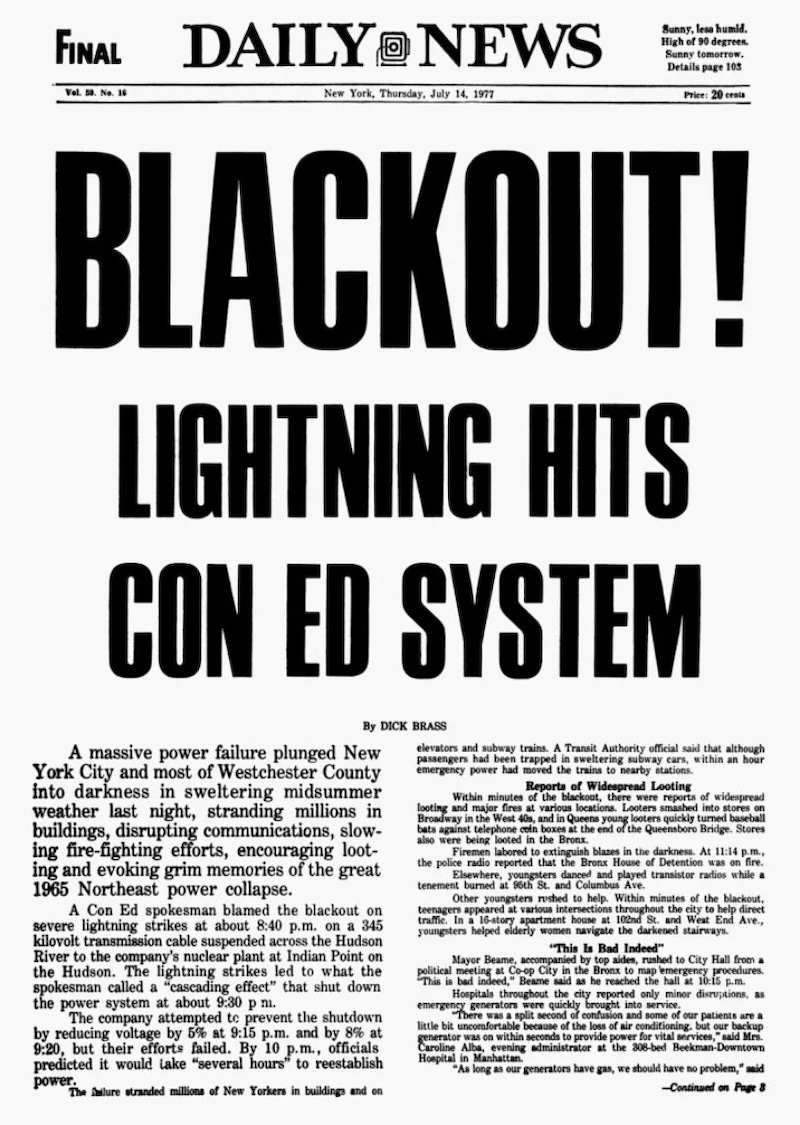
The Daily News front page on July 14, 1977.

Echoing the massive 1965 blackout, after an 11-day heat wave, on the evening of July 13, 1977, successive lightning strikes strained New York City’s already overtaxed power grid, shutting it down for 24 hours. A blacked-out bohemia pushed the already simmering hip-hop subculture to an overnight boil. Emcee Rahiem of Grandmaster Flash and the Furious Five says“The blackout of 1977 is what helped to spawn a multitude of aspiring hip-hop practitioners, because prior to that, the majority of aspiring DJs didn’t have two turntables and a mixer or the speakers. So, when the blackout happened, it just seems that everybody got the same idea at the same time. And when the lights came back on in New York City, everybody had DJ equipment.” Latin Quarter club manager Paradise Gray adds, “Not too many people in the Bronx could afford big sound systems until after the blackout. Then, everybody had sound.” To retrofit an idea, the Boogie Down became an unintentional temporary autonomous zone that night.

“When you get to the blackout, it shifts hip-hop. It’s a pivotal moment, because like a week later, everybody was a DJ. Everybody.” — MC Debbie D

Easy A.D. of the Cold Crush Brothers sums it up nicely: “The Bronx went from being decayed into something beautiful. The vibration of the music and the combination of bringing all those elements together, you had to be in there to feel it, because most of the time people only experience the music. But when you have all those elements in one place together, then you understand the essence of the hip-hop culture.”5 The blackout didn’t spawn the culture, but the autonomy it afforded pushed it toward national prominence.


This post is part of a loose trilogy:


Notes:

  1. Quoted in Gavin Butt, Kodwo Eshun, & Mark Fisher (eds.), Post-Punk: Then and Now, London: Repeater Books, 2016, 20; Iain Chambers writes, “With electronic reproduction offering the spectacle of gestures, images, styles, and cultures in a perpetual collage of disintegration and reintegration, the ‘new’ disappears into a permanent present. And with the end of the ‘new’—a concept connected to linearity, to the serial prospects of ‘progress,’ to ‘modernism’— we move into a perpetual recycling of quotations, styles, and fashions: an uninterrupted montage of the ‘now.’”; Iain Chambers, Popular Culture: The Metropolitan Experience, New York: Routledge, 1986, 190.
  2. Jane Bennett “The Agency of Assemblages and the North American Blackout,” Public Culture ‘7, no. 3 (2005).
  3. See chapter 2 of David E. Nye, Technology Matters: Questions to Live With, Cambridge, MA: The MIT Press, 2006.
  4. David E. Nye, “Public Space Transformed: New York’s Blackouts,” in Miles Orvell & Jeffrey L. Meikle (eds.), Public Space and the Ideology of Place in American Culture (pp. 367-384), Leiden, NL: Rodopi, 2009, 382.
  5. These quotations are from Jonathan Abrams’ The Come Up: An Oral History of the Rise of Hip-Hop, New York: Crown, 2022.

Escape from New York: Hip-Hop 1981

With its burnt-out buildings and broken windows, the South Bronx became an emblem of urban erasure, a wound of highway-bound white flight. It was late-night monologue fodder, a cautionary movie set, and a political pawn piece. Upon visiting the neighborhood on August 5, 1980, then-Presidential candidate Ronald Reagan commented that it looked like it had been hit by an atomic bomb.[1]

When Reagan took office in 1981, conditions were no better, but something was emerging from the area. Controversial on the streets, the Sugar Hill Gang’s “Rapper’s Delight” had brought hip-hop to the airwaves and subsequently the suburbs; Afrika Bambaataa and the Soulsonic Force and Grandmaster Flash and the Furious Five were touring the country; and those groups and Kurtis Blow had radio hits. “I didn’t see a subculture,” artist and emcee Rammellzee once said, “I saw a culture in development.”[2]

Though I didn’t know what it was called, I first heard hip-hop around this time. Copies of copies of copies, it trickled down from the Big Kids on hissy cassettes, shared via handheld recorder, Walkman, and boombox. My friends and I called it “breakdance music.” We were in middle school, a time of tribe-seeking and experimenting with identity. I’d just chosen skateboarding and BMX. Later those things would lead to DJing and keeping graffiti piece books, but breakdancing had loose ties with flatland—the spinning, gyrating strain of BMX done in empty tennis courts and parking lots. That was my thing and my entry point to hip-hop.

When I first heard it, most of hip-hop culture that existed at the time was yet to be recorded. Coming out of the electro scene in 1981, a group called Positive Messenger did a rap song called “Jam-On’s Revenge.” It was meant as a parody, but when it was re-released in 1983 as “Jam On Revenge (The Wikki-Wikki Song),” after the group changed their name to Newcleus, it was my first favorite rap song.[3] Its wacky, outsized characters and their high-pitched, cartoon voices proved the perfect initiation for my young ears, and the song contains the hallmarks of early hip-hop: catchy hooks and rhymes you could easily learn and rap along to (“Wikki-wikki-wikki-wikki… diggy dang diggy dang da dang dang da diggy diggy diggy dang dang”), lyrics about hip-hop culture itself (“‘Cause when I was a little baby boy, my mama gave me a brand new toy / Two turntables with a mic, and I learned to rock like Dolomite”), and of course, a beat you could pop and lock to. Having been re-released several times since, it’s still the song the group is most widely known for.

Though superproducer Dr. Dre cites seeing Clinton’s Parliament-Funkadelic in concert in LA as the event that opened his mind to music without limits, he also says, “My first exposure to hip-hop was ‘The Adventures of Grandmaster Flash on the Wheels of Steel’. That’s what started me deejaying. I think I was about 15.”[4] Released in 1981, Flash’s “Adventures…” remains the ultimate DJ cut, a cut-and-pasted collage of bits, beats, basslines, and spoken vocal samples from Chic, Queen, Blondie, Michael Viner’s Incredible Bongo Band, the Hellers, Sugarhill Gang, Sequence and Spoonie Gee, and his own Furious Five. This record and Afrika Bambaataa and the Soulsonic Force’s “Planet Rock,” which combines everything from Kraftwerk to Sergio Leone, provide the cornerstone of hip-hop composition. “To understand the magnificent creativity of the hip-hop DJ and the logical progression of today’s masters is to listen closely to both these cuts,” writes CK Smart.[5]

Long before hip-hop went digital, mixtapes—those floppy discs of the boombox and car stereo—facilitated the spread of hip-hop from the South Bronx in New York to far-flung suburbs and small towns. Hiss and pop were as much a part of the experience of those mixes as the scratching and rapping. Though we didn’t know what to call it, we stayed up late to listen. We copied and traded those tapes until they were barely listenable. As soon as I figured out how, I started making my own. A lot of people all over the world heard those early cassettes and were impacted as well. Having escaped from New York City to parts unknown, hip-hop became a global phenomenon. Every school has aspiring emcees, rapping to beats banged out on lunchroom tables. Every city has kids rhyming on the corner, trying to outdo each other with adept attacks and clever comebacks. The cipher circles the planet. In a lot of other places, hip-hop culture is American culture.

We watched hip-hop go from those scratchy mixtapes to compact discs to shiny-suit videos on MTV, from Fab 5 Freddy to Public Enemy to P. Diddy, from Run-DMC to N.W.A. to Notorious B.I.G. Others lost interest along the way. I never did, and it all started in 1981.


This post is part of a loose trilogy:


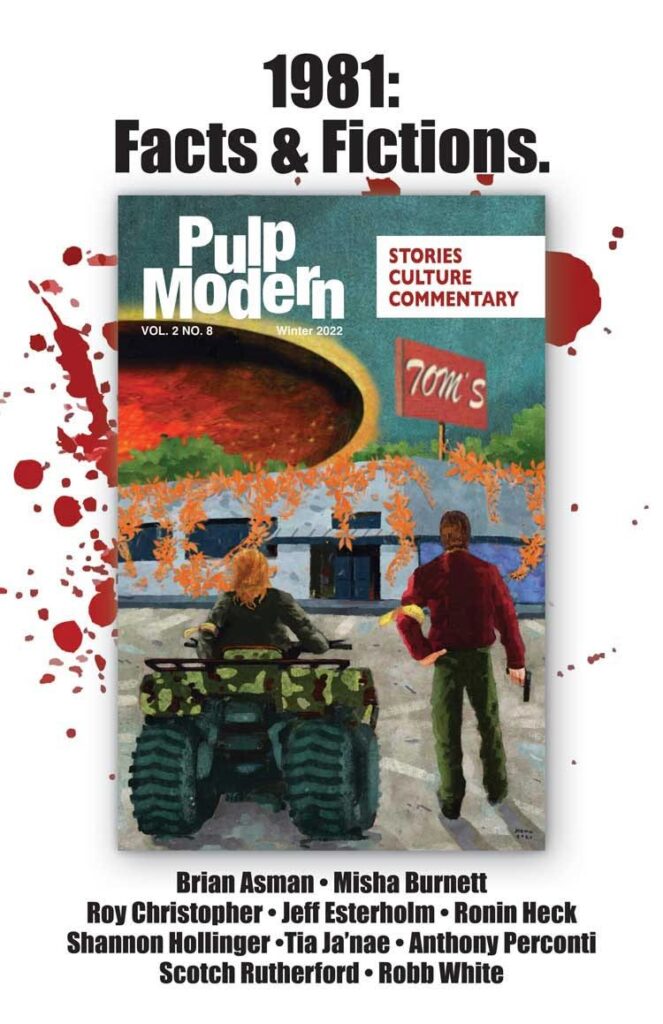
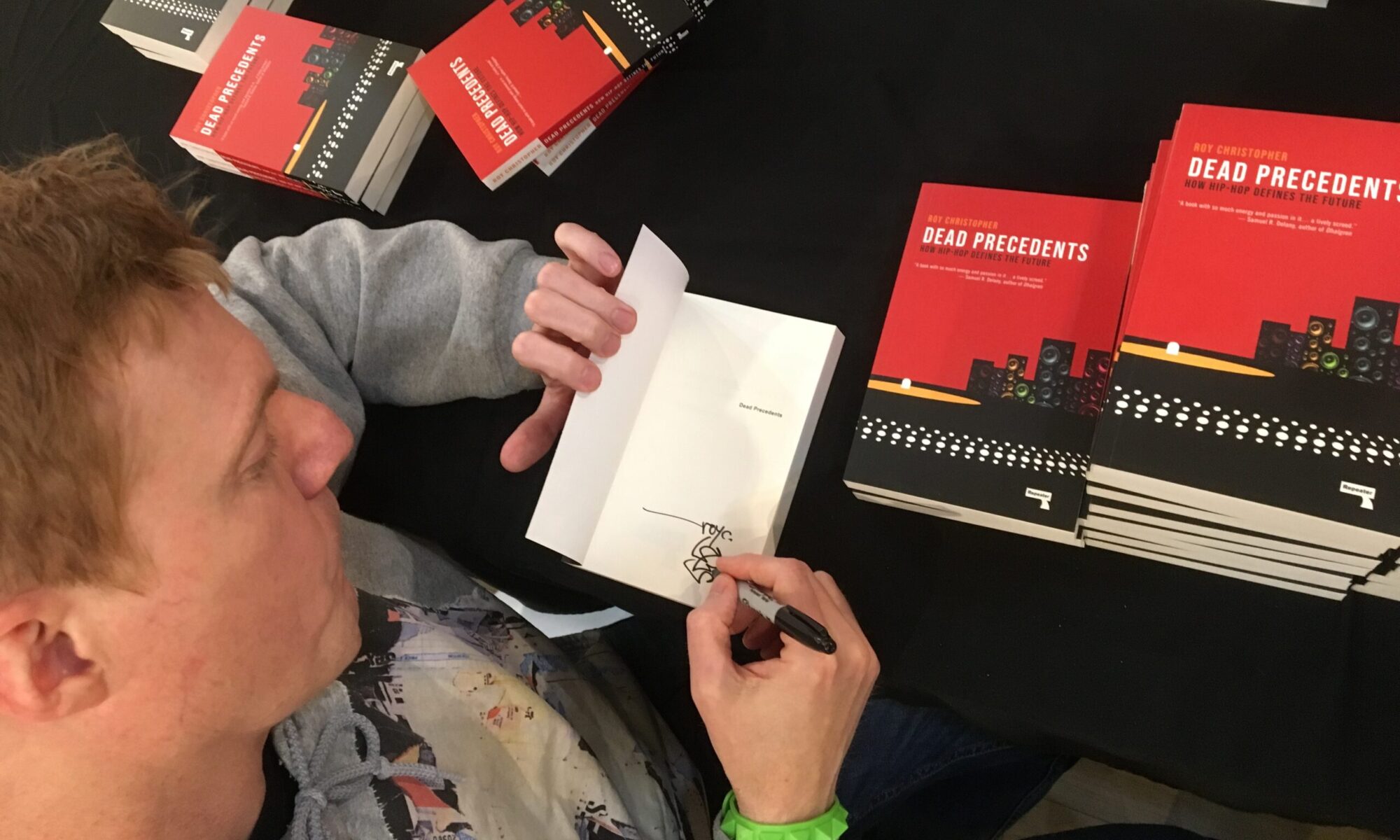
The above is an edited excerpt from my book Dead Precedents: How Hip-Hop Defines the Future (Repeater Books, 2019). In this form, it was originally published in the Winter 2022 issue of Pulp Modern. The year 1981 was the theme of the issue. Many thanks to Alec Cizak for the opportunity to correct a few factual flubs.


Notes:

[1] Parts of this piece were adapted from my book, Dead Precedents: How Hip-Hop Defines the Future, London: Repeater Books, 2019. This is a detail I got wrong in there: I said he was already president when he visited the South Bronx in 1980. Shout out to Josh Feit.

[2] Quoted in Rammellzee on the Making of “Beat Bop” (previously unpublished interview, 1999), Egotripland, March 27, 2010.

[3] In my lone TV interview so far, I mistakenly called the song “Joystick,” which was another early jam I liked in middle school. Such are the perils of memory and live television.

[4] Quoted in S. H. Fernando, Jr., The New Beats: Exploring the Music, Culture, and Attitudes of Hip-Hop. New York: Anchor Books, 1994, p. 237-238.

[5] CK Smart, A Turntable Experience: The Sonic World of Hop-Hop Turntablism, SLAP Magazine, pp. 74-75.

Friday the 13th, I’m in Love

I was a frightened child. I would be accosted by a clip or a trailer from a horror movie while watching TV and then freaked out for weeks. You’ve already read my reaction to seeing Bambi in the theater. That experience did nothing to encourage my movie watching, much less scary-movie watching. I distinctly remember glimpses of It’s Alive (1974), The Legacy (1978), The Fog (1980), The Children (1980), and Friday the 13th (1980) tormenting my young mind.

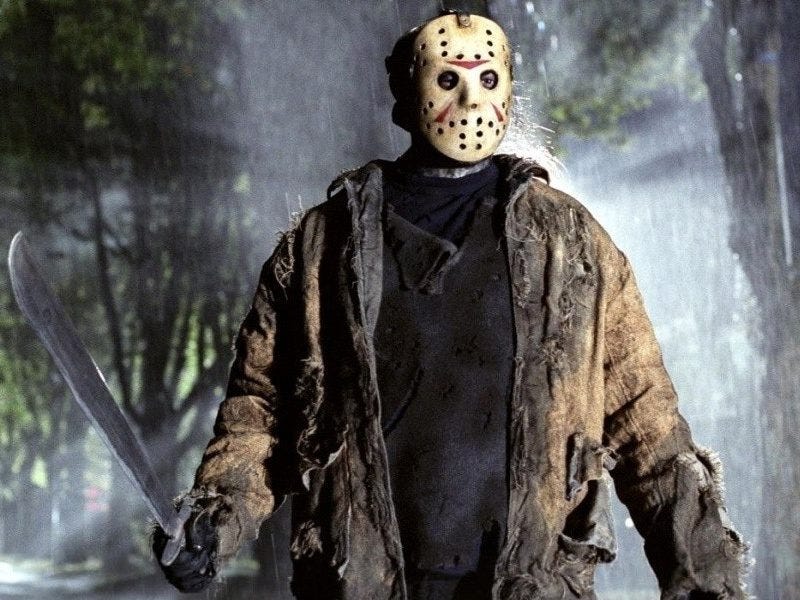
The final icon: Ken Kirzinger as Jason Voorhees in Freddy vs Jason (2003).

A decade or so ago, my sister and I were digging through DVDs at a pawn shop and came across six Children of the Corn movies. It was the franchise in its entirety at the time. Those movies are probably not the best place to start as several of them are just a retelling of the original Stephen King short story, but they set me on a path of watching slasher franchises. Soon to follow were A Nightmare on Elm StreetHellraiserHalloween, and others, but it was Friday the 13th that I found most compelling, perhaps because the trailer had so terrified me as a child, but maybe there’s more to it than that unshakeable memory.

There are different schools of thought about when the slasher subgenre emerged. Some cite proto-slashers like Alfred Hitchcock’s Psycho (1960) and Michael Powell’s Peeping Tom (1960). Some say the first true slasher was Bob Clark’s Black Christmas (1974), and others say it was Tobe Hooper’s The Texas Chain Saw Massacre (1974), but most people agree that the movie that really launched the subgenre proper was John Carpenter’s Halloween (1978). After Michael Myers terrorized the babysitters and children of Haddonfield, Illinois, a flood of holiday-themed slashers emerged: Prom Night (1980), New Year’s Evil (1980), My Bloody Valentine (1981), Graduation Day (1981), Happy Birthday to Me (1981), and Silent Night, Deadly Night (1984), among many others all celebrated their respective holidays with bodies, blood, and some slice-happy killer. Non-holiday slashers followed Halloween as well. They included Fred Walton’s When a Stranger Calls (1979), Abel Ferrara’s The Driller Killer (1979), Bill Lustig’s Maniac (1980), and the future-star-studded The Burning (1981; the movie debut of Holly Hunter, Jason Alexander, and Fisher Stevens).

Even among such a saturated line-up, Sean S. Cunningham’s Friday the 13th was 1980’s most commercially successful slasher, grossing nearly $60 million worldwide. It was also the first independent horror film to secure distribution by a major studio in the United States.

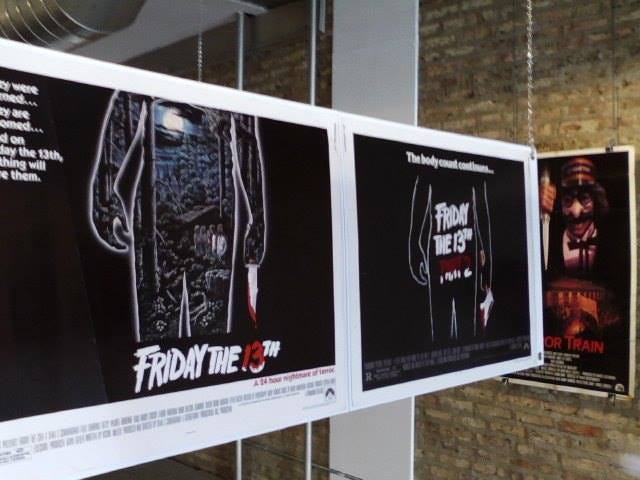
Friday the 13th posters from the vaults of the Logan Theater in Chicago on display in 2017. Original illustrations by Alex Ebel.

There are better original slashers (Halloween) and better franchises (Scream), but something about watching the first few Fridays find their feet is way more intriguing. In the pantheon of slasher killers, Halloween is built around Michael Myers, Wes Craven’s A Nightmare on Elm Street is nothing without Freddy Krueger, and in The Texas Chain Saw Massacre the chainsaw is brandished by no one but Leatherface. But on the Mount Rushmore of these murderers, there was one late arrival.

In Friday the 13th, Jason Voorhees only has a cameo in the first movie, he doesn’t become the machete-wielding killer until the second movie, and he doesn’t don his signature hockey mask until the third. What we talk about when we talk about Friday the 13th took at least three movies to fully form. The 2009 reboot combines elements of the first four movies into a foggy, nihilistic film with an extremely territorial killer, unlike the original lumbering menace in the woods around Camp Crystal Lake. The remake lacks any sense of levity, which I think is a major misstep. Horror and humor are adjacent universes with a very tenuous separation. That separation is even smaller between slashers and slapstick.

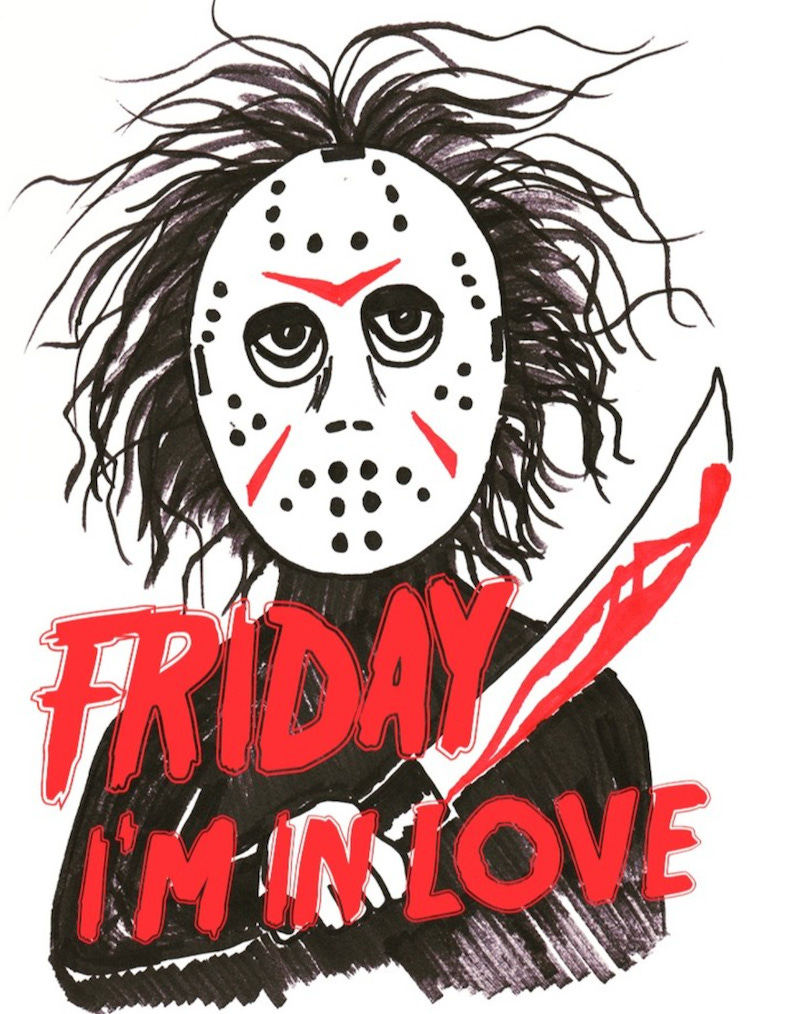
Horror and humor: my mashup of Friday the 13th and the Cure.

Another difference between Friday the 13th and most other slasher franchises: The first movie isn’t the best one. Most fans agree that even if a franchise comes back with a decent second and maybe third movie, the original is still superior (Silent Night, Deadly Night doesn’t get really good until deep into the franchise, but that’s for another discussion). HalloweenA Nightmare on Elm Street, and The Texas Chain Saw Massacre all have decent follow-ups, but none can touch the first of the bunch. Not so with Friday the 13th. The second movie is the best, and again, Jason had just become the killer, and he hadn’t even found his iconic hockey mask yet (There is an argument for The Final Chapter and Jason Lives being better and scarier, but that’s also for another discussion).

Aside from the successful and superb Scream and Terrifier franchises, most would say that the slasher era is far in the past. Yet send-ups like The Cabin in the Woods (2011) and The Final Girls (2015) and arty updates like Midsommar (2019) and In a Violent Nature (2024) show that where there are weapon-wielding maniacs hiding in the shadows and brutally innovative ends awaiting adventurous young people, we’re still watching.

3,000 Days

I started drinking coffee in kindergarten. I wanted to be more grown-up, and with enough cream and sugar, I could.

I didn’t realize I was addicted to the stuff in elementary school until I tried to quit many years later. The headaches that follow depriving your brain of caffeine are a special kind of pain. When I made my first effort to quit in my late 20s, I recognized that pain. My head had been through that before.

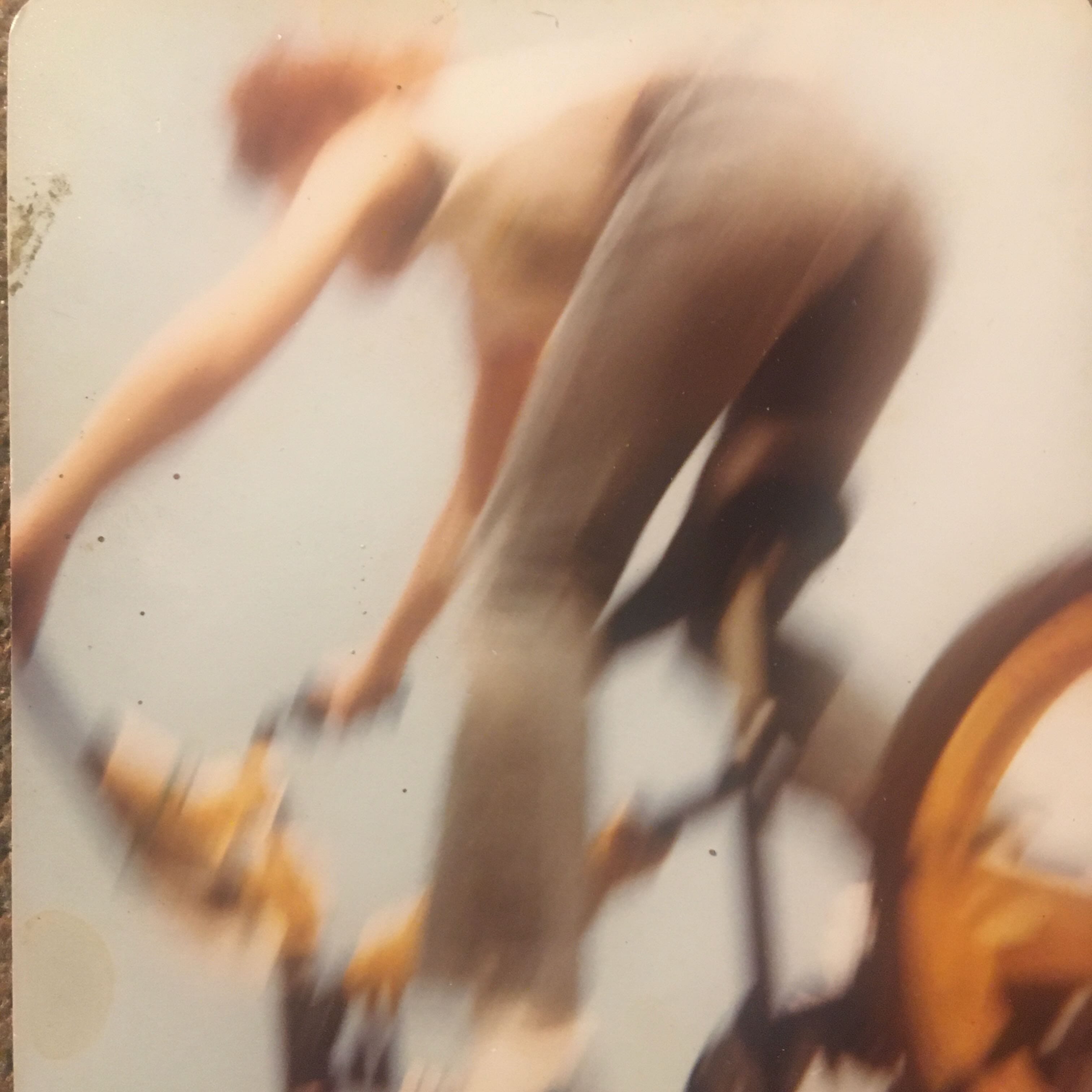
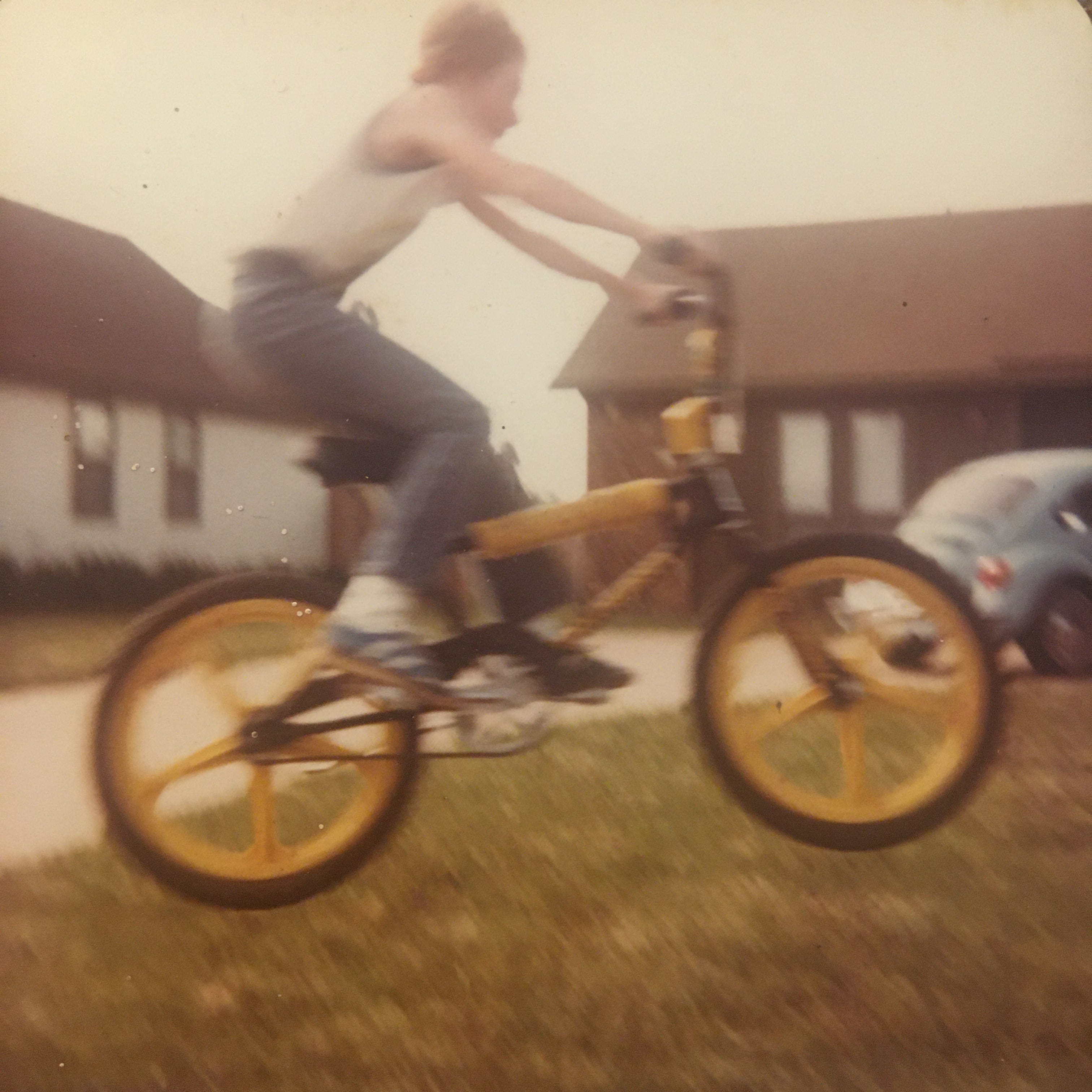
Blurry big air on the Huffy circa 1981.

I thought back and realized that my first sleepovers with friends were fraught with the same withering withdrawals. I had morning afters as early as first grade. An afternoon of Legos cut short by a trip home with a slamming hangover at six-years old. A matinee viewing of The Last Starfighter cancelled by cranium-crushing throbs. A Saturday at the BMX track not spent carving the tall berms and trying to clear the last doubles but in the backseat of a car with a cold washcloth over my head instead. It took me a long time to connect those dots.

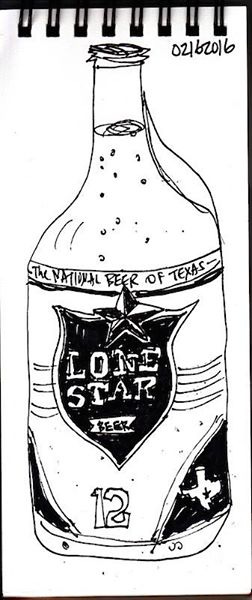
A Lone Star sketched at Big Star in Chicago.

I didn’t start drinking alcohol until I was old enough to do so. Sure, I had a sip here or there, but I usually had to drive, and I usually had to drive far, so I just didn’t drink.

I didn’t become a regular drinker until my 30s. I ditched my last car in my late 20s, so it’s been bikes and buses ever since. Pedaled and public transportation are more conducive to staying out late drinking than steering one-eyed, eluding police. I’ve ridden recklessly, and I’ve walked a bike I couldn’t keep upright, but I’ve always made it home.

I was also never the kind of drinker who felt like I needed it. It’s always been casual. Perhaps too casual. I used to go for lunch alone or with friends and then find myself skipping dinner at a different bar later. I remember telling a friend and quoting another friend at the beginning of one of those days that no one was going to stop me. I wasn’t being as defiant as that sounds, I was simply stating the fact that as far as anyone around me was concerned, my behavior was fine. No one would suggest I reconsider a second free shot during lunchtime. No one would suggest I go home instead of going to another bar to continue drinking. No one would suggest I save my money and save myself the mess I was making of the next morning.

Another angle on my early BMXing. No hangover here.

I decided to take a break a while back. I haven’t had a drink since March 17, 2017—3,000 days ago today. I can comfortably say that there’s nothing bad about it. I sleep better, dream clearer, and do so much more. From the lack of hangovers to the lost belly bloat, from the clear skin to the saved money, it’s been all positive. When you read those internet click-bait headlines about “One Simple Trick,” you never believe them. Well, this one works: Try not drinking for a while. If you drink like I did, quitting will fix problems you didn’t know you had. No one’s going to stop you. You have to stop you.

As Ian MacKaye once said, “If you want to rebel against society, don’t dull the blade.”

Amen.

Of Wands and Winds: That Lynchian Sound

Accompanying their stunning, fever-dream visuals, the films of David Lynch roar with sound, what Madison Bloom at Pitchfork calls a “bowel-deep grumble.” From visceral, industrial rumbles to crackling near-silence, sound is an aspect of his movies that he valued as much as the images. “The sound design can be subliminal where you barely hear it, or sometimes you can get hit over the head with it,” said his main composer and collaborator Angelo Badalamenti in Brad Dukes’ Reflections: An Oral History of Twin Peaks (Short/Tall Press, 2014). “He creates a remarkable aural experience.”

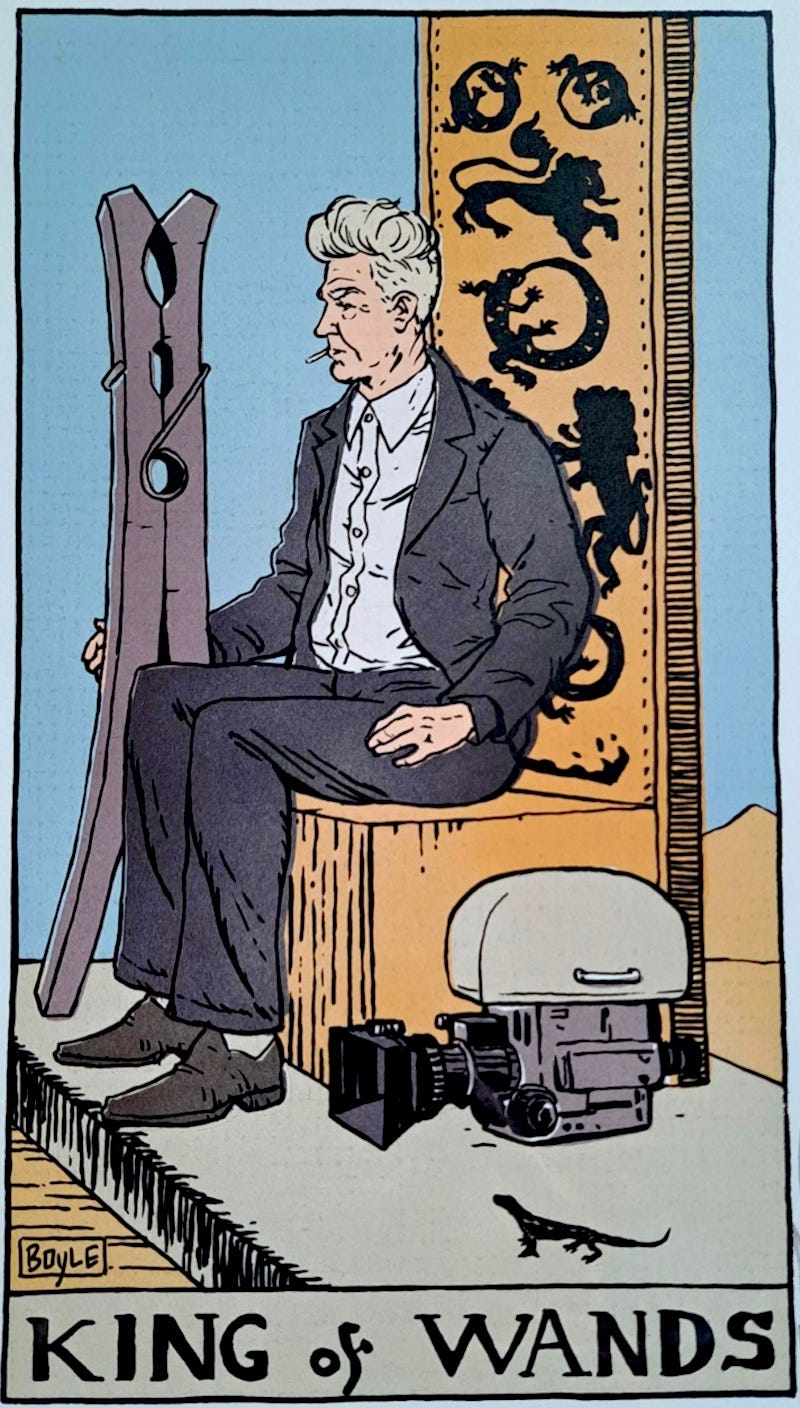
David Lynch as the “King of Wands” from the Philly Tarot Deck by James Boyle and Gina Tomaine.

Though I watch his movies and shows regularly, since his passing I’ve been revisiting them anew. Understandably, most of Lynch’s critics and fans focus on the visuals of his work, but there’s been a renewed interest in his attention to sound. “All the way back to Eraserhead,” said Badalamenti, who, starting as Isabella Rosselinni’s vocal coach on 1986’s Blue Velvet, composed music for almost all of Lynch’s projects. “David has loved to play and experiment with music and sound,” he said. Lynch said repeatedly that Badalamenti was the one “who really brought me into the world of music, right into the middle of it.”

Lynch explained the sound of Eraserhead in a 1977 interview:

Alan Splet and I worked together in a little garage studio with a big console and two or three tape recorders, and worked with a couple of different sound libraries for organic effects. Then we fed them through the console. It’s all natural sounds. No Moog synthesizers. Just changes like with a graphic equalizer, reverb, a Little Dipper filter set for peaking certain frequencies and dipping out things or reversing things or cutting things together. We had a machine to vary the pitch but not the speed. We could make the sounds the way we wanted them to be. It took several months to do it and six months to a year to edit it.

In the 2016 documentary David Lynch: The Art Life, Lynch told the story of how he first conceived of film and sound through painting:

I was painting a painting about four-foot square, and it was mostly black, but it had some green plant leaves coming out of the black. And I was sitting back, probably taking a smoke, looking at it, and from the painting I heard a wind, and the green started moving. And I thought, ‘oh, a moving painting, but with sound.’ And that idea stuck in my head. A moving painting.

Miguel Ferrer, who played the principled and persnickety Special Agent Albert Rosenfield in all three seasons of Lynch and Mark Frost’s Twin Peaks said, “The music was unlike any music you’d ever heard on television. […] It was so radically different and so evocative. It almost became another character.” Frequent musical collaborator Julee Cruise added, “You could scan the channels and know it was David Lynch, just three seconds in and you knew who it was. He pushes everything to the metal.”

“Oh, just let it float, like the tides of the ocean, make it collect space and time, timeless and endless.” — David Lynch describing a composition to Angelo Badalamenti

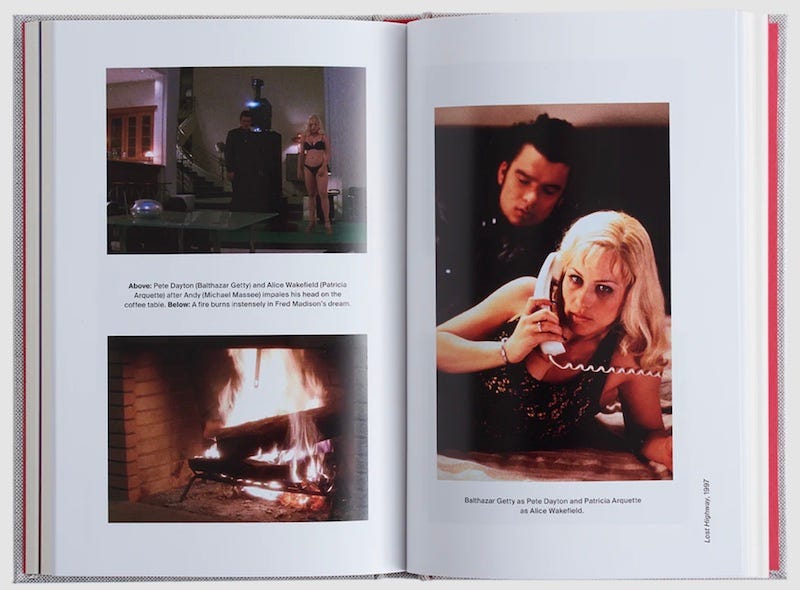
In addition to Badalamenti and Cruise, Lynch worked with Toto and Brian Eno (on the Dune soundtrack), Chris Isaak (both as a musician on Wild at Heart and an actor in Twin Peaks: Fire Walk With Me), Trent Reznor and Marilyn Manson (on Lost Highway), Karen O (sang on Lynch’s “Pinky’s Dream”), Moby (DJed his wedding), Lykke Li (sang on Lynch’s “I’m Waiting Here”) and his own band with Badalamenti, Thought Gang (named after the Tibor Fisher book?). Almost every episode of 2017’s Twin Peaks: The Return ended with a different musical act performing at the Roadhouse: everyone from acts he’d worked with before like Rebekah Del Rio (who performed in Lynch’s Mulholland Drive and, perhaps as an homage, on the Treer Jenny von Westphalen Megazeppelin in Richard Kelly’s Southland Tales, easily his most Lynchian film), Cruise (in two episodes), and Reznor and Atticus Ross (as the Nine Inch Nails), to newcomers like the Veils, Lissie, Eddie Vedder (as Edward Louis Severson III), Au Revoir Simone, and the Chromatics (in three episodes).

Beyond the Beyond: Music From the Films of David Lynch (Hat & Beard Press, 2016).

Emerging from an event at the United Artists Theatre in Los Angeles on April 1, 2015, the book, Beyond the Beyond: Music From the Films of David Lynch, edited by J.C. Gabel and Jessica Hundley (Hat & Beard Press, 2016), explores the music Lynch loved and the transcendental meditation he practiced for most of his life. As the above list of artists and collaborators indicates, Lynch was one heck of a curator. Beyond the Beyond includes interviews with many of his musical collaborators, followers, and fans.

“Haunting” is an easy but apt description of Lynch’s own music but also the music he chose from other artists. He used songs by This Mortal Coil, Roy Orbison, and many others, but Chris Isaak’s “Wicked Game,” which appeared in Lynch and Barry Gifford’s Wild at Heart (1990), is perhaps the best example. Somehow both twangy and gothic, with its deep sense of longing and loss, the song was not only a big hit for Isaak but struck the core musical chord for Lynch’s on-screen images. His own “Ghost of Love” echoes a lot of Isaak’s aching darkness, billowing like a cold wind blowing through your bowels.

“I play the guitar upside down and backwards,” Lynch said in Beyond the Beyond. “I’m not a musician. It’s more about sound effects for me. I just love the sound of it.” His pure ear for sound is obviously astute. The etherial vocals of Julee Cruise illustrate the point. She put an otherworldly lilt to several of his most iconic projects.

Cruise sang on a song for Blue Velvet called “Mysteries of Love,” and her song “Falling” from her 1989 debut record Floating Into the Night, which features compositions and production by Badalamenti and Lynch, became the main theme for Twin Peaks. About that record, she told Trey Taylor at Dazed and Confused, “I’m so proud that so many young girls have picked up on it, like Lana Del Rey. And fuck anyone who says anything bad about her, because she always credits me and I think that’s the greatest honor I’ve ever received.” The clip below is from “Industrial Symphony No. 1: The Dream of the Broken Hearted,” a play directed by Lynch, with music by Badalamenti and Cruise.

So, rest in peace to David Lynch, Angelo Badalamenti, Julee Cruise, Frank Silva, Jack Nance, Frances Bay, Catherine E. Coulson, Pamela Gidley, Peggy Lipton, Lenny Von Dohlen, Miguel Ferrer, Walter Olkewicz, Kenneth Welsh, Tom Sizemore, Piper Laurie, David Bowie, Warren Frost, Michael Parks, Don S. Davis, Robert Forster, Harry Dean Stanton, and all the other passed-away alumni of Lynch Land. As Lynch himself said in a BBC interview upon the passing of Badalamenti, “I believe life is a continuum, and that no one really dies; they just drop their physical body, and we’ll all meet again, like the song says. It’s sad, but it’s not devastating if you think like that […] It’s a continuum, and we’re all going to be fine at the end of the story.”

The joyous noise they must be making…

Come Out and Playeeyayy…

When I think of gritty, punk filmmaking, the first few movies that come to mind are Martin Scorcese and Paul Schrader’s Taxi Driver (1976), Alex Cox’s Repo Man (1984), Quentin Tarantino’s Reservoir Dogs (1992), James Merendino’s SLC Punk! (1998), and, of course, Walter Hill’s The Warriors (1979). References to the latter have popped up in everything from Wu-Tang Clan songs and Tarantino movies to Simpsons and Community episodes, but the punk-rock aesthetic and street-light ambiance of the gangland narrative linger as well. The film critic Pauline Kael described the movie as “visual rock.”

New York City gangs and their territories (Daily News, June 15, 1954).

In 1954, long before he was a science-fiction legend, Harlan Ellison set out to write a novel about the street gangs of New York City. As research, he joined the Brooklyn gang The Barons in Red Hook, considered to be one of the most dangerous neighborhoods in Brooklyn. Web of the City—originally published under the title Rumble—was Ellison’s first novel, and his nonfiction account of that time and the book’s writing was published in 1961 as Memos from Purgatory. We tend to think of the 1950s in this country as quaint and innocent. Ellison’s early work illustrates otherwise.

The gangs of New York were plentiful in the decades leading up to the release of The Warriors in 1979. During its second weekend in theaters, the lines between the screen and the street blurred as lines of gang members came out to play. Two hundred theaters hired extra security and many others pulled the movie for fears of public safety. A lot of those rowdy youths wanted to see this movie.

Purple Fury by Rob Ryder (Ryder, 2023).

In addition to playing a Baseball Fury in The Warriors, Rob Ryder started on the film as a production assistant but was quickly promoted to location scout. As he writes in his book, Purple Fury: Rumbling with the Warriors (Ryder, 2023), “So, the scene where they blow up the car,” came one of his tasks. “You need to find that street.” Ryder’s book is a candid look at the chaos behind the scenes, revealing some of the lesser known tasks of filmmaking, illuminating its dark alleys like a streetlamp.

“The streets were silent. How strange for this early in the evening. As though the being that was the neighborhoodand it was a thing with life and sentienceknew something was about to happen. The silence made the sweat return. It was too quiet.” — Harlan Ellison, Web of the City

It takes a rare filmmaker to build a legacy like Walter Hill’s, but The Warriors wasn’t his first, and he hasn’t stopped bringing similarly unique stories to the big screen. Quentin Tarantino credits Hill’s script for Hard Times (1975) for showing him what a screenplay could be—that it could be more than just the instructions for making a movie, that the script could be an end in itself. In his book, A Walter Hill Film (MZS, 2023), Walter Chaw takes a long look at Hill’s legacy.

A Walter Hill Film (MZS, 2023) by Walter Chaw. Cover illustration by Ganzeer.

Hill produced all of the Alien movies and wrote a couple of them,1 as well as The Long Riders (1980), 48 Hrs (1982), Streets of Fire (1984), and Red Heat (1988), among many others. He’s produced and directed an even longer list. Fellow writer and director Edgar Wright cites Hill’s The Driver (1978) as a major influence on his own movie Baby Driver (2017). Hill even cameos in that movie as a courtroom interpreter, and the numbers on Baby’s prison jumpsuit at the end refer to the release date of The Driver: 28071978. Walter Hill is one of our great filmmakers—a filmmaker’s filmmaker—and Walter Chaw has written a comprehensive account of his work.

Chaw also wrote a great little book about Steve de Jarnatt’s 1988 movie, Miracle Mile (Lulu, 2012), a movie he rented and watched so often that the lady at his local video store eventually just gave him the VHS tape. Little did she know, she helped saved his life.

Steve de Jarnatt’s Miracle Mile (1988).

Chaw had a rough 1989, ultimately attempting to kill himself that summer. He gives partial credit to Miracle Mile for keeping him alive and figuring out why as the impetus for this book. He digs deep into every aspect of it, enlisting writer/director de Jarnatt’s participation. It’s a thoughtful meditation on life, death, youth, writing, film in general, and this one in particular.

We’re toast. Landa checks her CliffNotes a.k.a. “The Key.“

I would be remiss not to mention Thomas Pynchon’s Gravity’s Rainbow (1973) here. Years ago, William Gibson posted a picture of the CliffsNotes for Pynchon’s sprawling novel online with the caption “The Key.” This sent me on a search. I dug in thrift stores, looked in bookstores, asked proprietors. No one seemed to know whether this particular volume of CliffsNotes existed. A couple of years later, I found out that the CliffsNotes volume on Pynchon’s most famous and confounding work was a prop for Miracle Mile. Chaw even reprinted one of Zak Smith’s illustrations (#738) from his book, Pictures Showing What Happens on Each Page of Thomas Pynchon’s Novel Gravity’s Rainbow (2006; archived here), in this book on the movie.

Steve de Jarnatt’s having written and directed Miracle Mile and written a great collection of short stories—Grace After Grace (Acre, 2020)—reminds me of one of my other favorite screenwriters, Hampton Fancher. Fancher wrote the screenplay for both Blade Runner and Blade Runner 2049, and he wrote and directed the wildly underrated film, The Minus Man (1999). Like de Jarnatt, he has a fabulous short story collection out called The Shape of the Final Dog (Blue Rider Press, 2012), as well as a profound and pithy little book about screenwriting called The Wall Will Tell You (Melville House, 2019).

Film is still our most powerful medium for storytelling. Television is more prevalent and novels are deeper, but the movie is easily accessible and quickly consumed, giving us glimpses of gangs in faraway city streets or totally alternate timelines, taking us places other forms, platforms, and formats cannot. At the very least, it decorates our lives, but sometimes it reaches out and saves them.