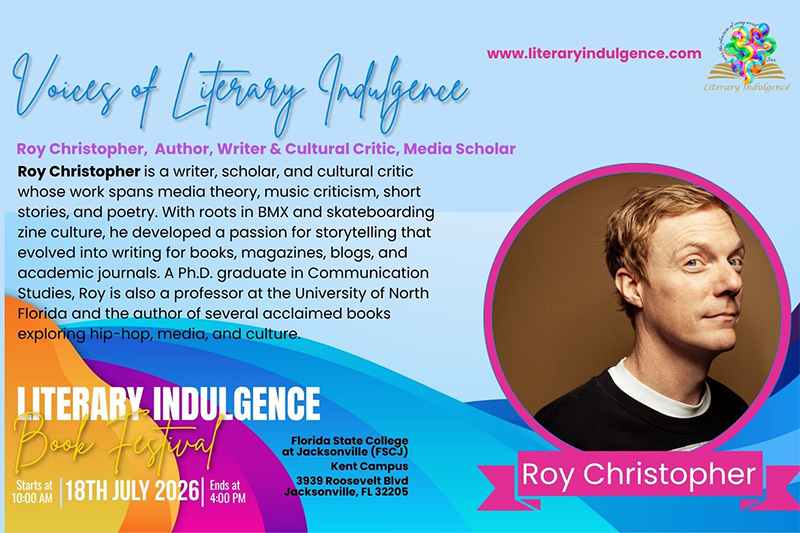
On July 18th I’ll be at the Literary Indulgence Book Festival here in Jacksonville! My books and I will be hanging out at Table #14 all day. Come through and get a book, some stickers, and my horrible hand style in one of your books! Indulge yourself!
Post-Self is a grim survey of all the ways we attempt to escape the limitations of our physical forms—technology, rapture, drugs, death—with a Foreword by the cultural critic Mark Dery titled “Welcome to the Misanthropocene.”
“We are all perpetually holding ourselves together. Our breath, our blood, our food, our spit, our shit, our thoughts, our attention—all tightly held, all the time. Then at death we let it all out, oozing at once into the earth and gasping at last into the ether.” — from POST-SELF
The back cover copy reads as follows:
In the 21st century, the body has become a prison—a problem to solve, a boundary to break. Post-Self plunges into the dark urge to escape flesh and mortality by any means necessary: technology, cybernetics, drugs, death, or pure rapture.
From horror movies to heavy metal, from radical philosophy to science fiction, this book explores how artists, writers, and visionaries have imagined transcending the human form. What drives our desire to shed our bodies? What lies beyond the self?
Bold, unsettling, and fiercely intelligent, Post-Self journeys through the shadowlands of the modern imagination—where dissatisfaction becomes inspiration, and escape is the ultimate creative act.
“Once the soul looked contemptuously on the body, and then that contempt was the supreme thing — the soul wished the body meagre, ghastly, and famished. Thus it thought to escape from the body and the earth.” — Friedrich Nietzsche, Thus Spake Zarathustra
What other people are saying about it:
“Too often philosophy gets bogged down in the tedious ‘working-through’ of contingency and finitude. Post-Self takes a different approach, engaging with cultural forms of refusal, denial, and negation in all their glorious ambivalence.” — Eugene Thacker, author, In the Dust of This Planet
“Using Godflesh—the arch-wizards of industrial metal—as a framework for a deep philosophical inspection of the permeable human form reveals that all our critical theory should begin on the street where wasted teen musicians pummel their mind and instruments into culture-shifting fault lines. Godflesh are not just a ‘mirror’ of all the horrors and glories we can inflict on our bodies, but a blasted soundscape of our moans. Roy Christopher’s book is a thought-provoking and delightful crucible of film, music, and the best kind of speculative thought.” — Peter Bebergal, author, Season of the Witch
“In his trademark breezy yet precise style, Christopher discusses everything from stimoceivers to Southland Tales, everyone from Henry Lee Lucas to Brummbear, and all without ever losing sight of his central points of reference: our all too malleable somatic limits and Godflesh’s Streetcleaner. And the combination here could not be more apposite, for however much we stretch and augment the reaches of our physicality, imagining ourselves the theophanies of some as yet speculative deities, we get no closer to getting away from ourselves, becoming Godly it seems only in the sense of becoming increasingly empty.” — Gary J. Shipley, author, Stratagem of the Corpse
“Through the lenses of Godflesh, J.G. Ballard, UFO phenomena, psychedelics, serial killings, and so much else, Christopher investigates humanity’s growing inclination to escape our bodies, to escape our species, to escape life itself.” — B.R. Yeager, author, Negative Space
“A peculiar hybrid of Thomas Ligotti and Marshall McLuhan.” — Robert Guffey, author, Operation Mindfuck
“An interesting read indeed!” — Aaron Weaver, Wolves in the Throne Room
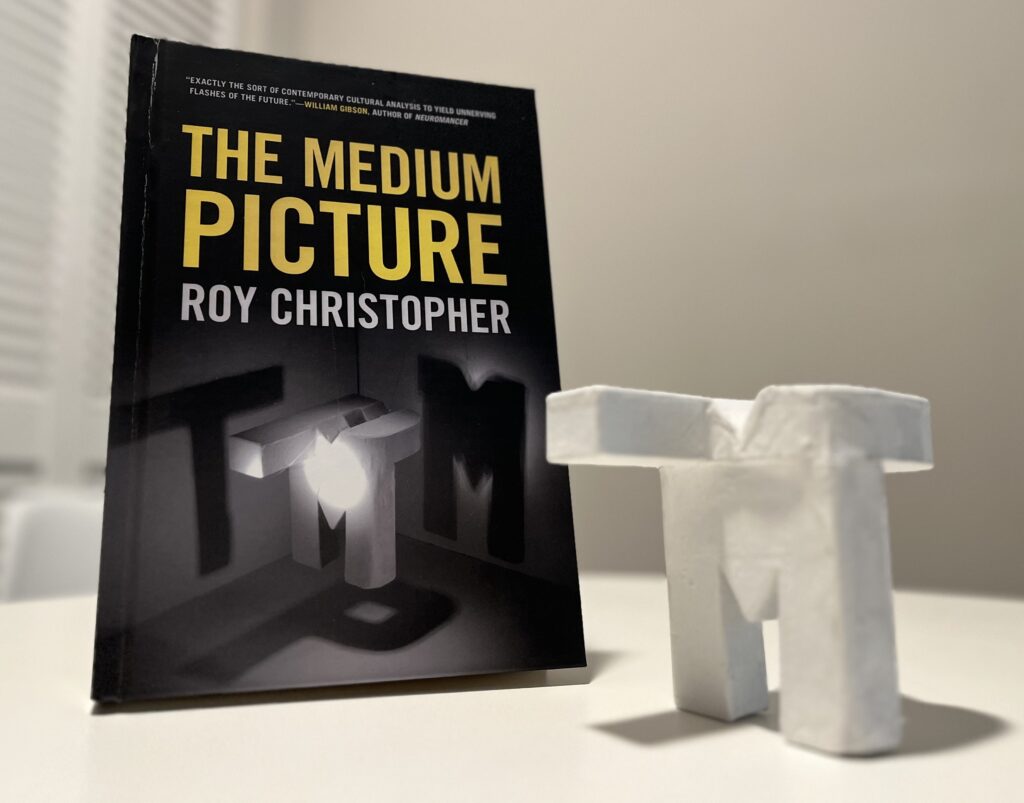
I am proud to announce that the University of Georgia Press has deigned to publish The Medium Picture. To wit, I was born in Georgia, and I attended UGA briefly during my first attempt at grad school. This project is very close to my heart, and I am stoked to have the UGA Press putting it out.
Here’s the brief overview:
The ever-evolving ways that we interact with each other, our world, and our selves through technology is a topic as worn as the devices we clutch and carry everyday. How did we get here? Drawing from the disciplines of media ecology and media archaeology, as well as bringing fresh perspectives from subcultures of music and skateboarding, The Medium Picture illuminates aspects of technological mediation that have been overlooked along the way. With a Foreword by Andrew McLuhan, itshows how immersion in unmoored technologies of connectivity finds us in a world of pure media and redefines who we are, how we are, and what we will be.
The book uses ideas from William Gibson, Marshall McLuhan, and Brian Eno, examples from Fugazi, Radiohead, Gang of Four, and Run the Jewels, and artists like Christian Marclay, Richard Long, and Laurie Anderson. It’s post-punk media-theory!
I am stoked to announce that my new book, Dead Precedents: How Hip-Hop Defines the Future, is now available for preorder! Dead Precedents uses the concerns and conceits of cyberpunk to thoughtfully remap hip-hop’s spread from around the way to around the world. Its central argument is that the cultural practices of hip-hop culture are the blueprint to the 21st century, and that an understanding of its appropriation of language and technology is an understanding of the now. This book is about is the many ways that the foundations of hip-hop appropriation—allusions and creative language use, as well as technology and sampling—inform the new millennium.
Here’s the cover:
Here are some nice words about it:
“Hip-hop has been around for well over forty years now, and in many ways, it has been absorbed into mainstream culture. Roy Christopher argues, however, that its radical practices still contain untapped possibilities. Dead Precedents shows how this cultural movement opens new hope for the future by changing our understanding of the past.” — Steven Shaviro, author of Discognition
“It’s exciting to be quoted so close to the beginning of a book with so much energy and passion in it… a lively screed.”
— Samuel R. Delany, author of Dhalgren
“This book dives into the essential nature of hip-hop re-invention and cyberpunk’s relationship to our web2.0 construct. Roy extracts detail after detail on these two topics and gracefully weaves together a clear and fresh perspective of these genres and their impact on where we are today. Such a refreshing nonstop read!”
— M. Sayyid, Antipop Consortium
“An intellectual hornet’s nest, buzzing with ideas. The canon of hip-hop crit welcomes a bold new entry, calculated to blow the doors off the usual moribund academic fare. Theory finds its own uses for things.” — Mark Dery, author of I Must Not Think Bad Thoughts
Dead Precedents comes out March 19, 2019 on Repeater Books.
My essay, “The Memes is Dead, Long Live the Meme,” argues that Dawkinsian memes have been supplanted by internet memes and are therefore dead. Here’s an excerpt:
If memes are indeed analogous to genes, then the real power of memes is that they add up to something. I’m no biologist, but genes are bits of code that become chromosomes, and chromosomes make up DNA, which then becomes organisms. Plants, animals, viruses, and all life that we know about is built from them.24 “The meme has done its work by assembling massive social systems, the new rulers of this earth,” writes Howard Bloom. “Together, the meme and the human superorganism have become the universe’s latest device for creating fresh forms of order.”
Perhaps that was true two decades ago, when Bloom wrote that, or three decades ago when Dawkins wrote The Selfish Gene, but the biases and affordances of memes’ attendant infrastructure has changed dramatically since. After all, memes have to replicate, and in order to replicate, they have to move from one mind to another via some conduit. This could be the oral culture of yore, but it’s more and more likely to be technologically enabled. Broadcast media supports one kind of memetic propagation. The internet, however, supports quite another.
I contributed several entries to the St. James Encyclopedia of Hip-Hop Culture, including ones on Gangsta Rap, Horrorcore, Rap Metal, and 1500 words on the hip-hop scene in my beloved Pacific Northwest, where I first lived from 1993 to 1998 (and three other times after). Here’s an excerpt from the latter:
Underground Hip Hop nationwide saw a resurgence during the mid-to-late 1990s. Having remained primarily underground since its inception, Pacific Northwest Hip Hop soldiered on… Wordsayer (Jonathan Moore, 1969-2017) formed the group Source of Labor in 1989. After moving back to Seattle in 1992, Moore, along with members of Source of Labor and soul group Beyond Reality, formed Jasiri Media group. “The artists in Jasiri forced the Seattle hip hop scene to move from the grandiose, self-aggrandizing rap of Sir Mix-a-Lot to a more educated, meaningful form of musical expression” (Key, 2010, p. 294). Fighting the Teen Dance Ordinance, which had all but killed all-ages events in Seattle since its implementation in 1985, Moore promoted “Sure Shot Sundays” in 1999 to open up possibilities for local youth to experience and perform Hip Hop. He passed away at age 47 in March of 2017 of kidney failure.
Labels like Loose Groove, Do the Math, Impact Entertainment, and Conception Records released definitive compilations showing and proving that the Pacific Northwest’s underground was rife with intriguing and engaging Hip Hop artists in the 1990s. 14 Fathoms Deep: Seattle Hip Hop Compilation (Loose Groove 1997) featured Source of Labor, the Ghetto Children, and Prose and Concepts. Do the Math (Tribal Music, 1998) featured Wordsayer, DJs Topspin, B-Self, and Vitamin D, and three tracks by the Ghetto Children. Classic Elements (Impact Entertainment, 1998) boasted Ghetto Children’s love letter to classic Hip Hop, “Hip Hop Was?” Walkman Rotation (Conception Records, 1998) was a DJ-blended mixtape, a form popular in the underground at the time, mixed by J-Rocc of the Beat Junkies. Other local DJs include Vitamin D, B-Mello, and Topspin.
This massive, 500-page encyclopedia of all-thing hip-hop is out now!
Reference:
Key, Rachel. 2010. From the SEA to the PDX: Northwest Hip Hop in the I-5 Corridor. In Mickey Hess (Ed.), Hip-Hop America: A Regional Guide. Santa Barbara, CA: Greenwood Press, pp. 287-314.
A few of my colleagues at UIC and a few of their colleagues from institutions around the world are all working on social media privacy. They put together a group called the Social Media Privacy Research Collective and wanted to solidify their efforts with a logo. Being the resident artist of our department, I was tapped to do the design. I immediately started playing with the initials.
At first I messed around with the P and the R. I knew there was something I could manipulate there. I thought it was goign to be flipping the P, then I thought it was going to be integrating their similarities. Flipping the R ended up being the way to go.
Then I started to see the similarities between the P-R combination and the M.
Once I got that, which took a few more iterations, the S and the C fell into place, and I had it. Then I moved to the computer to render it cleanly.
I ran this design by my colleagues, and they wanted it done up with some color.
Though it may go no further than this, I am thankful to Kelly Quinn and Dima Epstein for the opportunity to stretch a bit on this one.
UPDATE: This is another version I did later, and the one I think they ultimately ran with. I know they liked it better regardless.
I am happy to announce a contribution to the Journal of Hip-Hop Studies (Volume 4, Issue 1). I wrote a review of André Sirois’ book Hip-Hop DJs and the Evolution of Technology (Peter Lang, 2016).
Sirois’ book is not only a great fit for coverage in this particular journal, but it’s also one of the many pieces of the multiple puzzles I’m trying to assemble in the research for one of my own books-in-progress. Here’s an excerpt of my JHHS review:
André Sirois, a.k.a. DJ Food Stamp, the man behind the turntables on mixtapes by some of my favorite emcees, including Sean Price, Planet Asia, Common, M.F. Doom, and Atmosphere, grasps that tonal history [of turntablism]. In his book Hip-Hop DJs and the Evolution of Technology: Cultural Exchange, Innovation, and Democratization, Sirois argues that in its complexity, hip-hop culture is itself a new media culture. Current so-called ‘new media’ can be traced back from smartphones and the internet to landlines and the telegraph. Following hip-hop DJs’ hacking of recording technology and playback from Grandmaster Flash’s mixer toggle-switch and Grand Wizard Theodore’s manual scratch to digital sampling and Serato, Sirois historicizes the technical evolution and cultural practices of Hip Hop DJs as new media. Emphasizing the network mentality present from the beginning of Hip Hop, he employs an open source metaphor to characterize the culture. ‘From my perspective,’ Sirois writes, ‘what these South Bronx DJs started was the foundation of the new media ideology present in popular culture today: sample, mix, burn, share, and repeat’ (XVII).
I am proud to announce that I was recently a part of 9 Muses Photo’sA Book that Changed My Life project, “an open series focused on people and the books that changed their lives.” Dennis Sevilla took this photo of me with the book that changed my life:
Here’s my story:
James Gleick’s Chaos (Viking, 1987) changed my life. Quite simply, I was on a path, and after reading it I was on a different one. I was a music journalist. When I came across Chaos, I had spent a lot of time and effort becoming a music journalist. The book is about chaos theory. It’s about the disparate scientists who were working between the lines of different disciplines. It’s about sensitive dependence on initial conditions. It’s about how paths can change unexpectedly. Reading Chaos blew my head wide open. I was suddenly aware of so many other possibilities. I quit my job and went back to school. Now I teach college and write my own books. I still write about music, but now I write about a lot of other things. Also, after a few false starts with books that didn’t stick, Chaos turned me into a reader. I starting reading it 20 years ago this month, and I haven’t stopped reading since.
Having recently been interviewed about this book, I tried to focus on the fact that Chaos turned me into a reader. It’s the one that stuck.
You can see the rest of the series here. Many thanks to Dennis for including me in this project, my dude Tim Baker for hipping me to it, and of course to James Gleick.
Sometimes they take a while to come together… Unlike my HKRB logo, which came together overnight, this one’s been brewing for over a year. dälek is one of my all-time favorite groups, and I’ve known them for a minute now. Though unsolicited, it was an honor to finally put something like this together.
As I often do, I started with similarities in the first and last letters. Though the D and the K can be drawn structurally similar, the going was rough at first. I had to let it marinate.
When I came back to it the other day, I found a few new ways to bring the letters together.
Hollowing them out gave it a bit more life, but it still wasn’t quite there.
Much like my Alaska logo, once I found the X in the background, I knew I had it.
I tried a few more iterations after this one, attempting to make the D a bit stronger, but I like this one the best. I even went back to the very straight, less organic style I started with, and this is still the best version. It’s live, it’s dangerous, it’s like the band it represents.