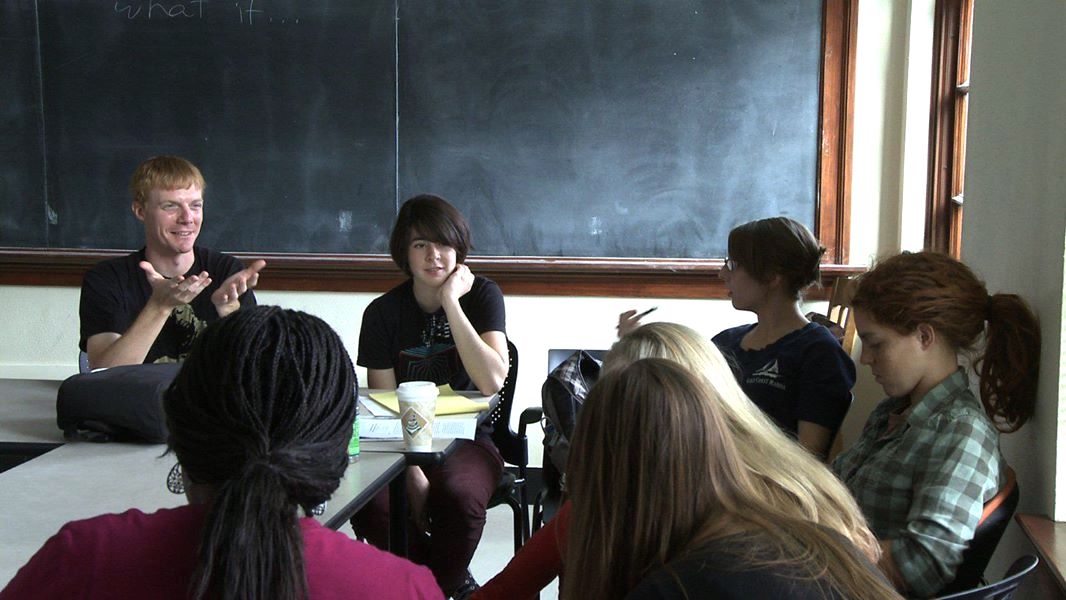

Sam Seidel: You Must Learn

Sam Seidel is a progressive pedagogue. He chronicles his forays into education reform on The Husslington Post. In his new book, Hip-Hop Genius: Remixing High School Education (Rowman and Littlefield, 2011), he drops science on the High School of Recording Arts, where he’s implemented many aspects of the four elements in the classroom. In what follows, we discuss the book, the classroom, and how Hip-hop can help education come correct in the twenty first.

Roy Christopher: Most would agree that modern education needs an upgrade. How can Hip-hop help in this endeavor?

Sam Seidel: Hip-hop innovators have always found value in things that mainstream society has deemed valueless–whether it’s old records, the sides of train cars, or the lives of poor young people. Educators can learn from this by recognizing brilliance and beauty where it is often ignored. Much of the schooling that happens in this country fails to respect or build upon the intelligence and cultural competencies of students. Instead schools–encouraged by standardized accountability measures from the federal and state governments–try to force all students to be homogenous generalists.

RC: It’s more than just rapping lessons and turntables in the classroom, right? What’s at the core of this idea?

SS: The core of the idea is respecting young peoples’ brilliance and culture. Bringing turntables and rap songs into a classroom and acting like an expert on hip-hop culture doesn’t necessarily make you a hip-hop educator. You might be an English teacher who is teaching rap songs as texts. I’m not trying to position myself as the arbiter of who is or isn’t a hip-hop educator, but what I’m excited about is exploring new ways of teaching–and beyond that, new kinds of learning environments and leadership models.

RC: Is the success of the HSRA reliably repeatable?

SS: Just like a rapper using a punchline that has already been used in another rhyme is wack, educators shouldn’t just copy someone else’s work, but that doesn’t mean they shouldn’t study others’ styles closely. More educators could definitely see results like those at the High School for Recording Arts and there are many aspects of HSRA’s program that they could potentially borrow and build upon, but they shouldn’t necessarily try to replicate everything from the school. People can definitely look to HSRA for inspiration, examples, and even direct consultancy, but there is only one David T. C. Ellis, there is only one Twin Cities (well, I guess there are two of those!), and it would be unrealistic to think that you could recreate what he and his team have done there.

RC: Every time I try to spread the word about the power of thinking through Hip-hop, I invariably meet resistance. Do you find yourself defending your love of Hip-hop?


SS: Not so much. I don’t find those conversations very rewarding and I seem not to attract them. Sometimes people want to point out some of the negative elements of Hip-hop… Okay. I’ve never argued that hip-hop is all positive all the time. It is an immense culture. But, in this day and age, who can really front on the power of Hip-hop? The culture has transcended almost every boundary imaginable. My man, Stephen Buddha Leafloor does life-changing hip-hop workshops with Inuit and first nation young people in remote Arctic communities that can only be reached by plane. Hip-hop artists who started as rappers have clothing lines, footwear, and fragrances sold in department stores across the world. The President of the United States has rap songs on his iPod and uses Hip-hop slang. I recorded a song with an emcee from Mozambique, who rhymed in four languages in one verse. I mean people can say they don’t personally like the music or they think graffiti is vandalism that should be stopped, but they can’t front on Hip-hop’s relevance and power–so my point is, if we know it’s relevant and powerful, then what effect it has is all about how it is engaged.

RC: Why do you think people resist this culture so strongly?

SS: They’re haters. It scares them. I don’t know. Yesterday I was walking across a street in New York City and i heard a rap song rattling out of a dude’s car. The lyrics were, literally, “bitch, bitch, bitch, bitch, fuck ’em all.” People hear something like that and form a lot of judgements–as if that song must represent the entirety of a multi-dimensional global culture. Don’t underestimate racism. Or classism. We’re talking about a cultural form that emerged from the hood. There’s a lot of people out there who will hate for that reason alone.

RC: So, it’s much more than just a generational difference?

SS: There can be a generational thing. As George Clinton points out in the Foreword to Hip-Hop Genius, the music of a generation often sounds like noise to the generation before. At the same time, it was my pops who brought home rap records when I was five years old. George Clinton is in his 70s and he loves the culture, so… It’s not just generational.

RC: What can we do to get past the stigma?

SS: We need to stop engaging it so much. People write whole books trying to validate uttering the words “hip-hop” and “education” in the same sentence. There’s a place for those arguments, but I think we need to just focus our energy on building beautiful things and proving that what we know works works. Jay-Z didn’t spend years arguing with music execs who weren’t feeling what he was doing, he went and did it himself and then they started paying attention. This has happened over and over again in the rap game. No Limit and Cash Money had to build their own empires before labels recognized that the south had a rap market. Success has a funny way
of smothering stigma.

RC: Whenever one tries to institutionalize an organic movement as such, there’s always a risk of making it lame and losing the students’ interest. How do we use Hip-hop in the classroom and keep it engaging?

SS: By letting the students run it. If they are creating art that reflects their interests and aesthetics, it will never get stale.

RC: What’s next for you and Hip-hop education?

SS: Now that Hip-Hop Genius has dropped I’ve been getting some great invitations to talk about it. The video we made about Hip-Hop Genius has also gotten a lot of buzz online which has led to other opportunities. I just started a book tour where I go to cities, visit as many cool organizations and schools as I can–specifically those related to Hip-hop arts and empowering young people–and then put on an event that features their work, the work of the High School for Recording Arts, and Hip-Hop Genius. The first few events have been dope! We’d love to bring it to more cities, so holler if you have ideas about locations we should add.

————-
Here’s the book trailer for Hip-hop Genius [runtime: 4:23]:

WLMdkGk5Ofo

Bring the Noise: Systems, Sound, and Silence

In our most tranquil dreams, “peace” is almost always accompanied by “quiet.” Noise annoys. From the slightest rattle or infinitesimal buzz to window-wracking roars and earth-shaking rumbles, we block it, muffle it, or drown it out whenever possible. It is ubiquitous. Try as we might, cacophony is everywhere, and we’re the cause in most cases. Keizer (2010) points out that, besides sleeping (for some of us), reading is ironically the quietest thing we do. “Written words were meant to evoke heard speech,” he writes, “and were considered inadequate until they did so, like tea leaves before the addition of hot water” (p. 21). Reading silently was subversive.

We often speak of noise referring to the opposite of information. In the canonical model of communication conceived in 1949 by Claude Shannon and Warren Weaver, which I’ve been trying to break away from, noise is anything in the system that disrupts the signal or the message being sent.

If you’ve ever tried to talk on a cellphone in a parking garage, find a non-country station on the radio in a fly-over state, or follow up on a trending topic on Twitter, then you know what this kind of noise looks like. Thanks to Shannon and Weaver (and their followers; e.g., Freidrich Kittler, among many others), it’s remained a mainstay of communication theory since, privileging machines over humans (see Parikka, 2011). Well before it was a theoretical metonymy, noise was characterized as “destruction, distortion, dirt, pollution, an aggression against the code-structuring messages” (Attali, 1985, p. 27). More literally, Attali conceives noise as pain, power, error, murder, trauma, and youth (among other things) untempered by language. Noise is wild beyond words.

The two definitions of noise discussed above — one referring to unwanted sounds and the other to the opposite of information — are mixed and mangled in Hillel Schwartz’s Making Noise: From Babel to the Big Bang and Beyond (Zone Books, 2011), a book that rebelliously claims to have been written to be read aloud. Yet, he writes, “No mere artefacts of an outmoded oral culture, such oratorical, jurisprudence, pedagogical, managerial, and liturgical acts reflect how people live today, at heart, environed by talk shows, books on tape, televised preaching, cell phones, public address systems, elevator music, and traveling albums on CD, MP3, and iPod” (p. 43). We live not immersed in noise, but saturated by it. As Aden Evens put it, “To hear is to hear difference,” and noise is indecipherable sameness. But, one person’s music is another’s noise — and vice versa (Voegelin, 2010), and age and nostalgia can eventually turn one into the other. In spite of its considerable heft (over 900 pages), Making Noise does not see noise as music’s opposite, nor does it set out for a history of sound, stating that “‘unwanted sound’ resonates across fields. subject everywhere and everywhen to debate, contest, reversal, repetition: to history” (p. 23).

Wherever we are, what we hear is mostly noise. When we ignore it, it disturbs us. When we listen to it, we find it fascinating.
John Cage

The digital file might be infinitely repeatable, but that doesn’t make it infinite. Chirps in the channel, the remainders of incomplete communiqué surround our signals like so much decimal dust, data exhaust. In Noise Channels: Glitch and Error in Digital Culture (University of Minnesota, 2011), Peter Krapp finds these anomalies the sites of inspiration and innovation. My friend Dave Allen is fond of saying, “There’s nothing new in digital.” To that end, Krapp traces the etymology of the error in machine languages from analog anomalies in general, and the extremes of Lou Reed’s Metal Machine Music (RCA, 1975) and Brian Eno‘s Discreet Music (EG, 1975) in particular, up through our current binary blips and bleeps, clicks and clacks — including Christian Marclay‘s multiple artistic forays and Cory Arcangel’s digital synesthesia. This book is about both forms of noise as well, paying due attention to the distortion of digital communication.

There is a place between voice and presence where information flows. — Rumi

Another one of my all-time favorite books on sound is David Toop’s Ocean of Sound (Serpent’s Tail, 2001). In his latest, Sinister Resonance: The Mediumship of the Listener (Continuum Books, 2010), he reinstates the human as an inhabitant on the planet of sound. He does this by analyzing the act of listening more than studying sound itself. His history of listening is largely comprised of fictional accounts, of myths and make-believe. Sound is a spectre. Our hearing is a haunting. From sounds of nature to psyops (though Metallica’s “Enter Sandman” is “torture-lite” in any context), the medium is the mortal. File Sinister Resonance next to Dave Tompkins’ How to Wreck a Nice Beach (Melville House, 2010) and Steve Goodman’s Sonic Warfare (MIT Press, 2010).

And how can we expect anyone to listen if we are using the same old voice? — Refused, “New Noise”

Life is loud, death is silent. Raise hell to heaven. Make a joyous noise unto all of the above.

———-

My thinking on this topic has greatly benefited from discussions with, and lectures and writings by my friend and colleague Josh Gunn.

References and Further Resonance:

Attali, J. (1985). Noise: The Political Economy of Music. Minneapolis, MN: University of Minnesota Press.

Evens, A. (2005). Sound Ideas: Music, Machines, and Experience. Minneapolis, MN: University of Minnesota Press.

Goodman, S. (2010). Sonic Warfare. Cambridge, MA: MIT Press.

Hegarty, P. (2008). Noise/Music: A History. New York: Continuum Books.

Keizer, G. (2010). The Unwanted Sound of Everything We Want: A Book About Noise. Philadelphia, PA: Public Affairs.

Krapp, P. (2011). Noise Channels: Glitch and Error in Digital Culture. Minneapolis, MN: University of Minnesota Press.

Parikka, J. (2011). Mapping Noise: Techniques and Tactics of Irregularities, Interception, and Disturbance. In E. Huhtamo & J. Parikka (Eds.), Media Archeology: Approaches, Applications, and Implications. Berkeley, CA: University of California Press.

Refused. (1998). “New Noise” [performed by Refused]. On The Shape of Punk to Come: A Chimerical Bombination in 12 Bursts (Sound recording). Örebro, Sweden: Burning Heart Records.

Schwartz, H. (2011). Making Noise: From Babel to the Big Bang and Beyond. New York: Zone Books.

Shannon, C.E., & Weaver, W. (1949). The Mathematical Theory of Communication. Urbana, IL: University of Illinois Press.

Sterne, J. (2003). The Audible Past: Cultural Origins of Sound Reproduction. Durham, NC: Duke University Press.

Tompkins, D. (2010). How to Wreck a Nice Beach. Brooklyn, NY: Melville House.

Toop, D. (2010). Sinister Resonance: The Mediumship of the Listener. New York: Continuum Books.

Voegelin, S. (2010). Listening to Noise and Silence: Towards a Philosophy of Sound Art. New York: Continuum Books.

remixthebook: Guest Post and Tweeting

In 1997, I wrote a piece about turntablism for Born Magazine called “Band of the Hand.” Years later, I wrote a related piece for Milemarker‘s now defunct Media Reader magazine, called “war@33.3: The Postmodern Turn in the Commodification of Music.” I’ve been revisiting, remixing, and revising these previous thesis pieces ever since. I eventually combined the two and posted them here, but I’ve also written other things that spin off from their shared trajectories.

This week, I am proud to be guest-tweeting for Mark America’s remixthebook (Univeristy of Minnesota Press, 2011). In addition, I posted a piece on the remixthebook site. remixthebook and its attendant activities situate the mash-up as a defining cultural activity in the digital age. With that in mind, I tried to go back to the writings above and update them using pieces of relevant things I’ve written since. If you will, my post is a metamix of thoughts and things I’ve written about remix in the past decade and a half or so, pieces which also represent material from my other book-in-progress, Hip-hop Theory: The Blueprint to 21st Century Culture. It’s a sample-heavy essay that aims to illustrate the point.

Here are a few excerpts:

Culture as meaning-making requires participation. In addition to the communication processes of encoding and decoding, we now participate in recoding culture. Using allusions in our conversation, writing, and other practices engages us in culture creation as well as consumption. The sampling and remixing practices of Hip-hop exemplify this idea more explicitly than any other activity. Chambers wrote, “In readily accessed electronic archives, in the magnetic memory banks of records, films, tapes and videos, different cultures can be revisited, re-vived, re-cycled, re-presented” (p. 193). Current culture is a mix of media and speech, alluded to, appropriated from, and mixed with archival artifacts and acts.

We use numerous allusions to pop culture texts in everyday discourse, what Roth-Gordon calls “conversational sampling.” Allusions, even as direct samples or quotations, create new meanings. Each form is a variation of the one that came before. Lidchi wrote, “Viewing objects as palimpsests of meaning allows one to incorporate a rich and complex social history into the contemporary analysis of the object.” It is through use that we come to know them. Technology is not likely to slow its expanse into every aspect of our lives and culture, and with it, the reconfiguration of cultural artifacts is also not likely to stem. Allusions – in the many forms discussed above and many more yet to come – are going to become a larger and larger part of our cultural vocabulary. Seeing them as such is the first step in understanding where we are headed.

Rasmussen wrote, “there is no ‘correct’ way to categorise [sic] the increasing diversity of communication modes inscribed by the media technologies. Categories depend on the nature of the cultural phenomena one wants to investigate.” Quotation, appropriation, reference, and remix comprise twenty first century culture. From our technology and media to our clothes and conversations, ours is now a culture of allusion. As Schwartz so poetically put it: “Whatever artists do, they are held in the loose but loving embrace of artists past.” Would that it were so.

The whole post is here.

Many thanks to Mark America and Kerry Doran for the opportunity and to everyone else for joining in on the fun. Here’s the trailer for the project [runtime: 1:21]:

iXnBVn_OS90

For the Nerds: Bricks, Blocks, Bots, and Books

I used to solve the Rubik’s Cube — competitively. I never thought much of it until I, for some unknown reason, was recently compelled to tell a girl that story. I now know how nerdy it sounds. The girl and I no longer speak.

Erno Rubik among his Cubes.
Some of the things I grew up doing, I knew were nerdy (e.g., Dungeons & Dragons, LEGOs, computers, etc.). Others were just normal. Looking back on them or still being into them, one sees just how nerdy things can be. In a recent column on his SYFFAL site, my man Tim Baker serves the nerds some venom. Nailing several key aspects of the issue, Baker writes,

Thanks to the proliferation of information on the internet anyone can be an expert in anything, well a self-presumed expert. The problem is that people are choosing to become experts in things that might carry a certain cultural currency in fringe groupings but have no real world value. Comic books and niche music scenes are great, and add to the spice of life but no matter how often the purveyors of such scenes repeat the mantra, they are by no means important. They are entertaining and enjoyable but fail to register on Maslow’s hierarchy of needs. So while cottage industries have popped up allowing those who are verbose enough to make a case that Led Zeppelin is essential to who we are, it does not change the fact that these experts are dabbling in the shallow end of the pool.

Now, if you know me, you know that I’m the last person to be promoting anything resembling growing up, but I will agree that since the widespread adoption of the web, nerd culture often gets completely out-of-hand. It’s also treated as a choice you can make, but as every true nerd knows, we’re born not made. As my friend Reggie Hancock puts it, citing the most recent nerd icon to end all nerd icons, Tina Fey:

Tina Fey is, unabashedly, a nerd. It’s not a badge of honor she wears, but a stink of reality. She’s not a nerd because she likes Star Wars and did an independent study of comedy in junior high school, Tina Fey likes Star Wars and did an independent study because she’s a nerd. It’s not a persona she assumes, she didn’t live with a dumb haircut for years on purpose, but because Tina Fey was born a nerd, lives as a nerd, and will die a nerd.

To the cheers and glee of nerdkind everywhere, John Baichtal and Joe Meno have edited a collection of ephemera regarding every adults favorite plastic blocks. The Cult of LEGO (No Starch Press, 2011) covers the blocks’ history, how-to, and hi-tech.

Nerd touchstones like comics, movies, LEGO-inspired video games (including Star Wars, of course), Babbage’s Difference Engine, and Turing machines are covered inside, as well as the LEGO font, image-to-brick conversions, home brick-printing, Douglas Couplandbrick artists, record-setting builds, and robots — Mindstorms, LEGO’s programmable robot line, by far the most sophisticated of the LEGO enclaves. Here’s the book trailer [runtime: 1:43]:

CByAKmKC4zQ

If you want to build stuff with more than just plastic bricks, O’Reilly’s magazine, Make: Technology on Your Time, is the grown-up nerd’s monthly bible. Volume 28 (October, 2011) is all about toys and games. There’s a pumpkin catapult, a kinda-creepy, semi-self-aware stuffed bear, a silly, copper steamboat, a giant bubble blower… It’s all here — and much more. Check the video below [runtime: 2:18].

So, whether you know someone who dweebs over arduinos, has fits over RFIDs, or just loves to build stuff, Make is the magazine. It gets no nerdier. Also, check out the Maker Shed (nerd tools and supplies galore) and Maker’s Notebooks (my favorite thing from this camp).

eU4GuSx3Z4Y

Oh, and if you can’t solve the Cube, there’s a LEGO Mindstorms Rubik’s Cube solver on page 245 of The Cult of LEGO. The machine takes an average of six minutes. For the record, my fastest time was 52 seconds.

Get on it, nerds.

David Preston’s Literature & Composition Class Talk

On November 2nd, I was invited to talk to Dr. David Preston’s Literature and Composition class via Blackboard Collaborate and Howard Rheingold‘s Rheingold University. Here’s a screen capture of that talk [Warning: It’s long. Runtime: 1:02:21]. Topics include a few of my projects, the web, advent horizons, collaborative learning, technology in the classroom and in the lives of the youth.

Many thanks to Ted Newcomb and Howard Rheingold for hooking this up, to David Preston and his students for their time, attention, and participation, and to Linda Burns for saving the video. This was a great opportunity and a humbling and inspiring experience.

Occupy the Edges: Boundary Objects

Managing the concept of time is never easy. Tangling with the temporal in an institution is a complex issue among many complex issues. Institutions use narratives to remember, and, as Charlotte Linde (2009) writes, “to work and rework, present and represent the past for the purposes of the present and the projection of the future” (p. 3). In what Stock (1983) calls a “textual community,” people in an institution or community determine which narrative texts are relevant for reference and which resonate with the shared beliefs of that institution or community. Members use references to the same narratives.

In a recent post on her website, futurist Emily Empel brought up the problem of communicating across boundaries between communities of practice. In this case, communication between business institutions and futures studies. Brand recognition is as much of an issue in this environment as it is anywhere else, hence Empel’s concern. “We are a cult where the code words are scenario, uncertainty, and emerging issues,” she writes. “Our clients speak revenue, profit, and predictability. Business and futures need to develop a common language in which advanced foresight becomes an integral and actionable piece of the strategy puzzle.”

A boundary is not that at which something stops but, as the Greeks recognized, the boundary is that from which something begins its presencing. — Martin Heidegger

Business interests and futures studies represent what Etienne Wenger (1999) calls “communities of practice.” These are communities of workers united by a similar goals, practices, and vocabularies. To the social scientist, the differences in these vocabularies are analogous to Kaplan’s (1998) “logic-in-use” and “reconstructed logic,” where the former is the native language of a community, and the latter is the language it uses to explain its work to those outside the community. Participation and reification of the practices of a community unite them, but also distinguish them from others and from the outside world in general. Their distinguishing features create boundaries.

Peripheries emphasize similarity and boundaries emphasize difference (Wenger, 1999). Where boundaries exist, as they obviously do between businesses and foresight work, we need to create peripheries. As posited by Star and Griesemer (1989), boundary objects aid this effort by translating differences between communities of practice. Boundary objects cab be “artifacts, documents, terms, concepts, and other forms of reification around which communities of practice can organize their interconnections” (p. 105). Star (1989) outlined a set of criteria for such objects as follows (the brief descriptions are my own):

1. Modularity: Something for everyone.

2. Abstraction: Limits information to what is useful.

3. Accommodation: Maintains usefulness for all.

4. Standardization: No surprises.

“When a boundary object serves multiple constituencies,” Wenger writes, “each only has partial control over the interpretation of the object” (p. 108). For instance, in typical scenario planning, parties in dispute can stay in dispute as they try to work out a future solution. As Stewart Brand (1999) puts it, they can “continue to disagree about the past and present (since such a scenario can represent a different version of what happened in the past) and at the same time allows them to agree about what possible futures they face together, and which of these might be most desirable for all” (p. 118). Communities in dispute are the extreme case, but we are currently surrounded by the extreme case. Our world is all edges and no middle ground.

Scenario planning is still one of the most versatile tools in use and can help businesses manage and temper the temporal. As Bruce Sterling (2002) put it, “a good scenario will slice through layers of time like a cake knife” (p. 217). Good scenarios are not predictive or probable, rather they are explorations of possibilities — plural. Brand (1999) concludes, “We don’t know what’s coming. We do know we’re in it together” (p.123).

References:

Brand, Stewart. (1999). The Clock of the Long Now: Time and Responsibility. New York: Basic Books.

Heidegger, Martin. (1994). Poetry, Language, Thought. New York: Harper & Row.

Kaplan, Abraham. (1998). The Conduct of Inquiry: Methodology for Behavioral Science. Piscataway, NJ: Transaction Publishers.

Linde, Charlotte (2009). Working the Past: Narrative and Institutional Memory. New York: Oxford University Press.

Star, Susan Leigh (1989). The Structure of Ill-structured Solutions: Boundary Objects and Heterogenous Distributed Problem Solving. Working paper, Department of Information and Computer Science, University of California, Irvine.

Star, Susan Leigh & Griesemer, James R. (1989). Institutional Ecology, ‘Translations’ and Boundary Objects: Amateurs and Professionals in Berkeley’s Museum of Vertebrate Zoology, 1907-39. Social Studies of Science, 19: 387.

Sterling, Bruce. (2002). Tomorrow Now: Envisioning the next Fifty Years. New York: Random House.

Stock, B. (1983). The Implications of Literacy: Written Language and Models of Interpretation in the Eleventh and Twelfth Centuries. Princeton, NJ: Princeton University Press.

Wenger, Etienne. (1999). Communities of Practice: Learning, Meaning, and Identity. New York: Cambridge University Press.

——————

Special thanks to Kathleen Tyner, Emily Empel, Frank Spencer, Scott Smith, Stuart Candy, Jamais Cascio, Stewart Brand, Bruce Sterling, and my other friends in futures who’ve taught me so much.

Follow for Now is Now Available at BookPeople

Yep, nearly five years after its release, Follow for Now is now available at BookPeople in Austin, Texas. As you can see in the photo below, it’s in the General Science section, and I am quite proud.

It’s also in Cyberculture & History, and right now, in the New Arrivals.

So, if you’re in Austin and don’t have a copy, stop by and get yours.

Many thanks to Michael McCarthy and everyone at BookPeople for their support. And to you for yours.

Evergreen Halloween: Ten Years of Donnie Darko

This week marks the ten-year anniversary of Richard Kelly’s Donnie Darko. In the time since its inauspicious, post-9/11 release, it has become my favorite movie ever. At the height of my obsession with it, I attended a midnight screening of the director’s cut at The Egyptian Theatre in Seattle. During the trivia contest that preceded the movie, I was asked to sit out due to my answering all of the questions. The movie struck something in me, and I am certainly not alone. As Kelly himself put it, “I think you are challenged by things that are slightly beyond your grasp” (p. xiv). So, this is not another “twenty-five things you didn’t know” or “fifty reasons why it’s the best” (the internet loves this movie), but there are some things about it that I think make it so engaging, endearing, and enduring.

Donnie Darko is set in a Virginia high school 1988. I was in high school during the time, so that connects the film to my life in several ways: The soundtrack, the angst, and the nerdy struggle are all very familiar to me. One of my friends once derided Donnie, saying he was, “so emo he can travel through time,” and I can see how Donnie’s whiney approach to therapy could wear on one, but it’s a minor flaw in a major piece of myth-making.

Like its lauded indie debut cousin Reservoir Dogs, Donnie Darko starts with a conversation scene set over a meal, a scene in which we meet most of the main characters of the film. It’s an elegant and efficient way to establish not only the characters but also their social dynamic. In Reservoir Dogs, the scene revolves around Mr. Blue’s Madonna monologue (which one assumes at this point was written by Roger Avery and not by Quinten Tarantino, who delivers it in the movie), Joe’s address book, and Mr. Pink’s refusal to tip. In Donnie Darko, it revolves around his sister Elizabeth’s (played by his sister Maggie Gyllenhaal) politics, Donnie’s (Jake Gyllenhaal) apparent refusal to take his meds, and their use of foul language at the dinner table. In each, the trio of topics reveals just enough about the characters’ attitudes and how they play together.

Aside from Donnie and Elizabeth (played by the the real-life siblings Jake and Maggie Gyllenhaal), the Darko family consists of father Eddie (the inimitable Holmes Osborne), mother Rose (the fabulous Mary McDonnell), and kid sister Samantha (Daveigh Chase, the only original Darko defector to the abortive sequel S. Darko). Other stellar performances are turned in by Gretchen Ross (Jena Malone), Kitty “Sometimes I doubt your commitment to Sparkle Motion” Farmer (Beth Grant), Jim Cunnigham (Patrick Swayze, R.I.P.), Ronald Fisher (Stuart Stone), Professor Monnitoff (Noah Wyle), Karen Pomeroy (Drew Barrymore), Ricky Danforth (Seth Rogan, in his big-screen debut), Seth Devlin (Alex Greenwald), and, of course, Frank (James Duvall).

Though he’s never formally acknowledged it, Kelly’s Frank the Rabbit character can be interpreted as a play on the pookah legend, which Robert Anton Wilson (1991) explained as follows:

The pookah takes many forms, but is most famous when he appears as a giant, six-foot white rabbit — which is the form most Americans know from the play and film, Harvey. Whatever form the pookah takes, he retains the special ability of his species, which is like that of Thoth in Egyptian legend, Coyote in Native American myth, or Hanuman the Divine Monkey in Hindu lore — he can move us from one universe, or Belief System, into another, and he likes to play games with our ideas about “reality” (p. 29).

Frank is from the future and he mentors Donnie through the film with cryptic guidance and disjointed advice. Like the overall feeling of the film, Frank’s ambiguity keeps Donnie and us wondering exactly what’s in store.

The iconography of Donnie Darko starts with Frank. He is as distinctive a symbol for a movie as there has ever been. The setting and surroundings of Halloween, as well as the late-night bike-ride nod to E.T., are also endemic to this movie. For example, take the music video for “What’s a Girl to Do?” by Bat for Lashes [runtime: 2:59]. Nothing here directly refers to the movie, but the cumulative homage is obvious.

EICkZWEzFGE&ob

The references to other movies in Donnie Darko are as subtle as the soundtrack is. Like Tarantino, Kelly uses music to add another element to the film. It’s a different approach to soundtracking than many movies use. For instance, I always wonder what the music in True Romance would’ve entailed had Tarantino ended up directing it as well (Tony Scott did a fine job, but the music is, well, lacking). The music in Reservoir Dogs and Pulp Fiction adds so much to the overall feel of the films. Kelly pulled off the same added element with Donnie Darko‘s soundtrack, saying, “there were opportunities in this story to put a musical code on the character’s experience within this era. Picking those songs was, on our part, not to do with making it campy and mocking of the 1980s… We wanted the music to be sincere” (p. xxvii). To wit, the feeling and lyrics of Echo and the Bunnymen’s “Killing Moon,” INXS’s “Never Tear Us Apart,” and Joy Division’s “Love Will Tear Us Apart,” as well as Michael Andrews’ cover of Tears for Fears’ “Mad World,” all play with the complex themes of the story.

Somehow in the midst of the musings of a confused, possibly schizophrenic teenage boy, Kelly puts no less than the future of humanity at stake. Drawing from Graham Greene’s “The Destructors,” Richard Adams’ Watership Down (the inspiration for Frank, according to Kelly), and The Last Temptation of Christ (what is Donnie Darko if not a teen angst-ridden, sci-fi version of the Christ narrative?), he carries us to the absolute brink on All Hallow’s Eve. The meaning of all of this is never fully explained, but whatever it means remains important to us. It’s not enough to just like the characters and to wonder. We have to care. As Stephen Jay Gould explained:

But we also need the possibility of cataclysm, so that, when situations seem hopeless, and beyond the power of any natural force to amend, we may still anticipate salvation from a messiah, a conquering hero, a deus ex machina, or some other agent with power to fracture the unsupportable and institute the unobtainable (p. 58).

The official story consists of a rogue alternate universe that must be resolved through a comic-book logic involving Manipulated Living, Manipulated Dead, The Living Receiver (all explained in Roberta Sparrow’s The Philosophy of Time Travel), and others, but one of the enduring features of Donnie Darko is that even given an “official story,” one can draw many meanings. This is essential to its proven shelf-life.

My favorite scene in the movie is a short snatch of conversation between Donnie’s teachers Professor Monnitoff (Noah Wyle) and Karen Pomeroy (Drew Barrymore). He’s grading papers and she’s eating lunch, presumably in the teacher’s lounge at Middlesex High School. Monnitoff mentions Donnie, chuckling incredulously, and she laughs, agreeing. The scene is so brief as to be missable, but it indicates that they’re in on something, that they know the answer. As Christopher Nolan said of Inception, there is an answer. That the answer doesn’t impede further speculation or meaning-mining is one of the things that makes Donnie Darko so tenacious. As Jake Gyllenhaal says, “What does it mean to you?” (p. viii)

If you haven’t seen the film (and of course I think you should), here’s the trailer [runtime: 2:23]:

N49ISZ4LpkU

References:

Gould, Stephen Jay (1999). Questioning the Millennium: A Rationalist’s Guide to a Precisely Arbitrary Countdown. New York: Crown.

Kelly, Richard. (2003). The Donnie Darko Book. London: faber and faber.

Wilson, Robert Anton. (1991). Cosmic Trigger, Volume II: Down to Earth. Las Vegas, NV: New Falcon.

Touching Screens: Digital Natives and Their Digits

Since I attempted to brand and explicate the Advent Horizon idea, the following clip has been circulating online. “The new generation is growing up with more digital than print media,” deigns The Huffington Post. “They play with their parents’ smartphones, tablets, laptops. We guess It’s only natural that they examine items that don’t respond to touch — and then move on to the things that do.” Danny Hillis once said that technology is the name we give to things that don’t work yet. I think this baby would disagree with that statement wholesale [runtime: 1:26]:

aXV-yaFmQNk

Though I find the sentiment that Steve Jobs “coded a part of her OS” a bit much, this clip reminds me of a story  by Jaron Lanier from the January, 1998 issue of Wired about children being smarter and expecting more from technology. Lanier wrote, “My favorite anecdote concerns a three-year-old girl who complained that the TV was broken because all she could do was change channels.” Clay Shirky tells a similar story in Cognitive Surplus (Penguin, 2010). His version involves a four-year-old girl digging in the cables behind a TV, “looking for the mouse.”

Without mutual engagement and accountability across generations, new identities can be both erratically inventive and historically ineffective. — Etienne Wenger

These are all early examples of a new Advent Horizon being crossed. The touchscreen, the latest ubiquitous haptic device, is here to stay. To those who are growing up with it, everything else seems “broken” — much like a TV “that only changes channels” to a native computer user. We become what we behold.

Why am I always looking at life through a window?
— Charlie Gordon in Flowers for Algernon by Daniel Keyes

The screen is already the most seductive of technologies. Think about how much time you spend staring at one screen or another. Iain Chambers (1994) writes, “In the uncanny property of the computer to present a ‘world picture’ we confront the boundary set by the screen, the tinted glass that lies between the apparently concrete world and the simulated one of ethereal lights” (p. 64). We want to get in there so bad. Think of the persistent dream of entering the screen and the machine: NeuromancerTRON, Snow CrashLawnmower Man, Videodrome, and even Inception, among many, many others. It has a mythology all its own.

To its end, we’ve gone from wearing the goggles and gloves of most virtual reality systems to using our bodies as input devices via the sensors of Wii and Kinect, bringing the machine into the room. Where our machines’ portability used to be determined by the size of the technology available, the size of our devices are now dictated by the size of our appendages. We can make cellphones and laptops smaller, but then we wouldn’t be able to hold them or press their buttons individually, a limitation that the touchscreen is admittedly working around gracefully. Still, we have to design at human scale. These are the thresholds of our being with our technology.

The Machine is not the environment for the person; the person is the environment for the machine. – Aviv Bergman

The long-range question is not so much what sort of environment we want, but what sort of people we want. – Robert Sommer

We have to think carefully and cumulatively about what we design. Technology curates culture. Technology is a part of our nature. How will we control it? The same way we do our lawns or our weight: Sometimes we will; sometimes we won’t, but we have to remember that we’re not designing machines. We’re designing ourselves.

References:

Chambers. I. (1994). Migrancy, Culture, Identity. New York: Routledge.

Christopher, R. (2007). Brenda Laurel: Utopain Entrepreneur. In R. Christopher (Ed.), Follow for Now: Interviews with Friends and Heroes. Seattle, WA: Well-Red Bear.

Keyes, D. (1966). Flowers for Algernon. New York: Harcourt.

McLuhan, M. (1964). Understanding Media: The Extensions of Man. New York: McGraw-Hill.

Shirky, C. (2010). Cognitive Surplus: How Technology Makes Consumers into Collaborators. New York: Penguin.

Sommer, R. (2007). Personal Space: The Behavioral Basis of Design. Bristol, England, UK: Bosko Books.

Wenger, E. (1998). Communities of Practice: Learning, Meaning, and Identity. New York: Cambridge University Press.

————-

And I say peace to Friedrich Kittler (1943-2011).

A Tribe Called Quest: Beats, Rhymes, and Strife

A Tribe Called Quest has trudged through many of the clichés of fame and ego and somehow managed to keep their classic status untarnished. The first time I heard Q-Tip was on De La Soul‘s 3 Feet High and Rising (Tommy Boy, 1989). I was instantly a fan, and A Tribe Called Quest was immediately placed on my radar. These four dudes, Q-Tip, Phife Dawg, Ali Shaheed Muhammad, and Jarobi (A, E I, O, U, and sometimes Y) all met in high school. Their first release, People’s Instinctive Travels and the Paths of Rhythm (Jive, 1990) was little more than an excellent companion piece to De La’s debut, but there was definitely something different about it. There was a playful sophistication about the beats and the rhymes that was barely evident in such stellar hits as “I Left My Wallet in El Sgundo” and “Bonita Applebum,” but that permeated their career. While I think their sophomore effort The Low End Theory (Jive, 1991) is their best record, People’s Instinctive Travels… remains one of my most-listened-to golden era albums (“Go Ahead in the Rain” is my jam!).

A, E, I, O, U...

Quest really hit their stride on The Low End Theory. Number two on the mic, Phife Dawg stepped up and started to shine on this one as well. “Buggin’ Out” is his undisputed arrival as an emcee. Many will debate whether Low End or Midnight Marauders (Jive, 1993) is the classic Quest album, but no one is likely to argue that it was down hill from those two.

A good documentary on a niche topic as such finds itself in a tight spot. One one side, its topic must attract enough of an audience to sustain it. On the other, it must tell them things they do not already know. Michael Rapaport makes his big-screen directorial debut with Beats, Rhymes, and Life: The Travels of A Tribe Called Quest (Rival Pictures, 2011), and he successfully negotiates said tight spot. Having been a Quest fan since day square, I’m fairly knowledgeable about their history. I collected every magazine article I could find about them in the early days (It didn’t take long for that to be an intractable task, but I still have the clips), but I found this documentary enlightening about every era of their past: the humble, high-school beginnings, the birth of the Native Tongues, the departure of Jarobi for culinary school (I always wondered what happened to the wavering vowel), the petty squabbles, the comeback, and the one album still left on their 1989 Jive Records contract. I got chills several times and verbally expressed surprise at others. It’s not only a good documentary, it’s a good movie.

As it turns out, internal beef and misunderstandings were the reasons A Tribe Called Quest fell off. Phife moved to Atlanta before the recording of their third record Beats, Rhymes, and Life (Jive, 1996), and he was the first to say that the chemistry was dead. To make the long story brief, they got back together for the “Rock the Bells” tour in 2008 for all the wrong reasons. Even their boys De La Soul said they didn’t want them to continue, citing an on-stage lack of love. Quest is all about love, and if it isn’t there, it isn’t them.

Don’t let it get twisted, it ends well: all beef squashed, Q-Tip rockin’ it solo, Ali Shaheed Muhammad still makin’ beats, Phife doing well, and Jarobi cooking good food. Props to Rapaport for bringing their story to the screen. Go’head witcha self.

————

Here’s the trailer for Beats, Rhymes, and Life: The Travels of A Tribe Called Quest [runtime: 2:22]:

L-zC29ZLdMQ