

 I don’t wanna throw the word around here, but Paul D. Miller a.k.a. DJ Spooky That Subliminal Kid is a postmodern-day Renaissance man. He’s known for many things: music, art, theory, teaching, writing, lecturing… I know him as a friend, so that’s where this is all coming from. Continue reading “DJ Spooky: Waxing Philosophic”
Stapled and Xeroxed Paper: The Power of Zines
You’re right, Roy, you’re hopeless. Hopelessly obsessed with a time in your sport that died a long time ago… — McGoo
Even after being dissed in Ride BMX (see the November/December 1995 issue) by McGoo, I still believe whole-heartedly in the power of zines. In his lengthy debunking of my DIY print media enthusiasm, McGoo enlisted the help of Andy Jenkins (an explanation of his importance in the zine world is too long to list here) saying, “If Andy’s own words don’t convince a thousand zine kids to throw away their Kinko’s cards and get on with their lives, BMX will remain locked in an era of Club Homeboy wristwraps, Army pants and Vision hipsacks forever.” Continue reading “Stapled and Xeroxed Paper: The Power of Zines”
Harlan Ellison: Stalking the Nightmare
Often compared to the likes of Poe, Kakfa and Borges, though he writes like no one else, Harlan Ellison has written and/or edited 70 books. His 1700-plus stories, articles, novellas, screenplays, essays, etc. have won more awards than any other living fantasist.

Ellison’s stories incessantly pursue the exposure of what he calls “mortal dreads.” He contends we are all in the same skin and therefore experience the same hindering dilemmas, the same painful losses and the same haunting regrets. Ellison’s stories are at once harrowing, poignant and — 24-hour anger notwithstanding — infinitely touching.
As he writes in the introduction to his 1980 short story collection Shatterday: “It is not my job to lull you with a false sense of the rightness of the universe. This wonderful and terrible occupation of recreating the world in a different way, each time fresh and strange, is an act of guerrilla warfare. I stir up the soup. I inconvenience you. I make your nose run and your eyes water. I spend my life and miles of visceral material in a glorious and painful series of midnight raids against complacency. It is my lot to wake with anger every morning, to lie down at night even angrier.”
The Ellison-edited anthologies Dangerous Visions (1967) and Again, Dangerous Visions (1971) featured some of science fiction’s most audacious and profound material. Ellison’s wry commentary on Philip K. Dick and LSD sparked a bitter public feud between them, ending their friendship but cementing Dick’s status as counterculture prophet. Ellison’s acclaimed television scripts have included the Star Trek episode “The City on the Edge of Forever”; he was also a consultant for J. Michael Straczynski’s darkly brooding television series Babylon 5.
Though Ellison writes many forms with rare skill and brilliance, he is probably best known for his undeniable mastery of the short story. Of his some 70 books, most are short story collections. My friend Scott Davidson, who introduced me to Ellison, described his writing thusly: “He is the master of the exploding ending, the ‘POW’ at the end of twenty or so pages of ‘fuck, this is a trip!’ The end result of a trip down Harlan Lane can leave even the most case-hardened Puritan minister in a pile of nerve endings and swear words.” Indeed.
 For starters, I’d recommend Angry Candy, Alone Against Tomorrow, Stalking the Nightmare, Love Ain’t Nothing But Sex Misspelled, the aforementioned Shatterday or his latest collection, Slippage. The latter contains both a harrowing account of his heart attack and the earthquake that lifted his home off the ground, as well as the stunning novella Mephisto in Onyx (which is supposed to be in the middle of a screenplay adaptation for Samuel L. Jackson).
All of Harlan Ellison’s books are doors to distant, lonely lands where the mortal dreads are not unlike the ones you’re feeling right now.
[Disinformation, December 28, 2000]
KRS-One: The Lyrical Superhighway
 More than anyone else out there today, KRS-One embodies all that is pure and true about Hip-hop music. He is the only artist who had a record out in 1986 who can still rip mics live as good or better than anyone attempting the art form since. Continue reading “KRS-One: The Lyrical Superhighway”
Douglas Hofstadter: The Smartest Man Alive
 Douglas Hofstadter, College Professor of cognitive science and computer science, director of the Center for Research on Concepts and Cognition, adjunct professor of philosophy, psychology, history and philosophy of science, and comparative literature at Indiana University, never sleeps. The man is always thinking. About thinking. Continue reading “Douglas Hofstadter: The Smartest Man Alive”
William Upski Wimsatt: The Revolution Will Not Be Taught in School
Shifting his ever-focused attention from Hip-hop to home-schooling, William Upski Wimsatt is changing perceptions and mixing people up like no other. “We’re turning the education system on its head and making it do headspins!” Billy announces proudly. As a graffiti artist-cum-youth activist, Billy criss-crossed the country on a two-year tour promoting his latest book No More Prisons (Soft Skull, 1999). Continue reading “William Upski Wimsatt: The Revolution Will Not Be Taught in School”
…And You Will Know Us by the Trail of Dead
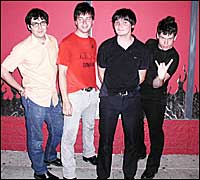
“We’re not just a band,” Conrad Keely stated rather matter-of-factly. Conrad is one-fourth of the now Austin-based and long-monikered …And You Will Us By The Trail Of Dead. He wasn’t trying to sound pretentious. I was probing him about the band’s dabbling in other forms of expression, specifically his own forays into the visual arts.
“I was originally in the visual arts. I was going to be a comic artist when I grew up. When I was a wee boy of 12, I was really into the X-Men.” Has this interest carried over into his involvement with music? Indeed it has. “One of the great things about music these days is that there’s so much emphasis placed on multimedia. And even if you’re just a visual artist, I think that there’s a lot to be gained from doing a lot of multimedia. And music seems to be like the pinnacle of multimedia where you’ve got a lot of pop stars doing these great installations on stage and they’ve also got websites and stuff like that. Entertainment on that level really runs the whole spectrum of communication: television, video, visual arts, costume design… We generally feel like everything – even the album cover art – is as much a part of the band as any of the songwriting.”
I made the mistake here of mentioning that Jackson Pollock once said that he was trying to paint what music sounded like. Or something to that effect.
“Well, I hate Pollock,” Conrad quickly retorted, “… but that almost gives me an appreciation for his stuff!”
“What was he listening to?” added Jason Reece, friend and band member.
Sonically, The Trail of Dead (as their cumbersome name is often shortened to for convenience) explore the darkest regions of emotion. As evidenced on their two full-length releases, Madonna (Merge, 1999) and their self-titled debut (Trance Syndicate, 1998), theirs is a heavy stack of despair, rage, regret and melancholy crumbling and falling like so many monoliths neglected and decaying. Taj told me that while he lived in Austin, he saw these guys play live five or so times and that they were completely different everytime: at once noisy and chaotic, another very orchestrated, another quite electronic-based and yet another straight-out punk rock. The shit is catchy though. Contagious even. It gets under your skin, burrows and festers until you can’t leave it alone. And they’re not really so sad.
In fact, they’re a bunch of jokers. Attempt any inquiries into the history of this foursome, and you will then know them by the trail of bullshit.
“We started in Plano, Texas,” began a smirking, unable-to-maintain-eye-conact Jason Reece. “A town about 75 miles away from Austin. It’s a small town with like one church and one general store, two bars and one decreped old movie theater… Basically we met in this church youth group and we had a youth minister who helped guide us. With his help, we managed to play music for the church for a while. It was like Christian rock with uplifting chord changes and modulations, but for some reason we started getting a hold of dangerous books and music and that seeped into our music and it created a darker sound. We started changing too. We started getting more and more corrupt. I guess to them we were going to the Dark Side. So we were cast out of our church and exiled to Austin and that’s where the Trail of Dead really got its start…”
“What was the question?” Conrad joined in, returning from getting himself a drink.
“I was asking about the history of the Trail of Dead and Jason here was giving me a line of crap,” I said to clarify the situation.
“Oh,” Conrad said laughing, “That’s what he’s good for.”
“We don’t like to talk about our history that much because our history seems to change day by day… We change history everyday,” Jason said and they both smiled.
“Somebody asked me the other day where we got our name from, and I made up something about it being the last warning Boadicea gave the Roman generals,” Conrad added laughing (Boadicea was an ancient British queen where, upon annexation of her kingdom by Rome, she led a ferocious revolt before finally being crushed by the Roman army).
The truth, as far as I’ve been able to discern, holds that Conrad and Jason met in Hawaii, moved to Olympia (where Reece was an explosive member of the notorious Mukilteo Fairies) and finally to Austin where the Trail of Dead proper was formed. When and where Neil Busch and Kevin Allen came into play is still a mystery. Like so many other things about the Trail of Dead. Reader beware though. Truth is relative with these guys.
As a final case-in-point, Jason closed our talk with, “This is my last interview because I’m dying soon.”
…And You Will Know Us By The Trail Of Dead is indeed not just a band. It’s a multi-layered, nonlinear, sonic enigma. It is everywhere. And it exists because.
[Copper Press, 2000]
[photo by Jessica Raetzke]
Survival Research Laboratories: Post-Apocalypse Now
Remember the evil toys from the movie Toy Story, the ones with all the mis-matched parts from other toys, all rearranged into new strategies of purpose? Imagine those same toys built to life-like scale: in car-lengths instead of Lego-lengths, built with military surplus parts and armed with military surplus weapons. Now picture no-holds-barred warfare between these bastardized giants of the scrap heap. A skirmish between screaming, fire-breathing, chewing, burning monsters bent on hate for one another and devoid of concern for their human overseers. Continue reading “Survival Research Laboratories: Post-Apocalypse Now”
Graffiti: Discontents Under Pressure
 One of the major things that differentiates the human species from all other species on Earth is our ability to externalize subjective memory. To write things down. To store and exchange ideas outside of our brains. This all started with cave paintings and etchings. Graffiti, if you will, was the beginning of written history.
Graffiti proper, in the modern sense of the term, started in the late 1960s in New York City when a kid from the Washington Heights section of Manhattan known as Taki 183 (“Taki” being his tag name and “183” being the street he lived on) emblazoned his tag all over NYC. He worked as a messenger and traveled all five boroughs via the subways. As such, he was the first “All-City” tagger. Impressed by his ubiquity and subsequent notoriety, many kids followed suit and graffiti eventually became a widespread renegade art form. Graff writers embellished their names with colors, arrows, 3-D effects and mad lettering styles.
By the mid-to-late 1970s, New York — especially its subway system — was literally covered with brightly colored murals with not only tag names, but holiday messages, anti-establishment slogans and full-on art works known as “pieces” (short for “masterpieces”). The world of graff preceded the rest of Hip-Hop culture, but became an integral part during hip hop’s early-1980s boom, joining Breakdancing, emceeing and DJing as Hip-Hop’s four elements.
 Replacing the drab city walls and boring metal subway trains with greetings and flashy colors, most graffiti artists honestly saw themselves as doing a service to the city. City officials and stuffy citizens hardly agreed. Massive anti-graffiti campaigns grew right along with the artform itself and are still in effect today in most major metropolitan areas. These specialized anti-graffiti forces only added to the artform’s already outlawed status. The ability to pull off a hype piece under such increasing pressure only made great writers more revered for their skills.
Graffiti still thrives in the jungles of our inner cities. It has survived as what Jello Biafra recently mentioned as “the last bastion of free speech”, and Abbie Hoffman called wall painting “one of the best forms of free communication.” Anyone can grab a can of spray paint or a fat marker and make their thoughts known to the passing population. You can buff graffiti, you can paint over it and you can arrest its practitioners, but as long as someone feels that their voice isn’t being heard, you can’t make it go away.
[Disinformation, October 18, 1999]
[photo by Drew Donnolly]
[art by SIRONE]
Just Add Water
Water is being added to juice concentrate. The frozen mass relinquishes its tart taste, compromising its original form to create something consumable. This same phenomenon occurs everyday in various forms in the lives of people you know. A college student makes good grades and wins a scholarship to a graduate school. He sacrifices his own free time to study to make these grades. A high school football player wins games for a team and lands a spot on a college team. He also sacrifices his time, perhaps even time for a job so he can practice his football skills. Your favorite band signs a million-dollar contract to a major label and loses some of their edge to gain mass appeal.
Water is added to the lives of these people in order that they give up a bit of themselves for the consumption of others. The college student’s good standing makes the grad school look good, the football player’s field skills make his college look good, and the band’s softening makes the major label look good through mass record sales.
How does all this relate to the topic at hand? Well, what does everyone want out of this life eventually? To make a living doing what we love to do. Athletes want to get sponsored by a major company, to go to events, shows, to get free gear at the very least. Artists want to get paid to make their art so that they don’t have to wait tables to pay bills. Here’s where the water comes in: Corporate sponsors have images to uphold. Your attitude and your free time will both either somewhat dissolve, or you can keep toiling away in Podunk, Nowhere. The point is, conformity has its place, but so does having a core that’s true. People all too often co-op their baser beliefs in exchange for what they think they should do at the time. What do you really want from this life? What do you really want from your hobbies? When the water is added, how much will you give up? How much will you keep for yourself? In the end, It’s all up to you.
[SLAP Magazine, 1998]