
 Lori Damiano has been skateboarding and making stuff for so long that I can’t even remember when or where I was first introduced to her work. Somewhere among her involvement in the zine Villa Villa Cola, her animation (she did the menus for the Spike Jones DVD, for one example), and skateboarding like a madwoman, she recently earned a master’s degree in experimental animation from The California Institute of the Arts and helped VVC get the Getting Nowhere Faster DVD out. Continue reading “Lori Damiano: Getting Nowhere Faster”
How To Draw a Bunny Directed by John Walter
Ray Johnson has been called the “the most famous unknown artist in the world.” He was an unsung Pop Art innovator, collaging, mailing, and performing his way through the mid-twentieth century New York art scene. As artist Billy Name says in one of the interviews in the film: “Rauschenberg was a person making art, so was Andy (Warhol). Ray wasn’t a person. Ray was art… That’s why he’s an artist’s artist.”
 How To Draw a Bunny documents Ray’s life as best as it could be done. Many were acquainted with him and his work – and many over long periods of time – but no one seemed to know who Ray was. His entire life was a performance. And so too, it appears, was his death (the mystery surrounding his apparent suicide opens the film). He never went to openings, never had his own art show, despised galleries, was meticulous about his prices, and truly worked outside the art system his entire career.
Ray Johnson started or helped start many of the techniques and trends for which other artists are known: the use of copy machines and collaging; using images from advertising, brand logos, and pop culture icons; and mail art, or as he called it, “correspondence art.”
How To Draw a Bunny is a fun collage in itself: a collection of interviews of artists who knew Ray, including Chuck Close, Christo and Jean-Claude, James Rosenquist, the aforementioned Billy Name, and Ray Johnson himself; many great photographs; and, presented mostly in black and white, the film maintains the opening mood of mystery throughout. It’s a fun and intriguing look at an artist about whom one may not have heard, but will certainly be better off with his acquaintance.
Chris Ware by Daniel Raeburn
In the much-maligned medium of comic books, Chris Ware is one of the artists that justifies — even as he transcends — the medium. His work encompasses aspects of typography, graphic design, fine art, Joseph Cornell-style cabinet-making, story telling, and, of course, comics.
 Daniel Raeburn’s book is the first to explore the expanse of Ware’s work. The book itself consists of a brief biography including in-depth interview sessions with Ware, and an extensive selection from all aspects and eras of Ware’s work. Included are pieces and layouts from Ware’s Acme Novelty Library series, Jimmy Corrigan: The Smartest Kid on Earth, and Quimby the Mouse, as well as drawings, sketches, paintings, toys, display cases, etc. In addition, Raeburn has assembled many of the work of artists who influenced Ware, and many catalog pages from which Ware lifted some of his layout ideas.
Chris Ware represents a brief but thorough overview of one of the most important visual artists working today.

Yoni Wolf and Richard Adams: The Sound of a Handshake
Under the radar of mainstream culture, unsuspecting genres have been quietly blending in the bedrooms of overactive imaginations. One such amalgam came in collaborative form when UK-based indie-rock band Hood brought Why? (Yoni Wolf) and doseone (Adam Drucker) from California-based avant hip-hop group cLOUDDEAD (which also includes David “odd nosdam” Madson) into the studio on their 2001 album Cold House (Aesthetics). Having been fans of each other’s work, the two groups were destined to work together — and tour together.

Where Hood’s sound jumps between “lo-fidelity avant-pop” and “pastoral, nearly instrumental songs,” cLOUDDEAD meanders through similar territory, but adds a skewed hip-hop vision to the mix. Though stunningly unique on their own, the two mesh well together, play well together, and their sounds blend into something like nothing else you’ve ever heard.
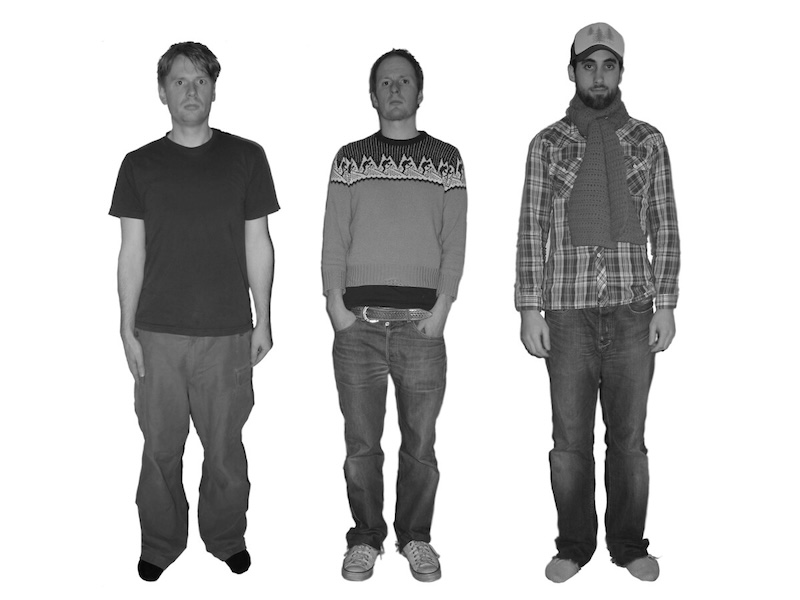
What follows is an email conversation between Yoni Wolf and Richard Adams from Hood. From the goings-on of their respective bands and their recent daily lives, to what kind of shoes they’re wearing and the origin of the name “Hood,” this conversation is much more interesting than my asking each of them questions would have been.
Richard Adams: Did you know you were mentioned by name in the lyrics to the new Hood single?
Yoni Wolf: In reference to your inquiry, I indeed did not know that I was mentioned by name in the new Hood single. Is this single out? What is it regarding? Is it a song like Billy Joel’s “We Didn’t Start the Fire,” where you mention everyone you know in an all-enveloping look at the current state of music from an historical standpoint? Or is it like a shoutout list at the end: “Micky Mantle rock rock on, Yoni Wolf rock rock on . . . “? Whazzup?
RA: It’s not quite up there with the Billy Joel classic. In fact, I think you’re the only “celebrity” to get a name-check. It’s quite subtle, but I think you’re mentioned twice. It’s not quite that song by the Beloved, “Hello.” (Did you get that in the States?) That name-checks a few people as well. I’ll ensure you get a copy when we get some. One for the grandkids maybe.
YW: The Beloved? I don’t think we got that in the States, but you have to remember I’m about twenty-five years younger than you. So I guess it’s possible it came out back in the ’60s or something when you were in high school and I was a first tenner in a pimp’s pocket. (Whatever that means.)
What are you guys working on at the moment? A new record?
RA: A new record is done — EP out in November, full-length in January.
YW: Whaddub wid sum promo? Still with Domino? New shoes: You? Chris? Who is in the band now?
RA: Yes, and with Domino USA in the States. Yes, I’m still in the band . . . just. And Chris is pretty much Mr. Everything. Steve’s still behind the drum stool (or sat upon it). Gaz left last year but might return temporarily in the new year, and we have a new chap called Mark who is brimming with enthusiasm.
YW: I’m glad to hear about the new guy and Steve’s continued dedication and the possible return of Gaz (the only true vegan lover of the Hood lot), but my inquiry regarding footwear was completely ignored. What do you mutherfuckers got on your feets? Currently, as of yesterday, I’m sporting these old Converse that I dug out of my closet that I got in a thrift store in London back when we were there for the Mush (cLOUDDEAD/Reaching Quiet) tour in 2002. They are white with blue trimmings, and I added a red stripe on the toe with nail polish. Pretty sharp. Oh, I’m going to a Subtle (Adam and Jeff, et al.) show tonight. It should be really cool. It’s their first show (pretty much) since they finished their first full-length. Cool.
RA: Footwear. Sorry, Yoni. I missed that. I’m gonna get Chris in on this chat. They don’t call him the “Imelda Marcos of Pop” for nothing, you know. The shoes on my feet are probably the same ones I was wearing on our U.S. tour. I need them replaced. At my age I seem to find myself wearing slippers more than anything. Hope your Converses went down well at the Subtle show. We were hoping to play with Subtle in London town this October, but it clashed with the one and only show we’d had planned all year.
YW: Where does the name Hood come from? I always took it to be referring to the part of the female anatomy that covers the clitoris. I always thought that particular part of a woman’s private sector was pretty unnecessary. It makes it nearly impossible to discover the pleasure-inducing zone. Maybe that’s the fun of it: the challenge.
I know you’re a conservative, thrice-married, middle-aged barrister-turned-pop musician, so if this open talk of sexuality offends you, feel free to find your pinky finger on the delete key.
RA: I’m completely ignoring your sexually explicit theory on where the name of Hood comes from. Safe to say that we were probably thirteen or fourteen years of age when we thought of it, so such thoughts were exempt from our innocent minds.
Laurence from Domino wants us to do some shows together next year. I wonder who he’s been talking to. What’s in the pieline or even pipeline for you?
YW: Oh yeah!? Are you guys coming to the States? We are looking to set up a tour of America in May and then we will hopefully be doing festivals and knocking about the more civilized part of the world all summer. Let’s definitely hook up.
RA: That could work; we’re coming over next Spring. Should well be on the road for a chunk. Let’s hope I don’t go completely insane this time.
How is everything with you? The Hymie’s Basement thing (Lex, 2003) was great. The first track on there was maybe my favorite (or second favorite) song of last year. In fact, I kind of went on a pilgrimage to Hymie’s Basement last Christmas. I had a good scrat through their records. Funnily enough, the only thing I bought was a Donald Fagen album.
YW: I’ve been recording a new Why? record with the boys in the band (Josiah, Doug, and Matt — I don’t think you met Matt, who we now call “Miss Ohio’s”). So I guess it’s Why? & Miss Ohio’s. Anyway, we’ve been hard at work on that. It’s quite pop. I’ve been watching these DVDs that Rhino puts out called “Classic Albums” or something like that, where they do interviews with the band now about their best album and talk about how it was made and the circumstances surrounding it. So far, I’ve seen Fleetwood Mac Rumours and Pink Floyd Dark Side of the Moon. I’m a sucker for that kind of shit. My dream would be to see a movie of just live studio footage of some of my favorite records being made with no commentary or anything, just a good behind-the-scenes look — all the arguments and the epiphanies.
RA: Yeah, you should see the DVD for our last album: fights, walk outs, nervous breakdowns, singers being forced to sing at near gunpoint, songs being recorded three or four times, mixes rejected, a full set of masters rejected, tears, laughter, screaming fits, complete and utter despair, the whole thing nearly being scrapped before the mixing stage. Oh yeah, it’s up there. Hope your thing went more smoothly. Glad it’s pop stuff. I like the pop stuff. Our next thing is pop — it’s nearly into Britney territory.
YW: Oh, and my girlfriend of two years (I don’t think any of you guys met Anna) and I split up last week. That leaves me feeling quite strange and aimless, but maybe it’s for the best. We will still be close I’m sure.
RA: Oh, no. That is a shame. It’s never easy. Keep your pecker up. Hope you feel better soon.
Summer Reading List, 2004
 In the midst of putting together a Summer Reading List for 2004, I took a lengthy Summer trip, delaying the release of this list until long after summer was officially over. Here, now, is the list of recommended I accumulated and sat on for far too long. Additions and corrections were made in the meantime. Many apologies for the delay, and many thanks to all those who participated.
note: All of the book title links on this page (and there are a lot of them) will take you to the selected title in Powell’s Bookstore (except where noted otherwise).
Gary Baddeley, Publisher, The Disinformation Company
 This is an easy one, Roy, I’m reading proofs of our new books: The Yes Men, which is about those ®TMark guys (remember) who created a fake gatt.org website and ended up being invited all over the world to speak as representatives of the WTO. United Artists released the movie late in the Summer, and we have created the book, which is very funny, but with a serious anti-globalization message.
As for right now, I’m re-reading our book Da Vinci Code Decoded by Martin Lunn because it’s doing so well that we’ve decided to produce a DVD based on it. It’s really deep into stuff like the bloodline of Christ.
I could go on about our own books, but for light beach reading it’s The Rule of Four by Ian Cladwell and Dustin Thomason because I’m interested in the Renaissance text the Hypnerotomachia Poliphili that provides the central theme.
Cynthia Connolly, Photographer and Artist.
Hey, I only have a couple things:
Hank Williams: The Biography by Colin Escott (Little, Brown)
Where I was From by Joan Didion (Knopf)

Billy Wimsatt, Editor, How to Get Stupid White Men Out of Office, Author, No More Prions and Bomb the Suburbs
You mean other than How to Get Stupid White Men Out of Office?
Mark Dery, Author, Pyrotechnic Insanitarium, Escape Velocity, Flame Wars
This summer, I did the sociocultural spadework for a book-in-progress — an anti-memoir about my San Diego adolescence, equal parts social history of ’70s SoCal and drive-by cultural critique of border consciousness. I began my excavations of Southern California history, cultural and otherwise, with Southern California: An Island on the Land, by the dean of left-wing California historians, Carey McWilliams (the progenitor of Mike Davis’s archaeological analysis of power, race and real estate in L.A.). Garrulous, generous of spirit, and dryly funny, yet possessed of a backroom dealmaker’s knowledge of how power really works in the Land of the Golden Dream, Williams is the perfect Audio-Animatronic tour guide to Southern California’s Amok Disneyland. His account of the Free Speech Rights in San Diego, in the ’30s, is unforgettable: Emma Goldman came to rouse the rabble and was ushered, by the local constabulary, onto a train to L.A., with a one-way ticket and the friendly admonition never to return. The socialist wobblies (IWW members) who came from all over the U.S. to join the protests suffered a less genteel fate: Cops and hired goons dragged them out to canyon country, forced them to kiss the flag, then beat them, some to death, with truncheons. This is rough justice, in the town where the social order and property values trump civil liberties every time. Mike Davis and his collaborators Jim Miller and Kelly Mayhew take up Williams’s song in Under the Perfect Sun: The San Diego Tourists Never See, a fastidiously researched collection of essays on San Diego’s powerbrokers and the dissident voices — underground journalists in the ’60s, migrant workers and illegal aliens more recently — raised against them.
Finally, before bed, on the beach, and at poolside, there’s The Raymond Chandler Papers: Selected Letters and Nonfiction 1909-1959 (ed. Hiney, MacShane), much of which is gleaned from Chandler’s La Jolla years, when he would dictate his correspondence late into the night. Written with a pitch-perfect ear for the American vernacular and the grammatical fastidiousness of a man born, bred, and classically educated in England, Selected Letters is an omnium gatherum of blunt, bleakly funny bon mots. On California: “There is a touch of the desert about everything in California, and about the minds of the people who live here.” “We are so rootless here. I’ve lived half my life in California and made what use of it I could, but I could leave it forever without a pang.” On his fan mail: “…[A]nother letter I had once from a girl in Seattle who said that she was interested in music and sex, and gave me the impression that, if I was pressed for time, I need not even bother to bring my own pyjamas.” On himself: “All my best friends I have never seen. To know me in the flesh is to pass on to better things.” Written in the dead of night with a Dictaphone and a bottle of gin, Chandler’s letters are an inexhaustible fund of insights into the noir aesthetic, the sublime agonies of the writer’s life, the American Language (as Mencken called it), and, forever and always, the sunbelt existentialism that shadows the California Dream.
Tom Georgoulias, Contributing Editor, frontwheeldrive.com
Candy by Mian Mian (Back Bay)
Candy is a semi-autobiographical novel about a Chinese girl who ran away to Shenzhen, a city free of state economic control, to escape from the confines of the government job system. She bounces around the underground club/music culture, which is filled with a lot of other wandering Chinese 20/30 somethings who are into music, fashion, and finding their way out of the world their parents created.
Small Town Punk by John L. Sheppard (Writers Club Press)
Lost punk teenagers stuck in a nothing small town, drinking between shifts at dead end fast food jobs, and struggling through their teen years. If you grew up like this, you’ll recognize the authenticity almost immediately. The characters and dialogue are just that good.
 All Hands On: THE2NDHAND reader Edited by Todd Dills (TNI/Elephant Rock)
Best of collection from the free literary broadsheet THE2NDHAND.
Vinyl Junkies by Brett Milano (St. Matrin’s)
Profiles of record collectors and their favorite haunts, hidden and famous. A fairly insightful and tender look at record colleting and obsessive hobbyists in general.
Working Stiffs Manifesto by Iain Levison (Random House)
The funniest book I’ve read in a long time. Read it all in one sitting. A documentary of Levison’s string of dead end jobs, one right after another, and all the hilarious and worthless crap he’s seen during and in between. Perfect.
Shepard Fairey, Artist, Obey Giant
I have not read a good book in a while. The last book I read was this big compilation of interviews from people who shaped the first 2 years of punk called Punk. My schedule has not been leaving time for more than magazine and newspaper articles.
Steven Shaviro, Author, Connected, Doom Patrols, The Cinematic Body, etc.
Process and Reality by Alfred North Whitehead (Free Press)
Whitehead, a hidden influence on such recent thinkers as Deleuze and Bruno Latour, is the most underrated philosopher of the first half of the twentieth century. Surprisingly timely.
 Fabric of the Cosmos by Brian Greene (Knopf)
The latest popularization of contemporary physics, going beyond the bounds of science into full-fledged metaphysical speculation.
The Filth by Grant Morrison and Chris Weston (DC Comics)
This mind-bending comic is now available as a single-volume trade paperback novel. Everything you wanted to know (and a lot you didn’t) about the ultimate nature of reality; together with a hero who is forced to battle everything from viral nanobots that take over human bodies, to pornographers who generate bioengineered predatory megasperm, to memetic cloning programs that turn human crowds into orgiastic Stepford Wives who provide the building blocks for an “emergent superorganism” — when all he really wants to do is stay home and care for his cat.
The Iron Council by China Mieville (Del Rey)
The third volume of Mieville’s Bas-Lag trilogy (after Perdido Street Station and The Scar). Mieville writes brilliant, dense meta-fantasy, utterly gripping yet at the same time deconstructing the tropes of the Tolkien tradition. Sort of Lovecraft-meets-Dickens-meets- Marxist theory. To be published in July.
Multitude: War and Democracy in the Age of Empire by Michael Hardt and Toni Negri (Penguin Press)
The much-awaited sequel to Empire.
Marc Pesce, Author, The Playful World
 The Emperor of Scent by Chandler Burr (Random House)
The amazing account of the probable discovery of the unlikely mechanism of smell, by renegade scientist Luca Turin. In a classic case of an outsider solving a previously intractable problem, Turin sweeps away a hundred years of accepted-if-hodgepodge theories about the “shape” theory of scent, and discovers something far more interesting: there’s a spectrograph in your nose — or rather, thousands of them. An incredible must-read for anyone who has ever gotten a whiff of the stench of scientific politics, or the scent of victory.
Phil Agre, Associate Professor of Information Studies, UCLA
Here are four very different history books that I recommend.
Birth of the Leviathan: Building States and Regimes in Medieval and Early Modern Europe by Thomas Ertman (Cambridge University Press, 1997)
This is an excellent example of a particular kind of history that compares and contrasts different nations in a systematic way based on a simple theoretical model. The topic is state-building: why did some European countries construct efficient, professionally rationalized bureaucracies where others spent centuries stuck in absolutism or corruption? Ertman argues that the difference has to do with two factors. One was the “starting conditions” left over from the dark ages. In some areas, such as England, the legacy of Roman administration left behind a tradition of strong local governments whose workings were homogeneous. This made it easy to start a parliament and hard not to, and parliaments are a counterbalance to bureaucracies. In other areas, such as Germany, local government was heterogeneous. The other factor was timing. State-building was driven largely by military competition, and countries for which such competition arrived early were less bureaucratic. It’s a theory, and Ertman uses it to analyze aspects of the various countries’ histories that might otherwise have gone unanalyzed. Does the theory explain Afghanistan? Even if it doesn’t, at least it makes clear just how contingent European institutions really are.
The Culture of Civil War in Kyoto by Mary Elizabeth Berry (University of California Press, 1994)
The major difficulty with the humanities is interpretations of things that go beyond the evidence. Despite all the yammer about postmodernism, this really begins with I. A. Richards, whose arbitrary interpretations of literature have been oppressing students for generations. Mary Elizabeth Berry’s book about everyday life in Japan during the century-long civil war that began around 1450 is an impressive lesson in how to interpret history when the evidence is slight. Because Japan lacks a tradition of bureaucrat-monks, and because its cities keep getting burned to the ground in wars, Japanese history is not as well documented as European history. Berry reads the available documents patiently and with admirable sympathy for the people who wrote them — people who in many ways didn’t understand their society any better than we do. It was as if the whole society had melted, so that every detail of their lives could change tomorrow and often did.
 The Age of Heretics: Heroes, Outlaws, and the Forerunners of Corporate Change by Art Kleiner (Currency Doubleday, 1996)
This is a journalistic history of an important chapter of the 20th century that could easily have gone unwritten: a generation of attempts, more or less countercultural, to reform and reinvent the corporation. It’s all here: unpredictable experiments in social engineering, weird tales of engineers dropping acid, computer programs predicting the future of the whole world, and the truly odd omnipresence of an Armenian mystic named G. I. Gurdjieff. We’re nowhere near putting these innovations in context. Some of them led to genuine reforms and others did not. Some of them transcended the limitations of 20th century rationalism while others were just irrational. In any event, Kleiner promises a sequel in which he brings the story up to the present day, and I bet it’s going to be great.
Cosmopoiesis: The Renaissance Experiment by Giuseppe Mazzotta (University of Toronto Press, 2001)
Giuseppe Mazzotta is Italian through and through. He is also very smart. The result is a sort of alternative intellectual reality that takes some getting used to. For a short book it is hard to summarize, and not least because the traditions of allegorical writing that Mazzotta reads in such detail are lost to us. So, for example, one poet writes a vast epic to argue with Machiavelli’s psychology, and Lorenzo de Medici and his contemporaries argue about his despotism by, of all weird things, writing Neoplatonic poetry whose numerous layers of meanings Mazzotta revivifies in phrase after unexpected phrase. Maybe it’s just the foreignness of it, but I’m not sure I’ve read a book that was so densely intelligent.
roy christopher, Editor, frontwheeldrive.com
The History of Forgetting by Norman Klein (Verso)
After seeing Norman Klein speak at UC Irvine last March, my girlfriend and I began a frantic search for all of his books. This one is about L.A. and proves a nice companion to Mike Davis’s City of Quartz. Part memoir, part critique, and part fiction, The History of Forgetting is an amazing glimpse at the city — and its past eras — looming at the edge of civilization.
Wounds of Passion by bell hooks (Owl Books)
Subtitled “A Writing Life,” Wounds of Passion chronicles bell hooks’ path to the role of Black public intellectual. It’s a deeply personal account of her struggles at home in Kentucky, leaving there for school at Stanford, her most important relationship during college and after, and all of the other trials that lead to her writing her first book (Ain’t I A Woman: Black Women and Feminism), and indeed her writing life. hooks has always reveled in poetry, lived through words, and escaped in books. Wounds of Passion is a painful, yet liberating glance into one writer’s journey with the word.
 Wondrous Strange: The Life and Art of Glenn Gould by Kevin Bazzana (Oxford University Press)
I wish I’d gotten this book a long time ago. I have several books about Glenn Gould and this one is by far the most complete look at his life, his music, his eccentricities, hislove of solitude and of Canada, and his passion for composing. Admittedly, my knowledge of classical music is limited, but Kevin Bazzana writes in such a way that one needn’t know the minutia of counterpoint, colour, and timbre. If you’re curious about Glenn Gould, this is the place to start.
Metaphors We Live By by George Lakoff and Mark Johnson (University of Chicago Press)
This brilliant little book explores and explains metaphor not as a form of language, but as the central structure of language. Written in clear, easy-to-understand language and rife with excellent examples and extensively explained linguistic concepts, Metaphors We Live By is a book everyone should — and can — read.
A Thousand Years of Nonlinear History by Manuel De Landa (Zone Books)
Meaning to have read this long ago, I grabbed it off the shelf just before leaving on my summer trip, and I’m glad I finally sat down with it. Using applied chaos theory, De Landa rewrites history as a dynamical system. It’s an amazing perspective on what is normally left to the dreaded “grand narrative.”
Sex, Drugs, and Cocoa Puffs by Chuck Klosterman (Scribner)
Leave it to Chuck Klosterman to write the best pop culture book of the year. His previous work, Fargo Rock City, was an excellent piece of commentary on 80s Hair Metal, but Sex, Drugs, and Cocoa Puffs proves that its subject matter obviously limited his abilities. This book finds him pontificating on everything from Saved By The Bell and Vanilla Sky to the 80s Celtics-Lakers rivalry as a political metaphor and why Soccer sucks. No one is safe from Klosterman’s keen sense of humor and uncanny knack for what’s going on behind the most seemingly mundane pop culture trends.
[Above, Sidney browses the books at Jackson Street Bookstore in Athens, Georgia. Photo by Roy Christopher]
R.I.P. Rest in Pieces: A Portrait of Joe Coleman Directed by Robert-Adrian Pejo
For the uninitiated, Joe Coleman paints meticulously constructed circus-dream visions that often depict serial killers and does performance pieces in which he bites the heads off rats and sets off explosions on his own body. One Chicago performance found him arrested and charged with “possession of an Infernal Machine” (a machine or apparatus maliciously designed to explode and destroy life or property) — a charge not levied against anyone since the 19th Century. Continue reading “R.I.P. Rest in Pieces: A Portrait of Joe Coleman Directed by Robert-Adrian Pejo”
The Architect’s Brother by Robert ParkeHarrison
The pieces in Robert ParkeHarrison‘s The Architect’s Brother depict a character named “Everyman” coping with a number of distraught scenarios in which the pace of technology has out-stepped the resources of the earth. As tired as this theme may sound, ParkeHarrison brings a new perspective to each of many glimpses of these possible futures. These images are riddled with melancholy, but the weight is ultimately lifted by an unflagging belief in human agency. Continue reading “The Architect’s Brother by Robert ParkeHarrison”
Centripedal Sound installation by Matt Heckert
All of my work ends up sounding like a train somehow. — Matt Heckert
I first became acquainted with Matt Heckert‘s work through issue #8 of Andy Jenkins’ Bend zine. There was a picture of Survival Research Laboratories‘ “Walk-Peck” machine and it was credited to one Matt Heckert. This was the Summer of 1986. Matt has long since departed from SRL with his work and his work’s aims. Continue reading “Centripedal Sound installation by Matt Heckert”
Manufacturing Dissent
I’m not much of a painter, but I found this canvas by a dumpster on my way home from campus one day here in San Diego. I had a tube of black and a tube of white acrylic paint left from my last stint attempting to paint, so I decided to try a new one. This piece was inspired by Kate Hayles’ book Writing Machines, code poetry, and (obviously) Noam Chomsky. Continue reading “Manufacturing Dissent”
1 Giant Leap Directed by Jamie Catto and Duncan Bridgeman
In order to thrive, ecologies need diversity. Functionalism has proven itself in the wild. What seems bad to us, if removed causes disturbance in the equilibrium of nature. As immune as we might feel, our cultural ecology is not excluded from the rule of diversity. Continue reading “1 Giant Leap Directed by Jamie Catto and Duncan Bridgeman”