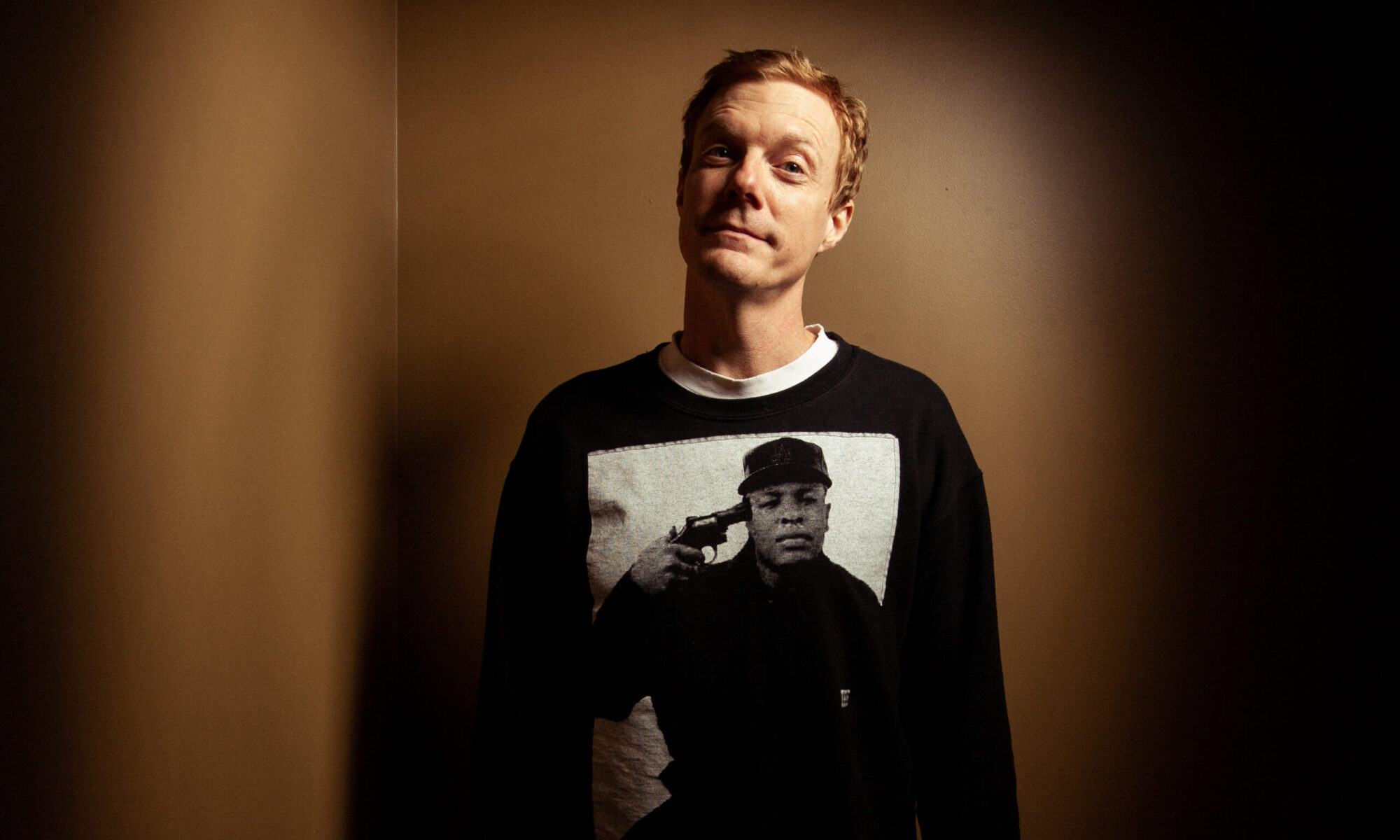

Though I’m admittedly not much of a painter, I have five pieces in the “Safety in Numbers” art show starting September 13th at The Ritz and Café Mundi in Austin, TX. Continue reading “Safety in Numbers Art Show”
Brenda Laurel: Utopian Entrepreneur
 With over twenty-five years exploring human-computer interaction, Brenda Laurel is an unsung veteran of the field. Her doctoral dissertation was the first to propose a comprehensive architecture for computer-based interactive fantasy and fiction. Laurel was one of the founding members of the research staff at Interval Research Corporation in Palo Alto, California, where she coordinated research activities exploring gender and technology, and where she co-produced and directed the Placeholder Virtual Reality project. She was also one of the founders and VP of design of a spin-off company from Interval — Purple Moon — formed to market products based on this research. Her latest book, Utopian Entrepreneur (MIT Press, 2001), explores the struggles she dealt with at Purple Moon — attempting to perform socially conscious work in the context of business. Continue reading “Brenda Laurel: Utopian Entrepreneur”
Cynthia Connolly: The Punk Stays in the Picture
 Cynthia Connolly has been a fixture in the DC punk rock scene since its voice started echoing out of the Capital. The independent stalwarts of Dischord in DC, K Records, and Killrockstars in Olympia, WA are among her friends and her photo subjects: She takes pictures and makes postcards — one series of which was of many of these musicians and their cars. Continue reading “Cynthia Connolly: The Punk Stays in the Picture”
Peter Lunenfeld: Critic as Curator
 Peter Lunenfeld is the director of the Institute for Technology and Aesthetics (ITA) and teaches in the graduate Media Design program at Art Center College of Design. He is considered one of the preeminent critics and theorists of the intersections of art, design, and technology. Afterimage referred to his edited collection, The Digital Dialectic: New Essays on New Media (MIT Press, 1999) as “the first printed book you read about the virtual world that does not merely describe it, but puts you there.” Continue reading “Peter Lunenfeld: Critic as Curator”
Shepard Fairey: Giant Steps
 You’ve seen them: “Andre the Giant has a Posse” stickers, “Obey Giant” posters, Andre’s face covering entire sides of buildings. You’ve seen them and you’ve wondered what it was all about. And once you found out, perhaps you wondered why.
Nearly the entire world has unknowingly fallen prey to Shepard Fairey’s phenomenological street-media experiment. Long-time friend Paul D. Miller recently described Shepard’s postering activities as “obsessive.” Continue reading “Shepard Fairey: Giant Steps”
Mike Patton: Life is Good
Though his time with Faith No More is undoubtedly one of the least interesting things about him, the story goes that when Mike Patton joined that band, they had their entire next record written — except for the lyrics. Patton wrote the lyrics to fit the music for their soon-to-be-multiplatinum third record, The Real Thing: no small feat. This record and the subsequent hit single/video “Epic” brought the rap/rock genre-hybrid blaring into the mainstream. Love it or hate it, popular music is still haunted by it.

The band’s masterwork, the follow-up, Angel Dust proved that the previous record’s ad hoc situation obviously held Patton back. As critically-acclaimed, expansive and beautiful as the record was, it marked the beginning of the lengthy end for Faith No More.
No matter, Mike Patton was deconstructing every other other genre in his original band Mr. Bungle. He was also kicking around solo experiments with John Zorn and by the time Faith No More finally disbanded, he had several other music projects headed in several other directions and eventually started his own record label, Ipecac Recordings (which has since released records by such artists as Kid606, dälek, Melvins, James Plotkin, Isis, and Skeleton Key, as well as Patton’s own projects Tomahawk, Fantômas, Peeping Tom, etc.).
Patton maintains an almost cartoonish public facade. If you’ve ever witnessed Mr. Bungle or Fantômas live, you know exactly what I mean. “He’s crazy,” is often said in reference to him. Under the mask though, is a true artist in ever respect of the word.
“Mike Patton is one of those guys who does whatever he wants,” Rob Swift of the X-ecutioners told me recently (Rob and the X-men are working on a record with Patton for Ipecac). “As crazy as it may sound, as goofy as it may sound, he tries it. Working with him has helped me be a little less inhibited about trying things that may not be what people are expecting.”
By now, fans of Mike Patton’s work have come to expect anything and everything. The following brief interview keeps coming back to the same point: Mike Patton does what he wants, unfettered by anyone’s expectations.
Roy Christopher: You’ve seen just about every side of the music industry — from heavy rotation on MTV and SPIN cover stories to decidedly obscure sonic experimentation. Do you see the current musical milieu as one where artists — if they so choose — can truly express themselves and gain exposure at a level where potential listeners will find their output?
Mike Patton: I think you are looking at it in a different way than I do. As an artist, I think it is important to focus on the art. There are too many that don’t and that is what creates boring art. I really just try to recreate the ideas that come to me. I’m not setting a sales goal or targeting a demographic. I just do what I do and what I can do. I am having a great time doing it. It can be done.
RC: With your many musical projects — especially the solo vocal releases and the work with John Zorn — what is it that your looking for or trying to express?
MP: Once again, I did not have a goal in mind. John offered me an outlet to experiment and I did. It was a great creative outlet.
RC: What are your goals with your label, Ipecac Recordings?
MP: To put out interesting releases, that we enjoy. To treat artists with the utmost respect. To be unique. And of course to have a proper home for my music.
RC: Do you consider the cultural ramifications of your output when making music?
MP: Christ no! My music has no cultural ramification. It is entertainment for others, work for me. I’m not recreating the wheel or curing a disease.
RC: Are you just having fun with whatever comes to mind?
MP: Life is good.
RC: Is Mike Patton a scholarly fellow? Do you read a lot, and if so, what do like to you read?
MP: I’m not scholarly, but I do like to read. I read a bit of everything. I enjoy both fiction and nonfiction.
RC: Given your obvious penchant for various musical styles, who are some of your all-time favorite artists?
MP: This is always a tough question. How ’bout Sinatra?
RC: Mr. Bungle and Fantômas put on the most intricate live shows I’ve ever seen. How extensive are your rehearsal sessions for tours and recording?
MP: Rehearsals can be pretty long and hard. That is why I always try to work with hard working musicians who are good players and can think on their feet.
RC: Is there anything else on which you’re working that you’d like to bring up here?
MP: I’m working on a lot. The first Peeping Tom record, new Fantômas & Tomahawk records, a record with the X-ecutioners and just finished an Ep with Dillinger Escape Plan. Of course for all the latest dial up www.ipecac.com.
Jared Souney: By Design
 From riding flatland, ramps and street on his BMX bike to designing magazine layouts and T-shirts as well as stealing many souls from behind a shutter, Jared Souney is many things to many poeple. Those in the BMX world know him as a rider from New England who made the move to the Left Coast to do design work and shoot photos for Ride BMX magazine and beyond. Continue reading “Jared Souney: By Design”
Stapled and Xeroxed Paper: The Power of Zines
You’re right, Roy, you’re hopeless. Hopelessly obsessed with a time in your sport that died a long time ago… — McGoo
Even after being dissed in Ride BMX (see the November/December 1995 issue) by McGoo, I still believe whole-heartedly in the power of zines. In his lengthy debunking of my DIY print media enthusiasm, McGoo enlisted the help of Andy Jenkins (an explanation of his importance in the zine world is too long to list here) saying, “If Andy’s own words don’t convince a thousand zine kids to throw away their Kinko’s cards and get on with their lives, BMX will remain locked in an era of Club Homeboy wristwraps, Army pants and Vision hipsacks forever.” Continue reading “Stapled and Xeroxed Paper: The Power of Zines”
Jay David Bolter: FutureText
 Brian Eno calls him, “The New Gutenberg.” His work tip-toes through the same conceptual gardens as Marshall McLuhan, Ted Nelson, Douglas Englebart, and yes, even Johannes Gutenberg himself. Hypertext (he is one of the principle developers of Storyspace — a standalone Hypertext authoring environment), media evolution and the computer’s role in the writing process as well as education are a few of his points of interest. Continue reading “Jay David Bolter: FutureText”
Survival Research Laboratories: Post-Apocalypse Now
Remember the evil toys from the movie Toy Story, the ones with all the mis-matched parts from other toys, all rearranged into new strategies of purpose? Imagine those same toys built to life-like scale: in car-lengths instead of Lego-lengths, built with military surplus parts and armed with military surplus weapons. Now picture no-holds-barred warfare between these bastardized giants of the scrap heap. A skirmish between screaming, fire-breathing, chewing, burning monsters bent on hate for one another and devoid of concern for their human overseers. Continue reading “Survival Research Laboratories: Post-Apocalypse Now”