We are all perpetually holding ourselves together. Our breath, our blood, our food, our spit, our shit, our thoughts, our attention—all tightly held, all the time. Then at death we let it all out, oozing at once into the earth and gasping at last into the ether.
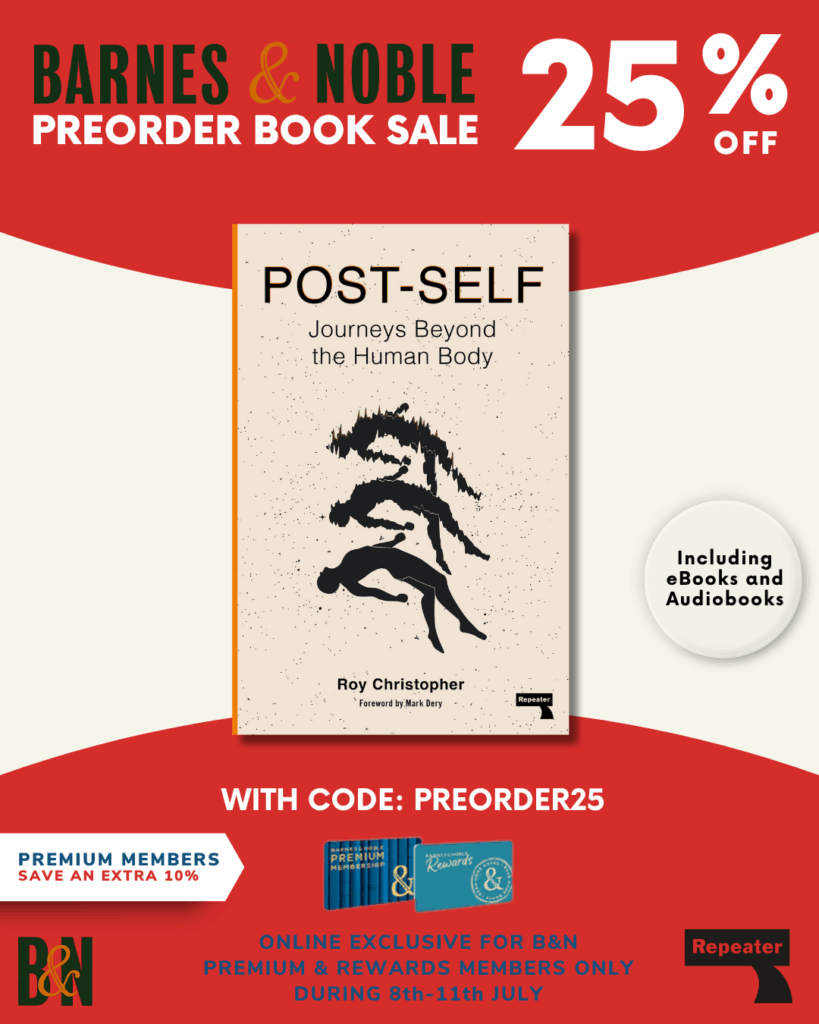
The physical body has often been seen as a prison, as something to be escaped by any means necessary: technology, mechanization, drugs, sensory deprivation, alien abduction, Rapture, or even death and extinction. Taking in horror movies from David Cronenberg and UFO encounters, metal bands such as Godflesh, ketamine experiments, AI, and cybernetics, Post-Self is an exploration of the ways that human beings have sought to make this escape, to transcend the limits of the human body, to find a way out.
As the physical world continues to crumble at an ever-accelerating rate, and we are faced with a particularly 21st-century kind of dread and dehumanization in the face of climate collapse and a global pandemic, Post-Self asks what this escape from our bodies might look like, and if it is even possible.
Advance Praise:
“Too often philosophy gets bogged down in the tedious ‘working-through’ of contingency and finitude. Post-Self takes a different approach, engaging with cultural forms of refusal, denial, and negation in all their glorious ambivalence.” — Eugene Thacker, author, In the Dust of This Planet
“Using Godflesh—the arch-wizards of industrial metal—as a framework for a deep philosophical inspection of the permeable human form reveals that all our critical theory should begin on the street where wasted teen musicians pummel their mind and instruments into culture-shifting fault lines. Godflesh are not just a ‘mirror’ of all the horrors and glories we can inflict on our bodies, but a blasted soundscape of our moans. Roy Christopher’s book is a thought-provoking and delightful crucible of film, music, and the best kind of speculative thought.” — Peter Bebergal, author, Season of the Witch
“In his trademark breezy yet precise style, Christopher discusses everything from stimoceivers to Southland Tales, everyone from Henry Lee Lucas to Brummbear, and all without ever losing sight of his central points of reference: our all too malleable somatic limits and Godflesh’s Streetcleaner. And the combination here could not be more apposite, for however much we stretch and augment the reaches of our physicality, imagining ourselves the theophanies of some as yet speculative deities, we get no closer to getting away from ourselves, becoming Godly it seems only in the sense of becoming increasingly empty.” — Gary J. Shipley, author, Stratagem of the Corpse
“Through the lenses of Godflesh, J.G. Ballard, UFO phenomena, psychedelics, serial killings, and so much else, Christopher investigates humanity’s growing inclination to escape our bodies, to escape our species, to escape life itself.” — B.R. Yeager, author, Negative Space
“A peculiar hybrid of Thomas Ligotti and Marshall McLuhan.” — Robert Guffey, author, Operation Mindfuck
“An interesting read indeed!” — Aaron Weaver, Wolves in the Throne Room
With its burnt-out buildings and broken windows, the South Bronx became an emblem of urban erasure, a wound of highway-bound white flight. It was late-night monologue fodder, a cautionary movie set, and a political pawn piece. Upon visiting the neighborhood on August 5, 1980, then-Presidential candidate Ronald Reagan commented that it looked like it had been hit by an atomic bomb.[1]
When Reagan took office in 1981, conditions were no better, but something was emerging from the area. Controversial on the streets, the Sugar Hill Gang’s “Rapper’s Delight” had brought hip-hop to the airwaves and subsequently the suburbs; Afrika Bambaataa and the Soulsonic Force and Grandmaster Flash and the Furious Five were touring the country; and those groups and Kurtis Blow had radio hits. “I didn’t see a subculture,” artist and emcee Rammellzee once said, “I saw a culture in development.”[2]
Though I didn’t know what it was called, I first heard hip-hop around this time. Copies of copies of copies, it trickled down from the Big Kids on hissy cassettes, shared via handheld recorder, Walkman, and boombox. My friends and I called it “breakdance music.” We were in middle school, a time of tribe-seeking and experimenting with identity. I’d just chosen skateboarding and BMX. Later those things would lead to DJing and keeping graffiti piece books, but breakdancing had loose ties with flatland—the spinning, gyrating strain of BMX done in empty tennis courts and parking lots. That was my thing and my entry point to hip-hop.
When I first heard it, most of hip-hop culture that existed at the time was yet to be recorded. Coming out of the electro scene in 1981, a group called Positive Messenger did a rap song called “Jam-On’s Revenge.” It was meant as a parody, but when it was re-released in 1983 as “Jam On Revenge (The Wikki-Wikki Song),” after the group changed their name to Newcleus, it was my first favorite rap song.[3] Its wacky, outsized characters and their high-pitched, cartoon voices proved the perfect initiation for my young ears, and the song contains the hallmarks of early hip-hop: catchy hooks and rhymes you could easily learn and rap along to (“Wikki-wikki-wikki-wikki… diggy dang diggy dang da dang dang da diggy diggy diggy dang dang”), lyrics about hip-hop culture itself (“‘Cause when I was a little baby boy, my mama gave me a brand new toy / Two turntables with a mic, and I learned to rock like Dolomite”), and of course, a beat you could pop and lock to. Having been re-released several times since, it’s still the song the group is most widely known for.
Though superproducer Dr. Dre cites seeing Clinton’s Parliament-Funkadelic in concert in LA as the event that opened his mind to music without limits, he also says, “My first exposure to hip-hop was ‘The Adventures of Grandmaster Flash on the Wheels of Steel’. That’s what started me deejaying. I think I was about 15.”[4] Released in 1981, Flash’s “Adventures…” remains the ultimate DJ cut, a cut-and-pasted collage of bits, beats, basslines, and spoken vocal samples from Chic, Queen, Blondie, Michael Viner’s Incredible Bongo Band, the Hellers, Sugarhill Gang, Sequence and Spoonie Gee, and his own Furious Five. This record and Afrika Bambaataa and the Soulsonic Force’s “Planet Rock,” which combines everything from Kraftwerk to Sergio Leone, provide the cornerstone of hip-hop composition. “To understand the magnificent creativity of the hip-hop DJ and the logical progression of today’s masters is to listen closely to both these cuts,” writes CK Smart.[5]
Long before hip-hop went digital, mixtapes—those floppy discs of the boombox and car stereo—facilitated the spread of hip-hop from the South Bronx in New York to far-flung suburbs and small towns. Hiss and pop were as much a part of the experience of those mixes as the scratching and rapping. Though we didn’t know what to call it, we stayed up late to listen. We copied and traded those tapes until they were barely listenable. As soon as I figured out how, I started making my own. A lot of people all over the world heard those early cassettes and were impacted as well. Having escaped from New York City to parts unknown, hip-hop became a global phenomenon. Every school has aspiring emcees, rapping to beats banged out on lunchroom tables. Every city has kids rhyming on the corner, trying to outdo each other with adept attacks and clever comebacks. The cipher circles the planet. In a lot of other places, hip-hop culture is American culture.
We watched hip-hop go from those scratchy mixtapes to compact discs to shiny-suit videos on MTV, from Fab 5 Freddy to Public Enemy to P. Diddy, from Run-DMC to N.W.A. to Notorious B.I.G. Others lost interest along the way. I never did, and it all started in 1981.
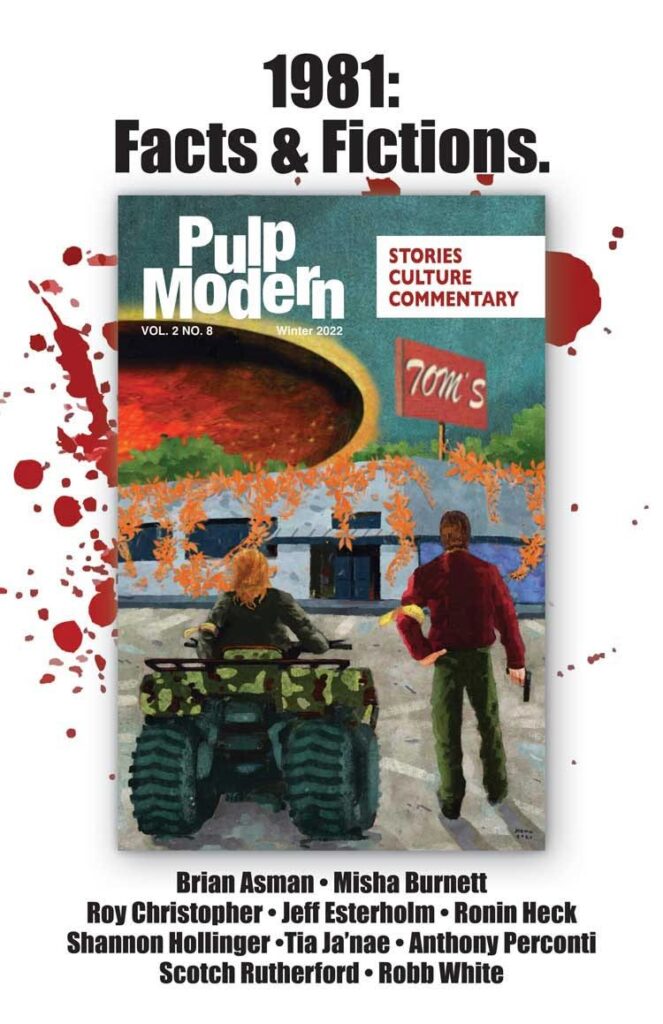
The above is an edited excerpt from my book Dead Precedents: How Hip-Hop Defines the Future (Repeater Books, 2019). In this form, it was originally published in the Winter 2022 issue of Pulp Modern. The year 1981 was the theme of the issue. Many thanks to Alec Cizak for the opportunity to correct a few factual flubs.
Notes:
[1] Parts of this piece were adapted from my book, Dead Precedents: How Hip-Hop Defines the Future, London: Repeater Books, 2019. This is a detail I got wrong in there: I said he was already president when he visited the South Bronx in 1980. Shout out to Josh Feit.
[3] In my lone TV interview so far, I mistakenly called the song “Joystick,” which was another early jam I liked in middle school. Such are the perils of memory and live television.
[4] Quoted in S. H. Fernando, Jr., The New Beats: Exploring the Music, Culture, and Attitudes of Hip-Hop. New York: Anchor Books, 1994, p. 237-238.
[5] CK Smart, A Turntable Experience: The Sonic World of Hop-Hop Turntablism, SLAP Magazine, pp. 74-75.
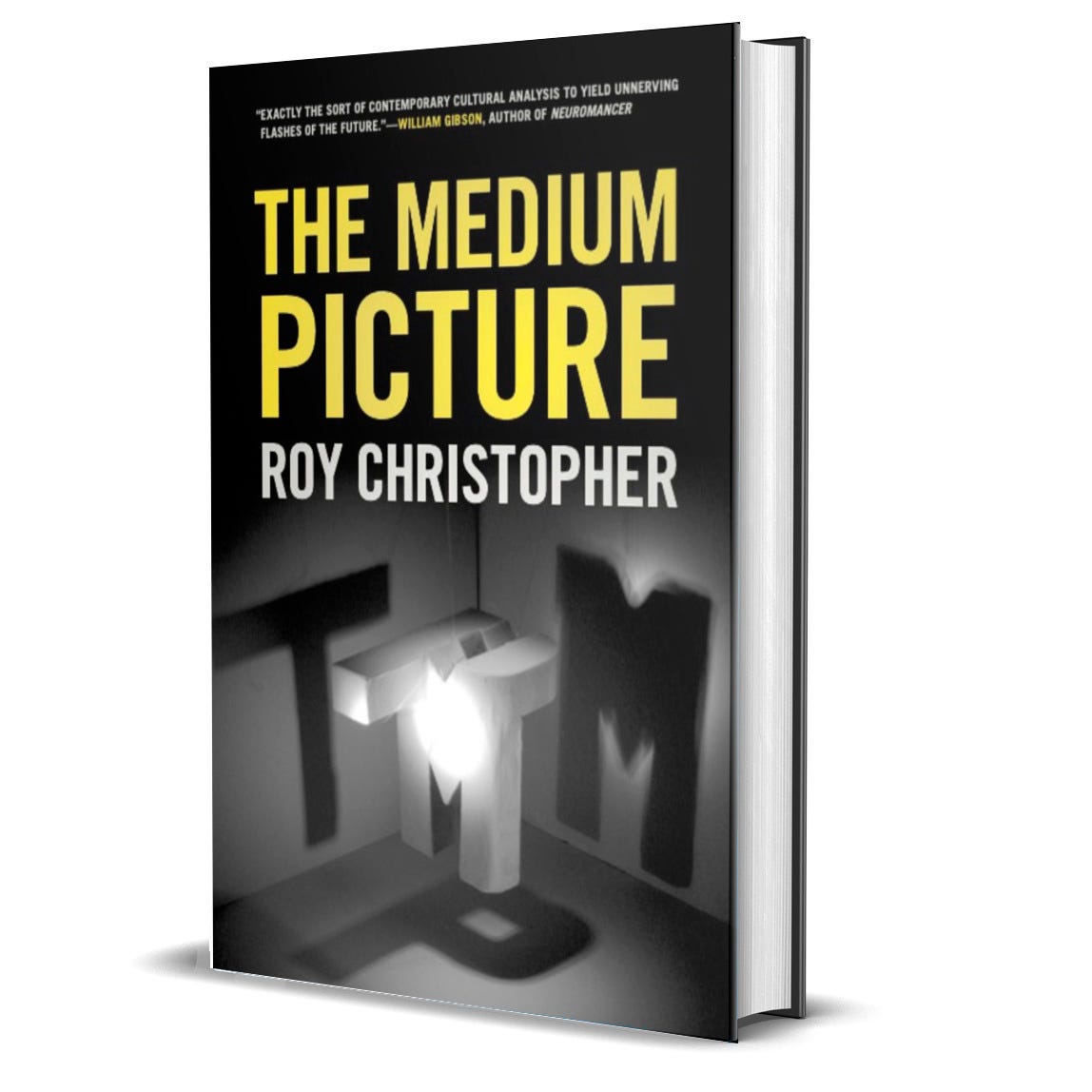
My post-punk media-theory book, The Medium Picture, is now available for preorder from all of your favorite places: UGA Press, Bookshop, Barnes & Noble, and even Amazon! Preorders mean more than you think. They’re very important for the life and success of the book. If you know you’re going to buy it, please consider snagging a copy early.
Preorders serve as an early indicator of a book’s potential success. They signal to publishers and retailers that there is interest in the book, which can lead to increased marketing efforts and larger print runs. For authors, preorders can be crucial in boosting their book’s visibility on platforms like Amazon. This can improve their sales rankings and increase exposure. On Amazon, preorders can affect the sales ranking before release, which might influence the platform’s promotional efforts. If you’re not sure, read on! Thank you!
Of all of my books, this is the one I’ve worked on longest and hardest. It’s the closest to my heart.
Here’s what other people are saying about it:
“Exactly the sort of contemporary cultural analysis to yield unnerving flashes of the future.” — William Gibson
“Like a skateboarder repurposing the utilitarian textures of the urban terrain for sport, Roy Christopher reclaims the content and technologies of the media environment as a landscape to be navigated and explored. The Medium Picture is both a highly personal yet revelatory chronicle of a decades-long encounter with mediated popular culture.” — Douglas Rushkoff
“A synthesis of theory and thesis, research and personal recollection, The Medium Picture is a work of rangy intelligence and wandering curiosity. Thought-provoking and a pleasure to read.” — Charles Yu
If you’re so inclined, you can post one these on the social medium of your liking. Link ‘em to your favorite online book outlet or just to http://www.themediumpicture.com
Accompanying their stunning, fever-dream visuals, the films of David Lynch roar with sound, what Madison Bloom at Pitchfork calls a “bowel-deep grumble.” From visceral, industrial rumbles to crackling near-silence, sound is an aspect of his movies that he valued as much as the images. “The sound design can be subliminal where you barely hear it, or sometimes you can get hit over the head with it,” said his main composer and collaborator Angelo Badalamenti in Brad Dukes’ Reflections: An Oral History of Twin Peaks (Short/Tall Press, 2014). “He creates a remarkable aural experience.”
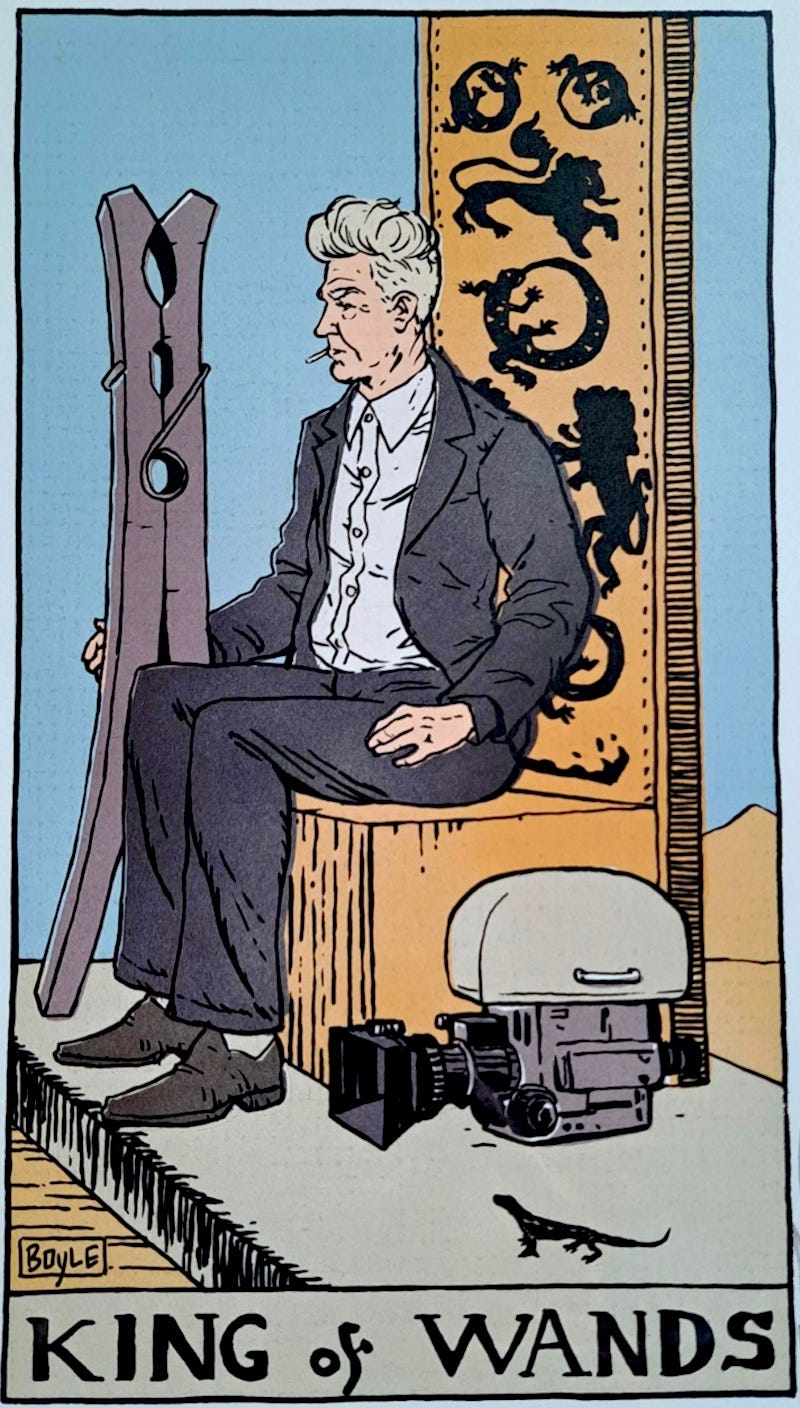
David Lynch as the “King of Wands” from the Philly Tarot Deck by James Boyle and Gina Tomaine.
Though I watch his movies and shows regularly, since his passing I’ve been revisiting them anew. Understandably, most of Lynch’s critics and fans focus on the visuals of his work, but there’s been a renewed interest in his attention to sound. “All the way back to Eraserhead,” said Badalamenti, who, starting as Isabella Rosselinni’s vocal coach on 1986’s Blue Velvet, composed music for almost all of Lynch’s projects. “David has loved to play and experiment with music and sound,” he said. Lynch said repeatedly that Badalamenti was the one “who really brought me into the world of music, right into the middle of it.”
Lynch explained the sound of Eraserhead in a 1977 interview:
Alan Splet and I worked together in a little garage studio with a big console and two or three tape recorders, and worked with a couple of different sound libraries for organic effects. Then we fed them through the console. It’s all natural sounds. No Moog synthesizers. Just changes like with a graphic equalizer, reverb, a Little Dipper filter set for peaking certain frequencies and dipping out things or reversing things or cutting things together. We had a machine to vary the pitch but not the speed. We could make the sounds the way we wanted them to be. It took several months to do it and six months to a year to edit it.
In the 2016 documentary David Lynch: The Art Life, Lynch told the story of how he first conceived of film and sound through painting:
I was painting a painting about four-foot square, and it was mostly black, but it had some green plant leaves coming out of the black. And I was sitting back, probably taking a smoke, looking at it, and from the painting I heard a wind, and the green started moving. And I thought, ‘oh, a moving painting, but with sound.’ And that idea stuck in my head. A moving painting.
Miguel Ferrer, who played the principled and persnickety Special Agent Albert Rosenfield in all three seasons of Lynch and Mark Frost’s Twin Peaks said, “The music was unlike any music you’d ever heard on television. […] It was so radically different and so evocative. It almost became another character.” Frequent musical collaborator Julee Cruise added, “You could scan the channels and know it was David Lynch, just three seconds in and you knew who it was. He pushes everything to the metal.”
“Oh, just let it float, like the tides of the ocean, make it collect space and time, timeless and endless.” — David Lynch describing a composition to Angelo Badalamenti
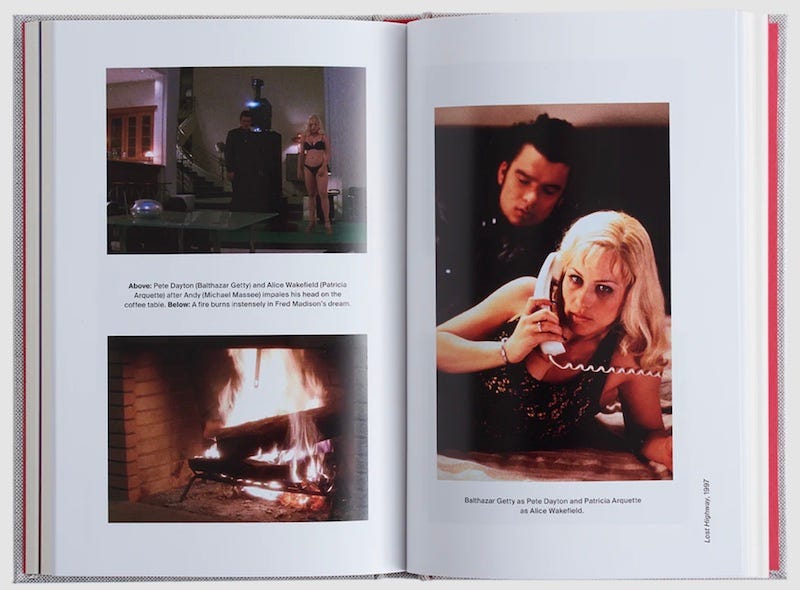
In addition to Badalamenti and Cruise, Lynch worked with Toto and Brian Eno (on the Dune soundtrack), Chris Isaak (both as a musician on Wild at Heart and an actor in Twin Peaks: Fire Walk With Me), Trent Reznor and Marilyn Manson (on Lost Highway), Karen O (sang on Lynch’s “Pinky’s Dream”), Moby (DJed his wedding), Lykke Li (sang on Lynch’s “I’m Waiting Here”) and his own band with Badalamenti, Thought Gang (named after the Tibor Fisher book?). Almost every episode of 2017’s Twin Peaks: The Return ended with a different musical act performing at the Roadhouse: everyone from acts he’d worked with before like Rebekah Del Rio (who performed in Lynch’s Mulholland Drive and, perhaps as an homage, on the Treer Jenny von Westphalen Megazeppelin in Richard Kelly’s Southland Tales, easily his most Lynchian film), Cruise (in two episodes), and Reznor and Atticus Ross (as the Nine Inch Nails), to newcomers like the Veils, Lissie, Eddie Vedder (as Edward Louis Severson III), Au Revoir Simone, and the Chromatics (in three episodes).
Emerging from an event at the United Artists Theatre in Los Angeles on April 1, 2015, the book,Beyond the Beyond: Music From the Films of David Lynch, edited by J.C. Gabel and Jessica Hundley (Hat & Beard Press, 2016), explores the music Lynch loved and the transcendental meditation he practiced for most of his life. As the above list of artists and collaborators indicates, Lynch was one heck of a curator. Beyond the Beyond includes interviews with many of his musical collaborators, followers, and fans.
“Haunting” is an easy but apt description of Lynch’s own music but also the music he chose from other artists. He used songs by This Mortal Coil, Roy Orbison, and many others, but Chris Isaak’s “Wicked Game,” which appeared in Lynch and Barry Gifford’s Wild at Heart (1990), is perhaps the best example. Somehow both twangy and gothic, with its deep sense of longing and loss, the song was not only a big hit for Isaak but struck the core musical chord for Lynch’s on-screen images. His own “Ghost of Love” echoes a lot of Isaak’s aching darkness, billowing like a cold wind blowing through your bowels.
“I play the guitar upside down and backwards,” Lynch said in Beyond the Beyond. “I’m not a musician. It’s more about sound effects for me. I just love the sound of it.” His pure ear for sound is obviously astute. The etherial vocals of Julee Cruise illustrate the point. She put an otherworldly lilt to several of his most iconic projects.
Cruise sang on a song for Blue Velvet called “Mysteries of Love,” and her song “Falling” from her 1989 debut record Floating Into the Night, which features compositions and production by Badalamenti and Lynch, became the main theme for Twin Peaks. About that record, she told Trey Taylor at Dazed and Confused, “I’m so proud that so many young girls have picked up on it, like Lana Del Rey. And fuck anyone who says anything bad about her, because she always credits me and I think that’s the greatest honor I’ve ever received.” The clip below is from “Industrial Symphony No. 1: The Dream of the Broken Hearted,” a play directed by Lynch, with music by Badalamenti and Cruise.
So, rest in peace to David Lynch, Angelo Badalamenti, Julee Cruise, Frank Silva, Jack Nance, Frances Bay, Catherine E. Coulson, Pamela Gidley, Peggy Lipton, Lenny Von Dohlen, Miguel Ferrer, Walter Olkewicz, Kenneth Welsh, Tom Sizemore, Piper Laurie, David Bowie, Warren Frost, Michael Parks, Don S. Davis, Robert Forster, Harry Dean Stanton, and all the other passed-away alumni of Lynch Land. As Lynch himself said in a BBC interview upon the passing of Badalamenti, “I believe life is a continuum, and that no one really dies; they just drop their physical body, and we’ll all meet again, like the song says. It’s sad, but it’s not devastating if you think like that […] It’s a continuum, and we’re all going to be fine at the end of the story.”
Dead Precedents: How Hip-Hop Defines the Future by Roy Christopher: We started making Dead Channel Sky because we’d made the song “Run It” for a video game that didn’t end up using it. But it wasn’t until I read Roy’s book about the parallel evolutions of hip-hop and cyberpunk fiction that I could wrap my head around creating a whole cyberpunk project. In the book, he draws connections between the two forms’ repurposing of technology, and making art out of the scraps of industrial capitalism (think: computer hacking and turntablism) as two potential visions for the future. I asked Roy to summarize his argument in the press release for the album, so I’d ask you to read it there, rather than have me stumble through it myself.
My friend Dave Allen passed away the other day. Like most people who knew him, Dave was not only a friend but also a mentor to me. Through his music and his thinking, it’s difficult to take measure of the influence he’s had on us. I last saw Dave in 2022 when I spent a week at his and Paddy’s house in Portland, collaborating with them on a book idea.
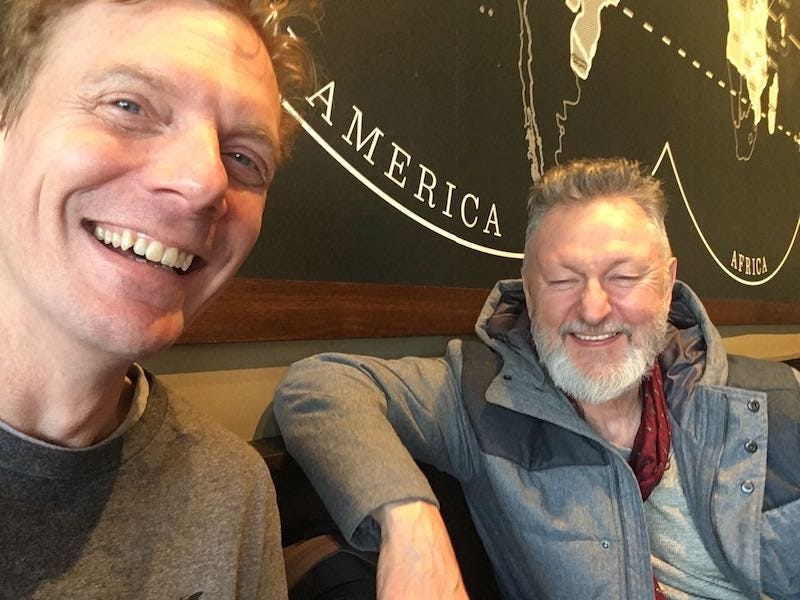
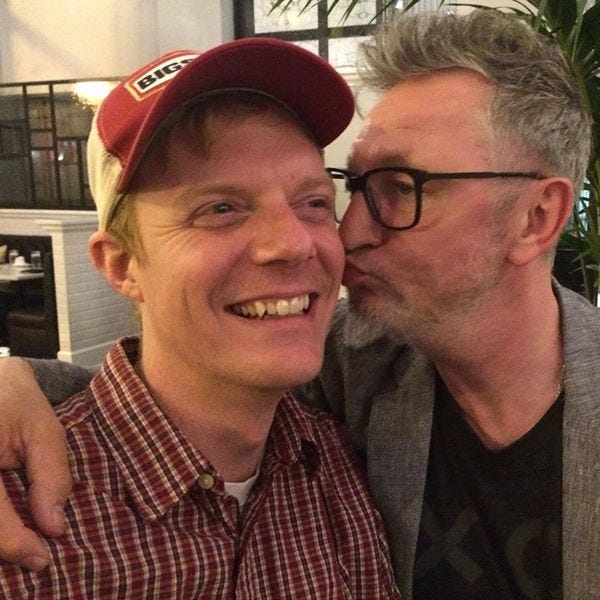
Me and Dave goofing and laughing in Portland in 2022.
In tribute, I’m sharing a piece I wrote about Dave and Gang of Four a few years ago and an interview I did with him in 2008. There’s really no way to do his influence justice, but this is all I have.
Rest in peace, Dave. You’re already sorely missed.
Return the Gift: Gang of Four
To create a spike of novelty high enough to be seen by history depends on a lot of things aligning: an open-armed zeitgeist, an interested public, a little bit of chaos, and a lot of charisma. Sometimes they become folklore, affecting only those who were there, like Woodstock, Altamont, or the June 4, 1976 Sex Pistols show in Manchester: Supposedly everyone there left that show dead-set on starting a band. There’s even a book about it. Other times these events are recorded, as great performances, works of art, books, or records.
Once the smoke cleared after the detonation of punk, there was still so much work to be done. Gang of Four’s original line-up tapped into a tectonic shift in the times. As Mark Fisher writes in The Ghosts of My Life, “It has become increasingly clear that 1979-80… was a threshold moment—the time when a whole world (social democratic, Fordist, industrial) became obsolete, and the contours of a new world (neoliberal, consumerist, informatic) began to show themselves.” It was also the dawn of post-punk. In tangents like tentacles, Joy Division, Wire, The Fall, PiL, Talking Heads, Television, and Gang of Four, among others, were stretching punk in ever new directions.
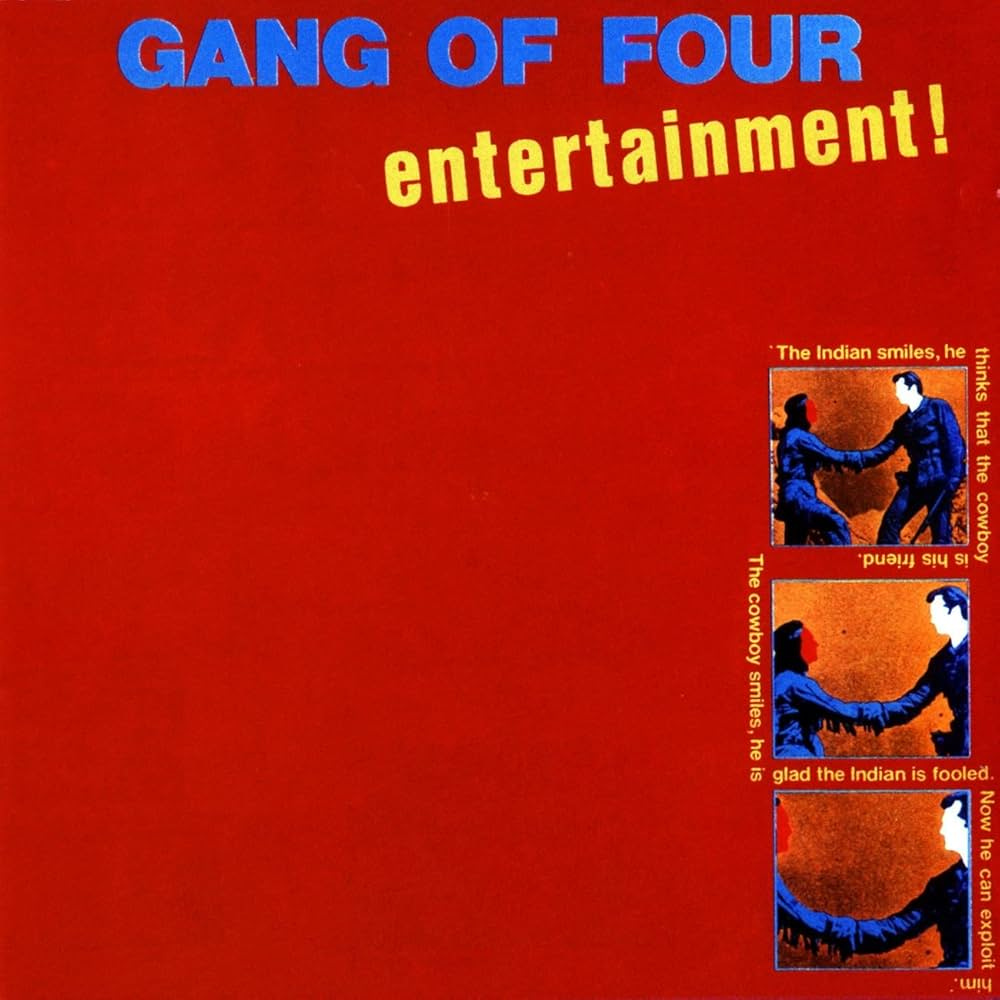
Gang of Four Entertainment! (Warner Bros, 1979)
One of the more significant of these, Gang of Four combined the lean muscle of punk with the bare bones of funk. Lyrically social and political, their lanky limbs swung hard and wide against the “middle-class malaise” of the 1970s. The first time I heard Gang of Four’s Entertainment!, suddenly much of what I was already listening to made much more sense. Fugazi had a lineage. Naked Raygun had context. Wire had contemporaries. During the post-Lollapalooza package tour phase, I finally saw them live in 1991. It was a woefully crippled line-up that only included Andy Gill from the original Four, sharing the stage at Atlanta’s Fox Theatre with a motley mess of bands: Young Black Teenagers, Warrior Soul, Public Enemy, and The Sisters of Mercy. The fact that Gang of Four was considered viable in that line-up ten years past their prime is significant though.
Woven as an influence and wielded as an instrument, Entertainment! remains a relevant strand of modern music. Frank Ocean sampled “Anthrax” for the song “Futura Free” on his 2016 record, Blond, and El-P sampled “Ether” for “The Ground Below” from Run the Jewels’ 2020 record, RTJ4. It was #81 on Rolling Stone magazine’s 2013 “100 Best Debut Albums of All Time” list, and in 2012, when they updated their 2003 list of the “500 Greatest Albums of All Time,” Entertainment! moved up from 490 to 483, a seven-spot jump in a decade, over 40 years after the record was released. It stands at number 8 on Pitchfork’s “Top 100 Albums of the 1970s” list for 2004.
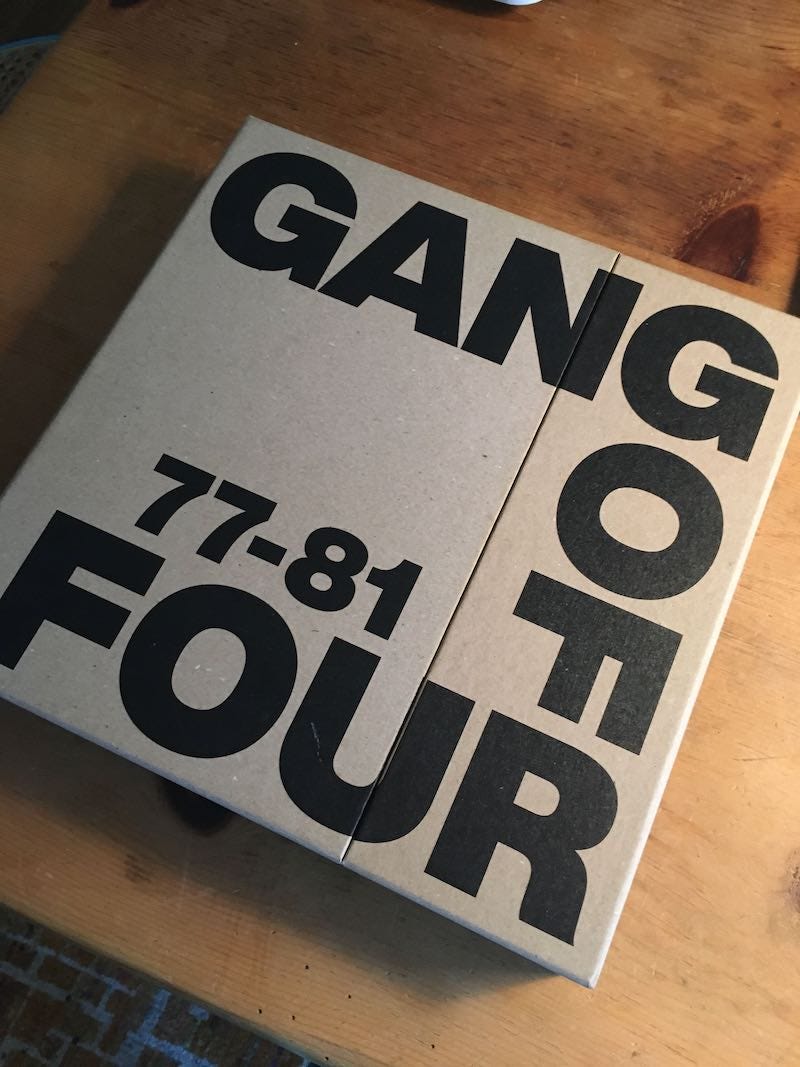
So, when the original four reformed in 2004, as if to prove how strident those early records were, they rerecorded those classic songs. The result was Return the Gift, which features predominantly tracks from Entertainment! And its follow-up, Solid Gold, performed live on a soundstage. Even 2021’s retrospective boxset represents their earliest era: Gang of Four 77-81.
The Gang of Four box set (Matador Records, 2021)
By the time they released Return the Gift in 2005, there were bands that had drawn direct influences from the original Gang of Four. People were comparing Franz Ferdinand and Bloc Party to them. “Those bands helped us get back into the limelight with a whole new generation of music fans,” says Dave Allen, “who came along thinking they were going hear Bloc Party or Franz Ferdinand and then got their minds shattered.” Though they are often considered overtly political, Dave bristles at the connotation. “People would say, ‘Rage Against the Machine is just like Gang of Four.’ As much as I respect those guys and what they do, our aims were very different. We weren’t revolutionaries. We were dissecting everyday life.”
After touring with the original line-up, Jon King and Andy Gill had set their sights on a new record, but Hugo Burnham and Dave didn’t think the world needed a new Gang of Four album. Dave, having spent many intervening years consulting bands on negotiating the music industry’s new digital landscape, wanted to do something new, something different. He told me at the time, “If we don’t own the idea, there’s no point in doing it.” He continues,
What I’d wanted to do instead was set up cameras in our rehearsal room in London and do what Radiohead did. This would have been a perfect Gang of Four moment: You can check in on our working methods, you can check in on the arguments that take place. You’d get the chemistry of the band, and then I just felt like, let the crowd decide: What do you think is worth following up on? We’d still never make an album, just complete these songs and leave them up on YouTube so millions of people could stream them forever, and you don’t have to pay a thing. Meanwhile, our cachet goes up in the world for touring, and we can go out again. That’s what the Web’s for. In music, I think the Web gives you this massive distribution system out of the hands of radio, out of the hands of distributors, out of the hands of record labels. What could be better for rock ‘n’ roll than that?
This sense of independence, the lingering influence of punk, runs through Dave’s many endeavors. The novelist Rick Moody writes of him,
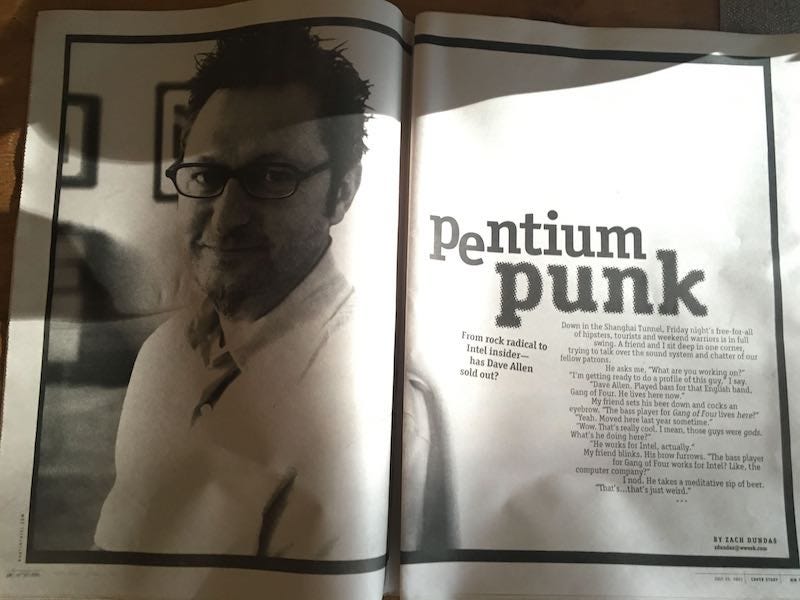
In calling Dave Allen an Internet strategist, or a pundit of the digital realm, or a high-tech agit-prop genius, you would be leaving out the job he had before that, when he was Dave Allen the bass player, first in Gang of Four (on their first two albums, and then for a couple of years during their reunion victory lap), and later in Shriekback. As such, he has experienced all of the vagaries of the music business as a player, producer, label owner, and now as a copyright owner of a great number of great songs from the seventies and eighties that are routinely streamed online. Few people of my acquaintance are better situated to talk about distribution and the difficulties thereof without romanticizing the story.
Dave in a Willamette Week cover story, “Pentium Punk“ by Zach Dundas, 2001.
If you know Dave Allen, you probably know him from his time in Gang of Four, but from post-punk and the music business to the post-internet, Dave has been ahead of every curve. A life and lessons from over four decades traversing the interstices of not just music and technology but also art and culture, Dave Allen is one of our most outspoken innovators and advocates.
Every Force Evolves a Form An Interview with Dave Allen, 2008
I can’t remember the first time I heard Gang of Four, but I do distinctly remember a lot of things making sense once I did. Their jagged and angular bursts of guitar, funky rhythms, deadpan vocals, and overtly personal-as-political lyrics predated so many other bands I’d been listening to. Dave Allen was the man behind the bass, and now he’s the man behind Pampelmoose, a Portland-based music and media blog.
I sat down with Dave in May 2008 for a lengthy beer-soaked session over Mexican food, and I managed to glean the following dialogue from it. We talked about Gang of Four, Dave’s personal history from forming that band to running Pampelmoose, the questionable state of the music industry, and why Portland is the place to be.
An update was planned, but now that Dave has parted ways with Gang of Four (along with drummer Hugo Burnham) again, I figured I’d go ahead and run this interview as-is. Dave’s ideas about the state of the record industry (about which he’s written extensively on Pampelmoose) and how Gang of Four should release their music clash with the band’s more traditional leanings. The seeds of his departure can be seen germinating in the talk below.
Dave Allen portrait by Laura Persat.
Roy Christopher: Seeing all of the sound-alike bands around, you guys originally got back together and did your old material.
Dave Allen: Yeah, the point that that was really validated was when we played in the West of England at the All Tomorrow’s Parties “Nightmare Before Christmas” show, curated by Thurston Moore, and we were the co-headliners. We’d already played with them the previous summer at the Prima Vera festival in Barcelona. We actually followed them that night, and I was really concerned, but what I realized was, although that band puts out new albums every now and again — Nurse, Rather Ripped… They make great records. They never stopped. Now, you might argue that nothing changes with Sonic Youth, so their style is the same: You just get a new batch of songs from Sonic Youth. And there’s something remarkably comforting about that, but at the same time, the moment when they launch into something from Daydream Nation, and they expand on it because they’re a jam-band at times, but the most interesting jam-band ever to be seen live. They are such a superb band. Forget everyone else. But it dawned on me, we and they are legacy bands. People don’t necessarily come to hear the new material. So, you better be sure to pack your set with a lot of old material. They’ve got twenty albums to draw on, right? We’ve only got two. Really. It limits the amount of time we can be on stage, but at the same time, we’re not ones to overstay our welcome. Live, those songs are more intense than ever before. They have a new vibe that I really like.
Anyway, point being, once you realize that people are coming to see you to hear the old songs — including the new crowd that turns up, by the way — then you’re okay.
If we do record twelve new songs, six of which are really good, then how do we put that out? My argument would be that we’re Gang of Four, and we’re supposed to do things a bit differently. So, do we do it through a cell-phone provider? Something different. Or should we give it away digitally and just press some heavy-gram vinyl to sell at shows? The days of doing a CD are over. That’s my argument. Now, I don’t know if Jon and Andy would agree, but the point being that the material can be used in many different ways. One idea that we’ve been kicking around with this new song that I really like. Jon’s got this thing about caffeine culture and it’s a really cool direction we’re going in, and it’s good, old-fashioned Gang of Four. I’m really enjoying it. Now, what if we perversely actually went to Red Bull or whoever and see if they want to release it? It’s not available anywhere else except in their ad. Then make it viral online where you can download the Red Bull/Gang of Four video, and so on. That way it gets spread around the globe in different ways. And the point being not to sell anything, but Red Bull would pay us for the campaign, and we get back on the road, which is where we do best. We play live, we get paid well, we can sell t-shirts and vinyl, so the concept of signing to a label, putting something out, and touring on it is so ridiculous to me. If we don’t own the idea, there’s no point in doing it.
RC:Right, it’s just like the legacy idea. You used the Rolling Stones as an example. The new records are just an excuse to get out on the road and play the old songs live.
DA: That’s all it is.
RC:Do they really realize that? You say they do, but I think it’s that you realize that. I don’t think the Rolling Stones think of themselves as a legacy band. I think they’re still trying to make another “great” Rolling Stones record.
DA: I think you’re right. That’s the counterpoint, right? They may not have realized it and I think all bands want to keep creating, and what I’m saying is—
RC: “We’ve done our good stuff. Let’s just keep doing it.”
DA: Right. There are other ways to be creative, so I would argue that doing my label, trying to find new bands is creative, and now I’ve got my heavily trafficked blog.
RC:Right. You have an outlet, and you get to play live.
DA: Yeah, why would we kill ourselves to do a new record when no one wants to buy it anyway?
RC:There’s no good way to say it.
DA: It’s all downhill. It’s retreat.
RC:Yeah, when you first mentioned the legacy band idea, it really resonated with me, but I finally got around to watching the Metallica documentary, and wow. Those guys are just so obviously past their prime and just killing themselves trying to make a new record. It just ends up being a parody of what they once were, and I think that really speaks to your idea of being a legacy band –- and realizing it.
DA: I would argue that who’s to blame here are the labels. The labels are to blame. It’s like when Coldplay decided not to make an album because Apple was about to be born, and Chris couldn’t write songs or whatever, EMI’s shares dropped 15%, because it was all about the biggest band on the label. Well, Metallica are huge, so it’s the same thing. All the heads of Warner Brothers will be pushing them, “Look at the share price! We need an album from you guys!”
RC:It was totally like that in the film! When James left for rehab, the label freaked, like “Oh my god, our cash cow is falling apart!”
DA: Well, didn’t Geffen pretty much go away after Kurt killed himself? Nirvana was Geffen’s cash cow.
RC: Not like they lost any when he died… In 1995, Sub-Pop’s second biggest seller was Sebadoh’s Bakesale. Their first? Nirvana’s Bleach! In 1995, Sub-Pop could’ve not released anything, just kept Bleach on the market, and made money.
DA: So, my point about these legacy bands making records is, the Rolling Stones will be given a million dollars every time they want to make a record. The label can recoup that money. They’re not going to get rich off of the record, but it revitalizes the back catalog, and puts the band on the road. Otherwise, why would they bother to get out of bed to record? They’re past their prime as songwriters. I’m sorry, there’s not anything redeeming about it.
I think it’s interesting that Sting got The Police back together but didn’t bother to make a record with those guys. And Sting is the consummate songwriter. Meanwhile, the cheapest ticket on the Police tour is a hundred dollars.
RC:You know how much the good ones are? Nine-hundred…
DA: Are they?! Let’s go back to that one-hundred dollars: There goes the music industry! The live side of it is growing, but there goes the recording industry. The back catalog is the only money to be made.
RC:What about Mötley Crüe? They had to prop Mick Marrs up, and Vince Neil is huffing and puffing and barely making it through one of those tours. They made millions of dollars and didn’t even do a new record!
DA: You don’t need to.
RC:Kiss did what, three reunion tours? And all three of those years, those were the biggest tours of the year.
DA: People don’t want to hear the new material.
RC:They want to hear “Rock and Roll All Nite.”
DA: It’s a reminder of your youth.
RC:It’s nostalgia marketing.
DA: Absolutely.
RC:It’s one of the strongest things out there.
DA: It’s what we did on our holidays, twenty years ago.
RC:Right.
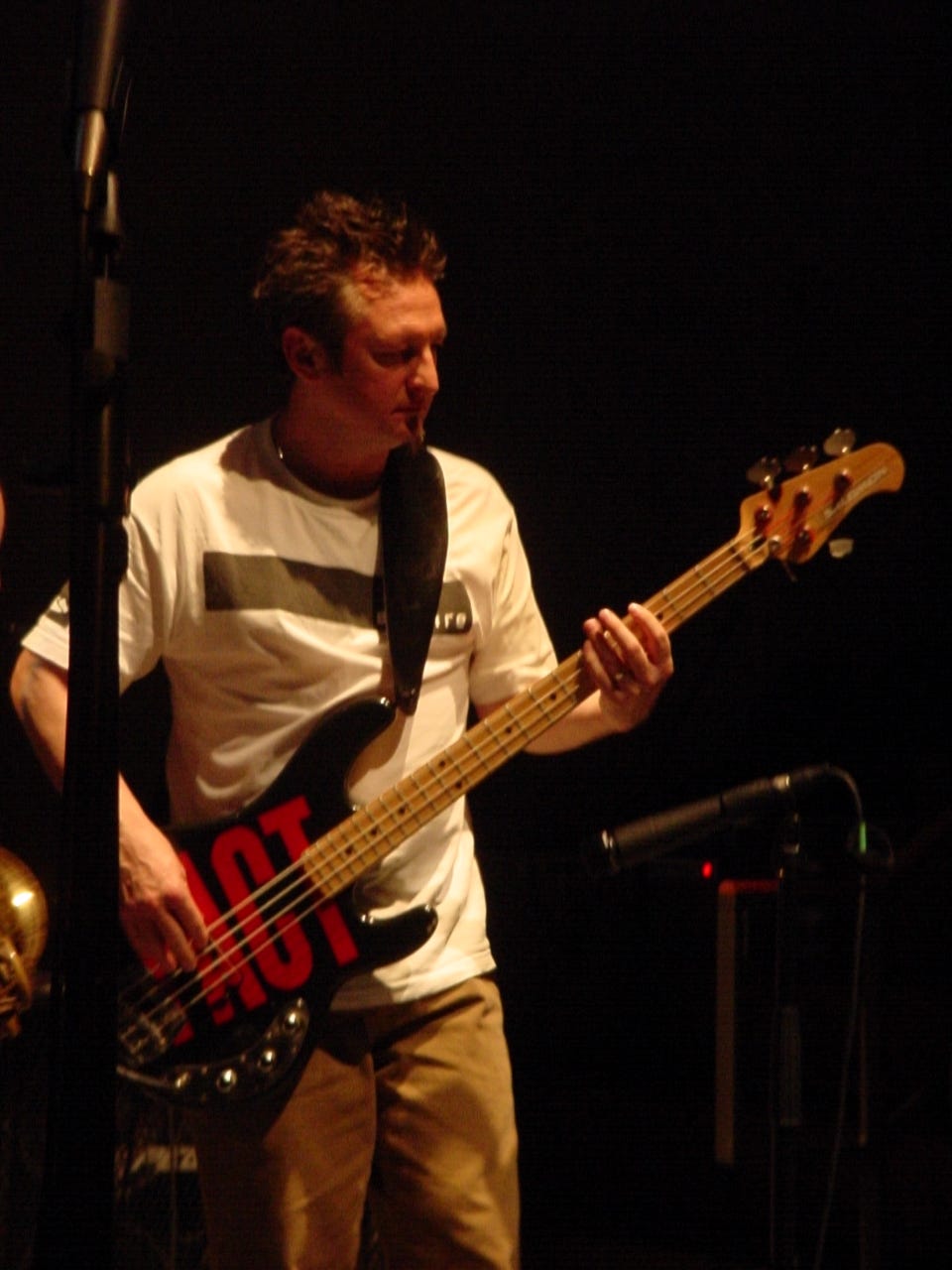
Dave playing bass at a Weiden + Kennedy party in 2002.
RC:So, why Portland?
DA: In late 1999, I was living in Lookout Mountain with my kids, all computer kids, and I went to a friend of mine Nigel Phelps who’s one of the top art directors in the movies, he did Titanic and all sorts of big movies, English guy, — his eldest daughter, I saw that she was on the computer, on AOL, and she was talking to herself saying, “You’re on dial-up, you’re not on broadband,” and I asked her if she was arguing with someone about who was on dial-up and who was on broadband. She said, “No.” On Napster, when you selected a song it tells you the bandwidth availability. So, when it was really slow, she would IM the person and say, “You liar. You’re on a 28K dial-up. You’re not on broadband.” That was my first exposure to Napster, and I was like “What the heck is this?” I look and she’s got all of this free music. Now, I was at eMusic, where we charged 99 cents per song, and the next morning, I went into the office and emailed the head guys and said, “Guys, you’re done. Everybody is getting free music from Napster.” Their attitude was that it was illegal and that they’d soon be put out of business. And I was saying, “Not before we go out of business.” And that’s exactly what happened.
Then around 2000, when the market sank and the whole dotcom thing fell in the toilet, I got the call that they were closing the LA office. I got a call from a headhunter that some guys in Portland wanted to fly me up and talk to me and would like to hire me for a similar position. I liked Portland, I’d been here a lot, I had friends here already, but I wasn’t ready to leave the big city just yet. Anyway, it turned out to be Intel, and on the campus here right outside Portland, they had this thing called New Business Investments, or NBI, and I was asked to join the Consumer Digital Audio Services or something like that. It sounded interesting, so I joined up. They were looking at internet connected devices, an MP3 player—pre-iPod—and different ways to get your music, Home Entertainment servers, and the thing we were building that you see now was this bridging system that transmitted music files from your computer to your legacy Hi-Fi. 802.11b had just arrived, so we were working to get the music from there to there, wirelessly. My job was to go to Yahoo music and these other content providers and license them for our service. It was a great idea. The problem was, Intel is known for developing amazing stuff and then getting cold feet at the last minute and not bringing it to market. At home I’ve got five MP3 players that are better than the iPod. There’s a soundcard in them, engineered to perfection. They’re amazing. The only problem was it’s just a flash device, it only had a 128Kb flash card for memory, and no one had thought of a adding slot where you could upgrade the memory. Never came to market. That was that.
They’d paid for me and my family to move up, I’d bought a great house, and I think it’s a great city. I don’t feel the urge to move back. I’m a booster for this town. I love it.
RC:I’ve only been here for two months, but every other day there’s someone else here that I didn’t know was here, or some event that I didn’t realize happened here. I never thought about moving here because Seattle has been my adopted home for so many years, so I never thought about dropping down here, but since I did… It’s an amazing town.
DA: Anthony Keidis just moved here.
RC:Really?
DA: Ironic, huh? Now I can ask him about my royalties. [Laughter] “You can come to my barbecue. Please bring blank check.” [Laughter] Everyone’s here. The Shins, Johnny Marr…
RC:His being in Modest Mouse…
DA: You can say it, Roy.
RC:Okay, I hate Modest Mouse. [Laughter] I love Johnny Marr, but I hate Modest Mouse. It’s funny that the Mouse House is right over there.
DA: Yeah, I ran into Isaac Brock’s girlfriend, and he came by the office to get some stuff, and he said I should come over, that there’s someone there I’d probably like to meet. So, I went over there and I walk upstairs and there’s Johnny Marr. He sees me walk in and he’s like, “What the fucking hell are you doing in Portland?” And I said, “Well, what the fucking hell are you doing in Portland?” [Laughter]
They’re an interesting band to watch because they were a multi-platinum band, and now they’re not. You have to make money on the road.
RC:That’s another area that hip-hop is missing out on. Hip-hop is not known for big live shows – and it should be. The lyrical element of hip-hop is one of the most exciting things to see live, but the acts that excel at that part of it are not the acts that are selling the records and doing those tours.
DA: The underground aspect is interesting, like The Roots do well touring, Blackalicious… But the bigger it gets, the more it slows down. I mean, is T.I. going to do a big arena tour?
RC:No, but T.I. is one of the guys who’s still selling records.
DA: Yeah, he’s fine, but the minute it drops off, what can he fall back on?
RC:Right. Then he can go be Jay-Z.
DA: That may be one of the things that hurt live hip-hop: It was so easy to sell records, it was like why bother going on the road?
RC:Well, for a long time hip-hop had a hard time getting security for shows because it had been tainted with this “violence” tag.
DA: And it was never as bad really as your average big rock show. It’s just racism.
RC:Yeah, it’s a race thing and something the press loves to play up, and it’s completely untrue, but it keeps you from getting insurance for a hip-hop show. The reality is, the insurance company is like, “Ice Cube? Oh, hell no!”
DA: Right. Every black person is packing, and there are 50,000 of them in an arena, we’re not covering that. And then Guns N’ Roses comes to town and there are two stabbing deaths—
RC:And all of the seats in the arena are ripped out and thrown on stage.
DA: Yeah, but those are all white guys from the suburbs.
Me and Dave clowning in Chicago in 2017.
RC:So, what are your goals with Pampelmoose?
DA: It started it off like it did with my label World Domination, maybe a little too starry-eyed. I feel I’ve done really well in music, and I’m generally a very positive person.
RC:That’s one of the things I love about you, Dave.
DA: Aw, thanks [Laughs]. I look at bands and at the scene, and I feel like I’ve gotta give back. I volunteer a lot and I try and help, probably to my detriment, too much sometimes. So, I worry that I start off with great ambitions and sometimes let people down, because you get over-burdened and everybody wants a piece of it. You back up and think, “I can’t do everyone, so I shouldn’t do anyone.”
RC:It’s hard to find a balance there.
DA: It is. It’s so difficult, but I think we’ve found some kind of balance with Pampelmoose, and a group of friends and I were able to apply ourselves to a website that became a company that can help artists to sell some of their stuff, come on by anytime for free advice, bring their contracts -– I have a lawyer friend who charges very little to look over that stuff. Pampelmoose is also an extension of my social life. I’m very active socially. I can’t be at home. I’ve got to be out. I like being with people, and that’s no offense to my family. I like being with them, too. So, Pampelmoose has become an extension of my personality. I’ve tried things like this in the past with fanzines and writing, but it’s so difficult. You have to get them printed, get them out there.
RC:It wasn’t a fanzine, Dave. It was an art project. [Laughter]
DA: That’s true, and that’s my problem too, I get too deep into the project and it gets too ambitious and takes on a life of its own, then after the fall, I realize I over did it again. With Pampelmoose, the safety net was the blog. Because once the blog took off, and I believe it was January 2006 was the first post, and I have no idea where it’s going to go, but I did have the idea that I could open the doors to a community. That’s the thing I love about blogging, with the comments, people can call bullshit on me. The interesting thing for me was, six months go by, and no one’s calling bullshit, and then you get confident. And it wasn’t a lot at first, I think in the early days if we got a thousand visitors in a month, that was a lot, but it did pick up and start attracting visitors. Then I began to take it as seriously as everything else I was doing. I’m the editor. I’m the public voice. I’m the journalist. I’m the copy editor. I’m the layout guy. And at first, I thought I might be building something that I couldn’t maintain, so I hired a bit of a support team. Then I learned to fly. I learned some basic HTML code, I learned to crop photos… Every post has an image, any image. It doesn’t have to go with the rest of the story. So, it has a little art aspect to it, if you will. In the past eighteen months it’s morphed totally into this blog. Pampelmoose is the blog, and as a side note, we still sell CDs, T-shirts, and give advice to local bands. So, getting up every day and having an opinion and having people comment on it drives the whole thing, and now that the traffic is up, it’s like, “Oh, shit.”
RC:Yeah, but it validates everything you’re doing there.
DA: Right, but just having explained it, it’s still weird. It’s not like we’re Wal-Mart, and we do this.
RC:Right, but with Wal-Mart, there’s a precedent. “Remember K-Mart? Like that, but better.” When you’re doing something like this, it’s more ambiguous. People ask me what my book is about, and I say it’s a collection of interviews. “Well, what’s the theme?” You have to read it. So, it’s frustrating, but if you read it, you get it. Even if you only read one interview per section, a theme emerges. I think Pampelmoose is the same way. If you go there and dig around, read, and become a part of it, it fits, but there’s no one-line explanation for what’s going on there.
DA: It is intriguing. It’s not Pitchfork, where they get a million hits a month, and it’s like, “What’s the point?” At the same time, I can’t deny their success. They’ve done it well, but now you’ve got this unfettered fan-boy day out where you can kill something before it even has a chance.
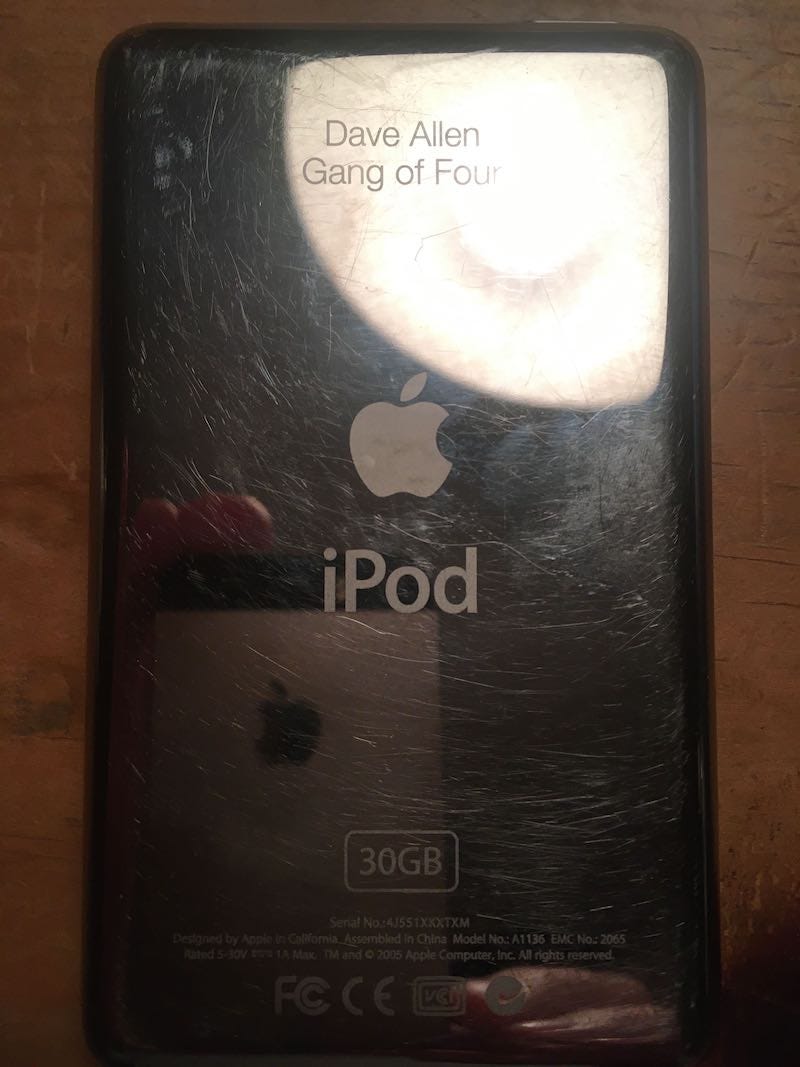
Dave’s old iPod.
These are excerpts from two upcoming books that Dave had a hefty hand in. The first bit is from The Medium Picture, a book heavily influenced by Dave and his thinking. That one comes out October 15th from the University of Georgia Press. The second is an interview I managed to record in 2008, when we both worked at Nemo Design in Portland. That one is in my second interview anthology, Follow for Now, Vol. 2.
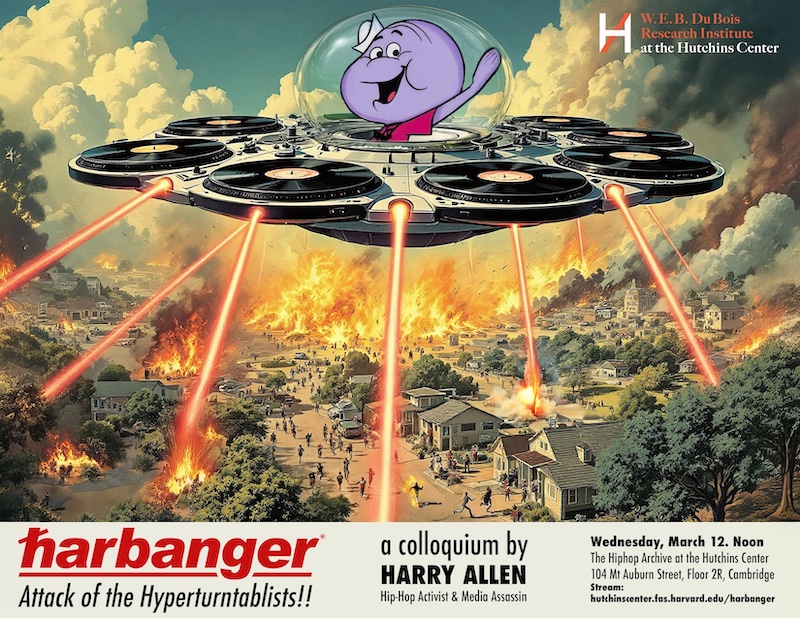
Harry Allen, Hip-Hop Activist and Media Assassin, will be presenting a colloquium on Wednesday, March 12 at noon EST at Harvard University’s Hutchins Center. harbanger is the turntablist septet formed by Harry Allen at MIT in 2020. He is currently working with them as his research project at the center. During the colloquium, He will discuss how the idea for harbanger came together, why he did it, his challenges, his objectives, and his vision of the future. In addition, he will play some videos they’ve shot and some music they’ve made. The whole lecture will last about 90 minutes, including a Q&A session. Join us!
When the French philosopher Jacques Derrida defined the lingering Marxism of late-Capitalist society as hauntological, mashing together the words “haunting” and “ontology,” he couldn’t have imagined what the era might sound like. Bay Area beat maestra Mars Kumari captures the grit and grief of loss we all feel now, haunted as we are by what was here and is now missing.
I met Mars Kumari at Oblivion Access in Austin in the summer of 2023, where she gave me a demo CD of her record, I Thought I Lost You (Bruiser Brigade, 2023). I already had her record for deadverse, Mars Kumari Type Beat (2021), so I was stoked for the preview. She’s moved on and on since then with collaborations in the works with legends like Del the Funky Homosapien and Dose One and a new solo record for Handsmade Collective.
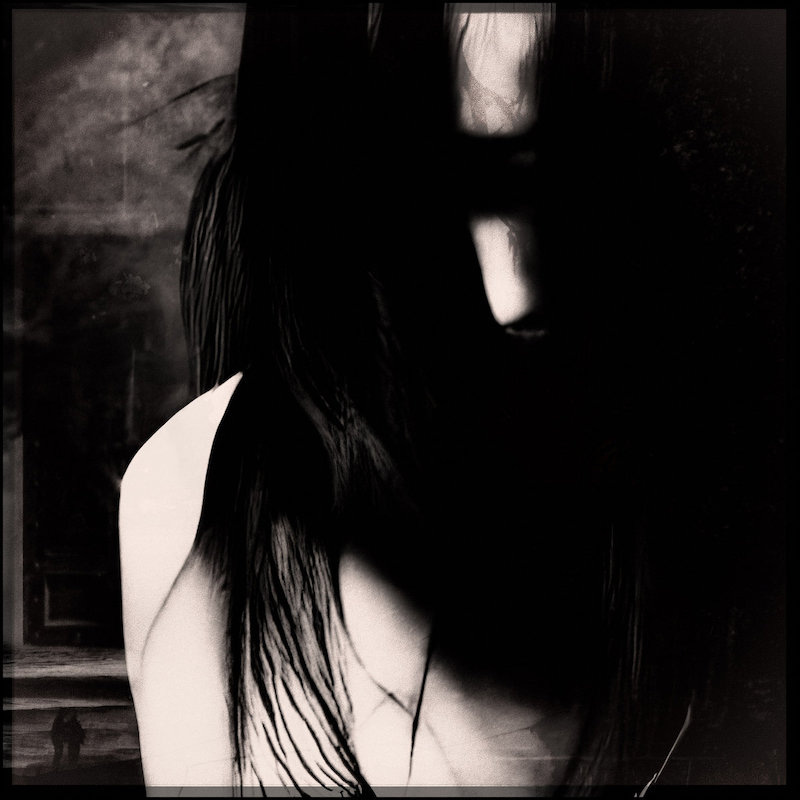
Mars Kumari. Illustration by Eleanor Purcell.
Roy Christopher: How’d you get into making music in the first place?
Mars Kumari: I first started learning music theory through piano lessons from age 6 onward, but didn’t start making my own music until around age 15/16 when my older brother gave me a pirated copy of Ableton. It was on version 8 at the time but 10 years later it’s still my weapon of choice. It took a lot of trial and error to learn (also YouTube tutorials). Throughout that period of time I’d absorb the music my brother listened to via these mix CDs he’d make, which is how I discovered MF DOOM, Del the Funky Homosapien, Crystal Castles, Flying Lotus, Nujabes, and Earl Sweatshirt, among so many others that ended up being core influences of mine.
I spent a year or so making beats by myself until I met my lifelong friends Keyvon and Shishan around 2015, and we all learned to produce and rap alongside one another. In 2019 and early 2020 when I was in university I performed alongside my good friends Nina Spheres and Parish as part of a dark ambient drone trio (collectively titled Nina Spheres). I learned much of what I know about sound design, layering and harmonics from that experience.
RC: More than any era of hip-hop, I hear the second wave of industrial acts (e.g, Scorn, Skinny Puppy, Justin Broadrick, Kevin Martin, the more ambient moments of Meat Beat Manifesto, Wax Trax Records output, et al.) in your work. Is that me just superimposing my own listening history, or do you find kindred sounds in there?
MK: I’ve been getting into the work of Justin Broadrick (specifically JK Flesh) since I saw him at Oblivion Access! I’m familiar with Skinny Puppy and Meat Beat Manifesto, but I need to get into their catalogs more. There are too many artists that influence me to name in one sentence, but Boards of Canada, dälek, Clams Casino, and Burial are some big ones for sure.
RC: What do you call it?
MK: My music?
RC:Yeah.
MK: I usually just say I make beats, even if that’s sort of oversimplifying it. My foundations have always been in industrial hip-hop, drone and shoegaze, but over the last 3 years that I’ve been performing for raves and nightclubs in the Bay, I’ve been listening to a lot more jungle, hard techno, dubstep, digital hardcore, things like that. I had listened to these kinds of music before but being around so much of it the last few years has had a major influence on my sound.
The context and emotions I associate with these kinds of music are consistently integral to the concepts behind my albums. For example, a lot of what I incorporated into Daybreak reminds me of some of my favorite memories of being surrounded by other trans people I love at parties and raves (places I’d be hearing the sort of music that inspired this) coupled with the comparative isolation of waking up the following morning alone in a world that hates people like us. It’s both of those feelings in equal measure behind the sound.
Given how important to the music the memories are, I guess I’d call it hauntology, but to me that feels more like a guiding philosophy and spirituality than a useful descriptor of the way it objectively sounds. There are many different sounds that the word hauntology describes; I think what unites them is more abstract.
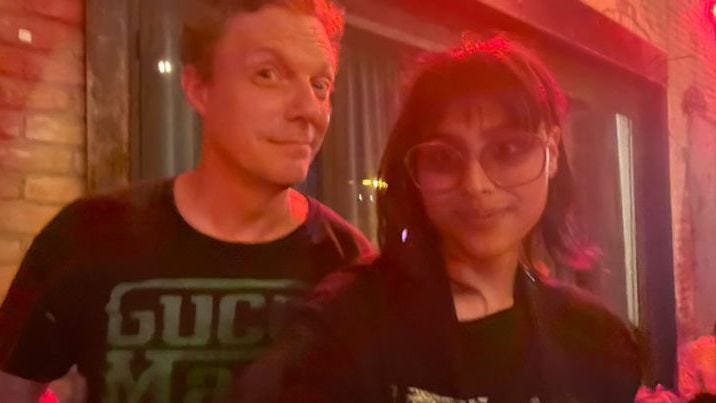
Me and Mars at Oblivion Access in Austin in 2023. Selfie by Mars.
RC: What does hauntology mean to you?
MK: Mark Fisher defined it far better than I ever could, but in the context of music I would say it refers to sounds that evoke the distance between yourself and something you remember. The core memory is important, yes, but all music evokes memory on some level. Hauntology centers that temporal distance between you and your memories along with the feelings that may summon (usually nostalgia or a nonspecific feeling of loss). To me it’s more of a guiding set of principles.
However, as a broader philosophy of ghost-like things and temporal disjunction, it strongly informs my relationship to identity (especially gender identity). My own experience of transition has been one of constant tension between past and future selves. Early on, I felt as if the future I had chosen to seal away by transitioning was still haunting me; these days what I feel is more of a sense of having the past selves live on as revenants in my body alongside who I am now. Even the phrase “who I am now” feels relatively meaningless when the present self is never without past or future iterations.
RC: How would you chart the progression of your sound over your last five records?
MK: I put together my first album Anhedonic Mirages (2020) using beats I had made across the previous 5 years which I resampled and reshaped using a lot of distortion, reverb, and grain delay. It serves twofold as an exploration of a new sound and a reflection of where I felt I existed spiritually and temporally in my transition (and by extension the way in which past and future selves behave like revenants). It’s very washed out and bathed in noise and the song structures across this project follow a sort of dream logic. The whole thing is pretty “lo-fi” so to speak; from here I’ve tried to achieve clearer and clearer mixes with each album.
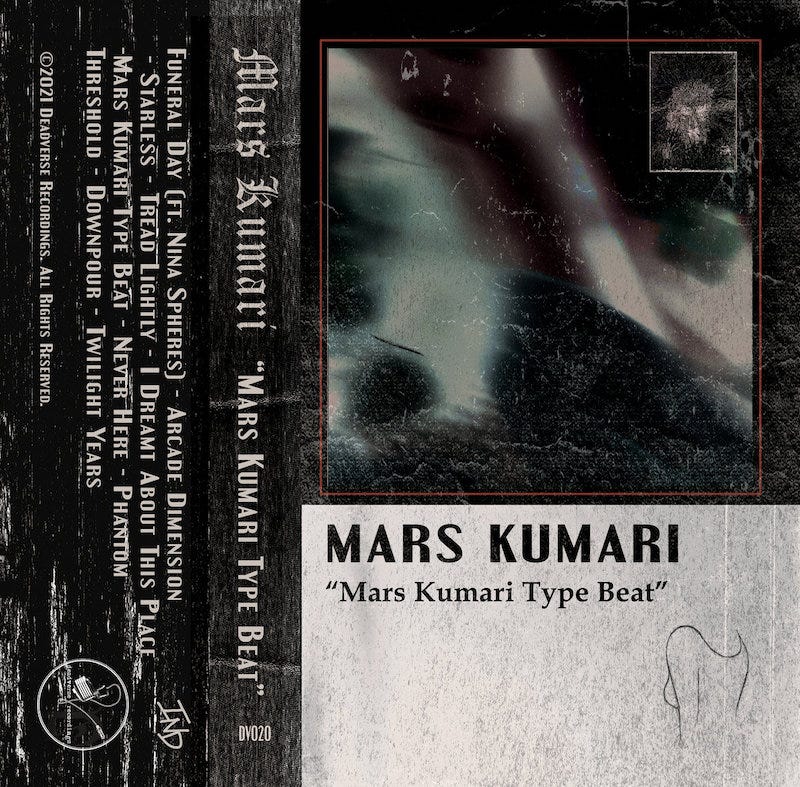
Mars Kumari Type Beat (deadverse, 2021).
I released my next project Elysian Mourning(2021) the following February. This album is a bit more sparse and dreamlike; there’s less percussion than in the last album and what is there is subdued. The drones were the focus here. I used my SP-404 extensively for this one; something I like about the original model is the way that electrical noise stacks and multiplies the more you resample something.
Mars Kumari Type Beat (2021) once again re-centers the drums. Some of the oldest beats I’ve ever put out are on here; as such it’s much more varied in its sonic pallet. There are alternative versions of tracks from the previous two albums, beats I started in 2015, and lots of samples from tape reels. I originally released it for Bandcamp Friday that August, and dälek took a liking to it and offered to put that out on deadverse. I’m endlessly grateful that he took a chance on me.
I Thought I Lost You (Bruiser Brigade, 2023).
My next album I Thought I Lost You (2023) took two years to complete and release. There were often field recordings and found sound in the backgrounds of previous albums but they’re much more in focus here, serving as leitmotifs. For example, the ambient passage at the beginning of the final track is lifted from a cassette I found with a recording of someone’s funeral. The atmosphere of that room comes through even in the absence of the eulogy. Even when these kinds of recordings aren’t so closely tied to death, the nature of them is inherently ghost-like in their detachment from any identifiable source. All you have is the recorder’s voice, the room they were in, and to a subtler extent what they were feeling. All with no semblance of an idea of who this was, what they were like, or if they’re even still alive. A voice with no name or body is a ghost in my eyes.
Anyways, I Thought I Lost You is stylistically similar to Anhedonic Mirages, but much more refined, versatile, and massive. There are elements of jungle, noise, industrial hip-hop, and plunderphonics, all texturally united with a dense veil of dark ambience. I wanted to instill a sense of immersion into a new world. Conceptually, it’s grief as a dimension. This was released via Bruiser Brigade Records and mastered by Raphy.
Daybreak (Handsmade Collective, 2024).
My latest album Daybreak (2024) is my attempt at deconstructed club, fusing hard techno and drum and bass and house with industrial hip-hop and gossamer layers of ambience. I wanted to make something that felt really crystalline and pretty that would sound great on a live soundsystem. Most of the songs here were designed for live performances, and many times I’d audition my mixes by playing them at shows and seeing how it sounded and how people responded. I try to wear my influences on my sleeve less these days, but it is very much inspired by artists like Burial, Arca, and Eartheater. I used a lot more synths and software drums here than in earlier albums (which were mostly or entirely sample-based, it’s more of a 50/50 ratio here). I’m really proud of the mix on this one. This is my first record with Handsmade Collective.
In summary, my sound has always had industrial trip-hop and dark ambient at its core, but over time has incorporated elements of deconstructed club and IDM with an increasingly glossy finish. Improving my mixing from one project to the next has always been a priority, and the results of working toward that are showing more and more in the increased clarity and scale of the sound.
RC: What’s coming up next?
MK: A full-length album with Del the Funky Homosapien has been in the works for most of the year. It’s about halfway recorded, and I’m aiming to have it out sometime midway next year. It’s tricky for me to say how it will sound given that it’s still in the works, but in a way it unites the grit of I Thought I Lost You with the gloss of Daybreak. I just started work on an LP with Dose One as well. There are other LPs and EPs planned as well, including one with my friend Q3, one with Uboa and Hook Operator, a noise EP with Lucas Abela and another solo record. Besides that, hopefully I can get a pet rabbit soon.
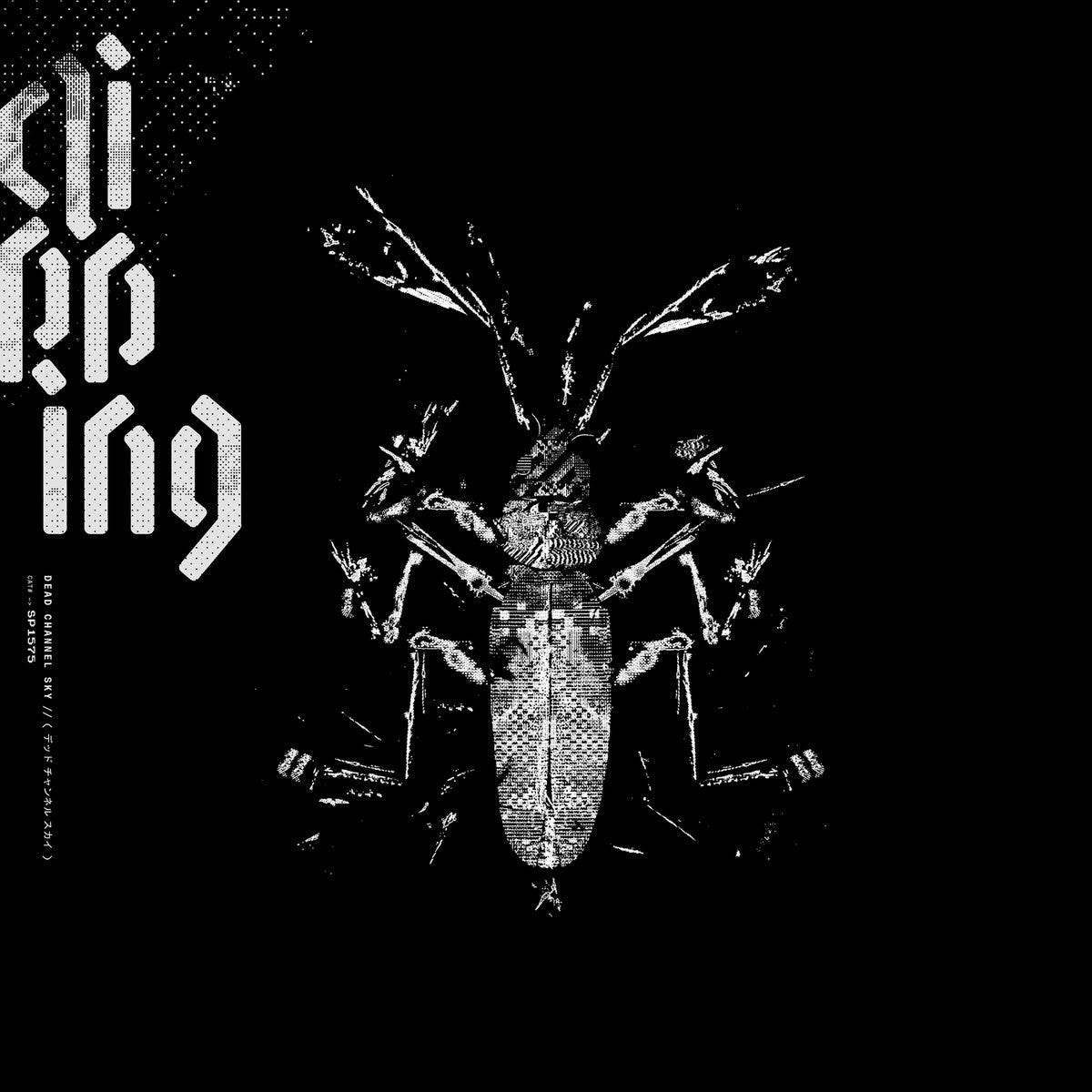
Because of their mix of hellified gangster shit and progressive compositions, I once jokingly called clipping. “Deathrow Tull.” Well, it’s not a joke anymore. While their last few projects have been record-long concepts like the classic prog rock of old, Dead Channel Sky is mixtape-like, a carefully curated collection of songs in which every track is a love letter to a possible present. Like a mashup of distinct elements, the overall concept is there, but the result is brief glimpses into a world rather than an overview of it. It sounds crisp and classic at the same time. When something strikes us as retrospective and futuristic at the same time, it’s a reminder of how slipshod our present moment truly is.
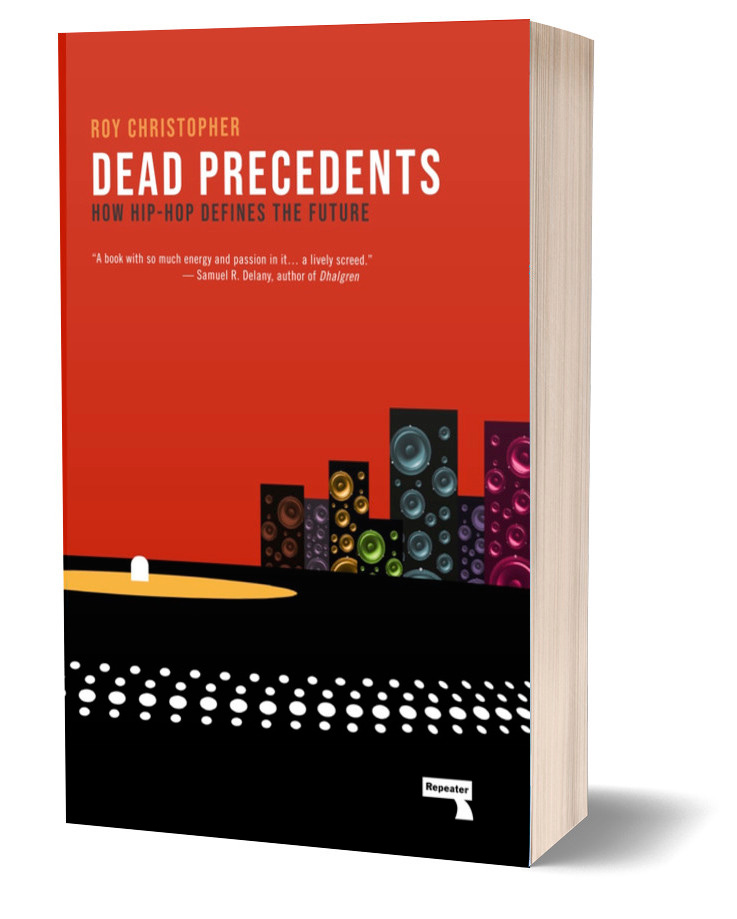
In my book Dead Precedents: How Hip-Hop Defines the Future (Repeater Books, 2019), I draw what Walter Benjamin would call correspondences between early hip-hop culture and cyberpunk literature, the binary stars of the solar system at the end of the millennium. I exploit their similarities to illustrate how the cultural practices of hip-hop have informed the cultural practices of the now. Hip-hop was borne of the post-apocalyptic scene in the South Bronx in the early 1970s. Its repurposing of outmoded technology, the hand-styled hieroglyphic screennames on every colorfast surface, and the gyrating dance moves—an entire culture forged from the freshest of what was available at hand—mirrors the post-apocalyptic techno-scrounge of William Gibson’s Neuromancer, Rudy Rucker’s Software, and other early works by the contributors to Bruce Sterling’s Mirrorshades anthology (Pat Cadigan, John Shirley, Lewis Shiner, and Sterling himself, among others). Add the leather-clad mohawks of Afrika Bambaataa and the Soulsonic Force or Rammellzee’s B-boy battle armor and a blend of the two comes further into focus.
Juxtaposing high-tech, corporate command-and-control systems (the “cyber”) with the lo-fi, D.I.Y. underground (the “punk”), cyberpunk proper starts in 1982 and ends in 1999, from Blade Runner to The Matrix. There are works before and works since that embody the visions and values of cyberpunk, but these dates act as rough parameters for their assimilation into the larger social sphere, for the time it took cyberpunk to become cyberculture. In the meantime, hip-hop matured, went through its Golden Era, then melted into further forms. Over the same decades, it went from “Planet Rock” to “Bring da Ruckus” to “Hard Knock Life,” from Fab 5 Freddy to Public Enemy to Missy Elliott, from Run-DMC to N.W.A. to Notorious B.I.G. While other genres flirted with it, hip-hop was fickle and fey. Any tryst with the odd bedfellow was a one-night stand at best. Rap and rock birthed mutant offspring maligned by most, and hip-hop’s relations with electronica rarely fared any better.
Those twin suns—hip-hop and cyberpunk—both rose in the 1970s and warmed the wider world during the 1980s and 1990s. What if someone explicitly merged them into one set and sound? Afterall, both movements are the result of hacking the haunted leftovers of a war-torn culture that’s long since moved on.
On Dead Channel Sky, clipping. texture-map the twin histories of hip-hop and cyberpunk onto an alternate present where Rammellzee and Bambaataa are the superheroes of old; where Cybotron and Mantronix are the reigning legends; where Egyptian Lover and Freestyle are debated endlessly, and Ultramag and Public Enemy are the undeniable forefathers; where the lost movements of 1980s and the 1990s are still happening: rave, trip-hop, hip-house, acid house, drum & bass, big beat—the detritus of a different timeline, the survivors of armed audio warfare. That war at thirty-three and a third, its atrocities imprinted upon yet another generation, what someone once called, “the presence of the significance of things” without a hint of ambiguity.
clipping. is very story oriented. They deal in ontology and narrative as much as beats and rhymes. They’ve been approaching making music like writing science fiction since their conception. Two of their records have been nominated for Hugo Awards. William Hutson and Jonathan Snipes both compose film scores, and Daveed Diggs is an actor, writer, and producer. As clipping., they’ve collaborated with as many of their fellow experimental noise artists (e.g., Pedestrian Deposit, Michael Esposito, Jeff Parker, et al.) as they have fellow rappers (e.g., Ed Balloon, King Tee, Gangsta Boo, Benny the Butcher, et al.). Here those co-conspirators include everyone from the guitarist Nels Cline on the outro to “Dodger” (titled “Malleus”) to their labelmates Cartel Madras on “Mirrorshades, pt. 2,” rapper/actor Tia Nomore on “Scams,” and the wordy wordsmith Aesop Rock on “Welcome Home Warrior,” among others.
Diggs is known for intricate lyrics and rapid-fire rapping, and the tracks that Snipes and Hutson build in the background are no less complex. On “Knocking in the Back,” they employ Pulsar Generator, a 1990s-era sound-particle software program developed by Alberto de Campo and Curtis Roads; on “Code,” they sample narrated memories from the Afrofuturist documentary The Last Angel of History; and on “Dominator,” they repurpose the classic Dutch track “Dominator” by Human Resource. All of the above serves to give us a glimpse of an adjacent possible present, where hip-hop and cyberpunk are one culture.
Binary stars are often perceived as one object when viewed with the naked eye. Like those twin sun systems, it’ll take some special equipment and some discerning attention to pull the stars apart on this record. As Diggs barks on the fire-starting “Change the Channel”: Listen up! Everything is very important!
When an emcee finds a producer who fuels his verbals, he keeps him close. Atoms Fam, Hangar 18, and Def Jux alumnus, Alaska found just such a fire in steel tipped dove on last year’s The Structural Dynamics of Flow. A journeyman in the pits, dove’s credits run way below the surface of things, and his pedigree shows in his ability to keep the rig moving no matter. Once again on the black circles is the inimitable Marcus Pinn, steady adding nitrous to the mix. Over numerous releases in the last few years including two from 2023 alone, Alaska has settled into a style as mature as it is versatile. He knows the course comfortably now, so he can take the turns, open it up, and just drive.
Along for the ride on Reverberations of a Dead Man’s Ego are PremRock and Curly Castro (a.k.a. ShrapKnel), who with Zilla Rocca, make up three-fourths of the Wrecking Crew. All appear on different tracks here, not that keeping them separated blunts their impact in the least. Prem and The Prophet, Fatboi Sharif, are Alaska’s accomplices on “Murder by Numbers,” and fellow Atoms Family member Cryptic One joins Zilla and Alaska on “Disappearing Acts.” There’s also Bateria, a.k.a Jedi Son of Spock, on “Imposter” and Sleeping Dogs on “Vulture Stones,” among others. Those guys are all undeniably dope, but they’re only passengers here.
Alaska never lets you forget who’s behind the wheel as he drops lyrical references to everything from classic slashers and Wu-Tang to Violent Femmes and Hunter S. Thompson. It’s fun, but it’s serious. You can feel the aging aches of “Mild for the Night” in your lower back. You can also feel the frustration on “Hundred Dollar Bills” when Alaska raps, “Yeah, I’m a nihilist, but only ‘cause I’m tired of shit.” Word to the dead man’s ego.