

Though I haven’t been keeping up with the actual lyrics, I do have a passing awareness that there’s currently lyrical beef between Nas and Jigga. This is only relevant to the following in that as much as I respect Jay-Z, he and everyone else has now fallen behind. Continue reading “One Song”
Mourning Unwound
Another one gone… Steve Albini says breaking up happens to too few bands, and usually I agree. Usually band breakups don’t bother me, but this one does. After over 10 years together, Unwound were still making some of the best music out there. And now it’s over. I am truly hurt and the music world is poorer for it.
 Unwound was easily one of the best meldings of mind and sound ever to come together on stage and in the studio. Whatever alchemy it takes to make the space between the nebulous possibilities of drums, bass, guitar, voice, emotion, timing, rage, and countless human and other factors, Justin Trosper, Vern Rumsey and Sara Lund had it in spades. Their catalog — not to mention their live shows — is absolutely phenomenal. And the last entry, Leaves Turn Inside You, was a candidate among many for their best yet. They were at the top of their game and still breaking the rules and expanding what it meant to play music.
Here’s to another band that will never suck. Even though it sucks that they’re not still together. Unwound, you will truly be missed.
Unwound: 1991-2002
MC Paul Barman: Architect of Dialect, Fulfiller of Dreams, Over-Educated MC Über Alles
 “I love that we’re talking about this right next to the water,” says a prophetic Paul Barman. We’re sitting on the beach in San Diego just outside Cane’s Bar and Grill where MC Paul Barman is playing his first San Diego gig — with Mix Master Mike no less. Our casual, pre-show chat has turned to water, and he’s turned very serious. Continue reading “MC Paul Barman: Architect of Dialect, Fulfiller of Dreams, Over-Educated MC Über Alles”
DJ Spooky: Waxing Philosophic
 I don’t wanna throw the word around here, but Paul D. Miller a.k.a. DJ Spooky That Subliminal Kid is a postmodern-day Renaissance man. He’s known for many things: music, art, theory, teaching, writing, lecturing… I know him as a friend, so that’s where this is all coming from. Continue reading “DJ Spooky: Waxing Philosophic”
Milemarker: The Only Band That Matters
The collective known as Milemarker has a vast and prolific output that encompasses much more than the average independent band: Dave Laney puts out a printed alternative media quarterly called MediaReader, Al Burian self-publishes a ’zine of his travels and views therefrom called Burn Collector (the first nine of which are collected into a book) and Roby Newton does traveling puppet shows and animations.

Milemarker songs cover many sociological topics, including many derived from living in our technology-driven culture. They liken their early records to video-game soundtracks when compared to their live sound at the time, but the aggression shows through. You see, in the studio, Milemarker preferred to experiment with sounds and samples (playing with the irony of using technology against itself), whereas live they’re more forthcoming. These two approaches finally meshed on Frigid Forms Sell (Lovitt, 2000) and grew on the recently released Anaesthetic (Jade Tree, 2001). The most important thing about Milemarker is that they will force you to think about things — even if you’re already thinking about things. They stir the corporeal, the angst, the spiritual core, and the cerebrum simultaneously. As a collective, they represent the epitome of the new paradigm of artist: one with fingers that run deep in many pies.
The Clash once called themselves “The Only Band That Matters” and Rolling Stone once called Fugazi the same. Milemarker has earned the title through years of hard work, expansive vision, and downright challenging music.
Roy Christopher: As a collective of individuals with a steady, varied, and prolific output outside of the band, what is it that drives you to do so much?
Al Burian: I feel like I do the band because there is this abstract entity of a band and it wants to be realized somehow — it wants to be a band. And then I feel like I do other things outside of the band because there are things I feel like expressing which don’t necessarily fit into the agenda of what the band is expressing.
Dave Laney: I’ve tried to tailor my life in a fashion that allows me to spend more time on the things that I actually want to be doing. I love to play music and travel, so I play in a band. I am also horribly  obsessive/compulsive, so I started a magazine which requires tons of time to be spent doing horribly mundane things. At this point, I’m actually forced to be spending my time doing these things instead of working a normal job — the mail keeps piling up and someone has to write back. Actually, I started MediaReader because I felt like the average DIY music magazine was ignoring a large part of the “community” that they advertised as covering. The idea with MR was to serve as a less specific type of magazine: not always political, not always musical, but always trying to be critical with a constructive edge to the criticism. There comes a time when you can’t complain about things anymore and you just have to force yourself to pick up your own complaints and create that new thing.
RC: Tell me about the new record, Anaesthetic. Is there a theme or specific issues addressed as there was with Frigid Forms Sell?
AB: Well, it’s sort of a secret theme. All of the lyrics and recording information are hidden in the packaging, so the idea is that the record initially seems to be about nothing, just a pretty object, all aesthetics. The idea is to make people pay a little more attention, sort of to involve the listener a little more actively in the process of figuring out what the record is about.
 DL: The themes contained in the songs vary more, compared to FFS. I actually think that the new one is the most political and socially relevant album that we have released. That was part of the idea with hiding the lyrics, as well. I think that the music is more accessible on the new album, enough so that we knew we would get hell from old friends that knew the band from the get-go. To go along with what we felt would probably be the first instinct from these people, we decided to try to double their reaction and make them second guess themselves later on. That was the idea anyway: have people come up and say, “new label, new sound, lyrics about love — what gives? What are you guys doing!?” When in reality I feel like we bumped it up a notch. At least on a personal level it feels like that. Whereas the overwhelming theme of FFS was commodification and the dumbed-down way that we are taught to relate to others through the way that we relate to products, Anaesthetic contains songs about gentrification, the atrocities of textile sweat shops, modern disconnection, terminal illness, and so on. I feel like throwing yourself into the mix is a big part of relating to other people, and of being able to step past sheer social commentary from the position of an untouchable critic.
RC: There seems to be a lot of Michel Foucault’s influence on Frigid Forms.
 AB: You are making some pretty grand assumptions there, young man. In fact, I have never read Michel Foucault. I was assigned some of his writing in college but I did not do the reading that day. My housemate claims that her entire college cultural studies major was essentially majoring in Michel Foucault, but I only remember her doing various video projects which involved wrapping herself in tin-foil. And considering that, perhaps I should investigate this Foucault fellow.
DL: Ha ha. I, myself, years ago, had read some short thesis of Mr. Foucault, but to be honest, I can not even begin to tell you what it was about. Maybe I should, as well, do some investigating.
RC: Richard Metzger once said that the most subversive thing one can do is to become popular. In the spirit of this quote, I have often argued in defense of bands like Rage Against the Machine, stating that — in spite of the fact that they create revenue for evil companies such as Epic/Sony — they reach and influence more kids than any activist-minded indie band (and probably lead kids to those bands eventually anyway) can. What do you (as an activist-minded indie band) think of the “mainstream vs. underground” debate and said point of view.
AB: I assure you that neither Rage Against the Machine, our band, nor any other band that has ever or will ever exist has subversion in mind when seeking popularity. The pursuit of popularity has to do with deep-seated feelings of personal inadequacy, usually left over from traumatic experiences such as being chosen last for the kickball team in grade school or something like that. Now me, personally, I don’t have any quibbles with the political platform of Rage Against the Machine, the Foo Fighters, the post-Buddhist Beastie Boys, or any of that type of music. My main concern is, when you examine the average mosh pit at one of these events, sure, those guys are all wearing Zapatista T-shirts, they all signed the Mumia petition, but take a closer look: aren’t those pretty much the same guys who were picking you last for kickball back in the olden days? Everyone has a right to enjoy music, and if Rage Against the Machine is willing to handle this demographic, so be it, but the point is that I don’t want to be around those people. I’m not into hanging out with those guys, they weren’t nice to me in grade school, I’m still bitter about the whole thing. That is the difference between “mainstream” and “underground” to me: do you want to convert the maximum number of people to cause X or T-shirt slogan Y, or do you want to help build a culture where people who feel alienated can find some commonality.
DL: That’s a difficult, ongoing debate. I do mostly agree with what Al said, but also think that there is some break point to the oversimplification. A lot of what I spend time doing is trying to build and support the community that I consider myself part of. There are limitations and compromises to everything, and I think it’s important to distinguish between the differences of building a community and solely maintaining a community. In order to build something, you have to broaden awareness about things and reach people that already don’t have the exact same political platform or ethics as yourself. This is the argument that I assume RATM would use as justification to touring with the Wu-Tang Clan and going the route that they did. RATM is really a weird phenomenon case study in the history of this argument, which is another reason why people use them all the time. There is also Fugazi, who went a completely different route, built what they have by themselves, and still hit an enormous audience. Even they have to deal with a huge contingency of football player jock types at their shows, buying their records, misinterpreting their lyrics, etc., but I do believe that when you look at the greater picture of the examples that both bands have set, it comes into focus very quickly that Fugazi did all this stuff with much more integrity in tact than RATM. Both of these bands are seemingly flukes of the modern rock industry, and both are hard to compare to the average indie rock band.
The overbearingly truth is that major label ethics can be very, very sleazy. From the little bit that I’ve seen from friends of mine that have signed on to the major game, everything changes completely. Even in a strict financial sense, history has proven that it works out for very few bands, and even when it does, I’m not into an economy that (to quote from Steve Albini’s article in the ages-old Maximum RocknRoll issue on major labels) makes the label $710,000, the producer $90,000, the manager $51,000, and, finally, the band $16,000. The real atrocity here is that the label made forty-five times more than the band, and the guys getting the kickbacks off the band probably know little to nothing about the band. There have been countless articles written on this, and there have been major-label bands that superceded the law, bands like Beck. But still, and keep in mind that this paragraph is only in reference to the finances and not the “artist shall have all control over her art” type thing, to go into one of these deals is a gamble that is usually lost by the band. It has, sadly, been proven over time. Which is to say that to encourage someone to be the next RATM is to encourage someone to shoot themselves in both feet.
Lately I’ve been almost obsessing over the idea of other people making money off of me working. I quit my job and got a job at a nonprofit, where there are no kickbacks to dudes in suits or higher-up positions. Of course, I recently got fired when I left for three months of touring, but I liked the place. There was no attitude, barely any superiors, and I felt good about what I was doing. In response to your question “do you think that getting famous is the ultimate act of subversion?” I say, no: getting famous on your own terms is the ultimate act of subversion.
RC: Whom do you read and respect?
AB: Milan Kundera’s Unbearable Lightness of Being (Harper & Row, 1984) is a good book; I also like Don DeLillo a lot, particularly White Noise (Viking, 1985). Jerry Mander’s Four Arguments for the Elimination of Television (William Morrow, 1978) is a good nonfiction choice. Orwell, Camus, Kafka, Salinger are good classics. Recently I’ve been getting really into the author John Fante.
DL: I’ve always been into the old Russian writers. Dostoevsky is my favorite. Tolstoy and the like, Camus (though French), Mark Twain. I know, I know, all this stuff is as old as rocks, but fantastic nonetheless.
RC: What made technology such a major theme in Milemarker songs?
AB: People occasionally misinterpret our band as very sci-fi and future-obsessive, when this is actually not the case at all. For instance, the opening line of Frigid Forms Sell:
We keep waiting for the robots to crush us from the sky
They sneak in through our fingertips and bleed our fingers dry.
Sounds like the press kit to The Matrix, but the giant robot has been a popular allegorical symbol since World War II, particularly in Japanese cartoons and movies, I would say clearly representing anxiety over nuclear war. So the point there is that we’re all looking for the big, instantaneous Armageddon ending (witness people’s susceptibility to Y2K panic), while the actual dangers are right under our fingers, in the small and mundane encroachments technology makes into our daily lives. An example: I was talking to my co-worker the other day and she mentioned how she has to get a stronger prescription for her glasses. She said that the eye doctor had told her that her eyesight would continue to deteriorate unless she stopped working with computers. “But in this day and age I don’t really see how I can do that,” she said. It struck me as really crazy that this person was literally making the choice to give up her eyesight so as not to go against the status quo of technological advancement. That’s a totally fucked-up world to be living in, and this is the sort of thing that people deal with right now on a daily basis. So I think the root of any technological obsession or phobia you might pick up on just comes from being freaked out about the contemporary state of things.
DL: Al is the real technology freak. He has written most of the songs that are about such things. I’ve always thought that his best subjects come from observing the world around him, figuring out what makes him feel uncomfortable or alienated, and writing about that discomfort.
RC: Anything else you guys are working on that you would like to bring up here?
AB: Dave and I are always working on some printed matter or other; the new MediaReader should be out soon enough, and my ’zine Burn Collector should have a new issue out, oh, who knows when, probably not for a while. You can contact PO Box 641544, Chicago, IL 60644 for more info about these publications. Roby continues to make things at such a furious pace that anything I could mention would be outdated before I even finished typing. She’s been contemplating putting together a video compilation of her puppet shows, which I wish she would do some day, as the world would be a kinder and more palatable place if such an object existed.
DL: The new issue of MediaReader, issue #5, should be completed by mid-January and set to go on tour with MM (U.S. tour Jan/Feb). Should be pretty exciting this time around. A bit bigger, a lot fancier, and still free.
Paul D. Miller a.k.a. DJ Spooky: Subliminal Minded
 If ever there were a postmodern-day Renaissance man, he is Paul D. Miller. Painter, philosopher, social scientist, DJ, author, and producer (among others) are all hats that fit snugly on his head. He is probably best known as “DJ Spooky aka That Subliminal Kid,” but this is only one of many roles he has taken on and made a success of in a process he calls “social sculpture.” He’s also the only DJ I’ve ever seen cut up a Marshall McLuhan record, closing the loop in more ways than one. Continue reading “Paul D. Miller a.k.a. DJ Spooky: Subliminal Minded”
KRS-One: The Lyrical Superhighway
 More than anyone else out there today, KRS-One embodies all that is pure and true about Hip-hop music. He is the only artist who had a record out in 1986 who can still rip mics live as good or better than anyone attempting the art form since. Continue reading “KRS-One: The Lyrical Superhighway”
…And You Will Know Us by the Trail of Dead
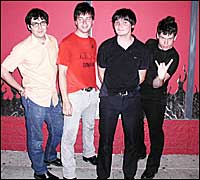
“We’re not just a band,” Conrad Keely stated rather matter-of-factly. Conrad is one-fourth of the now Austin-based and long-monikered …And You Will Us By The Trail Of Dead. He wasn’t trying to sound pretentious. I was probing him about the band’s dabbling in other forms of expression, specifically his own forays into the visual arts.
“I was originally in the visual arts. I was going to be a comic artist when I grew up. When I was a wee boy of 12, I was really into the X-Men.” Has this interest carried over into his involvement with music? Indeed it has. “One of the great things about music these days is that there’s so much emphasis placed on multimedia. And even if you’re just a visual artist, I think that there’s a lot to be gained from doing a lot of multimedia. And music seems to be like the pinnacle of multimedia where you’ve got a lot of pop stars doing these great installations on stage and they’ve also got websites and stuff like that. Entertainment on that level really runs the whole spectrum of communication: television, video, visual arts, costume design… We generally feel like everything – even the album cover art – is as much a part of the band as any of the songwriting.”
I made the mistake here of mentioning that Jackson Pollock once said that he was trying to paint what music sounded like. Or something to that effect.
“Well, I hate Pollock,” Conrad quickly retorted, “… but that almost gives me an appreciation for his stuff!”
“What was he listening to?” added Jason Reece, friend and band member.
Sonically, The Trail of Dead (as their cumbersome name is often shortened to for convenience) explore the darkest regions of emotion. As evidenced on their two full-length releases, Madonna (Merge, 1999) and their self-titled debut (Trance Syndicate, 1998), theirs is a heavy stack of despair, rage, regret and melancholy crumbling and falling like so many monoliths neglected and decaying. Taj told me that while he lived in Austin, he saw these guys play live five or so times and that they were completely different everytime: at once noisy and chaotic, another very orchestrated, another quite electronic-based and yet another straight-out punk rock. The shit is catchy though. Contagious even. It gets under your skin, burrows and festers until you can’t leave it alone. And they’re not really so sad.
In fact, they’re a bunch of jokers. Attempt any inquiries into the history of this foursome, and you will then know them by the trail of bullshit.
“We started in Plano, Texas,” began a smirking, unable-to-maintain-eye-conact Jason Reece. “A town about 75 miles away from Austin. It’s a small town with like one church and one general store, two bars and one decreped old movie theater… Basically we met in this church youth group and we had a youth minister who helped guide us. With his help, we managed to play music for the church for a while. It was like Christian rock with uplifting chord changes and modulations, but for some reason we started getting a hold of dangerous books and music and that seeped into our music and it created a darker sound. We started changing too. We started getting more and more corrupt. I guess to them we were going to the Dark Side. So we were cast out of our church and exiled to Austin and that’s where the Trail of Dead really got its start…”
“What was the question?” Conrad joined in, returning from getting himself a drink.
“I was asking about the history of the Trail of Dead and Jason here was giving me a line of crap,” I said to clarify the situation.
“Oh,” Conrad said laughing, “That’s what he’s good for.”
“We don’t like to talk about our history that much because our history seems to change day by day… We change history everyday,” Jason said and they both smiled.
“Somebody asked me the other day where we got our name from, and I made up something about it being the last warning Boadicea gave the Roman generals,” Conrad added laughing (Boadicea was an ancient British queen where, upon annexation of her kingdom by Rome, she led a ferocious revolt before finally being crushed by the Roman army).
The truth, as far as I’ve been able to discern, holds that Conrad and Jason met in Hawaii, moved to Olympia (where Reece was an explosive member of the notorious Mukilteo Fairies) and finally to Austin where the Trail of Dead proper was formed. When and where Neil Busch and Kevin Allen came into play is still a mystery. Like so many other things about the Trail of Dead. Reader beware though. Truth is relative with these guys.
As a final case-in-point, Jason closed our talk with, “This is my last interview because I’m dying soon.”
…And You Will Know Us By The Trail Of Dead is indeed not just a band. It’s a multi-layered, nonlinear, sonic enigma. It is everywhere. And it exists because.
[Copper Press, 2000]
[photo by Jessica Raetzke]
Unwound: Our Own Way
Unwound represents a true rarity in the cluttered and mundane music milieu that engulfs us here in the late nineties. Hailing from the small but prolific indie community of Olympia, Washington, Unwound does their own thing, makes consistently incredible records, and earns respect from everyone who counts.

Justin Trosper (vocals/guitar), Vern Rumsey (bass), and Sara Lund (drums) have proven themselves time and time again as an undeniable positive force against lame music and attitudes everywhere. With their sixth proper album, Challenge for a Civilized Society (Kill Rock Stars), they’ve once again pushed boundaries that they set with their previous records. Each recording has moved in a seemingly different direction around a solid hub of ideas both musical and socio-political.
“Well, sometimes you go into the studio with an idea, and you come out with something totally different,” Justin explains. “At least that’s what usually happens to me. Every one of our records has its own purpose. I don’t think we’ve aimed too high and I don’t think any of our records are perfect.” But they are very mindful of recording techniques and the studio as an instrument. “We just started building an eight-track studio and trying to learn more about recording.
There’s always been a veil of mystery surrounding this trio, partly due to their selectivity when doing interviews. “We’ve done lots of interviews just not with any major magazines,” Justin says, “but we’ve always done interviews with fanzines. We don’t have any problems doing interviews. We’re just cautious.” This understandable caution comes from music journalists’ propensity to lump bands into movements or scenes that they have nothing to do with in an attempt to pigeonhole the band’s sound or attitude. Unwound has been called “The West Coast Fugazi” and “The West Coast Sonic Youth” more times than I’d like to count, but they don’t have much in common with those bands other than their independence and the fact that they’ve toured with both. “I feel like we have our own thing,” Justin says seriously. “Definitely earlier on we were inspired by those bands, but now when people say that, I don’t really have anything to say about it.”
Unwound’s caution toward the music industry and their staunch independence also spill over into their emphatic dedication to their roots. All of their proper records have been released by Olympia-based Kill Rock Stars, and they’ve tried to keep ticket prices at their shows down as well. “It’s pretty hard to have five-dollar shows everywhere now. A band like Fugazi can pull it off ’cause they can kinda do what they want, charge five dollars, and everybody still gets paid. We can’t do that yet, but we still try to keep our shows down to five or six dollars. Then at least if we play a shitty show, it was only five dollars, and that’s not that big a deal. The money was still better spent than going to see some bad Hollywood movie. We’re just into sticking to out roots with the five-dollar shows and staying in Olympia instead of moving to a big  city and trying to have a higher profile. Sometimes it’s really boring, but there’s definitely a community here.”
As it gets harder and harder to find a decent listen through all the shit that just keeps coming out, rest assured that where there is a fertile independent music scene like Olympia, there will always be an Unwound putting out true-to-the-core good music.
[Originally published in the June 1998 issue of SLAP Skateboard Magazine]
Godflesh: Heads Ain’t Ready
 “I think Hip-hop is more important than any sort of Rock music,” states a resolved Justin Broadrick matter-of-factly. “Most of the beats are fatter and heavier than your average Rock n’ Roll riff.” Justin is the head of one of our planet’s most brutal ensembles. England’s Godflesh plows monolithic basslines and ear-searing guitar riffs over Hip-hop’s most brutal breaks. Their sound has been pummeling eardrums for nearly a decade now, and most of their fans don’t even get where the music is coming from. You see, Justin is a total Hip-hop junkie. Continue reading “Godflesh: Heads Ain’t Ready”