Skateboard and BMX zines defined my formative years. Those handmade, photocopied publications were our network of news, stories, interviews, events, art, and pictures. It’s very difficult to describe how an outmoded phenomena like that worked once such epochal technological change, one that uproots and supplants its cultural practices (i.e., the internet), has occurred. FREESTYLIN’ Magazine’s reunion book, Generation F (Endo Publishing, 2008; flip through it at the link), has a chapter called “The Xerox was Our X-Box,” and that title gets at the import of these things. As I said in that very chapter, “Making a zine was always having something to send someone that showed them what you could do, what you were up to, and what you were into. Ours was the pre-web BMX network.”
A small sample of my zines over the years.
At best, zines represent a hidden circuit of media, a grassroots exchange of information and ideas that slips through the cracks of popular culture. Zines are power in the hands of the fans. As Mark Lewman, editor of FREESTYLIN’ Magazine and head of Club Homeboy, as well as “Chariot of the Ninja” zine, points out, “The first zine I did once I moved to California was called ‘Homeboy’. I did one issue and some stickers, and it ballooned into a mail-order lifestyle company with 15,000 members, and became one of the first youth culture magazines, a pastiche of art and sport and randomness. So, the power of zines is pretty unlimited as far as I can tell.”
In spite of the proliferation of the internet, zines are not entirely a thing of the past. Every time we do something on our own instead of just taking what’s given to us, we strike a blow to the massive media machine that constantly shoves products and personality down our throats. Making your own zine is not only immeasurably rewarding (ask anyone who’s ever done one), but it gets your point of view out there and incites dialog between readers, riders and other zine-makers that wouldn’t necessarily take place.
Independent journalists wield the power to expose local underground talent as well. There were always obscure riders in sporadic locales ripping like top pros. There are always great bands no one has heard. The way to get them noticed was not to bug out about major magazines’ lack of attention, but to give the magazines a reason to pay attention. As ex-editor of Faction BMX Magazine John Paul Rogers puts it, “Quit bitching and get off your ass and do something about it.”
So, though they’re as much a part of the process anymore, I cannot overstate the importance of the experience of trading and making zines. There’s something to the physicality of the pages in your hand and the focus on those pages that pixels on screens don’t afford. As I said in FREESTYLIN’ Generation F, “Those first issues were the first steps on a path I still follow.”
Still true.
Portable Document Formats:
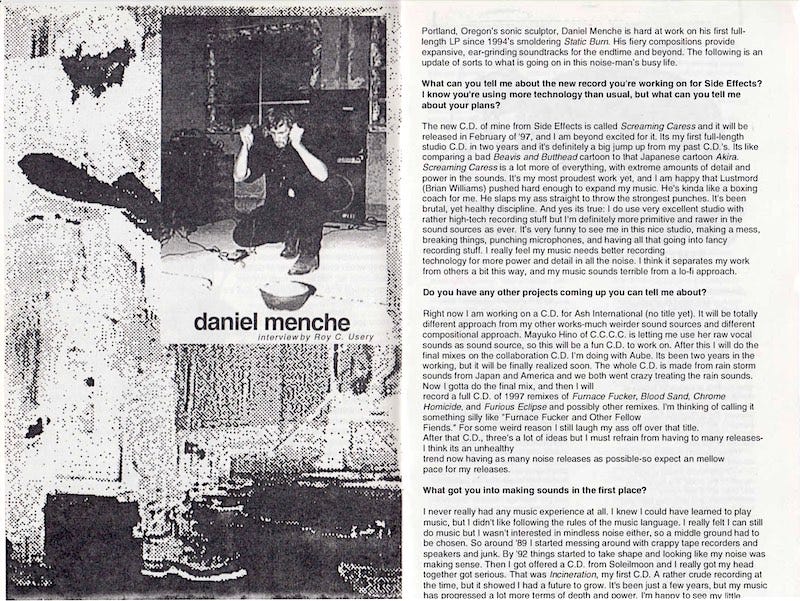
My Daniel Menche interview from wow&flutter.
If you’re interested, I scanned and uploaded a couple of my later zines as .pdfs. wow&flutter (1997) was an attempt to bring together experimental noise of all kinds and featured interviews with Daniel Menche, John Duncan, and a cover story about turntablism. It was intended as part of a series, but the second issue, attack&decay, featuring interviews with Jack Dangers of Meat Beat Manifesto and Warren Defever of His Name is Alive, among others, never made it to press. I still love the idea of noise and hip-hop coming together, and there are others who’ve merged them in the meantime better than I could have imagined (e.g., dälek, clipping., Ho99o9, Death Grips, Cloaks, Justin Broadrick and Kevin Martin, et al.)
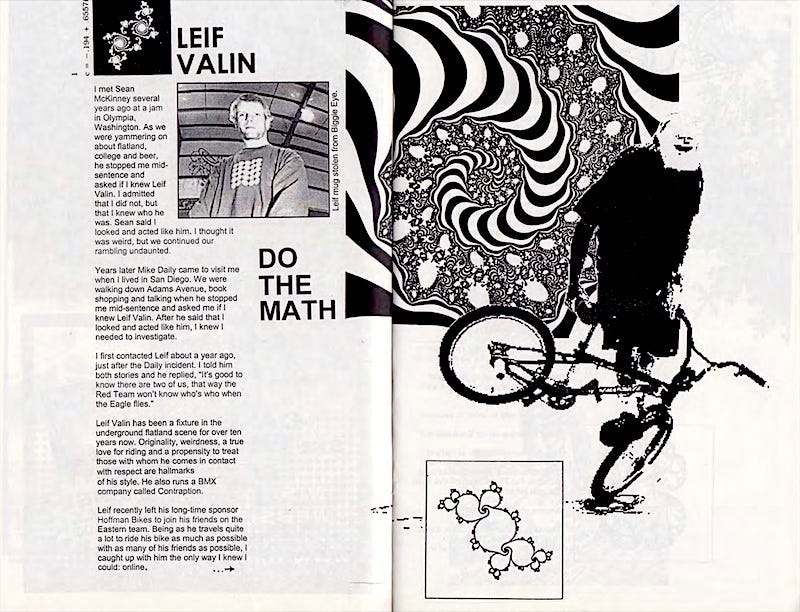
A spread from HEADTUBE featuring Leif Valin. [layout by me.]
HEADTUBE (2001) was my attempt to return to BMX zine-making while maintaining my other, newfound interests in the early 00s. Though I maintained the website for years after, the zine ended up as another one-off print publication. It features interviews with Seattle ripper Steve Machuga, flatland guru Leif Valin, and the band Milemarker, as well as reviews of books, records, and other media. I still have a few copies of the print version. Let me know if you’re interested.
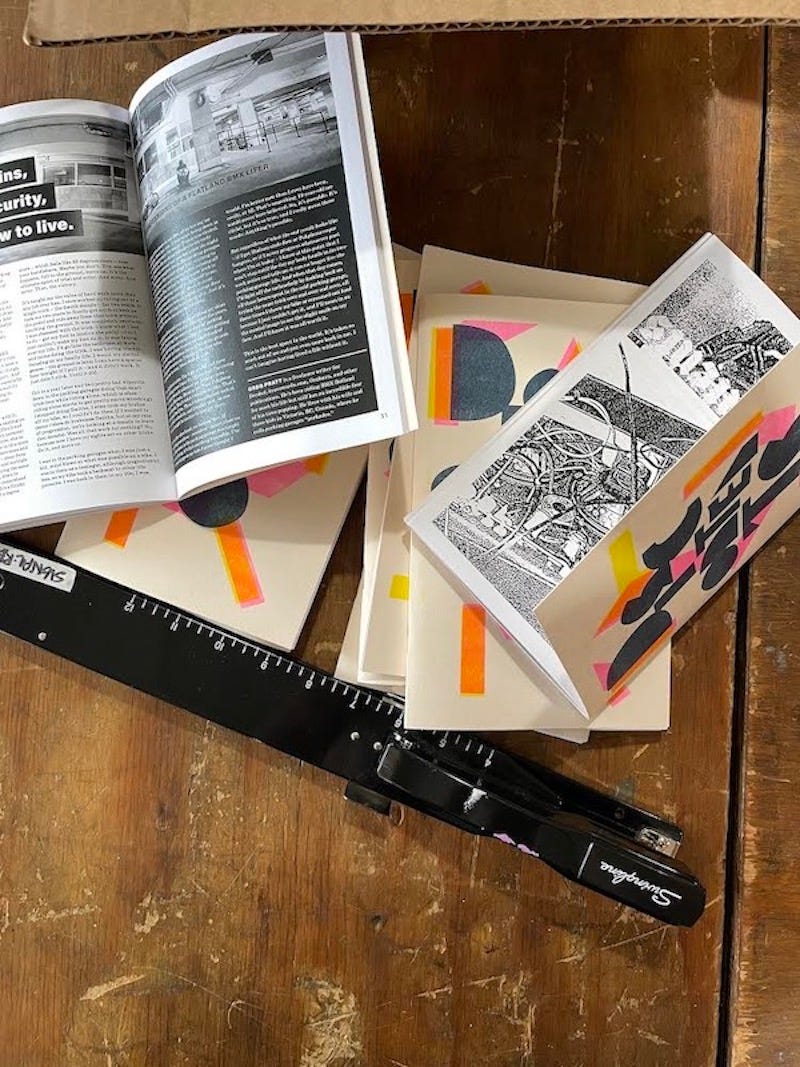
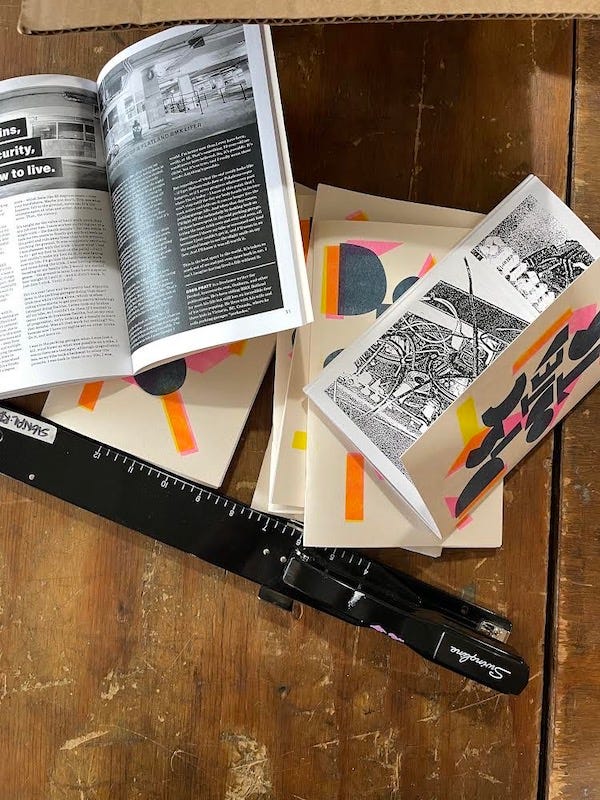
The pilot issue of discontents and the long-arm stapler: a zine-making essential.
Oh, and if you missed the pilot issue of discontents, the latest zine I worked on with my friends Patrick Barber and Craig Gates, we’re working on a proper debut issue. More on that soon!
I’m stoked to announce that next week I’ll be joining the teaching faculty in the School of Communication at the University of North Florida, thus ending three years of unemployment. I’ve been calling this my “Radical Sabbatical,” as I spent a lot of time on my BMX bike and my skateboard, but I also did a lot of writing. I really did a lot of writing.
I looked hard for a job when I left my last one in June 2020, but it being the early months of the COVID-19 lockdown, I quickly found that no one was hiring. Fortunately I’d been able to save a lot of what I’d made at my previous position, so I decided to just try to earn it. My dad always says to make sure you accomplish something every day, so I applied a strong reading of that advice and got to work.
So, as I start a new phase, what follows is a brief roundup of the results of my Radical Sabbatical. Read on!
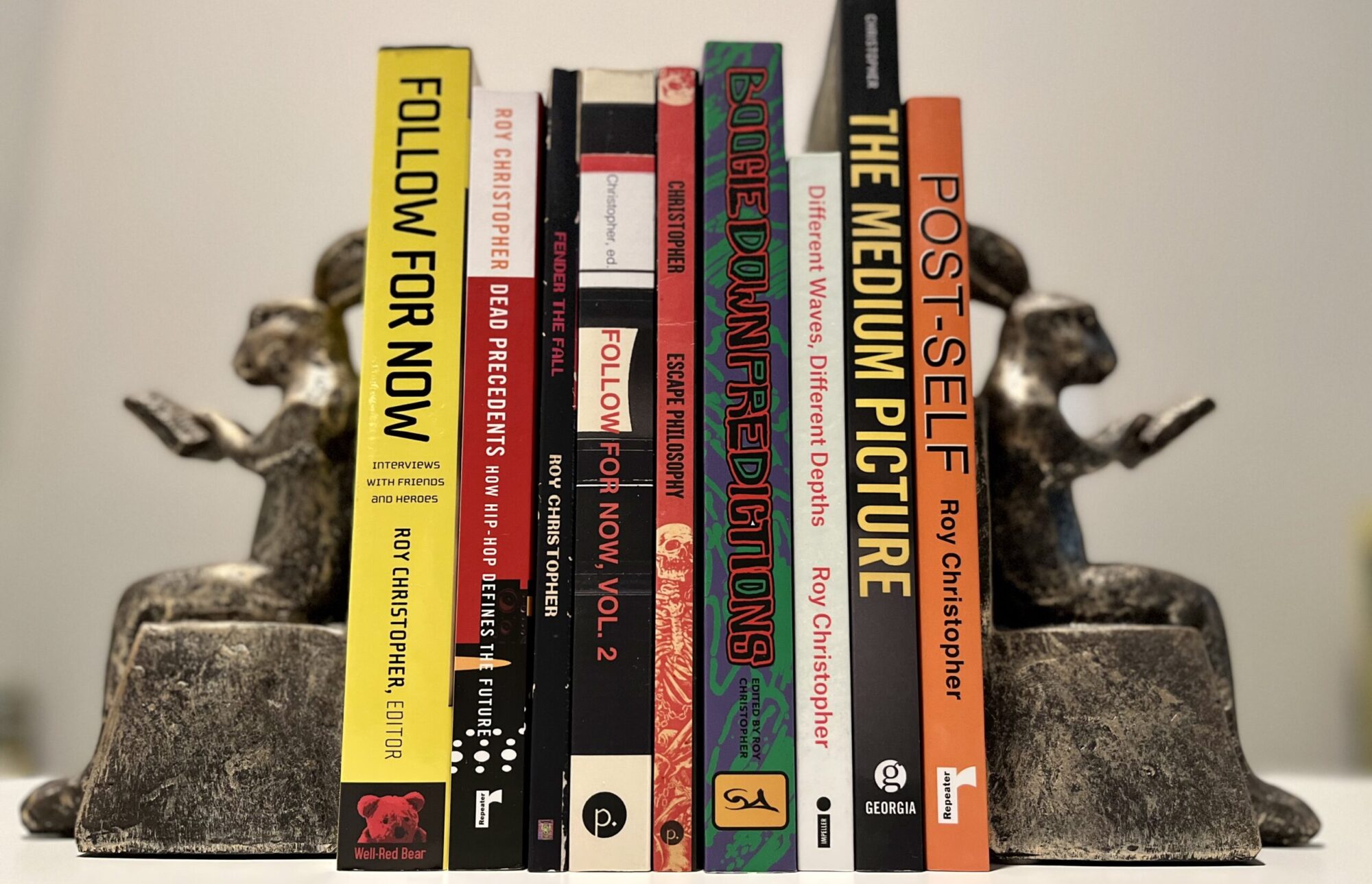
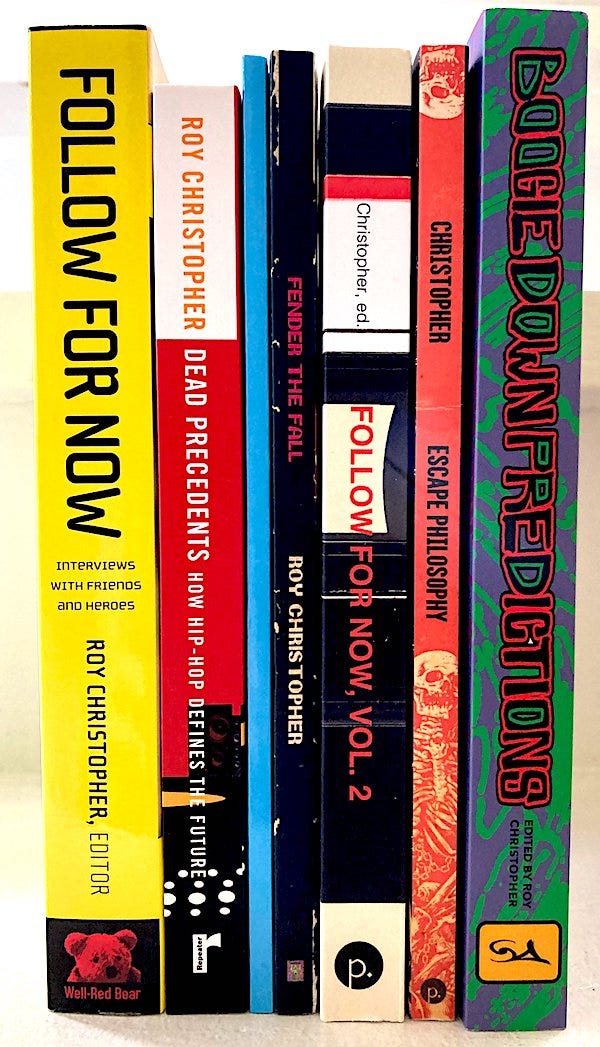
A few spines of mine.
Abandoned Accounts
When the lockdown started, I found it difficult to focus on the larger projects. In the months before, I’d started writing silly little poems about odd memories I had, tiny stories that didn’t fit anywhere else. I went back to those when I couldn’t think any larger. I eventually moved on to short stories and finally back to book-length writing, but not before I amassed a small pile of poems.
Abandoned Accountscollects those silly memories I started writing down, including reflections of walks in the woods at my parents’ house in the hinterlands of southeast Alabama, encounters with favorite bands and somewhat famous people, tales of travel and intrigue, and a few stray poems from as far back as 1990. It was an unexpected project, and I’m really proud of the results.
Fender the Fall
Fender the Fall is a short story about Chris Bridges, a lovelorn physics graduate student who goes back in time to return the journal of his high-school crush in order to save her life and his marriage. As you might expect, the plan doesn’t go as planned.
Tagline: You don’t know what you’ve got until you get it back.
It was briefly available as a standalone novella from Alien Buddha Press. I was fortunate enough to get Matthew Revert to design the cover and Mike Corrao to do the typesetting. As a result, it was a sharp-looking little book.
Though the novella is no longer in print, it will be included in my forthcoming short story collection, Different Waves, Different Depths (see below).
discontents
My friends Patrick Barber, Craig Gates, and I put together the pilot issue of a new zine called discontents. The content covers the usual concerns: music, movies, books, and poetry. We reached out to all of our old zine-era friends, so it includes writing by Cynthia Connolly, Peter Relic, Andy Jenkins, Spike Jonze, Fatboi Sharif, Timothy Baker, and Greg Pratt, artwork by Zak Sally and Tae Won You, as well as work by Patrick, Craig, and myself. Subjects include Ceremony, Unwound, Hsi-Chang Lin a.k.a. Still, Charles Yu’s Interior Chinatown, Crestone director Marnie Elizabeth Hertzler, Coherence director James Ward Byrkit, and others.
We did this one as a proof of concept (high-end content, lo-fi production) and will be releasing a full debut issue in the near future.
Follow for Now, Vol. 2
My second interview anthology, Follow for Now, Vol. 2, picks up and pushes beyond the first volume with a more diverse set of interviewees and interviews. The intent of the first collection was to bring together voices from across disciplines, to cross-pollinate ideas. At the time, social media wasn’t crisscrossing all of the lines and categories held a bit more sway. Volume 2 aims not only to pick up where Follow for Now left off but also to tighten its approach with deeper subjects and more timely interviews. This one is a bit more focused and goes a bit deeper than the last. It includes several firsts, a few lasts, and is fully illustrated with portraits of every interviewee.
“Relentlessly stimulating and insight-packed, Follow for Now is the kind of book I’d like to see published every decade, and devoured every subsequent decade, from now until the end of humanity.” — Maria Popova, Brain Pickings
There’s an updated version of Follow for Now, Vol. 2 coming soon!
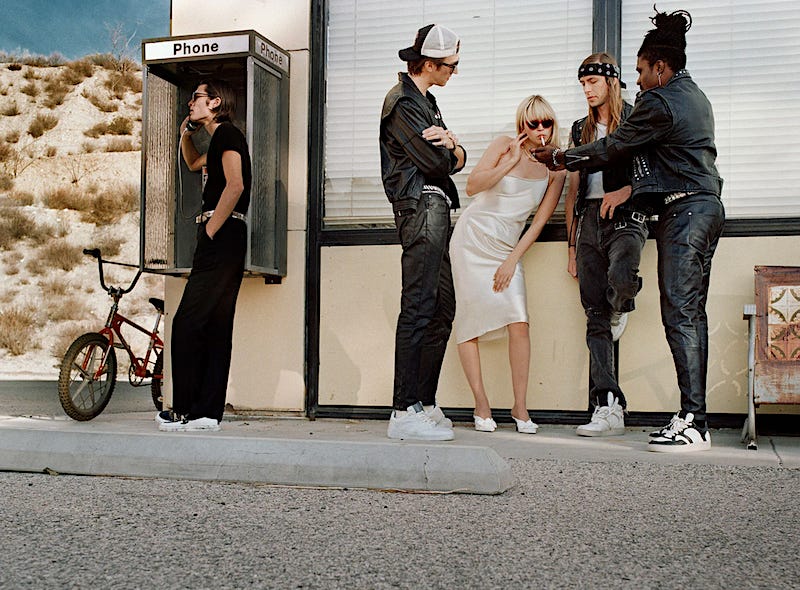
Midnight Diamond by Human Recreational Services.
Human Recreational Services
My old friend Erik Ellington asked me to write some things for his luxury shoe brand, Human Recreational Services. The collection I worked on is called Midnight Diamond, and I have to include it here as it was one of my favorite opportunities from the last few years. Here’s one bit I wrote:
As if trapped in a photograph by Ed Ruscha hanging on the wall in a David Lynch film, a young couple find themselves stranded along the lost highway in the deep desert. At a gas station, they stumble upon a door that leads to unexpected delights, a sudden contrast to their desolation. Figures emerge from the scene promising not safety but salvation, their boots made of distressed leathers studded with jewels, their movements imbued with the gestures of ceremony. Shoes sparkling in the sand, secret messages from parties hidden in back-masked 1980s metal. The flickering signifiers of ritual, dirty glamour marked by the patina of time. Midnight Diamond blends surrealism and serendipity with mystery and metaphor. Mining diamonds in the desert rough, uncertain times demand the discovery of unseen strengths in unexpected places.
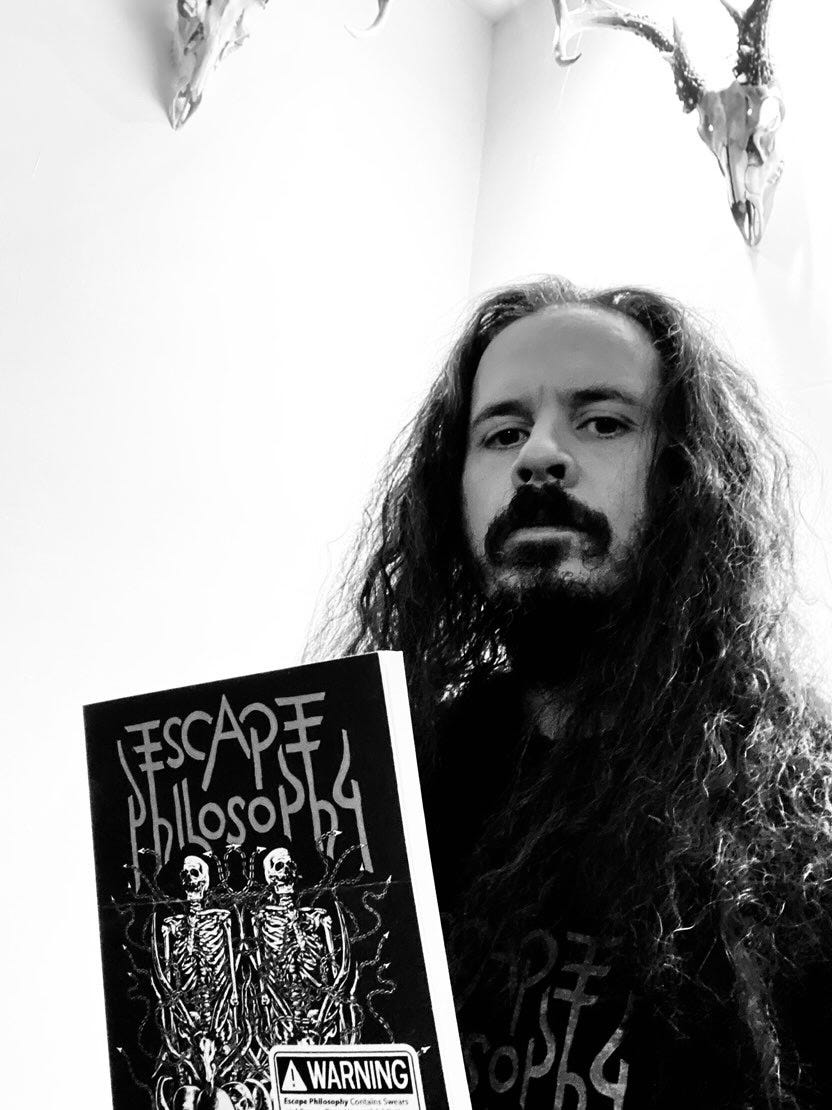
Using extreme examples from heavy metal music and science fiction and horror movies, Escape Philosophy: Journeys Beyond the Human Body is a survey of all the ways we try to shuck off the shackles of our physical forms.
“Too often philosophy gets bogged down in the tedious ‘working-through’ of contingency and finitude. Escape Philosophy takes a different approach, engaging with cultural forms of refusal, denial, and negation in all their glorious ambivalence.” — Eugene Thacker, author, In the Dust of This Planet
“An interesting read indeed!” — Aaron Weaver, Wolves in the Throne Room
There’s a new edition of Escape Philosophy forthcoming. More on that soon!
Boogie Down Predictions
While I was writing my book Dead Precedents: How Hip-Hop Defines the Future (Repeater Books, 2019), I gathered up some friends, and we put together an edited collection as sort of a companion to Dead Precedents. Time was one of the aspects of both hip-hop and science fiction that I didn’t get to talk about much in that book, so I started asking around. I found many other writers, scholars, theorists, DJs, and emcees, as interested in the intersection of hip-hop and time as I was. As I continued contacting people and collecting essays, I got more and more excited about the book. Boogie Down Predictions: Hip-Hop, Time, and Afrofuturism is a quest to understand the connections between time, representation, and identity within hip-hop culture, as well as what that means for the culture at large.
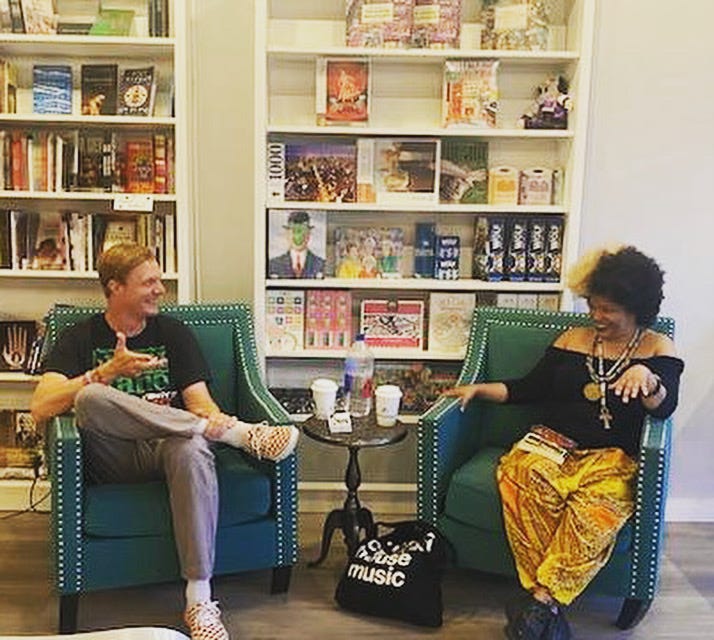
Me and Ytasha Womack talking hip-hop and Afrofuturism. Photo by Shannon Keane.
“Roy Christopher’s dedication to the future is bracing. Boogie Down Predictions is a symphony of voices, beats, and bars messing with time, unsettling histories, opening portals.” —Jeff Chang, author, Can’t Stop, Won’t Stop
First Friday Art Crawl
I had a collection of illustrations and logo designs up at Reset Mercantile in Dothan, Alabama. The clip above was shot by Ryan Mills for Big as Life Media. If you’re interested, you can see a few pictures of the pieces on the wall or check out my illustration portfolio. Many thanks to Justin April for the opportunity.
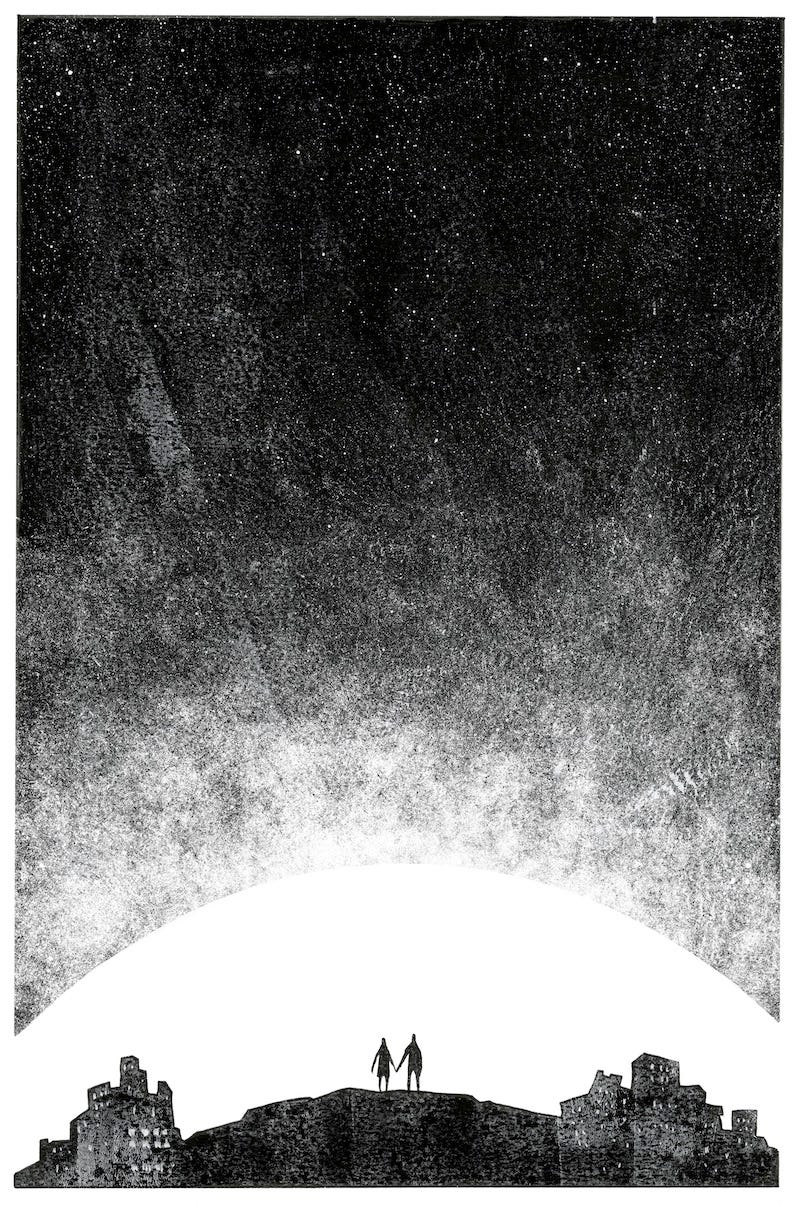
Cover illustration by Jeffrey Alan Love.
Different Waves, Different Depths
My debut collection of short fiction, Different Waves, Different Depths, takes its name from a comment an old crush made once about her feelings for the author. It also describes these nine stories, varying in style from the literarily weird to the science fiction and in length from the flash to the novella. There’s even a pilot script in here.
“Working the borderlands between philosophy, sci-fi, and ultra-contemporary social critique, these stories illuminate our strange cusp moment in a deeply humanistic and bracing manner. A sharp, propulsive, and canny collection.” — David Leo Rice, author, Drifter
At long last I have finished my post-punk media theory book. Drawing from the disciplines of media ecology and media archaeology, as well as bringing fresh perspectives from music (e.g., Fugazi, Radiohead, Gang of Four, Run the Jewels, Christian Marclay, Laurie Anderson, et al.) and skateboarding, The Medium Picture illuminates aspects of technological mediation that have been overlooked along the way. With a Foreword by Andrew McLuhan, it shows how immersion in unmoored technologies of connectivity finds us in a world of pure media and redefines who we are, how we are, and what we will be.
“Very much looking forward to reading new Christopher, exactly the sort of contemporary cultural analysis to yield unnerving flashes of the future.” — William Gibson
The Medium Picture is forthcoming.
Deborah Harry in 1976 vs. Margot Robbie as Harley Quinn in 2016.
The Grand Allusion
I also signed on to write The Grand Allusion for Palgrave Macmillan as a part of their Pivot series. I’m only a few chapters into this one, but it’s shaping up nicely. My dissertation was on the use of allusions in rap lyrics, and I’ve since wanted to expand the analysis to pop cultural references in other media. Our media is so saturated with allusions to other media that we scarcely think about them. Their meaning relies in large part on the catching and interpreting of cultural allusions, on their audiences sharing the same mediated memories, the same mediated experiences.
The Grand Allusion explores these experiences, yielding a new understanding of our media, our culture, and ourselves.
Hope for Boats
Somewhere in there, I decided I wanted to try to write a novel. The seed situation was a funeral and a parade on the same day in a small town, and the story has grown from there. On October 11, 2022, I read the Prologue of “Hope for Boats” to the Rotary Club of Elba, Alabama, on which the fictional town in the story is loosely based. If you’re into it, you can read the excerpt along with me at Malarkey Books.
More on this one as it develops.
I don’t know if I quite earned three years “off,” but I definitely tried. With all of that said, I’m looking forward to getting back into the classroom, corrupting young minds. My creative output might return to a somewhat normal pace though. You’ll be the first to know.
Many thanks to everyone who had anything to do with the above projects — writers, designers, editors, contributors, collaborators, even if you just read one of them — I appreciate it. Without you, all of this would just be scribbles in my notebook. Special thanks to my parents for tolerating me for the last year.
I had the pleasure of talking with Alex Kuchma of the New Books Network podcast about my recent edited collection, Boogie Down Predictions, as well as my books Dead Precedents and The Medium Picture. A student of hip-hop culture like me, Alex is steeped in the stuff. He came to the discussion with sharp questions and insight. It was a pleasure.
Check it out here, on Apple, or wherever you listen to podcasts. Many thanks to Alex and the New Books Network for the interest and the opportunity.
I’m on Talk Your Talk with my man Alaska this week. I’m the first guest on this spin off from his usual show, Call Out Culture with Curly Castro and Zilla Rocca, on which I was also the first guest. I did the artwork for their Michael Myers/Nas-themed “Killmatic” episode, too.
In this new one, we talk about my books, new, old, and not-out-yet, as well as a few high-minded social-science theories… and the raps, of course.
You know how every recipe online comes with a life story? Kelly Lum ran a site called Just the F*cking Recipe. She was very good at just that kind of finding and fixing a problem we all knew was there but never bothered to do anything about. If you look around online, you’ll see how much everyone who knew her loved and respected her.
I found out this morning that Kelly passed away last week. It feels silly to say, but Kelly Lum was my first online girlfriend. We met through her website (spinsugar.com) in the late 1990s, and we stayed in touch for a long time thereafter. I hesitate to post anything like this, but given its online nature, I wanted to try to honor the memory appropriately.
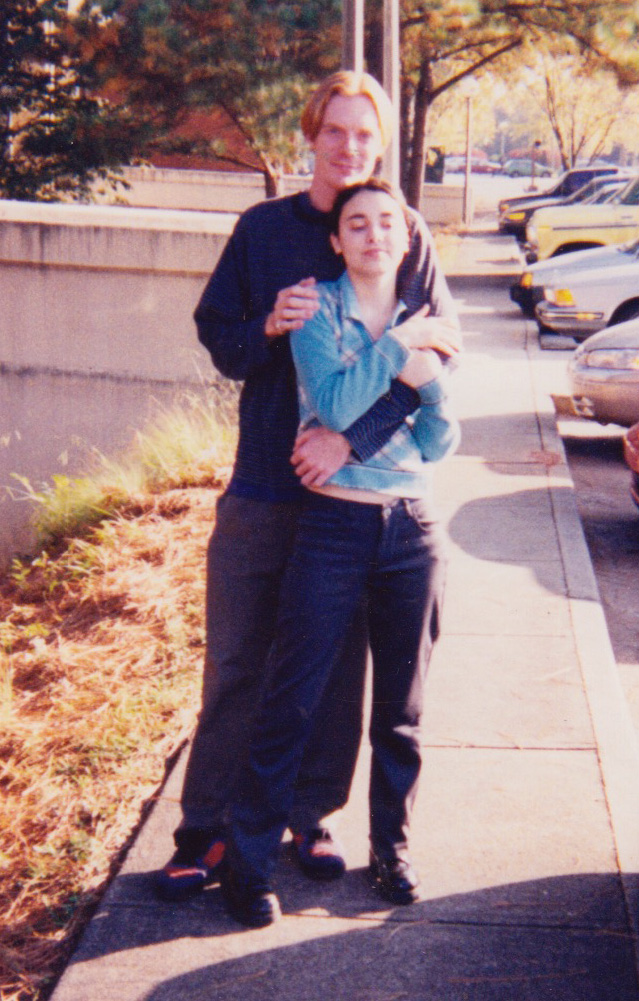
Me and Kelly at UGA in the fall of 1999.
She called me Chris, and I called her Lummy. That is until she finally told me that she hated the name. She had a special way of being brash and bashful at the same time. She was a truly unique person with a talent, a genius, and a wit all her own. She was way smarter than I am, and I miss the way she kept me sharp.
Kelly used to do drawings and write poems for the zines I was making. We did a website together for a few years in the early 2000s. It was sort of an online journal that we both posted to. Sometimes we were talking to each other, sometimes we were just posting nonsense. We started it when I briefly attended the University of Georgia. She came to visit me in Athens while looking at schools. In a letter from her just after that visit, dated November 13, 1999, she asked, “Will you take over the world with me?” She didn’t end up going to UGA, and I moved to Atlanta and then San Diego not long after, but we continued the site even after I moved again, back to Seattle.
The early days of blogging: epithet.nu by Kelly Lum and me.
We kept in touch off and on over the years, but I hadn’t talked to her in a long time. Her passing has me thinking hard about the nature of online relationships, and how to honor and memorialize seemingly such a tenuous connection. She and I weren’t together that long, and we only met IRL the one time, but she had a profound impact on me. Her passing has me mostly thinking hard about her.
The Later Lum. [Photo by Zach Lanier]
She had a clarity of intent that sometimes came off as something else. The last book she posted about was The Cement Garden by Ian McEwan. The phrase on page 66 describing windows like eyes as intimating “not concentration, but heavy sleep” has new meaning now.
I lost a hard drive full of writings not long after we broke up. It contained a whole directory about her called “The Lum Diary.” I wish I could share something from that time.
Kelly Ann Catherine-Xavier Lum… Rest in peace, Lummy. I’m sorry I ever called you that.
In 1997 I put out a zine called wow&flutter [.pdf]. It was an attempt to merge two of my main musical interests at the time, turntablism and experimental noise. I interviewed DJ QBert, DJ Spooky, John Duncan, and Daniel Menche, and reviewed records from the rapidly expanding releases of ambient, noise, and turntable artists. I lived in Seattle at the time, and there was so much going on in all of these areas. There were regular live events and several specialty stores, and I tried to bring them all together under the banner of sound experimentation.
wow&flutter was intended as part of a series, but the second issue, attack&decay, featuring interviews with Jack Dangers of Meat Beat Manifesto and Warren Defever of His Name is Alive, among others, never made it to press. I still love the idea of noise and hip-hop coming together, and there are others who’ve merged them in the meantime better than I could have imagined (e.g., dälek, clipping., Ho99o9, Death Grips, Cloaks, Justin Broadrick and Kevin Martin, et al.)
Two years ago, I moved from the Portland area to Southern Oregon’s Rogue Valley and met Scott Wozniak. Scott’s become a close friend. He writes poetry. He participates in readings and (yes, they still exist) slams. In 2014, during the first six months of his sobriety, Scott won $140 at a slam in Ashland. I told him he reminds me in some ways of Steve Richmond. He laughed. When we met, Scott hadn’t heard of Steve or read his poems. Familiar refrain in American Renegades poetry. Or Outlaw. Modern American Poetry. MAP. Whatever you want to call it. Why? Because there’s always someone you haven’t heard of or read in this realm. Realm meaning the underground scene or network worldwide. Which brings to mind Worldwide Pants, David Letterman‘s production company. Watch this video: On June 10, 1982, Allen Ginsberg appeared on NBC’s Late Night with David Letterman. Allen talked about singing mantras, poetry, rock and roll. He mentioned collaborating with The Clash, being friends with Bob Dylan, preparing to celebrate the 25th anniversary of Jack Kerouac’s On the Road (Viking Press, 1957) in Boulder, Colorado, and how he was inspired by William Blake. After the commercial break, Ginsberg performed a punk rock-paced poem backed by Paul Shaffer’s band.
— Allen Ginsberg on Late Night with David Letterman, June 10, 1982.
Scott Wozniak’s new book Crumbling Utopian Pipedream (Moran Press, 2017) features marvelous cover art by Marie Enger, a back cover blurb by poet and novelist Rob Plath, and 40 poems written by a “chaos enthusiast” who—when he isn’t “doin’ the blue-collar thing,” as he told Marcia Epstein on her Talk With Me podcast—spends his free time writing and “[s]hadowboxing the apocalypse,” opening lines from his poem “The Time for Doomsday Preparation is Over,” which goes:
Shadowboxing
the apocalypse
by throwing
punches
at the wind
seems more
productive
than banging
heads
against
bricks
in this
counterfeit
age
of reason.
Ladies and gentlemen, would you please welcome Scott Wozniak.
Mike Daily: The recent book review and interview by George Anderson in New South Wales, Australia, astounded me. Not many writers receive that kind of in-depth, insightful, “erudite” I think is the word, critical acclaim. You accomplished this with your second collection of poetry, Crumbling Utopian Pipedream, or CUP as I refer to it. Awestruck congratulations, my friend. What do you make of this?
Scott Wozniak: Quite honestly, I’m not completely sure there’s a whole lot to make of it. You know how things are in the small press world, especially poetry. You can rack up great reviews and remain unknown, except maybe by your peers. How far “acclaim” stretches is relative to how you perceive it.
The way I see it is this: George is one of those guys that writes great poetry himself, runs an awesome site dedicated to small press/underground lit, reviews books, basically shines a light on the scene, and has been doing it for a good amount of time now. The underground press survives thanks to guys like George, and there’s a ton of ‘em out there. You’re one of them, Mike. Guys who’ve been in the game a long time, writers who understand it’s up to us to keep the ball rolling.
Poetry, in particular, has been DIY for centuries. It’s a passion project. Ultimately, for me, if writers whose work I love, who I look up to, writers who’ve been doing this since before I was born, if those guys give me positive feedback, I’m stoked. I’m accomplishing more than I set out to accomplish. If I reach a wider audience thanks to these guys who have been grinding away for 10, 20, 30 years in the small press, because they just have to write, it’s in their bones, then I’m forever grateful. Because honestly, if not another soul on the planet read my words, I’d still be writing. So, I try to keep it in perspective. Sure, I like to hear that my writing connects with someone because I love that feeling of reading something that resonates with me. But, I’m a selfish fuck, a lot of times I’m writing for me. Clearing the trash out of the attic, you know? So, when I get a review like the one George did, I look at it more like he was very thorough and thoughtful, and paid my work huge respect on that level. I view it more as a reflection of his integrity and dedication to the small press than a reflection of how great my book is.
MD: The review drew attention to your choice to open CUP with an epigram by poet Doug Draime–
It’s then you see the crushing odds
and you know
you have
beaten them.
Somehow. You know
with the certainty
of your continued
breath.
–and since I had been unfamiliar with Doug’s work, can you tell us more about him, the impact his poetry had on you, and your personal interactions with him?
— Doug Draime
SW: Doug Draime is a legend, in my eyes, and deserves to be recognized as such. He had been publishing in the underground since the late ’60s, up until he passed away last year. I only became familiar with his work maybe six or seven years ago. I started noticing him on quite a few different poetry websites I would frequent and he would floor me every time. Then I came across one of his chapbooks that was included in the first Punk Rock Chapbook Series by Epic Rites Press. After that, I was in full blown fan-boy mode and consumed as much of his work as I could find. His full-length collection, More than the Alley, published by Interior Noise Press (2012), is still one of my all-time favorite books of poetry out there.
Eventually, a couple of years down the line, after I’d started getting work published, I discovered that he lived right down the road from me. This was a revelation. There aren’t too many writers that I idolized like I did him and he was living in my backyard, in middle of nowhere, Southern Oregon.
One evening I tracked down his email. I shot him a message, and, surprisingly, he messaged me back. We corresponded semi-regularly for the last year of his life. I had no idea he was sick at the time and he would always shoot down my offers to get a cup of coffee because he wanted to spend time with his family. Regardless, he would take the time to give me advice on writing, periodically critique my work, push me to submit my stuff, and generally taught me about being a kind, selfless person. I was just this random, poetry freak who started harassing him and he took the time to encourage and talk to me, even while he was sick.
I had built him up as this giant of poetry and assumed that he somehow managed to make a living off his writing, even though I’d read many, many poems where he would talk about his experience at some shit, dead end job. When I breached this subject, he laughed at me and brought me back down to reality, telling me, “Make no mistake, poetry don’t pay the bills.”
For this experience alone, I’m continually grateful. It removed any visions of grandeur I may have possessed and instilled in me the importance to just write, fuck anything else. Doug wrote incredible stuff, and got published for 40-plus years without the drive for fame. He wrote top notch poetry that tore into me like few writers have. He did this because writing was in his bones. Pure, no-nonsense love of the form, without any expectations. I know he was unaware of the impact that realization had on me, but it’s massive. That’s why I try not to put too much stock in things like good reviews. If I can just write solid work and remain happy with the joy that comes from the act itself, then I will have accomplished something holy. Recently, another writer/illustrator whom I highly respect, Janne Karlsson, read the manuscript of a project he and I are working on together and told me he felt it read “like a cross between Doug Draime and Nietzsche.” I don’t think I will ever receive a higher compliment.
MD: George Anderson asked, “Have you recently stumbled upon some new authors you haven’t read before who have impressed you?” You answered, “Man, there’s a ton of ‘em out there right now. I think the underground, or as my friend Mike Daily likes to call it, post-outlaw poetry, is alive and well. But a few names that are newer to me and very impressive would be Ryan Quinn Flanagan, Katie Lewington, Mather Schneider, James Decay, Paul Tristram, Jenny Santellano, Jamie Thrasivoulou, Matthew Borczon, and Benjamin Blake, to name a few.” Go ahead and name some others, expanding from contemporary writers to list your lifelong influences. Speak on William S. Burroughs, pro and con from your experience and current perspective, if you will.
SW: I hate doing these lists. I always feel like it’s some sort of, “Oh, look how well-read I am” B.S. that’s a way of proving to the gatekeepers that I belong here, wherever here is. I’m not saying that feeling is grounded in reality, I’m just saying that’s how I feel. But, since I know you’re a complete bibliophile and have a heartfelt respect for authors, I will comply…
Obviously, Bukowski is at the head of the list, followed, in no particular order, by Czeslaw Milosz, d.a. levy, Lawrence Ferlinghetti, Bob Kaufman, Jack Micheline, Gregory Corso, David Lerner, Miguel Algarin, Kurt Vonnegut, Ken Kesey, Hunter S. Thompson, Jim Carroll, Gary Snyder, Jack Kerouac, Walt Whitman, Bob Flanagan, Iceberg Slim, Donald Goines, Dan Fante (thanks to you), Carlos Castaneda, Phillip K. Dick, Robert Hunter, John Prine, Richard Brautigan, Woody Guthrie, Hubert Selby Jr., Harlan Ellison, Frank O’Hara, Bruce Springsteen, Joe Strummer, Tom Robbins, Tom Waits, Jack Black (author of, You Can’t Win, not the other guy), J.D. Salinger, everyone who ever wrote for Marvel Comics, a slew of other writers I’ve forgotten, and of course, Mr. William S. Burroughs, whom I tend to have a bit of a love/hate relationship with. Maybe hate is too strong of a word, it’s more of a love/ehh (shrugs shoulders) relationship.
The reason for this is that I love him for the madman he was, and how his work is a true representation of that. He lived hard and wild and that is obvious when you read him. His book, Junkie, is a hard one to top, and a clear, honest representation of a crazy-ass junkie. His cut-up period of work, I could do without. Naked Lunch is, in my opinion, the best of that style. I could do without the rest of the Nova Trilogy. Sure, it’s “experimental,” and “revolutionary” but it’s fucking hard to follow. That stuff is like learning a new language, it takes commitment to see it through. But, in all honesty, he’s probably the only writer who got clumped into the whole “Beat” category that I never outgrew. I can hear the gasps of sacrilege pouring from your readers’ mouths due to that statement, but it’s true. I could explain my stance further but that would be a long exhaustive conversation better suited for another time.
Focusing on Burroughs, I love him because he was bat-shit-crazy and I can relate. But I also see the folly of his ways the more I reflect on my own mistakes. I mean, he did murder someone. It may have been a drug-fueled mistake, and who am I to say it didn’t torment him, but the fucker got away with it because he comes from a wealthy family. That rubs me wrong. Maybe it shouldn’t reflect on my opinion about his work, but if I’m being honest, it kind of does. I will spare you an expanded discourse, which would undoubtedly be filled with hypocrisy…for now.
MD: What do you think was meant by my allusion to “post-outlaw poetry”?
SW: I’ve milled this over a bit since I first heard you use the term, and to me it seems like just another label, like “post-punk,” that is lost on me. You did, however, clue me in to the fact that you view it along the lines of straight-edge, but less militant. So, with that taken into consideration, I’ve come up with this…
Where “outlaw” has a (suicidal?) tendency to glorify the over-consumption of drugs and alcohol, and the life led while in such a state of existence, “post-outlaw” visits these same themes from the standpoint of experiences lived, pointing out the destruction while also revealing the desire, struggle, and necessity of overcoming such behavior, with the hope that the reader may learn that it’s not all fun and games in the fast lane, and yes, there is a way out. Maybe the “post-outlaw” is one who miraculously survived the “outlaw” life and is now searching for higher meaning thanks to the destruction of their past? Or you could be saying that all the outlaws have come and gone, but I think we know better.
MD: I saw on Facebook that poet Alan Kaufman, Editor of The Outlaw Bible of American Poetry (Thunder’s Mouth Press, 1999), is 27 years sober this week. Last question: How essential has working a program of recovery been in maintaining your sobriety? I had thought I was an anomaly in sobriety since I had for years used will power and determination to not try to change how I feel. Now I’m aware that others with the DIY (Do It Yourself) mindset seem to have quit using the same method. Individuals who have posted or interviewed to this effect include musician, writer, and anchor at MTV News Meredith Graves (1 year); BMX racer, dirt jumper, street rider, and writer Scott Towne (6 years); and rappers Evolve (Sergio Hernandez, 2 years) and Blueprint (Al Shepard, 7 years). I was surprised to hear while listening to “Super Duty Tough Work with Blueprint and Illogic: Podcast 67: The Benefits of Sobriety” that Blueprint and I share the same sobriety birthday, May 15th (Print’s got a year on me). He didn’t mention A.A. or any direct principles of the program during his podcast with Illogic. Likely because when he quit, he quit. Done deal for him. The Book of Drugs: A Memoir (Da Capo Press, 2012) by solo artist Mike Doughty (former singer-guitarist of Soul Coughing, 17 years sober as far as I know) is one of my favorite books. In “An Indie Superstar’s Slow Road to Sobriety,” Mike writes about how going to meetings and finding out how to work the program saved his life. Yours?
SW: There is no question that working a 12-step program of recovery saved my life. I’m a drunk junkie of the hopeless variety. There is no logical reason that you and I should be having this conversation. By all accounts, I should have died long ago. I tried to get sober a time or two by using self-will and I never got more than a handful of weeks under my belt. I just couldn’t do it, until I did the work outlined in the book. I’m not blessed with the capability to just turn off my need for oblivion. I was aware of this fact for a long time, I just thought it was my lot in life. When I started doing the program, I thought it was bullshit and wasn’t gonna work for me because, you know, I’m unique. But as I got into it, something happened. What that something is, I’m still not sure, nor do I care to know. I try not to think too deeply about the how’s or why’s. I just do what I’ve been taught and it keeps me clean, plain and simple.
———
Contributor Bio:
Mike Daily is a novelist, journalist, zinemaker, spoken words performer, and co-creator of the Plywood Hoods freestyle BMX trick team. He lives in Oregon. Daily is at work on his third novel, Moon Babes of Bicycle City. Excerpts from the book are being recorded with Joe Gruttola.
Each time we move to a new city, we make memories as the city slowly takes shape in our minds. Every new place we locate (e.g., the closest grocery store, the post office, rendezvous points with friends, etc.) is a new point on the map. Wayfinding a new city is an experience you can never get back. Once you are familiar with the space or place, it’s gone. Since moving out on my own, I’ve gravitated toward cities: Seattle, Portland, San Francisco, San Diego, Austin, Atlanta, Chicago. Externalized memories built in brick and concrete. As David Byrne writes, cities “are physical manifestations of our deepest beliefs and our often unconscious thoughts, not so much as individuals, but as the social animals we are” (p. 2).
[“Cloud Gate” drawing by Roy Christopher]
You can map out a whole city according to the weight of memory, like pins on the homicide board tracking the killer’s movements. But the connections get thicker and denser and more complicated all the time — from Moxyland by Lauren Beukes
Darran Anderson‘s Imaginary Cities (Influx Press, 2015) brings many of these unconscious thoughts out of our heads and into the light, mapping cities according to memories. Anderson humbly calls the book “a diminished non-fiction mirror” to Italo Calvino’s Invisible Cities (1974), but it is a masterwork unto itself. As Calvino (1974) writes in that book, “The city, however, does not tell its past, but contains it like the lines of a hand, written in the corners of the streets, the gratings of the windows, the banisters of the steps, the antennae of the lightning rods, the poles of the flags, every segment marked in turn with scratches, indentations, scrolls” (p. 11). Anderson’s book illuminates these interstitial crags and corners, yet it goes as wide as it does deep, digging through the details as much as minding the monolithic. It’s a book I will have to spend much more time with, as it deserves to be explored in depth, like any good city.
What is the importance of placing a memory? he said. Why spend that much time trying to find the exact geographic and temporal latitudes and longitudes of the things we remember, when what’s urgent about a memory is its essence?
— from Days Between Stations by Steve Erickson
I’m also interested in spending much more time with Dominic Pettman‘s In Divisible Cities: A Phanto-Cartographical Missive (Dead Letter Office/Punctum Books, 2013). Aside from Calvino’s Invisible Cities, this book’s form recalls only McKenzie Wark‘s Dispositions (Salt Publishing, 2002). These two books hint at their own genre. Locative love stories? Positional poetry? They’re nothing if not poetic, and and the style suits both the authors and their subjects. As Johannes Milner (1814) put it, “Poetry is not something to be activated and deactivated. It is a part of a process, a byproduct of simply being poetic” (p. 43). In Divisible Cities is definitely that, and Pettman’s subtlety is astounding. Download or buy it directly from Punctum Books or get lost in the interactive web version.
In the sagas it was said that humans dream with their hands, only their hands, and so have cities rather than sagas, monuments rather than memories. — from Easy Travel to Other Planets by Ted Mooney
Savage Messiah (Verso, 2011) is a compilation of Laura Oldfield Ford’s zines of the same name, chronicling the streets of London in various states of duress. I’ve never seen a zine or a zine collection that seemed this important. I’ve never even seen one with the potential to be this important. Ford’s writings and drawings map not only the city’s streets but also the lives underneath. In his Introduction, Mark Fisher calls the zine “out of time” but not “out of date”: “Savage Messiah deploys anachronism as a weapon. At first sight, at first touch — and tactility is crucial to the experience: the zine doesn’t feel the same when it’s JPEGed on a screen” (p. x). Indeed, Savage Messiah‘s return to the anarcho-punk aesthetic of the late-1970s is essential to Ford’s revival of that attitude. This is poetry. This is protest. This is London undone. Holding it in your hands is imperative.
Memory is redundant: it repeats signs so that the city can begin to exist. — Kathy Acker
Early on in In Divisible Cities, Dominic Pettman repurposes the idea of mattering maps, those maps we make to and from the things that matter: “A map that generates territory, rather than the other way around… A map that does not represent cities that exist independently, but a map that brings cities into being…” (p. 3). These three books can be read as giant, sprawling mattering maps. Within them, there are vast and multiple new cities to be explored.
References:
Acker, Kathy & Wark, McKenzie. (2015). I’m Very Into You. New York: Semiotext(e), p. 135.
When I started doing zines as a teenager, interviews were an easy way to get something no one else had. I could get in touch with a band, ask them questions, and write up an original piece of content. It was fun and it lead me to magazine writing. When I moved the operation online, my first site (frontwheeldrive.com) was almost all interviews.
Andy Jenkins and I have had a similar relationship with interviews. We both started off doing them for journalistic purposes, then moved away from them for various reasons. “Interviewing folks meant that I was drawing a line between myself and the interviewee,” he writes in the introduction. “So, instead of being a peer, I was sort of an outsider” (p. 3). For Bend #24: Questions (Bend Press, 2015), Andy returned to the interview format to check in with a bunch of people who’ve inspired him over the years: He asked 27 people the same 24 questions. Interview subjects include Johnny Knoxville, Megan Baltimore, and O; skateboarders Jerry Hsu, Ed Templeton, Tod Swank, and Marc Johnson; artists Lori Damiano, Ferris Plock, Kevin Wilkins, Thomas Campbell, and Evan Hecox; and one of my favorite character actors, Bob Stephenson; as well as many other creative folks. Questions is inspiring, entertaining, and funny. Andy’s introduction says he did these interviews “not feeling the line” because he knows all of these people in one way or another. His art and designs have always been inspiring to me, but this time it’s the minds he’s assembled that make me want to go do stuff.
Life from a window
I’m just taking in the view
Life from a window
Observing everything around you
— The Jam, “Life From a Window”
I met Tobin Yelland twice: once while I worked at SLAP Skateboard Magazine in San Francisco and once while I worked at Skateboard.com in San Diego. He’s a super-nice guy with a keen eye through the camera lens. Life From a Window (Deadbeat Club, 2014) is Clint Woodside and Tobin’s travel log from Asia, including pictures from Shanghai, Seoul, Hong Kong, and Guangzhou. Candid expressions, odd artifacts, and haunting cityscapes adorn its 40, full-color pages. It also comes with two 4×6″ prints, one from each photographer.
I picked up a copy of Bogus Rendition#9 from the merch table at a the Watain/Mayhem Black Metal Warfare tour stop at the Bottom Lounge in Chicago earlier this year. Split between hopping trains and black metal, Justin Curtsinger tells great stories and does solid interviews. He’s traversed the US by train several times and toured with Watain and many other black metal acts, so his stories and interviews (with members of Watain, The Devil’s Blood, Soulgrinder, et al.) come from a far more personal place. The lengthy transcribed talks in BR #9 are as meandering as they are interesting. These are not promo-copy fodder. They’re just regular chats with the guys behind the set and sound. It’s a welcome change from magazine interviews. Reflecting on Watain’s 2013 tour for The Wild Hunt, Curtsinger writes, “I’ve found it harder and harder as time has gone on to write about other people who happen to be friends as if they are ‘characters’ in a story.” Though he admits that he’s not the biggest Watain fan, he acknowledges their importance, writing, “The reminder that life is whatever the fuck we want to make it and that following one’s heart on whatever obscure path one wants to take is not a pipe dream.” The 108 pages of Bogus Rendition #9 document parts of Curtsinger’s obscure path(s), and the world is better off for the glimpses it provides.
A member of both the black metal band, Light Bearer, and the hardcore band, Momentum (two of my recent favorites), Gerfried Ambrosch is also a prolific writer. Not surprisingly, his writing is ideologically in-line with his music. Among his zines are Atheist Morality: Why We Don’t Need Religion to Be Moral (Active Distribution, 2013) and Vindication of a Vegan Diet (Active Distribution, 2013). We Want Something More: The Poetry of Punk Rock (Active Distribution, n.d.) is a 100-page pamphlet-style zine that could easily double as a master’s thesis. It’s also informed by interviews — with some of the most important people in punk rock. Its back copy reads,
We Want Something More is an extended essay about punk lyrics. It features exclusive interviews with well-known punk rock and hardcore artists such as Ian MacKaye (Minor Threat, Fugazi), Jello Biafra (Dead Kennedys), Henry Rollins (Black Flag), Ray Cappo (Youth of Today, Shelter), Greg Bennick (Trial), Brian D. (Catharsis), Dan Yemin (Kid Dynamite, Paint It Black), Chris Hannah (Propagandhi), and others. The essay investigates the connections between song lyrics, poetry, visual and acoustic aesthetics, musical conventions, the D.I.Y. ethos, and radical politics in the context of punk and hardcore. Its goals are to demonstrate that punk rock and hardcore song lyrics are a fascinating literary art form and to give punks and hardcore ‘kids’ an understanding of lyric analysis and close reading by reference to some of the songs that have changed their lives. Moreover, the essay discusses the particularities of punk culture and the things that set it apart from other subcultures. Given its focus on radical politics, is punk a serious counterculture, or at least part of a wider countercultural movement? This essay attempts to answer such questions by looking at song lyrics and how they have both reflected and affected the political discourse of punk and hardcore. If you have a passion for punk culture and/or the written word, there is a good chance that you will find We Want Something More to be a very interesting read.
I don’t do as many interviews as I used to, but I’m still biased toward them and read them regularly. I mean, I do teach a class on interviews now, and my first book is a collection of them. Interviews can be weird and indulgent, but they can provide keys to someone’s work you admire. They also let that someone know that you admire them. In Bend #24, Andy Jenkins asks, “Do you like answering questions?” Ed Templeton sums it up, saying, “Yeah. It means someone is asking.”
Over the past 30-odd years, writer Gareth Branwyn has been amassing an impressive body of work on the fringes of cyberculture. He wrote for bOING bOING when it was still a print zine, did his own zine called Going Gaga before that, was an editor at Mondo 2000, WIRED, MAKE, does book reviews for WINK, has edited over a dozen books, and is a regular contributor to my own Summer Reading Lists. He’s stayed as jacked-in to our current technoculture as one can be, for as long as there’s been a jack. His new book, Borg Like Me & Other Tales of Art, Eros, and Embedded Systems (Sparks of Fire Press, 2014), collects almost 300 pages of his pieces from all over the place. It’s like a cross between a very personal, edited collection on cyberpunk and a zine anthology.
One of the great things about being so bloody old is that I’ve had a chance to experience every flavor of fringe media from the mid-’70s on. I caught the tail end of ’70s hippie media, then the punk DIY movement of the ’80s, then the ’zine publishing scene of the ’90s, and then web publishing in the ’90s.
I finally met Gareth IRL at Maker Faire in Austin in 2008, and we haven’t had a genuine sit-down in over ten years. Once I got my hands on a copy of Borg Like Me, I knew it was time to catch up with him again.
Roy Christopher:After all of these years, what finally prompted the collecting of all of these pieces?
Gareth Branwyn: This is a book I started putting together years ago, before I became the Editorial Director at MAKE. But that job was so all-consuming, I knew the book would never happen if I stayed there. So, I left early last year and immediately launched a Kickstarter campaign. I also thought I had a very fun and innovative idea for a collection of this kind, what I call a lazy man’s memoir. I collected content from my 30+ year career and then wove a new, personal narrative around it, via deep intros to the pieces and new essays that helped flesh out the “story.” These (hopefully) create a narrative arc and a point to this book that makes it more interesting (and far more personal) than just a collection of my best writing.
RC:The title of the collection has a very personal connotation that people don’t necessarily know about. Tell us about your very close relationship with the machine.
GB: Well, as I like to tell people: I have an artificial hip, a rebuilt heart, and I take a biological drug that’s bioengineered from mice proteins. So I am literally a chimera—part man, part machine, part mouse. But as I make the point in the book, we are all so heavily mediated by technology and cutting-edge medical science at this point that we are all now cyborgs–part human, part machine.
The book’s subtitle, “& Other Tales of Art, Eros, and Embedded Systems,” also reveals more than people may be aware about me. Over the course of my career, I’ve written about far more than technology. I’ve written a lot about art, music, relationships and love, the occult and spirituality, and various aspects of underground media and culture. I even wrote a column for a sex magazine many years ago. This book is something of a coming out for me, revealing more about the breadth of my interests than I ever have before to a widespread audience. I’m like an onion, man. Layers.
RC:You’re primarily known as a writer through your writings on technology and technology-influenced cyberculture, yet you claim not to be that into technology. What gives, man?
GB: Well, that subtitle was a little bit of an exaggeration for effect. I’m not in love with technology for technology’s sake. I’m most fascinated by how people actually use technology, and how they bend (and even break it) for their own purposes. As I say in the book (referring to the William Gibson quote “The street finds its own uses for things”), I’m more interested in the street than the things. Because I’ve written extensively on how-to technology, such as robot building, people think of me as a real hacker, a real geek. But I’m not. Most of my geek/hacker friends like to tinker and problem solve tech for its own sake, for the challenge. I don’t. I just want my tech to work. As I once said in a MAKE bio piece once: “I’m more of a puffy-sleeved romantic than a pocket-protected geek.”
RC:One of the images from Jamming the Media that has always stuck in my head is that of you and your then-four-year-old son Blake leaving the darkened room of blinking lights that was your media lab at the time. Tell us about his involvement in Borg Like Me.
GB: That’s from the introduction to Jamming the Media, a piece called “The Electronic Cottage: A Flash Forward.” I included that in Borg Like Me. Because of my work in cutting-edge tech and media, Blake grew up completely immersed in early personal technology tools. They all came completely natural to him. He’s a 27-year old digital artist and game designer now, living in the Bay Area, and I think that early immersion is a reason why. He and I used to do things like create animated cartoons in HyperCard by drawing animation frames by hand, scanning them into the computer, and then creating crude animations by flipping the hypercards really fast. I think we even put music on some of them. And one of the games I got for review, Creatures, had a huge impact on him and made him declare he wanted to be a game designer. Hell, he even did some kid reviews of games and early LEGO Mindstorms in Wired and The Baltimore Sun. When he was a kid, I actually used to fantasize about him growing up and being some sort of artist, writer, or other creative type, and us collaborating on stuff. So it was was a dream come true working together on this book. At one point, I joked that he was acting as my project manager. So we decided to make it official. He was very pro about it and really did help keep me on track. He also did a ton of incidental art, icons for the book and such, did animation elements for my Kickstarter video, and graphics for the KS campaign. He also co-designed the rubber stamps I created to accompany the book, which I use on all of the mailing envelopes and letters I send out. It really does feel like the book was a collaboration between us. There were so many deeply gratifying aspects of doing this book. Working with him was definitely a highlight.
The book was also something of a “getting the band back together.” I worked with 18 artists from my old zine and early cyberculture mag days, people like Mark Frauenfelder, Danny Hellman, John Bergin, Shannon Wheeler, William Braker. There are some 30 illustrations in all.
RC:The artwork was the next thing I was going to ask about. You beat me to it… Twenty years ago, you wrote that “hackers represent the scouts to a new territory that is just now beginning to be mapped out by others.” How would you adjust or amend your conception of the hacker since?
GB: Well, the territory has certainly been mapped, and settled, and over-developed, and large tracts of it sold to the highest bidder. I’ve told people at several of my talks recently that, in the 1990s when I was writing about the “frontier towns of cyberspace,” I never for a moment could have imagined that my parents would now spend almost as much time online as I do. They are the most un-techie people I could imagine and yet they have his and hers desktop computers, laptops, smart phones, and at least one tablet. But I think that “hacking the future” process is still happening. I was on a panel at SXSW this year, with Bruce Sterling, Cory Doctorow, and Chris Brown. The subject was basically: What happened to the cyberpunks? Sterling focused on the darker side of things (as he is wont to do): The Silk Road busts, Cody Wilson and 3D-printed guns, Eastern European cybercriminals, and the like. While I think that’s all relevant, I argued that I think lots of cyberpunks became makers. A lot of the people I worked with at MAKE were very involved in early-90s cyberculture. I think, for many of us, we got tired of the overemphasis on virtuality, hyper-mentality, and the denigration of “the meat,” and so there was something of a corrective swing back towards physicality, getting your hands dirty. Mark Frauenfelder (bOING bOING) has an interesting theory about this. In the 90s, when everyone was hacking software and the net, to share your work, all you had to do was send a file or link. But as soon as microcontrollers and other physical computing hardware became readily available and people started hacking with that, suddenly, you needed to show your work off in person. From this grew hardware meetups, hackerspaces, Maker Faires, and the like.
One of the frequent takeaways from Borg Like Me that I’ve heard from readers is that (in the essays about early cyberculture) there’s a palpable sense of frontier spirit, passion, and a sense of just how powerful and potentially revolutionary these democratizing tools can be. These days, when net neutrality is at stake, it’s good to be reminded of the promise and potential that all of this networked tech initially offered. Sure the techno-cultural changes have been deep, and in many ways profound (we take for granted the power of that globally-connected device that we carry, forgotten, in our pockets), but the drift towards mundanity and big media subsumption is insidious and steady. If the “You know, back when I was a cyberpunk…” stories in my book can inspire today’s mutant change agents in even the smallest ways, I’d be thrilled.
RC:Music is another deep interest we have in common. I love the “Immersive Media Notes” spread throughout the book. Diving into media headlong while writing is something I advocate regularly. Do you have specific “writing music,” or do you play whatever you’re into at the time?
GB: Music has always been so deeply interwoven into my life, even before I met my late-wife, a musician, and lived with her for 22 years. I can’t think of many things in my past without thinking of the music that soundtracked those experiences. As I was writing the book, I noticed how many pieces mentioned music, were about music, or had music attached to them in my mind. So I created those “Immersive Media Notes” so that readers could listen to the music associated with that piece before, during, or after. The idea was inspired by the essay “By This River” (and the Eno song from where it gets its name). That song is so hauntingly beautiful to me and completely encodes much of my relationship with my wife. I felt like people HAD to listen to that track to better appreciate the feelings I was trying to convey in that piece. It’s funny though – I actually added the “Immersive Media Notes” at the very last minute, even after the book was in first proofs, and it’s one of the things that always gets mentioned by readers/reviewers.
RC:What’s coming up next for a Borg like You?
GB: I’m working on a number of projects. For my imprint, Sparks of Fire Press, I’m working on two new chapbooks in the Borg Like Me series. The Eros Part is a collection of my writings on love, sex, and muses. I promised this as one of the premiums for my Kickstarter campaign. Then I’m working on a follow up to my popular Gareth’s Tips on Sucks-Less Writing. I’m excited about that. I think there is some great new material in there. I’m also working on a big project I’m not at liberty to talk about, but if it comes through, it’ll be amazing. Oh, and I’ve also been working on Café Gaga, which’ll be a periodic podcast of things that are currently holding my attention. And I continue to do regular reviews for WINK Books, a gig that I really love. So, I’m definitely keeping busy!








 SW: There is no question that working a 12-step program of recovery saved my life. I’m a drunk junkie of the hopeless variety. There is no logical reason that you and I should be having this conversation. By all accounts, I should have died long ago. I tried to get sober a time or two by using self-will and I never got more than a handful of weeks under my belt. I just couldn’t do it, until I did the work outlined in the book. I’m not blessed with the capability to just turn off my need for oblivion. I was aware of this fact for a long time, I just thought it was my lot in life. When I started doing the program, I thought it was bullshit and wasn’t gonna work for me because, you know, I’m unique. But as I got into it, something happened. What that something is, I’m still not sure, nor do I care to know. I try not to think too deeply about the how’s or why’s. I just do what I’ve been taught and it keeps me clean, plain and simple.


