
Of Refuse and Refuge: The Downward Spiral

“Humans turned themselves into masters only to find a new way to become slaves.”
— Gunther Anders, The Obsolescence of the Human

The society depicted in Terry Gilliam’s 1985 movie Brazil is industrial in its aesthetics and institutional in its metaphysics, bureaucratic beyond all hope. Gilliam’s original title for the project was 1984½, in homage to both George Orwell’s novel Nineteen Eighty-Four and Federico Fellini’s film 8½, which share the concerns of the mechanization of modern life.1 They’re all about all the ways we are enslaved by our machines, our computers, our phones, surveilled by the eyes and ears of our technology.
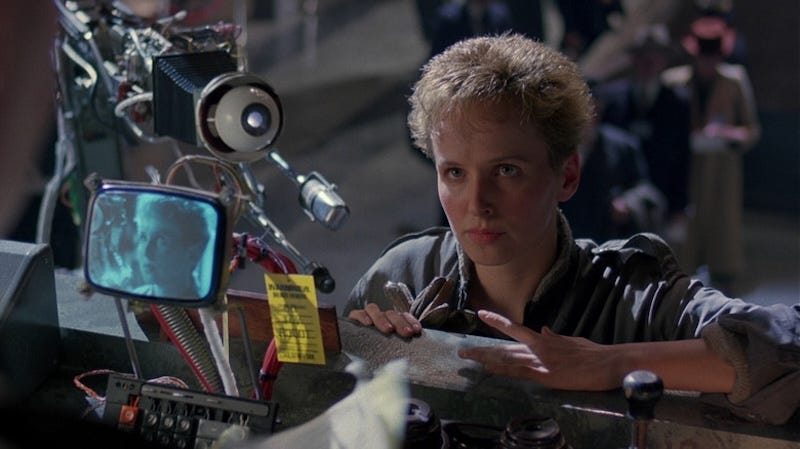
Jill Layton (Kim Greist) bugging the mechanized bureaucracy in Terry Gilliam’s Brazil (1985).

“Some of the technology was a deliberate mixture of the futuristic and the Victorian,” says Gilliam. “There’s a lot of growing up in America in the forties: progress and the utopian vision were always there, with technology as the answer to all of our needs.”2 The movie’s ontology operates atop a machine metaphor.3 Unexpected breakdowns, routine repairs, and replacing parts—hydraulic hoses, pneumatic tubes, and other analog accoutrements—make up a lot of the concerns of the characters in Brazil.

“The most virulent form of philosophical technolibertarianism is a kind of scary, psychologically brittle, prepolitical autism. It’s an inability to reconcile the demands of being individual with the demands of participating in society… these technolibertarians make a philosophy out of a personality defect.” — Paulina Borsook, Cyberselfish

Gilliam adds, “There was a collective dream of progress and a centralized belief in the perfectibility of man [sic] — either through technology or fascism, which effectively amounted to the same thing.”4 Brazil is a vision of the 1980s through the lens of the 1940s, just like Orwell’s, but unlike the panopticon of Nineteen Eighty-Four, Brazil focusses further on the desire for distraction, to escape from such technological fascism through fantasy.5 The film takes its surveillance society as a given and tries to find a way out through human imagination.
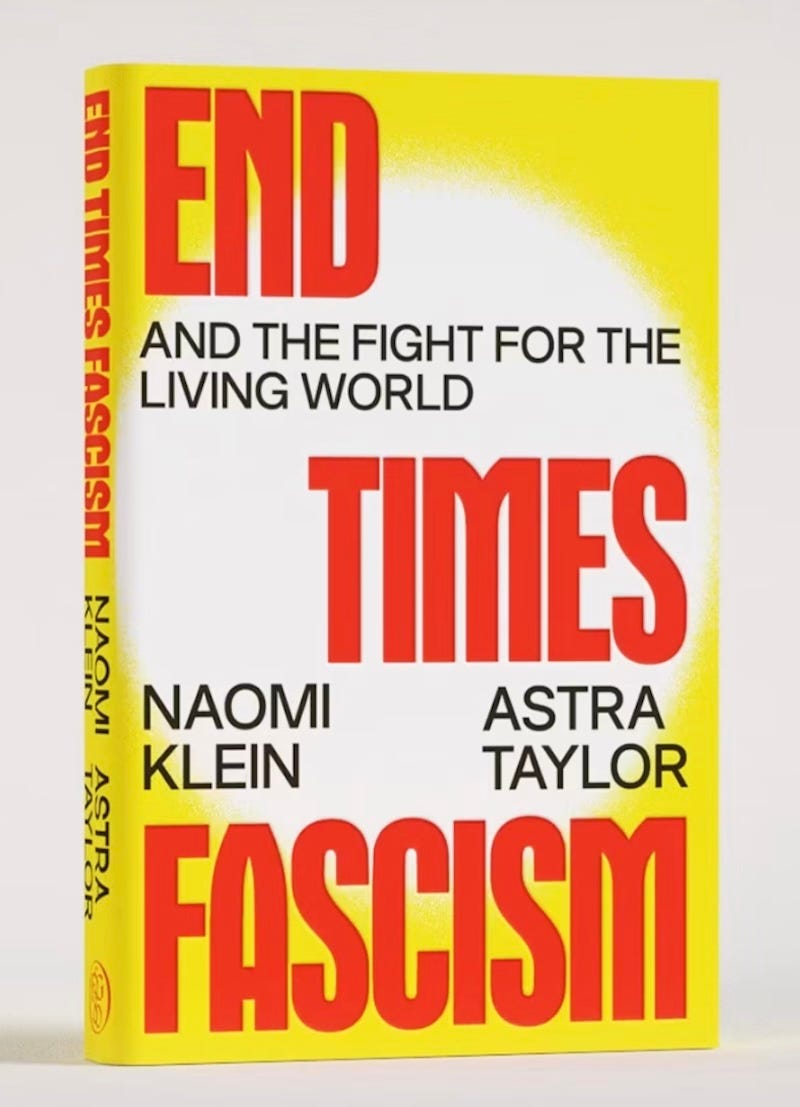
End Times Fascism by Naomi Klein and Astra Taylor (FSG, 2026).

End Times Fascism, and the Fight for The Living World (FSG, 2026) by Naomi Klein and Astra Taylor presents a new attempt at tackling this technologically enabled, creeping fascism. Both of these authors have been described as North Stars for the state of things: Klein’s No Logo (1999) and The Shock Doctrine (2007) and Taylor’s The People’s Platform (Picador, 2015) and The Age of Insecurity (House of Anansi Press, 2023) made many implicit ills and evils in our culture explicit, turning latent aches into blatant sharp pains. Their work is as enraging as it is engaging.

“Fascism is a counter-revolution against a revolution that never took place.”
— Ignazio Silone

And the rage is key. As the technologist Jaron Lanier has pointed out, “Social media is biased, not to the Left or the Right, but downward,”6 adding that it’s “neither liberal nor conservative; it is just pro-paranoia, pro-irritability, and pro-general assholeness.”7 Similarly Klein and Taylor frame fascism as capitalism’s “most ferocious” form, “a way of making sure that the public anger that wells up during times of deep crisis is directed downward at the vulnerable rather than upward at the system itself.” They keep that rage pointed down, urging us to “take back control”—not from oligarchs and politicians but from immigrants and minorities, with whom we have far more in common. “All over the world,” they write, “fascist forces are directing anger downward, at the people least responsible for our societal troubles, and persuading electorates that they can no longer afford to care about anyone but themselves, their families, and the neighbors who look and think like them.”8
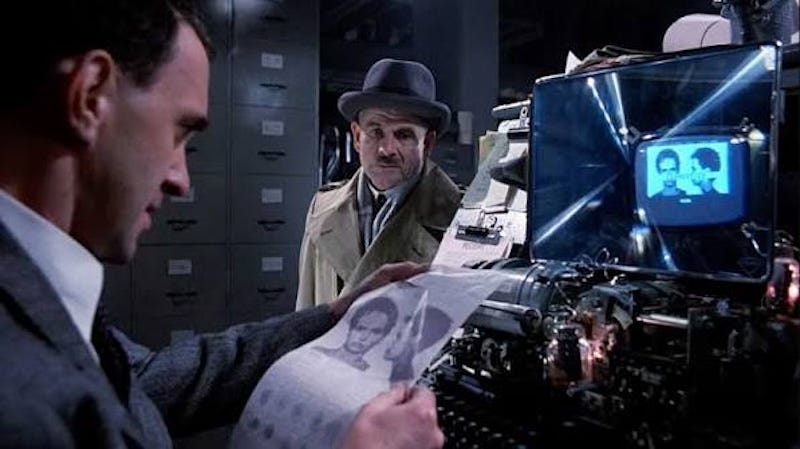
Men dwarfed by machines: Sam Lowry (Jonathan Pryce) and Mr. Kurtzmann (Ian Holm) in Terry Gilliam’s Brazil (1985).

Whether their “plans take the form of heavenly ascension, earthly bunkers and fortressed nations, or fantasies of colonized space or merging with machines. Instead of improving conditions on Earth, end times fascists are plotting their escape, oblivious to all that’s worth saving.”9 In the meantime, they’re fracking our attention with social media, fake outrage, and AI, the latter of which is especially concerning. Klein and Taylor write, “Executives who warn that AI might destroy the world also claim that they can’t slow down because China might outpace them—as though a race off a cliff is a race worth winning.”10

“Right now, the earth is full of refugees, human and not, without refuge.”
— Donna Haraway, Staying With the Trouble

In her book, Staying With the Trouble (Duke University Press, 2016), Donna Haraway writes, “I think our job is to make the Anthropocene as short/thin as possible and to cultivate with each other in every way imaginable epochs to come that can replenish refuge.”11 We tire of the myopic lockstep of election cycles and quarterly reports, the kind of short-term thinking that now only serves the technologically-enabled oligarchs and fascists, takes most of the resources, and leaves the rest as refuse. We do indeed need “to escape through human imagination,” but we shouldn’t be trying to escape our earth, our country, our state, city, neighborhood, or body. We are all embodied and embedded in these layers, limited by the boundaries of each. As Klein and Taylor write, “End times fascism is a symptom of all the ways capitalism is pushing beyond our planet’s limits.” We should be trying to escape the mindset that seeks the extraction of every finite resource. We should be trying to escape the mindset that sees us as lesser and leaves us with less. We should be trying to escape into a future of community and cooperation with our neighbors.
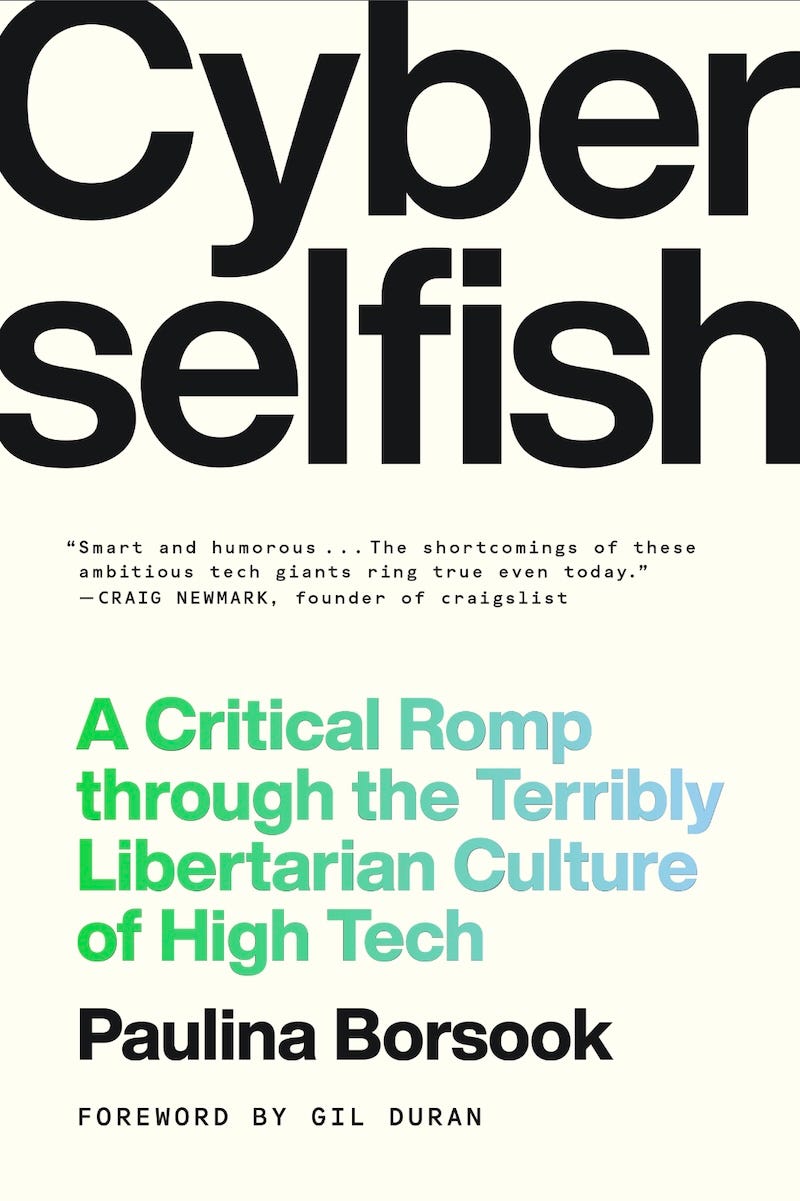
Cyberselfish by Pauline Borsook (PublicAffairs, 2000; Tin House/Zer0 Books, 2026).

Klein and Taylor write,

History isn’t linear but it also doesn’t repeat on a loop, circling back to the same place over and over again. Rather, it moves in more of a spiral, pushing to places that feel familiar but are fundamentally different. The accumulated weight of what came before collides with new, unpredictable developments.12

Paulina Borsook explored some of these “unpredictable developments” in her 2000 book, Cyberselfish: A Critical Romp Through the Terribly Libertarian Culture of High Tech (PublicAffairs, 2000), which was recently rereleased (Tin House/Zer0 Books, 2026) because as our centrifugal force widens the spiral, it remains as relevant as ever. That’s good for Borsook and her insights, but not so much for the rest of us. In a recent profile in WIRED, Tommy Craggs writes, “Everything Borsook would later write as a journalist covering the industry—the frisky pieces for Salon and Suck, the weightier profiles for WIRED, every barbed word of Cyberselfish—seemed to flow from a simple imperative drawn from her experience: never lose sight of the human in the machine.”13 She aptly calls this approach “agonized humanism,”14 a critical stance that still cares deeply about its embedded human subjects.

“There was a collective dream of progress and a centralized belief in the perfectibility of man [sic] — either through technology or fascism, which effectively amounted to the same thing.” — Terry Gilliam
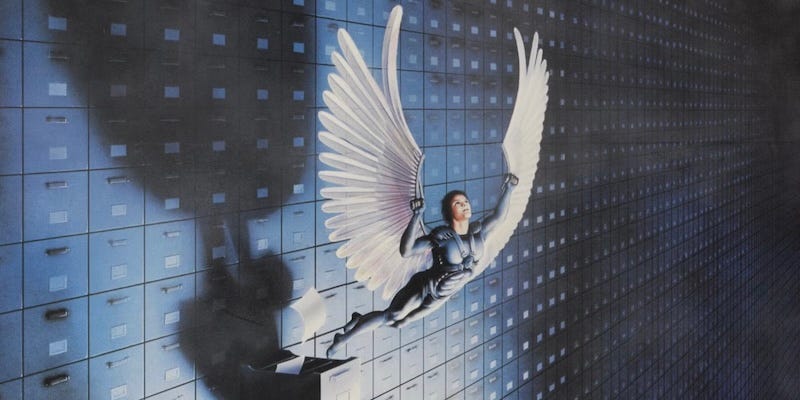
A dream of fleeing the files: Terry Gilliam’s Brazil (1985).

“[T]echnology is just like indoor plumbing or electricity: it’s infrastructure, not magic,” Borsook wrote in 2015, adding “software was a human artifact; that is, I began to be able to think the way the creators […] thought… The dyer’s hand, the design sensibility, the cognitive blind spots: all evident and all human artifacts. Technology is idiosyncratic like the humans who devise it and the people who make it are just people.”15 We would do well to remember those people have biases and agendas.16 We would do well to remember that they make our information infrastructure in their own likeness, codified as policy and politicized as code.

“Fascism is capitalism with bared teeth.”
— Naomi Klein and Astra Taylor, End Times Fascism

Notes:

1 Bruce R. Burningham, Tilting Cervantes: Baroque Reflections on Postmodern Culture, Nashville, TN: Vanderbilt University Press, 2008.

2 Quoted in Ian Christie, Gilliam on Gilliam, London: faber & faber, 1999, 129.

3 Barry Brummett writes, “Several references within the film make it clear that the characters regard their society as if it were a machine.”; Brummett, Rhetoric of Machine Aesthetics, 1999, 122; Michel de Certeau defines a “culture” as “systems of operational combination”; de Certeau, The Practice of Everyday Life, Oakland, CA: University of California Press, 1984, xi.

4 Quoted in Christie, 1999, 145; Jeffrey Melton and Eric Sterling describe the world of Brazil as “an authoritarian nightmare that in every way discourages human aspiration beyond the desire for comfort and commodities.”; Melton & Sterling, “The Subversion of Happy Endings in Terry Gilliam’s Brazil,” In Birkenstein, Froula, & Randell (eds.), The Cinema of Terry Gilliam, New York: Wallflower Press, 2013, 69.

5 Melton & Sterling, 2013; Most of this first section is lifted from my book The Medium Picture; See Roy Christopher, The Medium Picture, Athens, GA: University of Georgia Press, 2025.

6 Jaron Lanier, Ten Arguments for Deleting Your Social Media Accounts Right Now, New York: Henry Holt, 2018, 24.

7 Ibid., 115.

8 Naomi Klein & Astra Taylor, End Times Fascism, and the Fight for The Living World, New York: Farrar, Straus and Giroux, 2026.

9 Klein & Taylor, 2026; See also Mark Dery, The Pyrotechnic Insanitarium, New York: Grove Press, 1999; Douglas Rushkoff, The Survival of the Richest, New York: W.W. Norton & Co., 2022; and Roy Christopher, Post-Self: Journeys Beyond the Human Body, London: Repeater Books, 2025.

10 Klein & Taylor, 2026.

11 Donna Haraway, Staying With the Trouble, Durham, NC: Duke University Press, 2016.

12 Klein & Taylor, 2026.

13 Tommy Craggs, “Who Killed Paulina Borsook’s Career?” WIRED, September 25, 2026.

14 Quoted in Craggs, 2026.

15 Quoted in Geert Lovink, “Cyberselfish, 15 Years After,” Public Affairs, 2015.

16 As Cathy O’Niell says, “Algorithms are opinions embedded in code.” See Cathy O’Neill, Weapons of Math Destruction, New York: Crown, 2016, and Jeff Orlowski (Director), The Social Dilemma [Film], Exposure Labs, Netflix, 2020.

Joseph Rathgeber: anticon and Beyond

anticon was a time, a team, a blip on a screen, 
a group, a label, a stable of men.
anticon was a movement, a moment, an underground scene,
a business, a base, a stance against the status quo.


anticon was a voice, a mic, a 4-track backing track,
a collective, a corrective, a fix for the pre-millennium tension.
anticon was a concept, a conspiracy, a crew on a mission,
a shout, a scream, a call out to listen


anticon was a scam, a hoax, a marketing plan destined to fail,
a process, a project, a product for sale.
anticon was a wave, a wormhole, a wish for acceptance.
a way forward, a way out, a way away from the present tense.
The bottle of humans that was anticon: doseone, Yoni Wolf, Controller 7, Sole, DJ Mayonaise, Odd Nosdam, Alias, pedestrian, and Jel.

Call them a collective, a crew, or any and all of the above, anticon started with collaborations and compilations from different points on the map (Maine, Cincinnati, Chula Vista, Chicago, and parts unknown), but on the cusp of the new millennium, they got it all together in the grey area of the Bay Area. Now, underground scholar Joseph Rathgeber has compiled their definitive history.

One rapper I talked to called him “a professor of word salad,”1 but Rathgeber’s loosely aphoristic, epigrammatic style wanders somewhere between the manic musings of Dave Tompkins and the futuristic philosophy of Rammellzee. Like me, he matriculated in the zine trade and graduated to books.

Joseph Rathgeber: As a zine press, Caltrops has been actively documenting and analyzing the underground rap renaissance since 2020, disseminating handmade zines direct from the kitchen table to the rest of the world. Catch Us Before We Fall Off inaugurates Caltrops Press as a publisher of hip-hop books.2

From 1,200 Hobos to 1,200 pages: The definitive history of anticon (Caltrops Press, 2026)

Rathgeber’s Caltrops zines have been a steady wealth of in-depth analysis of some of the most obtuse recent releases by some of the most complex and compelling underground artists of the decade: billy woods, ELUCID, Fatboi Sharif, Armand Hammer, and ShrapKnel, among others. Yo, kid kinda nice.

doseone: Joe [Rathgeber] is part person, part pen. Someone who grows because of other’s writing and grows wilder still within his own. It’s an honor to have our creativities intertwine…3

One could estimate the impetus of anticon’s beginnings in the game, but like some lo-fi, hip-hop, jazz version of Genesis or The Mystic Knights of the Oingo Boingo, Apogee (doseone, Yoni Wolf, Josiah Wolf, and Mr. Dibbs) represents the direct precursor to anticon’s most known and most creative period. They recorded everything and yet the only tape one might find is a bootleg, a testament to the sporadic and ephemeral nature of the hydra-headed genius(es) at work here. Their improvised, theatrical rehearsals and performances—decidedly interchangeable designations—collected the scraps of previous projects and composed the compost from which grew others. The later assemblies of different members included Deep Puddle Dynamics (doseone, Sole, and Alias, as well as Slug of Atmosphere and Rhymesayers Entertainment; another candidate for the coalescence of the collective), Themselves, cLOUDDEAD (another one), Why?, subtle, Reaching Quiet, So-Called Artists, Greenthink, and so on—row, row, row, rotating rosters. It was all a beautiful mess at best, a catalog of risks, “some careless, some calculated,”4 with pregnant promises of vision and never getting paint on spectacles again.5

“My dream would be to see a movie of just live studio footage of some of my favorite records being made with no commentary or anything, just a good behind-the-scenes look — all the arguments and the epiphanies.”6
— Yoni Wolf

Rathgeber has ingested that mess, investigated that dream, and interrogated those responsible—all of it and all of them, which resulted in a 1,200-page, two-volume mega-tome. Part prose-poetic pastiche, part oral history, Catch Us Before We Fall Off: A [Ch]oral History of anticon. (Caltrops Press, 2026) is the kind of deep dig you wish someone would do on all of your favorite artists, bands, collectives, labels—an excavation of all the burial sites, an autopsy of all the bodies. For fans of all things anticon, this is the definitive history, “an audacious document of a pivotal moment in hip-hop history.”

Jel: It wasn’t being played on the radio, but it was bumping at the Scribble Jam.7

The lore is true. Scribble Jam is another gravesite in this ruined geography, another node in this invisible network. Starting in 1996 in a parking lot, Scribble Jam hosted and boasted some of the most legendary battles in hip-hop’s short history. Emcees, DJs, beatboxers, and B-boys all battled for underground supremacy. Artists like Juice, Eminem, and Rhymefest, as well as anticon artists like doseone and anticon-adjacent artists like DJ Abilities, Eyedea, and Sage Francis made or built their names exchanging weaponized wordplay and battle-sharpened skills at Scribble Jam’s many hectic melees.

Archived by any means, many of anticon’s early documents were recorded on 4-track tape machines, what Rathgeber, channeling Marshall McLuhan, describes as “medium and message, DIY, unbridled bedroom creativity spinning around magnetic tape spools.”8 I, too, once compared the “primitive and unadorned nature” of anticon’s output to adjacent lo-fi indie-rock outfits hiding behind the same wow and flutter: Guided by Voices, Sebadoh, Hood (the latter of whom would collaborate with members of the collective). In similar spirit, theirs was not an aesthetic choice but a necessary one. With an excess of output from the rhymers-only room, the 4-track bridged the bay between process and product, between the ether and something tangible, between table talk and a cassette tape. The hiss was the ignorance of which bliss is made.

“I tested my chassis on the road and drove faster accordingly.”
— doseone

Dan Hancox: doseone is the label’s most out-there, artful rapper, and his ghostly, nasal rhymes are the centrepiece to the bizarre compositions of Themselves. The distorted drones and drum samples, clunking pipes, feedback and abrupt time signatures of “It’s Them” and “Live Trap” do to hip-hop what Columbus did to world geography. Such experimental creations will not be to everyone’s tastes, but repay repeated listening—with not a gold necklace in sight.9

Alias: Who the hell’s that guy?10

Rathgeber describes doseone’s style as “an invitation to get lost in the funhouse,” an invitation “to be riveted by the skillset, rapt by the rapping,” and adds, “sometimes the mental plane which doseone operates on feels unreachable, his messages utterly abstruse.”11 dose’s style is varied, verbose, sometimes sing-songy, sometimes chanty… It’s shanti, shanti, all over the rap; divisive, polarizing, an affront to all those frontin’ on the mic.

If music fandom is radically subjective, then hip-hop fandom is even more so. I’ve been in many discussions where mentioning anticon was anathema, I’ve been in several situations where admitting to liking them was an irreversible faux pas. To quote Hua Hsu in The Wire, anticon “embodies all the fascinating contradictions which both sustain and complicate the culture.”12 As pedestrian puts it in his Foreword to Catch Us Before We Fall Off, “In the vacuum of crew, molecules of burning gas will as a rule go solo. And so, a posse cuts both ways, loosens into them and you, now uniquely incomplete.” And from Vladimir Nabokov’s Pale Fire: “A system of cells interlinked, within cells interlinked, within cells interlinked within one stem. And dreadfully distinct against the dark…”13 Deep lines were drawn, not in sand but hella underground.

Their underground was “twilit tunnels and secret passages”14 from trading tapes to downloading songs, from CDs to mp3s. Their underground saw a seismic shift, the tectonics of an industry in upheaval, where ever-new forms of bootlegs were balms and “clandestine comforts.”15 Their underground was both burden and boon.

Sole: Underground music was tape trades and Napster. The whole groundwork for a market existing for the label came out of widespread sharing of that music.16

anticon was baptized by bandwidth, they stepped from one era to the next over the cataclysm of the internet. Adapting to the new tech as they adopted it, anticon took advantage of the early bit trade. Downloaded on the down low, spreading at the speed of P2P, their music moved from around the way to around the world through wires and wormholes alike.

“It was as if we came home from a semester at sea with nothing to eat but dreams.”
— pedestrian

Rathgeber finally describes the anticon aesthetic as “a fleeting moment in time—rap-as-literature; sonics-and-phonics thoroughly plundered; altruistically allusive and relentlessly referential; an irreverent and foolish yet holy pursuit of art.”17 Maybe it was just “a fleeting moment,” but maybe it was the music. Maybe it was the attitude. Maybe it was the Sole/El-P feud. Maybe it was just too many halfway crooks in their kitchen. Whatever it was and whatever you think of them, they followed their own path accompanied by their own drums. Like the Wu-Tang Clan before them and Odd Future after, anticon came together for a brief period, jumped in the deep puddle, splashed spectacularly, rippled to the edges, and then subsided.

dosone: The whole paper towel was wet with our experiment.18

anticon was a time, a team, a blip on a screen, but if you’re interested in indie discourse and rhymes outside the lines, Rathgeber’s Catch Us Before We Fall Off interjects anticon back into the history, the conversation, the cypher.

.


Joseph Rathgeber. [photo by by Ananda Lima]

Roy Christopher: You and I came to this writing racket making our own zines. Aside from that, what’s your background?

Joseph Rathgeber: My mother recently found my fourth grade report card. My teacher, Ms. Kroll, wrote, “Joseph is doing as little as possible.” That was an accurate assessment. When it’s come to education and employment, I’ve been unmotivated and directionless. Near the end of high school, I had to be reminded to apply to college, and I only worked enough (washing cars) to afford a weekly plate of fries from Six Brothers Diner (R.I.P.). When my parents threatened to kick me out of their home, that Atmosphere lyric that goes “I rather live in a tent than bust my ass to pay the rent” was all the ideology I needed.

Ultimately, I got an English degree from a state school here in New Jersey. Again, no thoughts of a “career” in mind. I was reading poems, plays, and novels anyway, so it made sense to do so in the pursuit of a degree. I also had a concentration in Creative Writing, which just means I took a lot of workshop classes and minimized my workload even further. I found plenty of time to do what I really wanted to do, which was record rap music. I also started writing about music in the form of record reviews for Tiny Mix Tapes. Anyway, with no career options to speak of after college graduation, my girlfriend (now wife) and I decided to pursue the “alternate route” to teacher certification. Basically, you find a teaching job at a Catholic or private school and complete night classes during the first year of employment. That job also paid for me to get a Master’s a couple years later. They didn’t even require it be a Master’s in Education, so of course I went for English. I was encouraged to continue toward a PhD or MFA, but, again, the motivation wasn’t there and neither was the money.

At that point, I was still paying off my student loans from undergrad. When I first started writing about billy woods’ music in 2021, he made some good-natured crack about me being on sabbatical for the semester, and then something about me being the department chair. I like to think of that compliment as my framed PhD diploma. In reality, I teach high school kids how to analyze literature. I also constantly urge them to consider diverging from their predicted life path. It’s noble work.

Various Caltrops zines. [author photo]

RC: Aside from the zines, you’ve written other books in the past. Why a book on anticon and why now?

JR: I’ve been pretty vocal about how this anticon book is a decade in the making, so “why now” feels interminable. When I first conceived the idea, it was because I had great affection for the music that emerged from anticon’s salad days, roughly between 1996 and 2003. I had some thoughts about hip-hop and otherwise that I wanted to explore through them and their work, but at some indeterminate point the vision for the project began to swell. I like to be thorough, and so my vision for the project went from something manageable to monstrous as I decided I had to write about all the music from that period and tell the stories of all the players.

Eventually I decided to have the players tell the tale themselves. Suddenly, I realized I was juggling both an oral history and a critical commentary. The former required that I learn how to make contacts with artists, conduct interviews, and integrate those transcripts into a narrative. Bear in mind I had no real experience to speak of and had to slowly prove my credibility to these people, not to mention earn their trust as I ventured deeper into the project. Ultimately what resulted was an unwieldy conglomeration. The result is Robert Shelton’s No Direction Home biography of Dylan and Michael Gray’s Song & Dance Man analysis of his body of work in one. It’s Greil Marcus’s Lipstick Traces subcultural commentary and the oral history of Please Kill Me combined.

I’m a fool, frankly, for even attempting this. Nonetheless, I got it done and I feel more than good about it. A more direct answer to “why now?” would be that over this decade of working on the book anticon has been absent from the story. Retrospectives of late ‘90s/early 2000s underground hip-hop include the likes of Fondle ‘Em, Rawkus, Def Jux, SoleSides, Hiero, and others, but anticon has been routinely and, in my view, deliberately omitted. The book examines why that is while inserting them back into that conversation in the process.

RC: How did you get into zine-making in the first place?

JR: Like most, I’ve always appreciated the DIY nature of zines. As I became more and more disillusioned with publishing poetry and fiction through the conventional means and processes, I decided life’s too short to fill out submission forms and wait months or even years for responses, be they rejections or acceptances. That traditional way worked fine for a time, specifically when I was young and seeking validation from institutions and perceived authorities in the field. But zines and chapbooks were more immediate, and the medium matched the urgency of the art.

I will say this: I have received far more validation, praise, and opportunities in the years I’ve been doing things myself and on my own terms. And I’m always going to prize the tangibility of zines, the intimate pasting, folding, stapling, and mailing of an artifact that is transferred to someone else’s hands. Those things will last. Podcast episodes will soon be lost in the ether.

Rathgeber at Gutter Bar. [photo by Suchi Jalavancha]

RC: What’s next for Joseph Rathgeber and Caltrops Press?

JR: Personally, I’m champing at the bit to write fiction again. Between the anticon books and the underground hip-hop renaissance I’ve been documenting over the last six years, I’m very eager to open up the notebook with all the story ideas I’ve had to look away from until these current projects reached a conclusion. I have been writing plenty of poetry over these years, though, so I’m sitting on a couple of manuscripts and trying to figure out what to do with those. I also miss doing public readings.

As for Caltrops Press, the plan is to continue publishing books about hip-hop. The next one will be a book about the work of Armand Hammer and billy woods and ELUCID as solo artists, also written by me. That’s basically done and will come out Spring 2027 if, as DOOM once said, everything goes according to plan, man. I want to open up the press to proposals by other writers, but I’m intimidated by anything “business” related and don’t have the wherewithal to send out 1099s and all that shit, so it’ll have to be people I’m close with first. Caltrops, as a zine, just hit issue 30, and I don’t plan to stop there.


Notes:

  1. Interview with the author, September 15, 2026. ↩︎
  2. Joseph Rathgeber, “Book Release: Catch us Before we Fall Off,” Caltrops Press Substack, September 8, 2026. ↩︎
  3. Interview with the author, September 15, 2026. ↩︎
  4. Joseph Rathgeber, Catch Us Before We Fall Off, Vol. 1, Caltrops Press, 2026, 2. ↩︎
  5. cLOUDDEAD, “I Promise Never to Get Paint on My Glasses Again” [10” EP], Mush Records, 2001. ↩︎
  6. Quoted in Roy Christopher, “Yoni Wolf and Richard Adams: The Sound of a Handshake” (pp. 211-215) in Roy Christopher (ed.), Follow for Now: Interviews with Friends and Heroes, Seattle, WA: Well-Red Bear, 2007, 214. ↩︎
  7. Quoted in Rathgeber, Vol. 1, 2026. ↩︎
  8. Rathgeber, 2026, Vol. 1, 334. ↩︎
  9. Dan Hancox, “The Download,”  New Statesman, London Vol. 18, Iss. 849, March 7, 2005, 43; The gold-chain thing is a whole other story. ↩︎
  10. Quoted in Rathgeber, Vol. 1, 2026, 555. ↩︎
  11. Rathgeber, Vol. 1, 2026, 100. ↩︎
  12. Hua Hsu, “Anticon: Hip-hop’s Oddball Alliance,” The Wire, #200, October 2000. ↩︎
  13. Vladimir Nabokov, Pale Fire, New York: Putnam, 1962, 61. ↩︎
  14. Rathgeber, 2026, Vol. 1, 17. ↩︎
  15. Ibid. ↩︎
  16. Quoted in Rathgeber, Vol. 1, 2026, 567-8. ↩︎
  17. Rathgeber, Catch Us Before We Fall Off, Vol. 2, Caltrops Press, 2026, 496. ↩︎
  18. Quoted in Rathgeber, Vol. 2, 2026, 565. ↩︎

Skate Book Club: THE MEDIUM PICTURE Review

Adam Abada wrote the following thorough and thoughtful review of The Medium Picture for Tails of Skateboarding‘s Skate Book Club newsletter:

In a mode appealing to members of any subculture, Roy Christopher’s dense but slim The Medium Picture charts the changes in culture as dictated by technology on both a personal and intellectual level. Like the history of our media itself, he first references large monolithic examples — radio/music and television shows — that have become embedded in our culture, then complicates and fragments our relationship to them. One example focuses on how the change from record to tape in the music industry helped to alter our cultural expressions and how we synthesize information. He moves through post-modern history and shows how more technology can create corrosive representations and information, like a copy of a copy of a copy. 

A sort of punk rock luddite — Christopher has never owned a TV and hasn’t had a car since the 1990s — he draws from subculture crossover icons like Gang of Four, Laurie Anderson, and Ian MacKaye as well as well-researched academic theories from people like Marshall McLuhan to show how things like zines and mixtapes led to the tiny screens of today. The theory is sprinkled in references; I personally was drawn in with the often-cited works of William Gibson, a robust establishing of skateboarding’s relationship to his topic, and the dozens of chapter-opening quotations from films, poems, music, or authors like Kim Stanley Robinson.

Spike Jonze making marks in The Medium Picture. Photo by Rodger Bridges.

This vast collection of references is supported by well-referenced theory and research that mesh with the book’s easily readable format. Christopher’s claim of lifelong journaling seems very likely given the easy, conversational manner in which he delivers so much information. It is our insights into his own relationships to the theories at hand that make this book most compelling, and Christopher exudes a real love for the things he talks about. I maintained interest through loftier, hard-to-grasp ideas with clearly illustrated connections between seemingly disparate topics like metaphor and technology, while receiving new insight into everyday things such as walking.

The Medium Picture probes many of the questions and desires that we feel as people and may not have words for. The extremely clever title gives a very accurate idea of what the book is about — a play on words that folds in on itself from multiple angles. There is even a nicely designed title page logo calling attention to these interlocking angles, not to mention the pleasing chapter and section headers. Importantly, at only 162 pages, Christopher makes a seemingly intimidating topic appear tackleable and packs a lot into his punch. Perhaps the best thing The Medium Picture does, though, is recognize that it is a piece of a larger whole — a very important and often forgotten thing for cultural theory to do. For that and much more, it is worth your read.


Many thanks to Adam, John Freeborn, and all at Tails of Skateboarding and the Skate Book Club!

The Medium Picture is now available from the University of Georgia Press.

Intertextual Orientation: The Pop Palimpsest

During my undergraduate days, my friends and I used to play a silly game. Whenever a situation or topic came up and they pointed to me, I would attempt to recite a relevant rap lyric. Sometimes it was a stretch to get Ice-T or the Beastie Boys to fit a late-night Waffle House run, but I was rarely stumped.

As Gorham and Gilligan (2006) put it, “media allusions represent an important way in which audiences make use of the cultural products around them to form relationships with others and build community out of shared media experiences” (p. 3). That is, we determine which texts are appropriate for appropriating and which resonate with the shared beliefs of our community (Linde, 2009). We run around in these collective “textual communities” (Stock, 1983). Members of said communities allude to the same, shared texts in their personal narratives. The shared texts are where we “compare notes” on our collective experiences, as I used to do in college. The fans of a particular cultural artifact (e.g., fans of the band Rush, fans of Stanley Kubrick’s The Shining, etc.) do not constitute a textual community; textual communities are constituted by their sharing of similar texts in their personal narratives (Linde, 2009). A lot of these texts come from song lyrics.

Christian Marclay: Cyanotype

Sometimes this sharing is called intertextuality, but the term is often misused and abused (Allen, 2000; Irwin, 2004; Orr, 2003; Roudiez, 1980). As originally coined by Julia Kristeva in 1966, the term meant “the transposition of one or more systems of signs into another” (Roudiez, 1980, p. 15; emphasis in original). Therefore, while lyrics, media allusions, and conversational sampling can all be considered intertextual, their intertextuality does not indicate a cohesive system of signs.

Reguardless, intertextuality says there is something outside the text — more texts. Building on Gérard Gennette’s work in art and literature (see Gennette, 1982; 1987; 1994/1997) , The Pop Palimpsest: Intertextuality in Recorded Popular Music (University of Michigan Press, 2018), edited by Lori Burns and Serge Lacasse, aims to explore those texts in popular music. I did my own dissertation research on allusions in rap lyrics, so I immediately gravitated to the chapters on hip-hop: “Rap Gods and Monsters: Words, Music, and Images in the Hip-Hop Intertexts of Eminem, Jay-Z, and Kanye West” by Lori Burns and Alyssa Woods would’ve been invaluable in my earlier research; “Intertextuality and Lineage in The Game’s ‘We Ain’t’ and Kendrick Lamar’s ‘m.A.A.d. City'” by Justin A. Williams also immediately grabbed me; “Mix Tapes, memory, and Nostalogia: An Introduction to Phonographic Analogies” by Serge Lacasse and Andy Bennett overlaps with a couple of new areas of my research.

It’s not all rap lyrics and samples though: Everything from French Vaudville and Neil Young to Genesis, E.L.O., and Eurythmics get a spin. And it’s not all just research either: The Pop Palimpsest is that rare academic collection that’s exhaustively researched and meticulously assembled, but also damn fun to read. The book has inspired dueling desires: I wish it had not only come out earlier but also that I could have contributed.

References:

Allen, Graham. (2000). Intertextuality: The New Critical Idiom. New York: Routledge.

Genette, Gérard. (1982/1997). Palimpsests: Literature in the Second Degree. Lincoln, NE: University of Nebraska Press.

Genette, Gérard. (1987/1997). Paratexts: Thresholds of Interpretation. Cambridge: Cambridge University Press.

Genette, Gérard. (1994/1997). The Work of Art: Immanence and Transcendence. Ithaca, NY: Cornell University Press.

Gorham, B. W. & Gilligan, E. N. (1997, May). And now for something completely different: Media allusions, language, and the practice of everyday life. A paper presented to the Language and Social Interaction division, ICA, Montreal.

Gorham, B. W. & Gilligan, E. N. (2006, June). Are you talkin’ to ME? The reasons for and use of media allusions. Paper presented at the annual meeting of the International Communication Association, Dresden International Congress Centre, Dresden, Germany.

Irwin, William. (2004, October). Against Intertextuality. Philosophy and Literature. Volume 28, Number 2, pp. 227-242. The Johns Hopkins University Press.

Linde, Charlotte. (2009). Working the Past: Narrative and Institutional Memory. New York: Oxford University Press.

Orr, Mary. (2003). Intertextuality: Debates and Contexts. Cambridge: Polity.

Roudiez, L. S. (1980). Introduction. In J. Kristeva, Desire in language: A Semiotic Approach to Literature and Art. New York: Columbia University Press, pp. 1-20.

Stock, B. (1983). The Implications of Literacy: Written Language and Models of Interpretation in the Eleventh and Twelfth Centuries. Princeton, NJ: Princeton University Press.

Media Literacy: Curing the Common Code

“Media literacy” is as socially contested a term as they come. Its meaning of has been debated at least as far back as 1933 (see Tyner, 2010).It’s not difficult to make the case that Marshall McLuhan‘s work in the main was about media literacy. Not to mention Howard Rheingold‘s lengthy and thorough work on new media and social media literacy.

So much has changed and changed hands since McLuhan left us. The computer moved from business and industry to the home and finally to every place and pocket available. In Coding Literacy: How Computer Programming is Changing Writing (MIT Press, 2017), Annette Vee argues that literacy is infrastructural. She explores two phases of its spread. One is where we adopt inscription technologies as material infrastructures. Then, as we adopt those technologies that affect the “quotidian activities of everyday citizens: literacy is adopted as infrastructure” (p. 141). She notes crucially that communicative practices such as writing and programming can manifest as actions and as artifacts. Vee’s approach addresses the social aspects of these literacies (i.e., understanding the actions), as well as their material underpinnings (i.e., understanding the artifacts). It’s an important new view of several serious issues.

Zooming out to the walls, rooms, and roads around us, Shannon Mattern’s Code + Clay… Data + Dirt: Five Thousand Years of Urban Media (University of Minnesota Press, 2017) takes up the mantle of media archaeology and “challenges the newness of the new” by looking back at infrastructure at large — our built environment. Our urban areas are the site of information access as well as media themselves. Citing Malcolm McCullough and echoing McLuhan, She writes, “Our physical landscapes inscribe, transmit, and even embody information–about their histories, their state of repair, their potential uses, and so forth” (p. xii). Mattern’s use of sound, inscription, voice, and code illuminates our environment in a different and generative light.

We academics do a lot of work to justify and perpetuate our own work, a lot of advertising for ourselves. This is not that kind of work. Both of these books are about current situations verging on crises, and both of them take a long, historical view of these situations. There is still much to learn about all of these constructs and all of their relationships. There is an entire network of literacies we all need to learn. Now.

References:

Mattern, Shannon. (2017). Code + Clay… Data + Dirt: Five Thousand Years of Urban Media. Minneapolis, MN: University of Minnesota Press.

Tyner, Katherine (Ed.). (2010). Media Literacy: New Agendas in Communication. New York: Routledge.

Vee, Annette. (2017). Coding Literacy: How Computer Programming is Changing Writing. Cambridge, MA: The MIT Press.

—-

Many thanks to Alison Langmead, Lily Brewer, and the fine folks at the University of Pittsburgh and their Digital Scholarship Services for hosting and allowing me to crash the Willful Transgressions: Transdisciplinary Teaching workshop with Shannon Mattern. It was there that I was able to meet and work briefly with both Shannon and Annette.

The Alterity of Cool

William Melvin Kelley’s debut novel, A Different Drummer (Doubleday, 1962), imagines a different America, one where a slave revolt reconfigured the civil war and the nation thereafter. Three weeks before its release, Kelley flipped the term “woke” into its current common parlance in a New York Times Op-Ed piece. His central point was that the African Diaspora was responsible for the cool, “beatnik” slang of the time. One could say the same for hip-hop slang now. Some of it stays in predominantly hip-hop contexts, but quite a lot of it has traveled the wider world at large. As Biggie once rapped, “You never thought that hip-hop would take it this far.”

Say word.

I dare say it’s gone farther than Big could’ve imagined. In Muslim Cool: Race, Religion, and Hip-Hop in the United States (NYU Press, 2016), Su’ad Abdul Khabeer traces the elusive cool to Africa, arguing that it’s “not the sole purview of U.S. Black American expressive cultures,” but that it is “fundamentally Diasporic” (p. 140). Cool requires detachment. Alterity is inherent in Muslim cool. Raised as a Muslim in the U.S., Khabeer operates as an anthropologist, enabling to both cross boundaries and remain of her subjects. Embedded and embodied, she nonetheless recognizes how these factors mediate her work, writing, “…simply being Muslim was never enough. In fact, my race and ethnicity (Black and Latina), my gender (female), and my regional identity (reppin’ Brooklyn, New York!) as well as my religious community affiliations and my performance of Muslimness mediated my access–how I was seen in the field, what was said to me, and what was kept from me–as well as my own interpretations of my field site” (p. 20). Just being “cool” ain’t always so cool. Sometimes it’s about standing out. Sometimes it’s about fitting in. The diasporic distinction of cool is one of the many things Paul Gilroy points out in The Black Atlantic (1995): History without a consideration of race and place is not history at all. In her ethnographic approach, Khabeer maintains attention to both and then some.

As Gilroy himself puts it, “the old U.S. cultural copyrights on hip-hop have expired.” Along with the rest of the globe, Europe is in the house. Some of the best at it are based over there. Dizzee Rascal is a native and a hip-hop veteran. Fellow East-Coast emcees M. Sayyid and Mike Ladd relocated separately to Paris years ago. Ex-New Flesh for Old emcee Juice Aleem also holds it down in the UK, among countless others. There’s an entire chapter on Aleem in J. Griffith Rollefson’s Flip the Script: European Hip-hop and the Politics of Postcoloniality (University of Chicago Press, 2017). Sometimes to move ahead, you’ve gotta step back first. Rollefson investigates Aleem’s postcolonialism via pre-Enlightenment performative linguistics. It’s an Afrofuturist alternative history via precolonial tricks and tropes, not unlike Kelley’s reimagining in A Different Drummer. Aleem’s signifyin’ is one of many examples of Rollefson’s arguments regarding the postcoloniality of hip-hop.

“Hip-hop has come full circle at present,” South African emcee, Mr. Fat (R.I.P.) once said. “Emcees are like the storytellers of the tribe, graffiti is cave paintings, and the drums of Africa are like turntables: This is our ideology.” (quoted in Neate, 2004, p. 120). Indeed, as hip-hop has moved from around the way to around the world, mapping it requires a deft hand, a def mind, an understanding of the alterity of cool, and a handle on histories other than those in the history books.

References:

Gilroy, Paul. (1995). The Black Atlantic: Modernity and Double Consciousness. Cambridge, MA: Harvard University Press.

Kelley, William. (1962). A Different Drummer. New York: Doubleday.

Khabeer, Su’ad Abdul. (2016). Muslim Cool: Race, Religion, and Hip-Hop in the United States New York: NYU Press.

Neate, Patrick. (2004). Where You’re At: Notes from the Frontline of a Hip-Hop Planet. New York: Bloomsbury.

Rollefson, J. Griffith. (2017). Flip the Script: European Hip-hop and the Politics of Postcoloniality. Chicago: University of Chicago Press.

Schulz, Katheryn. (2018, January 29). The Lost Giant of American Literature. The New Yorker.

Wallace, Christopher. (1994). Juicy. On Ready to Die [LP]. New York: Bad Boy/Arista.

Top Records, 2017

This has been another year of change for me. I’m finding more and more difficult to see how others stagnate as they age. Maybe others see me some kind of way, but one place that tendency is evident is in the music we listen to: I am constantly finding new and exciting sounds. Whether it’s seeing Street Sects open for my dudes dälek at Beat Kitchen in Chicago, or EMA, Sleaford Mods, Moor Mother, and Sturgill Simpson making me rethink the very concept of genre, there’s always someone pushing things one way or another.

One thing about this list you might notice: There’s a lot less metal this year. Though I did see Nails at the Bottom Lounge in April, my several-years-long metal kick somehow finally lost momentum early in the year. My in-between phases are kind of all over the place, but maybe you’ll find something in here you like. At the very least, this year’s list is more diverse than it has been in a while.

The clear label winner for 2017 is The Flenser. We were definitely riding the same waves this year.

As always, I’ve included links to Bandcamp where available. I’m not in cahoots with them, I’m just a fan of their platform. Without further fuckery, here are my top however-many records from 2017 and some leftovers from last year.

Shabazz Palaces Quazarz: Born on a Gangster Star and Quazarz vs. The Jealous Machines (Sub Pop): With little-to-no warning, Shabazz Palaces dropped a double smartbomb on the summer of 2017. I mean, I interviewed Ish Butler in January, and he didn’t even mention the imminent releases. To attempt to describe this double release is to participate in folly. It will be a long time before anyone is able to place this greatness.

EMA Exile in the Outer Ring (City Slang): Erika M. Anderson claims not to be making science fiction records, but each time she says it, her voice grows fainter due to her distance from Earth. Exile in the Outer Ring‘s sounds are more spacey, its textures more other-worldly. This is EMA from the farthest out yet.

Planning for Burial Below the House (The Flenser): Over the past few years, Planning for Burial has slowly become one of my absolute favorite bands, and stunning records like Below the House are the reason. I’ve listened to its opener, “Whiskey and Wine,” more times than any other song this year.

dälek Endangered Philosophies (Ipecac): On their second record after a lengthy hiatus, dälek has already outpaced the momentum that made them the pioneers of this sound. Every song is a weapon against complacency, a bomb in your brain. The result is fucking devastating.

Kendrick Lamar DAMN. (TDE): He’s not hailed as the best doing it for nothing. If untitled unmastered proved how good he is when left to himself, DAMN. only adds to that power. The polish is in the right places, and the rest is left jagged, rugged, and raw.

Joey Bada$$ All-Amerikkkan Bada$$ (Pro Era/Cinematic): The ongoing debates regarding who’s the best right now seem to always be between Kendrick Lamar, J. Cole, and Drake. Why Joey Bada$$ is excluded is baffling. All-Amerikkkan Bada$$ is easily one of the best records of 2017 — in any genre, much less hip-hop. And if I hear one more person say that the “industry changed him,” whatever the fuck that means, I will duct-tape headphones to their head and make them listen to Enta Da Stage until further notice. Bada$$ is a badass.

Wand Plum (Drag City): Despite the cloud on the cover, Plum is not quite as thick and hazy as Wand’s previous outings. From the contagious psych-groove of “White Cat” to the dreamy jam-out of “Blue Cloud,” Wand has the soundtrack to your synesthesia right here.

Playboi Carti s/t (AWGE/Interscope): Before Playboi Carti’s self-titled debut came out, I read an interview with him in which he talked about not being in a hurry to get it finished. He was taking his time. His diligence and patience paid off. A couple of weeks after I’d last listened to this record, I heard “wokeuplikethis*” blaring out of a boutique on Milwaukee Ave in Chicago. I still have it stuck in my head. Infectious A.F.

Street Sects Rat Jacket (The Flenser): Street Sects is back with all their previous industrial rage plus guitars! These four songs pack more power than most bands’ full-length records. See them live for the full effect.

Godflesh Post Self (Avalanche Recordings): Also regaining their momentum after a lengthy hiatus, Godflesh is back with a monster slab of riffs and beats. Post Self sounds more like a confident continuation than a comeback, and more than 2014’s A World Lit Only by Fire, it picks up where 2001’s Hymns left off. Brutal grooves.

Open City Open City (self-released): Boasting ex-members of Lifetime, Ceremony, Kid Dynamite, Armalite, and Ted Leo & the Pharmacists, among several others, it’s difficult to imagine Open City being anything other than awesome. They deliver on the promises of their collective past with a core that’s rock hard and a sophistication that only comes with years of honing it.

White Suns Psychic Drift (The Flenser): Since abandoning their guitars, White Suns have only gotten louder, harsher, and more interesting. Psychic Drift is as abrasive as it is subversive, as textured as it is layered, and as hot as it is bright.

Vince Staples Big Fish Theory (ARTium/Blacksmith/Def Jam): It’s difficult to pin down exactly what Vince Staples is doing on Big Fish Theory, but it’s good, and dude is definitely growing. From the laid-back bass-fuzz of “Yeah Right” (with Kendrick) to the rumbling flow of “BagBak,” Staples is up there with the best of his contemporaries.

Aesop Rock Bushwick Soundtrack (Lakeshore): It’s not just tracks without the raps, though there are a few on here that are begging for the man’s multisyllables. Aes’s Bushwick score has been some of my favorite work music this year. Put it on, bob the head, and tear into the task. Energetic, eerie, and emotive.

Metz Strange Peace (Sub Pop): In the mid-1990s, there emerged a genre-less sound somewhere between punk and metal, but totally different from what their merging conjures. Think Barkmarket, Jesus Lizard, or Jawbox. Metz brings that sound bludgeoning back with a brutal update. It’s never been clearer than on their third, Strange Peace. Play loud or not at all.

Heinali and Matt Finney How We Lived  (The Flenser): A pairing made somewhere south of heaven, Heinali and Matt Finney are back with another dark, droney collection of beautiful bedtime stories. There’s absolutely nothing like it anywhere else.

Ride Weather Diaries (Wichita): I once went on a year-long kick during which all I listened to was Ride. There’s something about their harmonies beset by droning feedback rhythms that just hooks me. Weather Diaries is a welcome return to that lovely, lulling sound.

Wolves in the Throne Room Thrice Woven (Artemisia): As much as I was off metal for most of the year, I had to check the new Wolves in the Throne Room. Thrice Woven is a return to their Cascadian transcendental black metal roots, real roots you can feel like fingers deep in the dirt.

Sean Price Imperius Rex (Duck Down): He’s still my favorite, so of course I love this posthumous release. Imperius Rex would be better if he were still around. Sean is a monster emcee, growling from the grave. r.i.P!

Exit Order Seed of Hysteria (Deathwish, Inc.): With all the indecisive genre bending going on these days, it’s refreshing to hear a band hit one right down the middle. Exit Order is good ol’ punk rock: fast, ferocious, and ready for anything. Frontwoman Anna Cataldo surfs their bundle of angry energy like a pro.

Words Hurt Soul Music for the Soulless (self-released): With Hangar 18 alumnus Alaska on the mic and his dude Lang Vo on the beats, Words Hurt is on the rampage on their second full-length. Alaska’s been busy all year dropping a track a month with his Atoms Fam homie Cryptic One (as IT), so the lyrical skills are as sharp as ever.

Kicking Giant This Being the Ballad of Kicking Giant, Halo: NYC​/​Olympia 1989 – 1993 (Drawing Room): Kicking Giant has always been about juxtaposition, the angles at which the worlds of Rachel Carns and Tae Won Yu meet. As Tae writes, “On one hand, there was the derangement of living in urban squalor and on the other, a predilection for simple harmonies and unpretentious purity.” This collection is a welcome return to that place in between. It’s also quite a beautiful package.

Drab Majesty The Demonstration (Dais): Where some just rehash and revive, Drab Majesty is one of the few bands to transcend their sound’s lineage. What could’ve been just throwback Gothic pop is instead a dark celebration of now as much as then. The Demonstration is as original as it is honorary, as catchy as it is cathartic.

Arca s/t (XL): Don’t let the cover scare you, Arca’s third record is the stuff of dreams. It’s his first with vocals, and you’ll wonder why as his voice carries most of these songs. It’s all great, but hang in there: The slower, later tracks “Desafío” and “Miel” are the best.

Jlin Black Origami (Planet Mu): Perhaps more frenetic than her last outing, Black Origami shows Jlin sharpening her set and sound. If 2015’s Dark Energy (also on Mike Paradinas’ Planet Mu label) is a knife, this is its very edge. Footwork from the future.

Eluvium Shuffle Drones (Temporary Residence): As the song list reads, “Simply put, the suggested manner of listening to this work is to isolate the collection and to randomize the play pattern on infinite repeat — thus creating a shuffling drone orchestration — the intent is to create a body of work specifically designed for and in disruption of modern listening habits and to suggest something peaceful, complex, unique, and ever-changing. Thank you.” It’s all of that and more.

Cloakroom Time Well (Relapse): There’s something so cozy about the landlocked, fly-over doom-pop of Cloakroom. They’re like an earthbound Hum, a rock-stanced Jesu, or Swervedriver on the wrong speed.

Uniform Wake in Fright (Sacred Bones): The nastiest of the now, Uniform noise it up not-so-nicely. There’s something really satisfying about the precision of parts of this and the sloppiness of others. It’s like being sliced up with a scalpel and bludgeoned over the head at the same time.

Steven Wilson To the Bone (Caroline): I’ve been a fan of Steven Wilson’s work since Porcupine Tree’s Fear of a Blank Planet, but I had lost interest in his solo work since his work with Mikael Åkerfeldt and his own Grace for Drowning (2011). I checked in again with this one, and everything I liked is here: the grand arrangements, the soaring choruses, the catchy quirkiness. Like early Eno, Wilson works with and around the conventions of progressive pop to great effect.

Björk Utopia (One Little Indian): No matter the era, Björk has always been one of the most compelling artists in the world. The last time she sounded this overtly in-love was perhaps on “Hit,” from her last record with The Sugarcubes nearly 30 years ago.

Sleaford Mods English Tapas (Rough Trade): Staggering between the stilted pop of The Fall to the electronic claustrophobia of Suicide to the whitey alt-hip-hop of Soul Coughing, these blokes have stumbled upon something awesome. With Andrew Fearn helming the laptop and Jason Williamson ranting along, English Tapas is so weirdly catchy, you’ll want to listen to it all the time.

Dizzee Rascal Raskit (Island): Staying out ahead of everyone else for over a decade, Dizzee Rascal has been building a body of work average emcees can only aspire to. Raskit is no exception. This is dude’s sixth record! Please stop sleeping on the Brexit brethren.

Last Year’s Leftovers:

Sometimes it takes a minute. Here are the one’s that either missed last year’s list or just deserve continued attention regardless.

Radiohead A Moon Shaped Pool (XL): While it missed my list last year, it’s one of the best of 2016. It took a long time for this record to unfold for me, but now I can’t stop listening to it. “Decks Dark” alone is one of my all-time favorite Radiohead tracks.

Choke Chains s/t (Slovenly): Choke Chains deliver heaps of nasty fun on their 2016 self-titled LP. It’s energetic and dirty like buried cables. Don’t call first. Just dig right in.

Moor Mother Fetish Bones (Black Quantum Futurism/Afrofuturist Affair): The best thing I heard all year came out last year. Though I’d read quite a bit by Moor Mother, I had yet to hear her music — a mistake I hope you won’t repeat. If you like your hip-hop noisy, your noise groovy, and both angry as fuck, then you’ll love the righteous rage of Moor Mother Goddess.

M. Sayyid Error Tape 1 (self-released): There’s simply no one like M. Sayyid. Antipop Consortium’s resident storyteller is back on his solo game. The best thing out of that camp for a minute, Error Tape 1 is M. Sayyid at his best yet.

Sturgill Simpson A Sailor’s Guide to Earth (Atlantic): Written as letters from a seaward father to his young son, A Sailor’s Guide to Earth is easily Simpson’s most personal record, an area he hasn’t necessarily avoided in the past. A Sailor’s Guide… places him somewhere between the cowpunk country of Dwight Yoakam and the haunting twang of Chris Isaak. It leans toward the latter.

Youth Code Commitment to Complications (Dais): As soon as someone declares a style dead, it comes raging back with a fury unforeseen. Youth Code is one of several recent outfits resurrecting danceable but deadly industrial music.

Danny Brown Atrocity Exhibition (Warp): Damn… Worthy of both its nominal forebears, Atrocity Exhibition is rap at its artistic peak. Really doe.

Minor Victories s/t (Fat Possum): What happens when Stuart from Mogwai and Rachel from Slowdive are in the same band? A victory more than minor.

Tim Hecker Love Streams (4AD): Love Streams is an odd mix of old and new, organic and synthetic. According to the 4AD site, “Hecker admits to thinking about ideas like ‘liturgical aesthetics after Yeezus‘ and the ‘transcendental voice in the age of auto-tune’ during its creation.” Hear it in there.

Jenny Hval Blood Bitch (Sacred Bones): Comparing Jenny Hval to Kate Bush and Laurie Anderson are easy, but if Julie Cruise were slightly pissed, a little more aggro, she might sound like Jenny Hval. Blood Bitch is beautifully unsettling, simmering with a rage barely contained.

Clipping. Splendor & Misery (Sub Pop): According to clipping., “Splendor & Misery is an Afrofuturist, dystopian concept album that follows the sole survivor of a slave uprising on an interstellar cargo ship, and the onboard computer that falls in love with him. Thinking he is alone and lost in space, the character discovers music in the ship’s shuddering hull and chirping instrument panels.” I mean, it was nominated for a Hugo for Best Dramatic Presentation, Short Form — and deservedly so. It’s dope.

Roly Porter Third Law (Tri-Angle): From the booming bounce of “Mass” to the scraping majesty of “High Places,” Third Law shows Roly Porter in full command of his craft.

Aesop Rock The Impossible Kid (Rhymesayers): It must be added that The Kid’s last record soundtracked a lot of my 2017, as it did my 2016.

The Light at the End of the Tunnel is a Train

I often make a distinction between my favorite bands and the bands I think are the best. Unwound is one of the few bands for which that distinction means nothing: They are both one of my all-time favorite bands and one of the best to ever do it. Unwound have now been apart longer than they were together, but every time I listen to one of their records, I am reminded just how great they were. Numero Group’s extensive new boxset leaves no doubt that they still deserve more attention.

— Unwound down the coast at Off The Record in San Diego, 1997.
[Photo by Dave Young]
Having moved to the Pacific Northwest in the summer of 1993, I was trying to ease myself into the then-exploding local music scene. Their recent national attention had me already familiar with many bands and labels, but there were many more that only had fame and notoriety in their home region. I was digging deeper. That’s when I found Unwound.

On a trip to Alaska that winter, I bought Fake Train (Kill Rock Stars, 1993). I still have vivid memories of falling asleep to it on headphones every night during that trip, immersed in basement darkness and new sounds. Some of my favorite songs are from that initial exposure. I was hooked. I bought New Plastic Ideas (Kill Rock Stars, 1994) on vinyl at Mother Records in Tacoma the day it came out.

In the What Was Wound book, David Wilcox writes that The Future of What (Kill Rock Stars, 1995) “would prove to be not so much a radical departure as the sound of a band growing restless, clinging to their past even as they lashed out against it…” (p. 131). Oddly, this is what all of their records sounded like to me, each at the time that it came out. As Justin told me in 1998, “Well, sometimes you go into the studio with an idea, and you come out with something totally different. At least that’s what usually happens to me. Every one of our records has its own purpose. I don’t think we’ve aimed too high, and I don’t think any of our records are perfect.”

Unwound started out with a different drummer. Brandt Sandeno had been their drummer when he, Justin Trosper (guitar/vocals), and Vern Rumsey (bass) were called Giant Henry. Brandt moved on about the same time the band was moving on to something larger, more definitive. They recorded one record as Unwound, but it wouldn’t be released until they’d become a sonic force beyond their 3-piece aspirations. Something special was emerging. The missing piece was Sara Lund.

Everyone involved — even Brandt — will admit that Unwound wasn’t truly Unwound until Sara started playing drums. Like most great bands, the Justin/Vern/Sara line-up didn’t waver until the three were no longer a band.

The new, commemorative box, What Was Wound (Numero Group, 2016), includes 10 CDs, a DVD, and the aforementioned 256-page, hardback book. The DVD includes various live and candid clips of Unwound from throughout their 11-year lifespan, including footage from the one time I saw them play (pictured above): April 10, 1994 at the Capitol Theater in Olympia, Washington. Unwound was opening for Jawbreaker while the latter was touring their last good record, 24-Hour Revenge Therapy (Tupelo/Communion, 1994).

These home movies from all phases of Unwound’s existence illustrate not only their unsung greatness but also just how hard they worked at it. What Was Wound is the definitive history of one of the best bands to push sounds through speakers and commit those sounds to tape.

ZuL2yVCdVHw

Firing the Canon: Read This, Not That!

I know you have your giftcards handy, and you’re looking for something new to read. In these times, I often think about books everyone’s supposed to read. I’ve read some of them. Many are damn good and on the list for a reason, but some need to be avoided like carbs or fat or sugar. So, in the tradition of Eat This, Not That!, here are a few of my recommendations:

The Wisdom of DonkeysInstead of the whiney tedium of Zen and the Art of Motorcycle Maintenance by Robert M. Pirsig (William Morrow, 1974), read Andy Merriman’s The Wisdom of Donkeys (Walker & Co., 2008). I reviewed the latter a while back, writing,

Andy Merriman explores his humanity through the calm eyes of the donkey. A former academic, Merriman escaped that bookish bedlam to the south of France to roam the hills with a donkey named Gribouille. He visits the outdoor clinic of the Society for the Protection and Welfare of Donkeys and Mules in Egypt and finds it more inspiring than the Pyramids. The economy there is driven by donkeys, not camels as is widely assumed. Donkeys plow the fields, carry the equipment and supplies, and since they are being bred less and less, the few extant donkeys are more precious to the economy and subsequently evermore overworked… The workers there don’t seem to think that donkeys feel pain. They treat them as machines.

digging-up-motherThough it contains some similar lessons, the book is just so much better in every way. Instead of a longwinded, pretentious narrator, a whiney kid, and a fixer-upper motorcycle, you get a thoughtful storyteller, no children, and a donkey!

Instead of A Heartbreaking Work of Staggering Genius by Dave Eggers (Vintage, 2001), read Digging Up Mother: A Love Story by Doug Stanhope (Da Capo, 2016), which I reviewed for Splitsider. I won’t ruin it for you. Mother doesn’t die at the end. She dies at the beginning. Do know this: Mother’s death was an inside job.

Both of these books are about the narrator’s mom dying, but one of them is as real as it is funny. The other one is depressing and not even a true story. One of them has a foreword by Johnny Depp. The other does not.

The Faraway NearbyIf depraved comedy is not your thing, do not retreat to Eggersland. Go get Rebecca Solnit’s The Faraway Nearby (Viking, 2013). As I wrote previously, there are several intertwining allegories threading through The Faraway Nearby. One is about a windfall of apricots rotting slowly on the floor of Solnit’s bedroom, and that story is connected to the very dire story of the diminishing mind of her mom. Overall though, the book is about moving, about going, coming, and becoming, the crisis of living where cartographers have yet to tread, losing your way and finding it again.

Kim Gordon’s Girl in a Band (Dey St., 2015) is another solid option. She has helped define the art of her time, but she hasn’t been limited by it. Her art, performance, and writing all feel completely fearless.

Instead of the fumbling, faux intelligence of A Confederacy of Dunces by John Kennedy Toole (Grove Weidenfeld, 1987), read The Flamethrowers by Rachel Kushner (Scribner, 2013), or grab this year’s best book, The Girls by Emma Cline (Random House). Both are better in every way. Instead of suffocating under the overbearing sloth of Dunces, you can grow with the lovely language of either of the others. Also, there are motorcycles and art in one (The Flamethrowers) and hippy communes, rockstars, and murders in the other (The Girls). You can thank me later.

Instead of the woefully contrived Ready Player One by Ernest Cline (Crown, 2011), read any one of the following:

We’re all going to die. There is only a certain amount of time to read, which means only a certain number of books are going to get read. Your brain is not a computer, but the old phrase “garbage in, garbage out” still applies. There are no deadlines, but there’s no time to waste. Choose well, choose wisely, and don’t read or finish crap writing of any kind.

Five Fives: Top 25 Records, 2016

2016 was a year of monster releases from veterans and relative newcomers alike. Weirdly, three of the top five were neatly stacked side by side. N-bands Nails, Neurosis, and Nothing put out three of my most-listened-to and most revered records. My friends and heroes, emcess/producers Aesop Rock and dälek round out The Five Best. It’s not a huge drop off from there, but these were definitely my five favorites. Let’s run them down along with the other worthy candidates in five sets of five: The Five Best, Five More, The Five Less Likely, The Five Heaviest, and Five Leftover From Last Year. Disclaimer: hyperboles abound. It was a good year for music!

The Five Best:

Aesop Rock: The Impossible Kid

Aesop Rock The Impossible Kid (Rhymesayers): On easily his most personal record yet, Aesop Rock dug deep but didn’t forget to come up for air. I’ve listened to this record hundreds of times — more than any other this year. There’s not a skippable song in the bunch, and too many favorites to name. The Kid just keeps getting better.

Neurosis: Fires Within Fires

Neurosis Fires Within Fires (Neurot Recordings): Thirty years strong and still pushing every boundary in every direction, Neurosis proved once again why they’re considered one of the best bands doing it. Fires Within Fires pulls from all of their flame-forged, hard-earned strengths. “Broken Ground,” for one, seethes with the slow burn of a raging star. Their output from this century alone puts them high above most other bands, and this is just one more untouchable document of their power.

Nothing: Tired of Tomorrow

Nothing Tired of Tomorrow (Relapse): Where they’ve previously flown their influences like a flag in the fog, Nothing really cleared a definitive path for themselves on Tired of Tomorrow. They’ll probably never shake the 90s-revivalist, shoegazer tag, but they’re bigger and broader than that. This—only their second full-length record—more than proves it.

dalek: Asphalt for Eden

dälek Asphalt for Eden (Profound Lore): Back at it with their OG DJ (rEK), longtime fellow traveler (Mike Manteca), and of course MC dälek (Will Brooks; Peace to Brother Oktopus), they’ve never sounded better. “Masked Laughter (Nothing’s Left),” with its mix of dreamy feedback drones and nightmare non-notes, is a perfect example of how unique and how powerful this music is. Shame on you for not playing this all year as loud as possible.

Nails: You Will Never Be One of Us

Nails You Will Never Be One of Us (Nuclear Blast): I watched with excruciating anticipation as Nails released in-studio video teasers in the months leading up to the release of You Will Never Be One of Us. One of the most used words in those videos was “Slayer,” which only made my pain more acute. The record owes as much to Nails’ past as it does Slayer though: all of their bluntness sharpened to a lethal point. At a breakneck 21 minutes and 43 seconds, it’s a beast of a release in every way.

Five More:

ERR: Marked for Death

Emma Ruth Rundle Marked for Death (Sargent House): Emma Ruth Rundle’s Marked for Death rolls in emotional waves, crests in catharsis, and is downright devastating all round. “Heaven” alone is enough to level the strongest of any of us. If you’re still standing after that, try “Real Big Sky.” If that doesn’t do it, you’re more of a “man” than I.

Daniel Lanois: Goodbye to Language

Daniel Lanois Goodbye to Language (ANTI-): In his 2010 book, Soul Mining (faber & faber), Daniel Lanois mentions an idea called “future hymns.” Goodbye to Language is somewhere between “future hymns” and an update to the Apollo: Atmospheres and Soundtracks record that Lanois did with Roger and Brian Eno in 1983. There’s an outer-space quality to these compositions but also a frontier feeling. According to Eno, the twang on Apollo was to “give the impression of weightless space.” According to Lanois, it was because the astronauts were from Texas. The steel guitar is the reason here, and it works here as it did there. Such a beautifully subtle record.

True Widow: Avvolgere

True Widow Avvolgere (Relapse): Great music is often completely confounding. True Widow has been slowly building a body of work that confuses me in the very best way. It’s doomy and heavy but also light and shoegazy. It’s hypnotic above all else. Given enough time, True Widow might be one of the only bands future-people still talk about from our era.

Explosions in the Sky: The Wilderness

Explosions in the Sky The Wilderness (Temporary Residence): Call it a comeback, if you must. The Wilderness is everything you love about Explosions in the Sky refined and redefined all over again.

Savages: Adore Life

Savages Adore Life (Matador): Savages’ infectious, angular energy is showcased properly on Adore Life. The original Gang of Four finally have a worthy heir.

The Five Less Likely:

It Only Gets Worse: Angels

It Only Gets Worse Angels (self-released): Over the past few years, the words of Matt Finney and the music of Maurice de Jong have been melding into some of the most heartbreaking sounds around. Angels, their first proper full-length record, is no exception. If I had this on any analog format, it would be worn out.

Wreck and Reference: Indifferent Rivers Romance End

Wreck & Reference Indifferent Rivers Romance End (The Flenser): Indifferent Rivers Romance End is a hard star to place in a constellation, but there’s no denying its gravity. It’s so heavy it hurts. I don’t know what to call what Wreck & Reference does, but it doesn’t really matter. They do it because they have to, and that’s enough. Pain is intoxicating.

the body: No One Deserves Happiness

The Body No One Deserves Happiness (Thrill Jockey): Most of The Body’s output the last several years has been collaborations with everyone from Thou and Full of Hell to Japan’s Vampillia. On this, their first full-length by themselves in two years, they continue illustrating why they’re one of the most adventurous bands in the Metal underground. Brutally weird.

White Lung: Paradise

White Lung Paradise (Domino): I often wake up with Mish Barber-Way’s words—written and sung—in my head. She is the absolute embodiment of 21st Century Punk Rock, and White Lung is but one arm of her full-frontal haranguing of hegemony. Join the fight or else.

Father: I'm a Piece of Shit

Father I’m a Piece of Shit (Awful Records): So laid-back as to be dreamlike, Father’s latest is a pill-fueled fantasy of excess. It’s like using the last of your three wishes to wish for more wishes, getting them, and then realizing how bad you fucked up. This is the slow-grinding sound of greed, indulgence, and ultimate nihilism. His new song is dope too. Father is the future.

The Five Heaviest:

Mouth of the Architect: Path of Eight

Mouth of the Architect Path of Eight (Translation Loss): Delivering on the promises of 2013’s Dawning, Path of Eight is Mouth of the Architect at the peak of their massive powers.

Vukari: Divination

Vukari Divination (Bindrune Recordings): Chicago’s own Black Metal powerhouse, Vukari came back even more polished on 2016’s Divination. This has been my go-to Black-Metal release of the year, and one that I’m guessing hasn’t revealed all of its delights.

Oathbreaker: Rheia

Oathbreaker Rheia (Deathwish, Inc.): Burning down the barriers between all the subgenres of heavy music, Oathbreaker is one of the only bands worthy of the “post-” part of the post-metal mantle. That, and Rheia might be the best metal record of the decade. It’s huge.

Heiress: Made Wrong

Heiress Made Wrong (The Mylene Sheath): Seattle’s most underrated band did it again. Another great mix of pedigree (Undertow, Botch, et al.) and prophesy, Made Wrong is the product of pieces of the past and planning for the future. The metal is strong with this one.

Russian Circles: Guidance

Russian Circles Guidance (Sargent House): As an instrumental three-piece, Russian Circles have few peers. Their live shows are always stellar and their records always push limits. Guidance is no exception. Heavy music gets no better than this.

One Day You Will Ache Like I Ache

The Body & Full of Hell One Day You Will Ache Like I Ache (Neurot Recordings): As one of The Body’s aforementioned many recent collaborations, this is easily the heaviest. It’s difficult to imagine tempering the fiery fury of Full of Hell with anything, much less the mechanical, maniacal howling of The Body. This melding of metal is as much noise as it is music, and that is to its credit not its detriment.

Five Leftovers from Last Year:

Kamasi Washington: The Epic

Kamasi Washington The Epic (Brainfeeder): I totally missed this one last year. The Epic, Kamasi Washington’s immense, three-disc debut (after self-releasing a few gems and collaborating with everyone from Ryan Adams to Kendrick Lamar), is the future of Jazz. Don’t sleep like I did. Do yourself a flavor.

Panopticon: Autumn Eternal

Panopticon Autumn Eternal (Bindrune Recordings): One of the most underrated one-person, American Black Metal bands (even I only gave it runner-up status on last year’s list), Panopticon’s latest, 2015’s Autumn Eternal is his—Austin Lunn’s—best yet. It’s the third of a trilogy including Kentucky (2012) and Roads to the North (2014). Dig in!

Tunde Olaniran: Transgressor

Tunde Olaniran Transgressor (Quite Scientific): If ever there were an album that deserved to linger at the top of a list such as this, Transgressor is that record. If this year’s “Namesake” video doesn’t do it for you, then just never mind me over here dancing. Guaranteed to keep you reaching up for them high notes.

Red Apollo: Altruist

Red Apollo Altruist (Moment of Collapse/Alerta Antifascista): One thing lots of bands and fans miss about the many strains of Black Metal is the subtleties. Another runner-up from last year, Altruist has so many, it took me an extra year to hear them all. And don’t miss their cover of Deftones’ “Knife Party” from White Pony.

Deafheaven: New Bermuda

Deafheaven New Burmuda (ANTI-): What else can I say? They’re my favorite, and this is their best record yet. Sunbather may have solidified their status, but New Bermuda shows shades of the many other things they can do. This lives in rotation.