Tales Rabbits Tell: Dominic Pettman’s New Book

Welsh naturalist Ronald M. Lockley spent a large chunk of his life on the rabbit-riddled island of Skokholm just southwest of Wales. When he found he could do better writing about rabbits than catching and breeding them, he wrote The Private Life of the Rabbit (Macmillan, 1964). The book, which is a detailed account of all rabbit activities and proclivities, has become the manual on rabbit life. It informed Richard Adams’ novel, Watership Down (Rex Collings, 1972), which is the rabbit adventure tale, about the ways and mores of leporid life. Fiver, the runt-rabbit guide embodies the spirit animal that bunnies have become in many mythologies, pop cultural contexts, and other great stories.
Rabbit
Rabbits extend far outside of the hillsides, downs, and Easter baskets in which we we typically envision them. Examples I can think of without too much effort include Bugs Bunny, Greg the Bunny, the Playboy Bunny, the Ray Johnson documentary How to Draw a Bunny (2002), Beatrix Potter’s Peter Rabbit, 8 Mile‘s B. Rabbit (played by Eminem), the rabbit hole of Lewis Carroll, Bambi’s pal Thumper, Echo and the Bunnymen, the Watership-Down mythology of Fall of Efrafa’s Warren of Snares, and the out-moded rabbit ears of broadcast television. As Susan E. Davis and Margo Demello (2003) write in their definitive Stories Rabbits Tell (Lantern, 2003),

…besides inhabiting forests, fields, backyards, and homes, they inhabit the realm of representation–in folklore and photos, on television and film, in gift stores and in literature. These fabricated rabbits may not tell us much about the lives of real rabbits, but they do tell us a great deal about how we think about rabbits and their place in society (p. 129).

Look at the BunnyLook at the Bunny: Totem, Taboo, Technology by Dominic Pettman (Zer0 Books, 2013) uses the rabbit as totem as a trope through which to interrogate our relationship with technology. Pettman explores the Heideggerian being-toward-death of the pooka in Harvey (1950) and Donnie Darko (2001), the overwrought sexuality of Who Framed Roger Rabbit? (1988), and the spectral haunting of the rabbits in David Lynch’s Inland Empire (2006). Like Frank the bunny in Donnie Darko, Pettman reads the rabbits both Of Mice and Men and Watership Down as guides: Looking at the bunny is looking into the future.

Skipping ahead, however, is not always a promising prospect. The Cassandra conundrum of seeing imminent catastrophe and having no one in the present believe you follows the prophet–rabbit or otherwise. The vagabond rabbits of Watership Down led by the frequently hysterical Fiver, Lennie, George, and Candy in Of Mice and Men led by a rabbit-ridden future vision, Donnie Darko led by his daylight hallucinations of Frank, and Elwood led by his imaginary Harvey are all held suspect by their peers. “The list of lapine totems, no doubt, could go on and on–which is partly my point,” Pettman writes (p. 63). Moreover, two more rabbit holes he mentions early in the book include “the bunny plot” and “the Easter egg.” The former is a nagging idea that won’t leave you alone until you write it out of there, and the latter, of course, refers to the hidden treats of media: DVD menus, websites, etc. Pettman writes,

Indeed, the notion of the Easter egg can be employed to reflect on the nature or possibility of significant surprises in a claustrophically overcoded – thus predictable – world. A world seemingly bereft of alternatives. Perhaps we need to enact rituals designed to encourage the magic bunny to break the tedious cultural algorithms that restrict every day – in the West at least – to a smooth series of anticipated rhythms. (After all, a predictable consumer is a docile and productive citizen.) Perhaps we should be finding inspiration from the temporal tricks of this particular totem to get access not to the material Easter eggs of fetishized commodities, but the hidden, virtual gift of the “something else”: an unprecedented experience, a unimagined possibility, an unanticipated alliance, and so on (p. 63).

A future seen eliminates the element of surprise. For the living being, it’s an ontological issue, one that Pettman explores from virtual rabbits to software, citing everyone from Eugene Thacker, McKenzie Wark, William Gibson, Marshall McLuhan, and N. Katherine Hayles, to Slavoj Žižek, Deleuze and Guattari, Vilém Flusser, and Giorgio Agamben. Make no mistake, this rabbit hole is deep.

Concluding, Pettman sums it up, writing,

The rabbit, Orc, penguin, avatar, angel, pixelated lover – even Paradise itself – all make appearances in the idiosyncratic virtual montage fashioned by this book. They are neototems for an era in which the monolithic notion of Nature is finally giving way to an understanding of ecology that includes computers as much as whales, and in which humans are just as likely to be sheep as shepherds (p. 164).

Far from the private life of the rabbit, its many public representations can show you the way. Totems can help us see the world with fresh eyes. So, next time you’re lost in the media matrix, wake up and follow the rabbit.

References:

Adams, Richard. (1972). Watership Down. London: Rex Collings.

Davis, Susan E., & Demello, Margo. (2003). Stories Rabbits Tell: A Natural and Cultural History of a Misunderstood Creature. New York: Lantern Books.

Lockley, R. M. (1964). The Private Life of the Rabbit. New York: Macmillan Publishing.

Pettman, Dominic. (2013). Look at the Bunny: Totem, Taboo, Technology. Ropley Hants, UK: Zer0 Books.

—————–

Rabbit drawings by Roy Christopher.

How Soon is Now? The Perpetual Present

When I was growing up, the year 2000 was the temporal touchstone everyone used to mark the advances of modern life. Oh, by then we’d be doing so many technologically enabled things: Cars would fly and run on garbage, computers would run everything, school wouldn’t exist. We were all looking forward, and Y2K gave us a point on the horizon to measure it all by. When it came and went without incident, we were left with what we had in the present. In Present Shock: When Everything Happens Now (Current, 2013), Douglas Rushkoff argues that the flipping of the calendar to the new millennium turned our focus from the future to the never-ending now. “We spent the latter part of the 20th Century leaning towards the year 2000, almost obsessed with the future, the dot-com boom, the long boom, and all that,” he tells David Pescovitz, “It was a century of movements with grand goals, wars to end wars, and relentless expansionism. Then we arrived at the 21st, and it was as if we had arrived.”

“We spent centuries thinking of hours and seconds as portions of the day,” he continues, “But a digital second is less a part of greater minute, and more an absolute duration, hanging there like the number flap on an old digital clock.” A digital clock is good at accurately displaying the time right now, but an analog clock is better at showing you how long it’s been since you last looked. Needing, wanting, or having only the former is what present shock is all about. It’s what Ruskoff calls elsewhere “a diminishment of everything that isn’t happening right now — and the onslaught of everything that supposedly is.” As the song goes, when you say it’s gonna happen “now,” well, when exactly do you mean?

Michael Leyton (1992) calls us all “prisoners of the present” ( p. 1), like runners on a temporal treadmill. He argues that “all cognitive activity proceeds via the recovery of the past through objects in the present” (p. 2), and those objects often linger longer than they once did thanks to recording technologies. In 1986 Iain Chambers described the persistence of the present through such media, writing,

With electronic reproduction offering the spectacle of gestures, images, styles, and cultures in a perpetual collage of disintegration and reintegration, the ‘new’ disappears into a permanent present. And with the end of the ‘new’ – a concept connected to linearity, to the serial prospects of ‘progress’, to ‘modernism’ – we move into a perpetual recycling of quotations, styles, and fashions: an uninterrupted montage of the ‘now’ (p. 190).

Present ShockNeedless to say that the situation has only been exacerbated by the onset of the digital. In one form or another, Rushkoff has been working on Present Shock his whole career. In it he continues the critical approach he’s sharpened over his last several books. Where Life, Inc. (Random House, 2009) tackled the corporate takeover of culture and Program or Be Programmed (OR Books, 2010) took on technology head-on, Present Shock deals with the digital demands of the now. A lot of the dilemma is due to the update culture of social media. No one reads two-week old Tweets or month-old blog posts. If it wasn’t posted today, in the last few hours, it disappears into irrelevance. And if it’s too long, it doesn’t get read at all. These are not rivers or streams, they’re puddles. All comments, references, and messages, and no story. The personal narrative is lost. It’s the age of “tl; dr.” The 24-hour news, a present made up of the past, and advertising interrupting everything are also all about right now, but our senses of self maybe the biggest victims.

“Even though we may be able to be in only one place at a time,” Rushkoff writes, “our digital selves are distributed across every device, platform, and network onto which we have cloned our virtual identities” (p. 72). Our online profiles give us an atemporal agency whereon we are there but not actually present. On the other side, our technologies mediate our identities by anticipating or projecting a user. As Brian Rotman (2008) writes, “This projected virtual user is a ghost effect: and abstract agency distinct from any particular embodied user, a variable capable of accommodating any particular user within the medium” (p. xiii). Truncated and clipped, we shrink to fit the roles the media allow.

Mindfulness is an important idea cum buzzword in the midst of all this digital doom. Distraction may be just attention to something else, but what if we’re stuck in permanently distracted present with no sense of the past and no time for the future? If you’ve ever known anyone who truly lives in the moment, nothing matters except that moment. It’s the opposite of The Long Now, what Rushkoff calls the “Short Forever.” Things only have value over time. Citing the time binding of Alfred Korzybski, the father of general semantics, Rushkoff illustrates how we bind the histories of past generations into words and symbols. The beauty is that we can leverage the knowledge of that history without going through it again. The problem is that without a clear picture of the labor involved, we risk mistaking the map for the territory.

James Gleick summed it up nicely when he told me in 1999,”We know we’re surrounding ourselves with time-saving technologies and strategies, and we don’t quite understand how it is that we feel so rushed. We worry that we gain speed and sacrifice depth and quality. We worry that our time horizons are foreshortened — our sense of the past, our sense of the future, our ability to plan, our ability to remember.” Well, here we are. What now?

The existence of this book proves we can still choose. In the last chapter of Present Shock, Rushkoff writes,

…taking the time to write or read a whole book on the phenomenon does draw a line in the sand. It means we can stop the onslaught of demands on our attention; we can create a safe space for uninterrupted contemplation; we can give each moment the value it deserves and no more; we can tolerate uncertainty and resist the temptation to draw connections and conclusions before we are ready; and we can slow or even ignore the seemingly inexorable pull from the strange attractor at the end of human history (p. 265-266).

We don’t have to stop or run, we can pause and slow down. Instant access to every little thing doesn’t mean we have to forsake attended access to a few big things. Take some time, read this book.

References:

Chambers, Iain. (1986). Popular Culture: The Metropolitan Experience. New York: Routledge.

Leyton, Michael. (1992). Symmetry, Causality, Mind. Cambridge, MA: The MIT Press.

Morrissey, Steven & Marr, Johnny (1984). How Soon is Now? [Recorded by The Smiths]. On Hatful of Hollow [LP]. London: Rough Trade.

Rotman, Brian. (2008). Becoming Beside Ourselves: The Alphabet, Ghosts, and Distributed Human Being. Durham, NC: Duke University Press.

Rushkoff, Douglas. (2013). Present Shock: When Everything Happens Now. New York: Current.

Building Stories: The Edifice Complex

The house I live in is warped. Its floors undulate as if built on unstable earth or designed by drunken architects. Pipes protrude at odd angles, capped at even odder points. Dutifully obeying gravity and the laws of physics, kitchen drawers and medicine-cabinet doors chronically hang open. I often wonder if the house slouched into this shape or if it was just built this way.

Peter Gabriel’s 1986 hit, “In Your Eyes,” was originally a song about buildings. It was called “Sagrada Familia,” and the idea stemmed from two people who were driven to build for very different reasons. “One of them was Antoni Gaudi building his masterpiece, the Sagrada Familia cathedral in Barcelona,” Gabriel told Rolling Stone Magazine. The construction of the cathedral took ages and was left unfinished when Gaudi was tragically killed in front of it: “He stepped out into the road so he would have a better view of the massive spires on top of the giant building and was hit by a tram.”

Citizens of No Place
(the abstraction of the outside shape is an impression / the fluidity of the inside episodes are stories) — Jimenez Lai

Like the house of breath, the house of wind and voice is a value that hovers on the frontier between reality and unreality.
— Gaston Bachelard, The Poetics of Space

Citizens of No Place“Cartoon is an enticing way to convey complexity,” opens Jimenez Lai’s Citizens of No Place (Princeton Architectural Press, 2012), an architectural graphic novel, which “offers narratives about character development, through which the reader can explore relationships, curiosities, and attitudes, as well as absurd stories about fake realities that invite new futures to become possibilities” (p. 7). Using manga to map future forms and dropping references to everyone from Chuck Palahniuk to Robert Venturi, the book is only one facet of Lai and his firm‘s critical design program (see his Briefcase House and White Elephant for two more examples, both of which guest star in the book as well).

The stories of Citizens of No Place are poignant, funny, and based on Lai’s own architectural ideas and life experiences. Lai is a professor at The University of Illinois at Chicago, my current home institution, and I hope to take my copy of his book to him and have him fix the cover in person.

All buildings are predictions.
All predictions are wrong.
— Stewart Brand, How Buildings Learn

The other subject of Peter Gabriel’s song about buildings was the heir to the Winchester rifle fortune, Sarah Winchester. Gabriel continues. “After the death of her daughter, she became incredibly depressed and, after seeing a medium, became convinced she was being haunted by all the people who had been killed by Winchester rifles. She started adding rooms to her mansion to house these ghosts, a task which went on nonstop for 38 years until her death.” She held her own house of leaves inside her head.

Chris Ware‘s latest comic seems haunted in the same manner. It’s not actually a single comic book, but a box of them–broadsheets, single strips that unfold four times, a Little Golden book, a hardback, several almost standard comic books–a nonlinear yet interconnected collection of strange stories about the inhabitants of an apartment building. Ware, who has already proven he can design in and draw on any style he pleases, told Comic Book Resources,

There’s no mystery to be unravelled or any hidden secret that will explain everything; the book is simply an attempt to recreate, however awkwardly, the three-dimensionality of our memories and to try to make a story than has no apparent beginning or end, much like our memories, which we can enter from any direction and at any point, which is also the way we get to know people, i.e., a little bit at a time. And yes, the title points both towards the way we put together and take apart memories to make stories about ourselves and others, as well as to the structure of a building itself.

Like a velvet glove cast in concrete, its pieces blown apart and strewn about, Building Stories leaves us to (re)construct the story like so many memories past. It’s not exactly a choose-your-own-adventure book, but, like our own patterned pasts, some assembly is required. Fortunately the parts were designed by one of the best artists working today.

“Every building is potentially immortal,” writes Brand (1994), “but few last half the life of a human” (p. 111). The same can be said of our stories. Whether forced or built this way, the house I live in struggles to tell its tale. Straining against Euclidian geometry, its odd rooms and angles are haunted only by the expectations of its inhabitants. Bachelard (1964) writes, “A house that has been experienced is not an inert box. Inhabited space transcends geometrical space” (p. 47). This jumbled house is certainly not inert, the current, humble site of my own building stories.

References:

Bachelard, Gaston. (1964). The Poetics of Space. Boston, MA: Beacon, p. 60.

Brand, Stewart. (1994). How Buildings Learn: What Happens After They’re Built. London: Viking, p. 178.

Danielewski, Mark Z. (2000). House of Leaves: A Novel. New York: Pantheon.

Lai, Jimenez. (2012). Citizens of No Place: An Architectural Graphic Novel. New York: Princeton Architectural Press.

Ware, Chris. (2012). Building Stories. New York: Pantheon.

———–

Special thanks to Jeisler Salunga and Belem Medina for the tip on Lai’s book and to all of my other architecture students for reminding me how cool this stuff is.

Shane Carruth’s Upstream Color

After years of trying to play the Hollywood game, Shane Carruth is finally back with a new film. That news on its own is enough to send cinema nerds scrambling for seats. Upstream Color, which Brian Rafferty at WIRED aptly calls, “beautifully baffling,” and about which Steven Shaviro tweeted, “wrenching, nearly impalpable. Left me dazzled, tongue-tied. Sort of the Martian riposte to Terence Malick? I don’t even..,” is definitely worth the wait. Carruth, who previously dazzled us with the self-produced, garage sci-fi thriller, Primer (2004), spent the years since trying to get a script called A Topiary made, which, even with the support of no less than Steven Soderbergh, never received the funding it needed. He was on hand at the Music Box Theater in Chicago last night and answered questions between screenings of his two films. Reluctant to offer up spoilers and background on the underlying elements of the story, he was additionally thwarted by the audience from doing so. Carruth did say that after all the time he wasted on A Topiary, he’s sold on the independent route he’s been following.

Upstream Color

Where Blade Runner (1982) uses memory as the basis for identity, gifting its android Replicants with an implanted past thereby giving them a sense of self, Upstream Color manipulates its characters’ lack thereof. Not knowing exactly what happened to you means not knowing exactly who you are. Both Kris (Amy Seimetz, who, among other things, was previously in Lena Dunham’s Tiny Furniture; 2010) and Jeff (Shane Carruth, who also co-starred in Primer) have experienced a trauma they don’t recall, and their spotless minds do not yield eternal sunshine. Their missing memory strips them of their subjectivity, which is then built back up again in incomplete layers, juxtaposed with suspicion, worry, and paranoia. It’s an allegory and a love story, but don’t go in trying to figure it out.

The hollow, breathless feeling I always choke down at the climax of Primer was evident throughout Upstream Color. If the grammar of Primer is mechanical, spurred on by engineers spending their off hours tinkering in the garage, then Upstream Color is organic, revealing itself through rote ritual, hypnotic motion, and passages from Walden. Where Primer was wordy, stacked with dialogue and guided by Aaron’s answering-machine voiceover, Upstream Color is primarily nonverbal, a collage of scenes, snatches of dialog, subtle sounds, and spacious music. As a composer, Carruth gave props to my favorite score of all time, Cliff Martinez’s Solaris (2002). Though both are beautifully sparse yet eerily unnerving, his own soundtrack for Upstream Color owes little to Martinez (Clint Mansell’s 2009 Moon score has cornered that debt).

Carruth promised not to keep us waiting another nine years for his next film, saying he’s hoping to start production on his next project, called The Modern Ocean, this summer.

———-

Here’s the official trailer for Upstream Color [runtime: 2:10]:

5U9KmAlrEXU

Remix Redux: Transformative Appropriation

Scholars, researchers, and journalists have had a tumultuous relationship with Hip-hop in general and the cultural practice of remixing specifically (McLeod, 2002). Some, seemingly refusing to contend with Hip-hop at all, trace the practice back to the collages of the Dadaists, the détournements of the Situationists, or the cut-ups of Burroughs and Gysin. Regardless, there’s no denying that Hip-hop brought sampling, scratching, and manipulating previously recorded sounds to a global audience. Along with allusion, quotation, and interpolation, sampling is now standard among the tools of the modern media maker (McLeod & DiCola, 2011). It’s one more option in what Joanna Demers (2006) calls “transformative appropriation, the act of referring to or quoting old works in order to create a new work” (p. 4).

Even so, some use such appropriation as an opportunity to either critique or dismiss the idea of originality altogether. In 1985, Eleanor Heartney complained that “we have finally reached the stage where the very notion of artistic originality is suspect” (p. 26). Others want to spread the practice out, to see it everywhere. As Simon Reynolds puts it, appropriately citing the worst misuses of the concept yet,

“We use the old to make the new and the new is always old.” Much the same idea crops up in Austin Kleon’s Steal Like an Artist, a sort of self-help manual for modern creatives. Kleon moves quickly from “every new idea is just a mashup or a remix of one or more previous ideas” to insisting that “you are the sum of your influences” and that “you’re a remix of your mom and dad.”

Remix TheoryEverything is not a remix, and putting two things together does not a remix make. To say that all such combinations, appropriations, and amalgams are remixes is to lose sight of what makes remix a unique concept of its own. Eduardo Navas remedies this line of thinking with a nuanced, discursive approach to remix culture. In his Remix Theory: The Aesthetics of Sampling (Springer, 2012), Navas lays out a systematic way to think about the cultural history and controversial layers of remix, grounded in the “concrete form of sampling,” and focusing on “conceptual strategies used in different forms of art, media, and culture” (p. 6). These include photography, art, and, of course, music. The latter form of remix being rooted in Jamaican dub and defined by three actions: extending, selecting, and reflecting.

Extending the break is the original form of Hip-hop remix, but those roots reach back not only to Jamaica but also to Jazz. When the written melody ended, Jazz players would improvise over the chord changes to keep the dancers moving (Byrne, 2012), just as the original Hip-hop DJs did in the park. Selective remix is just what it sounds like: a new composition created by adding and subtracting elements from the original piece, heightening or downplaying its salient aspects. Reflexive remix extends, adds, and subtracts but also allegorizes the original composition. That is, it is its own thing, but also maintains the original’s “spectacular aura” (Navas, 2012, p.66) and displays “distorted reflections” (Hebdige, 1979, p. 26) of its source material. It is allusive, revealing its sources through a warped, funhouse mirror. In more general terms, Navas contends that remix is the cultural adhesive that holds our current culture together. Remix Theory is as erudite as is is readable and deftly demonstrates how remix applies far outside its origins.

Groove MusicTaking a more specific tack, Mark Katz’s Groove Music: The Art and Culture of the Hip-hop DJ (Oxford University Press, 2012) explores all of the practices of the Hip-hop DJ including remix. With his stethoscope firmly pressed against its chest, Katz listens closely to what Rob Swift calls “the heartbeat of Hip-hop culture.” Groove Music is as definitive a cultural history of sampling, scratching, and remixing you’re likely to find. The art of the DJ proves that it ain’t all final on black vinyl, but Katz has it all down in black and white. From the early 1970s to the early 21st century, it’s all in here. Groove Music along with Joseph Schloss’s Making Beats: The Art of Sample-Based Hip-hop (Wesleyan, 2004) and Katz’s previous book, Capturing Sound: How Technology Has Changed Music (University of California Press, 2004), will get you a long way to understanding the cultural production of music in the 21st century.

For the most part, Hip-hop DJs and producers don’t think about remix the way that scholars, researchers, or journalists do. Heartney (1985) continues, “Appropriation is culture with an omnivorous appetite, gobbling up every image that wanders across its path” (p. 28). While any DJ might agree with that, their reasons will vary. Are they always making a statement with their sampling choices? Nah, sometimes certain sounds just sound dope together (for one example, see Schloss, 2004, pp. 147-149). As Steinberg (1978) puts it, “there is as much unpredictable originality in quoting, imitating, transposing, and echoing, as there is in inventing” (p. 25). Indeed, cutting and pasting pieces of the past together can yield work as original as any other act of creation.

But you don’t need me to tell you that.

References:

Byrne, David. (2012). How Music Works. San Francisco: McSweeney’s, p. 21.

Demers, Joanna. (2006). Steal This Music: How Intellectual Property Law Affects Musical Creativity. Athens, GA: University of Georgia Press.

Heartney, Eleanor. (1985, March). Appropriation and the Loss of Authenticity. New Art Examiner, 26-30.

Hebdige, Dick. (1979). Subculture: The Meaning of Style. New York: Routledge.

Katz, Mark. (2012). Groove Music: The Art and Culture of the Hip-hop DJ. New York: Oxford University Press.

McLeod, Kembrew. (2002). The Politics and History of Hip-hop Journalism. In Steve Jones (ed,), Pop Music and the Press. Philadelphia, PA: Temple University Press, pp. 156-167.

McLeod, Kembrew & DiCola, Peter. (2011). Creative License: The Law and Culture of Digital Sampling. Durham, NC: Duke University Press, p. 55.

Navas, Eduardo. (2012). Remix Theory: The Aesthetics of Sampling. New York: Springer.

Reynolds, Simon. (2012, October 5). You Are Not a Switch: Recreativity and the Modern Dismissal of Genius. Slate.

Schloss, Joseph G. (2004). Making Beats: The Art of Sample-Based Hip-hop. Middletown, CT: Wesleyan University Press.

Steinberg, L. (1978). The Glorious Company (of Horse Thieves). In J. Lipman & R. Marshall (Eds.), Art About Art, (pp. 21-32). New York: Dutton.

Enjoy the Silence: Jonathan Sterne’s Sound Studies

Though considered the absence of sound, an entity defined by lack, silence is its own swollen signifier. We often find it awkward in social situations, public forums, on the radio. Anywhere we expect the sound of a voice, silence is suspect. “Uncomfortable silences,” Mia Wallace complains in Pulp Fiction (1994), “Why do we feel it’s necessary to yak about bullshit in order to be comfortable?” We fill every space with sound. But, as the sultan of silence, John Cage (1991), taught us, “[S]ilence is not acoustic. It is a change of mind, a turning around” (p. 59)

The most successful ideological effects are those which have no need of words, and ask no more than complicitous silence.
— Pierre Bourdieu, Outline of a Theory of Practice

Orfield Lab's Anechoic Chamber

Silence indicates unheard voices, both figuratively and literally. In The Sound Studies Reader (Routledge, 2012) edited by Jonathan Sterne, Mladen Dolar writes, “The absence of voices and sounds is hard to endure; complete silence is immediately uncanny, it is like death, while the voice is the first sign of life” (p. 540). Orfied Laboratories’ Anechoic Chamber, built by Eckel Industries and pictured above, is a foam room within a room, built on i-beams and springs, surrounded by steel. The outer room is encased in foot-thick, concrete walls. There’s a running bet at the lab offering a case of beer to anyone who can stay in it with the lights off for over 45 minutes. In a rather psychological example of what Douglas Kahn (1999) calls the “impossible inaudible” (p. 189), no one’s been able to stay inside for more than half an hour. Its death-like silence makes its Guinness Book of World Records award as “The Quietest Place on Earth” seem sinister.

The Sound Studies ReaderIn her investigation of silence in fiction, Alix Ohlin (2012) notes, “Silence, created through ellipsis, white space, and repetition, is another form of erasure; it tells the reader of a pain that is too great to bear, yet must be borne” (p. 58). As Susan Sontag (1969) writes, “Silence remains, inescapably, a form of speech” (p. 11). The complaint is often hidden until heard. Breaking the silence is the first step to its resolution. Tara Rodgers’ essay in Sterne’s collection, “Toward a Feminist Historiography of Electronic Music,” also equates silence to a unspoken grievance, quoting poet Adrienne Rich: “The impulse to create begins–often terribly and fearfully–in a tunnel of silence… [T]he first question we might ask a poem is, What kind of voice is breaking the silence, and what kind of silence is being broken?” (p. 478). Similarly, in “The Audio-Visual iPod,” Michael Bull equates it with isolation. Silence makes an uneasy companion.

 Air has so much to say for itself. Sound is just bugged air.
— McKenzie Wark, Dispositions

Bugging the air and bugging the airwaves, sound surrounds us. In his essay, “The Auditory Dimension,” Don Ihde phenomenologically relates hearing to seeing, the silent to the invisible. Rephrasing the age-old, tree-falling-in-the-forest question, he writes, “Does each event of the visible world offer the occasion, even ultimately from a sounding presence of mute objects, for silence to have a voice? Do all things, when fully experienced, also sound forth?” (p. 27).

MP3: -The Meaning of a FormatTackling the presence of no object, Sterne’s other new book, MP3: The Meaning of a Format (Duke University Press, 2012), investigates the evolution and epistemology of our prevailing sound format. Originally intended as a way to transfer sound over phone lines, the MP3 has become a case study in the digital reorganization of an industry. “Chances are,” Sterne writes, “if a recording takes a ride on the internet, it will travel in the form of an MP3 file” (p. 1). Identifying the internet as its native environment, the “dot-mp3” file extension was born on July 14, 1995. “At some point in the late 90s,” says Karlheinz Brandenburg, whose Ph.D. work in 1982 landed him in the middle of the development of the format, “MP3 was technically the best system out there, and at the same time, it was accessible to everybody.” These two aspects gave the MP3 an early foothold, it was patented in 1989, and now every device that plays digital audio files can play one (Wikström, 2009). With the introduction of the first portable MP3-player in 1998, the record industry’s early-eighties nightmares were coming true (Coleman, 2004), and the Recording Industry Association of America (RIAA) started its ongoing legal battle against the digital revolution. Once online file-sharing and the iPod came online around the turn of the millennium, the floodgates were open, and music was liberated not only from the dams of physical formats but also physical spaces. What once took rooms of equipment and stacks of physical media to enjoy is now in everyone’s pocket.

Where the printing press gave us “an eye for an ear” (McLuhan, 1962, p. 27), the MP3 gave us all an endless, solitary soundtrack. The visual is still culturally privileged over the audible (Kahn, 1999), but studying sound has never been more imperative. The Sound Studies Reader and MP3: The Meaning of a Format, along with Sterne’s earlier book, The Audible Past (Duke University Press, 2003), provide a solid foundation.

Without sound, celebration and grief look nearly the same.
— Sam in Ben Marcus’s The Flame Alphabet

Sharing silence can be the ultimate sign of intimacy. The unspoken solace of a loved one close by manifests a complicit quiet. Mia Wallace continues, “That’s when you know you’ve found somebody special. When you can just shut the fuck up for a minute and comfortably enjoy the silence.” Amen.

References:

Bourdieu, Pierre. (1977). Outline of a Theory of Practice. New York: Cambridge University Press, p. 188.

Cage, John. (1991, Winter). An Autobiographical Statement. Southwest Review, 76(1), 59.

Coleman, Mark. (2004). Playback: From the Victrola to MP3, 100 Years of Music, Machines, and Money. New York: Da Capo.

Kahn, Douglas. (1999). Noise, Water, Meat: A History of Sound in the Arts. Cambridge, MA: The MIT Press.

Marcus, Ben. (2012). The Flame Alphabet: A Novel. New York: Knopf, p. 181.

McLuhan, Marshall. (1962). The Gutenberg Galaxy: The Making of Typographic Man. Toronto: University of Toronto Press.

Ohlin, Alix. (2012, December). “I Am In Here”: On Silence in Fiction. The Writer’s Chronicle, 45(3), 56-63.

Sontag, Susan. (1969). Styles of Radical Will. New York: Farrar, Straus & Giroux.

Bender, Lawrence (Producer) & Tarantino, Quentin (Director/Writer). (1994). Pulp Fiction [Motion picture]. United States: A Band Apart.

Wark, McKenzie. (2002). Dispositions. Cambridge, UK: Salt Publishing.

Wikström, Patrik. (2009). The Music Industry. Cambridge, UK: Polity Press.

Joy Division: The Rest is Mystery

In late May of 1980, Joy Division had planned their first tour of the United States. Planned, that is, until just a few days before they were board the plane, Ian Curtis committed suicide. Life had been a few notches higher than hectic for Curtis for the months before the planned tour. He was juggling a family (Debbie and their one-year-old daughter Natalie), a girlfriend (Annick Honoré), and a band on the verge (they’d just recorded their second record, Closer, and were all set to tour the world), not to mention his epilepsy getting the better of him both on and off stage. They’d had to cancel several shows in England, and he’d already made an attempt on his life on April 6. All of the above would have been heavy load even without the disorder. Something had to break.

Joy Division

Even with his life’s story on film with the Anton Corbijn-directed Control (2007) and many books written, there remains so much mystery around Ian Curtis. “He seemed able to surrender control of his life as if it was nothing to do with him at all,” his widow Debbie writes of him at the time of his overdose (p. 115). Indeed, he wasn’t much in control as the band went straight back to doing shows. “Ian went straight from his suicide attempt to a gig at Derby Hall, Bury, on 8 April 1980,” Debbie writes. He only sang two songs at that fabled show, which ended in an outright riot. Something, nay, many things had to break.

Just four years earlier on June 4, 1976, the Sex Pistols played another much-fabled show in Manchester to a few dozen people and even more empty chairs (the scene in the movie 24-Hour Party People supposedly has it about right). Supposedly everyone there left that show dead-set on starting a band. There’s even a book about it: I Swear I Was There: The Gig That Changed the World by Dave Nolan (Blake Publishing, 2006). In attendance were Pete Shelley and Howard Devoto (of the nascent Buzzcocks, who organized the gig but weren’t ready to play), Kevin Cummins (photographer who took many great pictures of the British punk and post-punk scene, including the one above), Mark E. Smith (The Fall), Mick Hucknall (Simply Red), Tony Wilson (TV personality and future Factory Records owner), Paul Morley (writer; chronicler of the Factory scene for NME; future co-counder of The Art of Noise), Rob Gretton (future manager), Martin Hannett (future producer), Morrissey (duh), and Bernard Sumner and Peter Hook (who of course went on to immediately start the band that would become Joy Division). Peter Hook gets all of this down in his newly released Unknown Pleasures: Inside Joy Division (!t Books, 2013), and like Debbie Curtis, he was right there when it all went down, albeit facing a different facet of there.

Peter Hook: Unknown Pleasures“Inside Joy Division” is an apt subtitle for this story as Hook was as inside as one gets. Playing high on the bass, as apparently Ian liked it, Hook’s bass-lines are some of the most distinctive in rock music of any kind. Hook’s prose in the book is even-handed, heartfelt, and hilarious. He’s open about what he remembers and what he can’t, and he struggles throughout with the mystery surrounding Curtis. As troubled and tortured as he was, Curtis always said he was okay, and everyone believed him to the very end. A lot of it was apparently written right in his lyrics, giving them an eerie hindsight prescience. Debbie, Annick, Tony, Martin, Rob, Steve, Bernard, Peter–no one near him believed he was singing about himself. It was his art.

Like Kurt Cobain, Jim Morrison, and Darby Crash, Ian Curtis was the stormy center of an iconoclastic young band. They were all “serious young men with important things on their minds,” as Tim Keegan describes Joy Division in The First Tim I Heard Joy Divsion/New Order (see below). All of these singers left behind a legacy of longing, but Peter Hook’s book helps explain the groupthink that may have contributed to their early deaths. It’s tragic and truthful, complex and comedic, and essential reading for any fan of the band.

The First Time I Heard Joy DivisionAs many did at the Sex Pistols gig above, everyone has that moment with a band. Scott Heim has set out to capture them–poignant and palpable–in his The First Time I Heard... series. The Joy Division/New Order entry boasts tales from members of Lush, The Jesus & Mary Chain, Maps, Rothko, Stereolab, Swervedriver, The Wedding Present, Bedhead, Silkworm, and Jessamine, as well as writers such as James Greer (once of Guided By Voices himself), Daniel Allen Cox, Sheri Joseph, Mark Gluth, and Sylvia Sellers-Garcia, among many others.

Having missed his one chance to see Joy Divsion before Curtis died, Philip King describes seeing New Order for the first time a few months later: “My memory of the show was the band looking very numb and solitary as though they were all on their own separate islands, having to deal with their grief on their own–and there being a very conspicuous space, center stage, where Ian Curtis would have stood.” The song “Ceremony” stands in that liminal space between Joy Division and New Order, between the presence and absence of Ian Curtis. Joy Division only performed the song live once just a week before Curtis died, and it became New Order’s first single. Illustrating that middle, and the lasting influence of both bands, here’s Radiohead doing a rather Pixiefied version of “Ceremony” [runtime: 5:01]:

6xliP7OdBtM

Like that song, The First Time I Heard Joy Division/New Order illustrates the how important the Ian Curtis mythos is to the experience of these two bands but also how much it’s just about rocking out to great music.

I’ve got the spirit, but lose the feeling.
— Joy Division, “Disorder,” Unknown Pleasures

Chris Ott: Unknown PleasuresChris Ott describes Joy Division’s music as “potent as any drug: overwhelming, stupefying, and certainly addictive” (p. xvi), and Simon Reynolds cites Unknown Pleasures as one of the trinity of “postpunk landmarks” from 1979, along with Talking Heads’ Fear of Music and Public Image Ltd’s Metal Box (p. 164; to which I would add Gang of Four‘s Entertainment!). Joy Division’s odd conventions are among the “hallmarks of indie sound” (Reynolds, 2007). One can hear their punky proto-goth in everything from Low, Codeine, Radiohead, and Godflesh to the more obvious Bedhead, Bloc Party, and Interpol — the latter of whose resemblance prompted my friend Max Bristol to quip, “Joy Division is a band, not a genre.” Joking aside, their legacy still lingers.

Listening to Joy Division as much as I have over the years and particularly in the past few weeks, a few key things about them emerge. As most of the above witnesses and writers are quick to point out, their chemistry is undeniable. As large as the presence and subsequent absence of Ian Curtis looms, Joy Division was the distinct product of these four guys. Think about most other truly great bands: They are something beyond their sum. It wouldn’t be what it is otherwise. Another thing that becomes evident is that they were still growing. Joy Division only recorded two full-length records and a handful of singles. Some of them are rock n’ roll romps reminiscent of Chuck Berry, some of them are Sex-Pistols punky, some of them hint at the goth/industrial bent that others would later pick up, and some of them are something else entirely. Their sound just wasn’t quite developed yet. With that said, it’s also obvious that they are one of the greatest groups to ever do it. There’s no mystery about that.

References:

Astor, Tom (Producer), Gee, Grant (Director), & Savage, Jon (Writer). (2007). Joy Division [Motion picture]. United Kingdom: Hudson Productions.

Corbijn, Anton (Producer/Director), & Greenhaigh, Matt (Writer). (2007). Control [Motion picture]. United STates: 3 Dogs & a Pony.

Curtis, Deborah. (1995). Touching from a Distance: Ian Curtis and Joy Division. London: Faber & Faber.

Eaton, Andrew (Producer), Winterbottom, Michael (Director), & Boyce, Frank Cottrell (Writer). (2002). 24 Hour Party People [Motion Picture]. United Kingdom: Revolution Films.

Heim, Scott (ed.). (2012). The First Time I Heard Joy Division/New Order. Boston, MA: Rosecliff Press.

Hook, Peter. (2013). Unknown Pleasures: Inside Joy Division. New York: !t Books.

Nolan, Dave. (2006).  I Swear I Was There: The Gig That Changed the World. London: Blake Publishing.

Ott, Chris. (2004). 33 1/3: Unknown Pleasures. New York: Continuum.

Reynolds, Simon. (2006). Rip It Up and Start Again: Postpunk 1978-1984. New York: Penguin.

Reynolds, Simon. (2007). Bring the Noise: 20 Years of Writing about Hip Rock and Hip-hop. London: Faber & Faber.

——–

Full disclosure: I have an essay in the forthcoming collection The First Time I Heard My Bloody Valentine.

Jonathan Lethem and David Byrne Explain It All

Jonathan Lethem and David Byrne were both featured in Seed Magazine‘s “Seed Salon” in 2007 though not in conversation with each other: Lethem was in the March issue with Janna Levin, while Byrne was paired with Daniel Levitin in the June issue.* In his This is Your Brain on Music (Penguin, 2006), the latter writes,

David Byrne is generally known for his abstract, arty lyrics, with a touch of the cerebral. In his solo performance of ‘Lilies of the Valley’, he sings about being alone and scared. Part of our appreciation for this lyric is enhanced by knowing something about the artist, or at least the artist’s persona, as an eccentric intellectual, who rarely revealed something as raw and transparent as being afraid (p. 244).

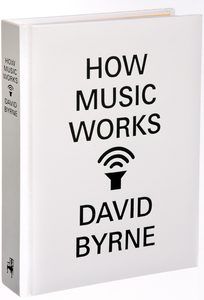
In How Music Works (McSweeney’s, 2012), Byrne reveals less fear and more fearlessness. He eschews what he calls the “crowded shelf” of aging-rock-star biographies and instead brings together a career’s worth of insight on the practice and process of music-making, from performing and using studio technology to building a business and maintaining a community. Byrne’s attention to the neglected factors that contribute to music-making (e.g., the physical context of its performance, the physical context of its reception by the listener, the available recording technology, live amplification, collaborators, producers, instruments, etc.) make this book a must-read for anyone interested in music or making it. It’s also beautifully put together, with tons of color photographs and an elaborate, cushioned cover.

Twenty-six years ago, Byrne predicted that computers would have little influence on the arts by 2007 (Long, 1987, p.94), but How Music Works more than makes up for his former oversights. It’s as comprehensive as it is constructive. As with previous books, Byrne strays in ways one wouldn’t expect, and always in ways you’ll want to follow.

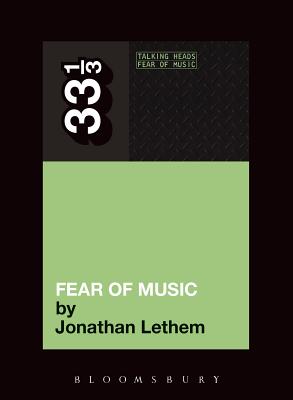
Byrne credits CBGB for the scene he and Talking Heads came up in. “The mere existence of CBGB facilitated the creation of the bands and songs that touched our hearts and souls,” he writes. “It was the right size, the right shape, and in the right place” (p. 253). In relation to the other New York bands of the time, James Wolcott describes Talking Heads as “deceptively light, a model airplane with a erratic flight pattern” (p. 135). NME‘s Paul Rambali wrote that their 1979 record, Fear of Music, “doesn’t sound like an album at all, just songs caught in full flight and grouped together in a pleasant combination” (quoted in Sheppard, 2008, p. 322). Jonathan Lethem, who wrote one of my favorite novels of all-time partially concerned with flight and partially set in the New York of the time (Fortress of Solitude; Vintage, 2004), triangulates his musings in Fear of Music (the book; Continuum, 2012) using Fear of Music (the record), his adolescent self (who first heard the record), and his grown-up self (who’s writing the book). Initial sketches of the album were recorded by a mobile studio van parked outside Tina Weymouth and Chris Frantz’s apartment in New York. With cables running from the van up through the windows, they hashed out the basic tracks. It was art as ephemera, a provisional situation at best, and it gave them the creative constraints that both Byrne and collaborator Brian Eno crave so much.

On “Mind,” David Byrne adopts the voice of a “paternal narrator without flaw or dysfunction,” as Ian Gittins (2004, p. 53) puts it. Lethem characterizes the song as decidedly liminal, a narrator arising from the negative space between identities. Much of Fear of Music (the book) emerges similarly in interludes between Lethem’s song-by-song analysis. The interstitial chapters pose such questions as “Is Fear of Music a Talking Heads Record?,” “Is Fear of Music a David Byrne Album?,” “Is Fear of Music a Text?,” “Is Fear of Music a Science Fiction Record?,” and “Is Fear of Music a New York Album?,” Lethem looks for the heart of the record from all angles. The Bottom Line is that if you love this record, you’ll love Lethem’s book — and that’s not necessarily true of all of the books in this series.

Brain Eno, who’d also produced 1978’s More Songs About Buildings and Food, joined in again as the fifth Talking Head on Fear of Music. His collaborations with Byrne and the band redefined the studio-as-instrument idea. On the funked-up “Animals,” Eno ran the bass drum signal through a synthesizer, added an echo, then filtered out the distortion (Tamm, 1995). Practices like this eventually became commonplace, but Eno and Talking Heads were pushing boundaries. All of their pushing on “Animals” landed them squarely On the One (that start-stop hallmark of Classic Funk). “A studio is a situation with literally infinite possibilities,” Eno would later say (quoted in Sheppard, 2008). Even so, as Byrne discusses at length in How Music Works, as a band Talking Heads were still very much a live act. Eno pushed them beyond that on Fear of Music, with “more overdubs and wiggly treatments,” as Byrne (2012) puts it (p. 46). Ever tying the record and book together, Lethem relates the urgency of “Animals” to “I Zimbra” and its structure to “Memories Can’t Wait.” If he didn’t find this record’s heart in this book’s pages, no one else is likely to locate it.

Most of the entries in the 33 1/3 Series show a propensity for close reading, but Lethem’s Fear of Music is exactly what these books were made for: lyrical geeking-out, unfettered fandom, great writing about great music.

A conversation between Jonathan Lethem and David Byrne would be undeniably generative, especially given their obvious overlapping areas of interest. Reading these two books together hints at a small piece of the awesomeness that such a dialogue might entail.

References:

Bly, Adam. (2010). Science is Culture: Conversations at the New Intersection of Science and Society. New York: Harper Perennial.

Byrne, David. (2012). How Music Works. San Francisco: McSweeney’s.

Gittins, Ian. (2004). Talking Heads: Once in a Lifetime: The Stories Behind Every Song. London: Carlton Books.

Lethem, Jonathan. (2004). The Fortress of Solitude: A Novel. New York: Vintage.

Lethem, Jonathan. (2012). Fear of Music. New York: Continuum.

Levitin, Daniel, J. (2006). This is Your Brain on Music. New York: Penguin.

Long, Marion. (1987, January). The Seers’ Catalog. Omni Magazine, pp. 36-40, 94-99.

Sheppard, David. (2008). On Some Faraway beach: The Life and Times of Brian Eno. Chicago: Chicago Review Press.

Tamm, Eric. (1995). Brian Eno: His Music and the Vertical Color of Sound. New York: Da Capo Press.

Wolcott, James. (2012). Lucking Out: My Life Getting Down and Semi-Dirty in the Seventies. New York: Anchor.

———

Special thanks to Doug Armato for the tip on James Wolcott’s book.

* Both of these conversations are included in Adam Bly’s SEED Salon anthology, Science is Culture (Harper Perennial, 2010).

My Bit on mbv on Reality Sandwich

I wrote a tiny, little bit about My Bloody Valentine’s recently released mbv for Reality Sandwich. Many thanks to Ken Jordan, Daniel Pinchbeck, and Faye Sakellaridis for the opportunity to blab about one of my current favorite records by one of my all-time favorite bands.

My Bloody Valentine: mbv

Here’s an excerpt:

With nine songs total, mbv is a trilogy of trilogies. It hangs together as a whole, but one can easily discern three movements. Three floes in the waves. The first set of three songs pulls you in with perhaps the poppiest sounds on the record. Theirs is a sweet stupor recalling the most sugary spots of Loveless. The second set is hypnotic in its lack of dynamics. This is the bed of shards upon which you will sleep. Set three, starting with “In Another Way,” my favorite track so far, brings all the characteristic My Bloody Valentine traits into play. The walls and waves of guitar and the buried but beautifully breathy vocals, as well as the hooks and beats. The whole record builds to “Wonder 2,” which will finish you off nicely.

Read the full list here.

My Bloody Valentine: Here Come the Drones

mbvThe figureheads of an entire subgenre of modern rock music, My Bloody Valentine is the only band in history to make a career out of not releasing a record.

Following the likes of Glenn Branca, Band of Susans, The Jesus and Mary Chain, Phil Specter, and Alan Moulder, as well as the core sound associated with Alan McGee’s Creation Records, My Bloody Valentine became a genre unto themselves with their second full-length record. Released on November 4th, 1991, Loveless was Kevin Shields’ self-proclaimed masterpiece and few have disagreed with that designation. Its sultry vocals buried in layers of guitars launched a thousand imitators as it became one of the most influential records of the 1990s.

After Loveless came out, The Stone Roses waited five years to release a great follow-up record and everyone hated it. The Britpop of the era hadn’t been much for following-up on its initial brilliance. As of last night, My Bloody Valentine has finally tried. They’ve delayed this record so many times that most of us doubted it would ever happen, yet according to the server load on their website last night, they found what the world was waiting for.

My Bloody 503 Error

It’s difficult to say what any of us expected from a follow-up, but wearing out the Reload button on our web browsers probably wasn’t one of them. Regardless, mbv is apt. It’s noisy and beautiful in the way that all of their records are, and in that way that only they can seem to do.

It’s also still sinking in. Upon a day or so of listening, I can definitely say that I like it. I’m glad it’s here. It seems choppier and less seductive than Loveless, perhaps less love than Loveless. It’s thornier, worn down, weary, and gives less of a fuck. One thing’s still for damn sure: No one does this sound better than My Bloody Valentine.

For example, here’s “In Another Way” from mbv, which I could listen to all day [runtime: 5:32]:

6oXJus1ajIU

In the meantime, Loveless has been lauded, applauded, imitated, reissued, copied, covered, and worshipped. In 2007, Athens, Georgia’s Japancakes did an all-instrumental cover album of the whole thing. Here’s their version of “Only Shallow” [runtime: 8:57]:

zjDs37Ya6ks

As if anticipating the stars’ alignment, a couple of other MBV-related projects have emerged more recently. A little over a week ago, Japan’s High Fader Records released a Loveless tribute album called Yellow Loveless, which is much, much better than similar send-ups usually are. Tokyo Shoegazer’s two covers sound damn well indistinguishable from the originals, Lemon’s Chair stay true to their two entries as well, Shonen Knife evoke the girl-group roots of shoegazing pop on their version of “When You Sleep,” and the mighty Boris do a slowly crushing but primarily faithful rendition of “Sometimes.” Goatbed stray the furthest from the original “Loomer,” making it almost all their own. But the real gem here is Sinobu Narita’s “Blown a Wish,” which takes the original to dreamy new heights. Here’s Yellow Loveless in full [runtime: 1:01:25]:

Lbf8h3sykiw

In a slightly more experimental vein, Bullet for My Bloody Valentine is an hour-long drone-fest released late last year that makes its source material sound downright poppy. As described on the project’s Bandcamp page, the record is made up of “tracks taken from My Bloody Valentine’s Loveless and Bullet For My Valentine’s The Poison slowed down, the best bits cut out and layered on top of each other to create some sort of droney noise album.” It sounds nothing like either record, and it’s actually quite nice.

So, MBV fever is at an all-time high, but it’s hard to say if mbv will be judged well considering its predecessor and the decades in between. I for one aim to ignore the inevitable backlash that’s been germinating for the twenty-one year wait and enjoy the new My Bloody Valentine record. Finally.

————-

P.S. Be on the lookout for an entry in Scott Heim‘s The First Time I Heard… book series on My Bloody Valentine, including an essay about my first time.