
Photocopy and Find Out

Skateboard and BMX zines defined my formative years. Those handmade, photocopied publications were our network of news, stories, interviews, events, art, and pictures. It’s very difficult to describe how an outmoded phenomena like that worked once such epochal technological change, one that uproots and supplants its cultural practices (i.e., the internet), has occurred. FREESTYLIN’ Magazine’s reunion book, Generation F (Endo Publishing, 2008; flip through it at the link), has a chapter called “The Xerox was Our X-Box,” and that title gets at the import of these things. As I said in that very chapter, “Making a zine was always having something to send someone that showed them what you could do, what you were up to, and what you were into. Ours was the pre-web BMX network.”

A small sample of my zines over the years.

At best, zines represent a hidden circuit of media, a grassroots exchange of information and ideas that slips through the cracks of popular culture. Zines are power in the hands of the fans. As Mark Lewman, editor of FREESTYLIN’ Magazine and head of Club Homeboy, as well as “Chariot of the Ninja” zine, points out, “The first zine I did once I moved to California was called ‘Homeboy’. I did one issue and some stickers, and it ballooned into a mail-order lifestyle company with 15,000 members, and became one of the first youth culture magazines, a pastiche of art and sport and randomness. So, the power of zines is pretty unlimited as far as I can tell.”

In spite of the proliferation of the internet, zines are not entirely a thing of the past. Every time we do something on our own instead of just taking what’s given to us, we strike a blow to the massive media machine that constantly shoves products and personality down our throats. Making your own zine is not only immeasurably rewarding (ask anyone who’s ever done one), but it gets your point of view out there and incites dialog between readers, riders and other zine-makers that wouldn’t necessarily take place.

Independent journalists wield the power to expose local underground talent as well. There were always obscure riders in sporadic locales ripping like top pros. There are always great bands no one has heard. The way to get them noticed was not to bug out about major magazines’ lack of attention, but to give the magazines a reason to pay attention. As ex-editor of Faction BMX Magazine John Paul Rogers puts it, “Quit bitching and get off your ass and do something about it.”

So, though they’re as much a part of the process anymore, I cannot overstate the importance of the experience of trading and making zines. There’s something to the physicality of the pages in your hand and the focus on those pages that pixels on screens don’t afford. As I said in FREESTYLIN’ Generation F, “Those first issues were the first steps on a path I still follow.”

Still true.

Portable Document Formats:
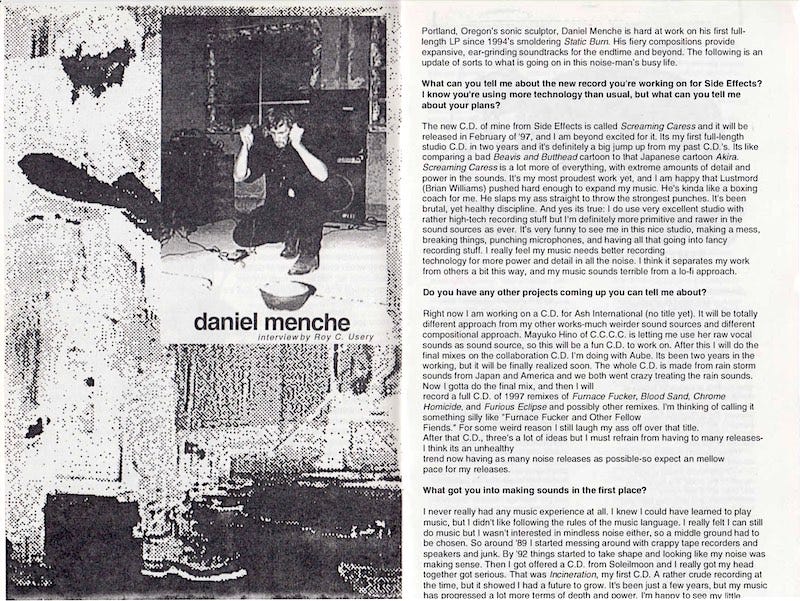
My Daniel Menche interview from wow&flutter.

If you’re interested, I scanned and uploaded a couple of my later zines as .pdfs. wow&flutter (1997) was an attempt to bring together experimental noise of all kinds and featured interviews with Daniel Menche, John Duncan, and a cover story about turntablism. It was intended as part of a series, but the second issue, attack&decay, featuring interviews with Jack Dangers of Meat Beat Manifesto and Warren Defever of His Name is Alive, among others, never made it to press. I still love the idea of noise and hip-hop coming together, and there are others who’ve merged them in the meantime better than I could have imagined (e.g., dälek, clipping., Ho99o9, Death Grips, Cloaks, Justin Broadrick and Kevin Martin, et al.)
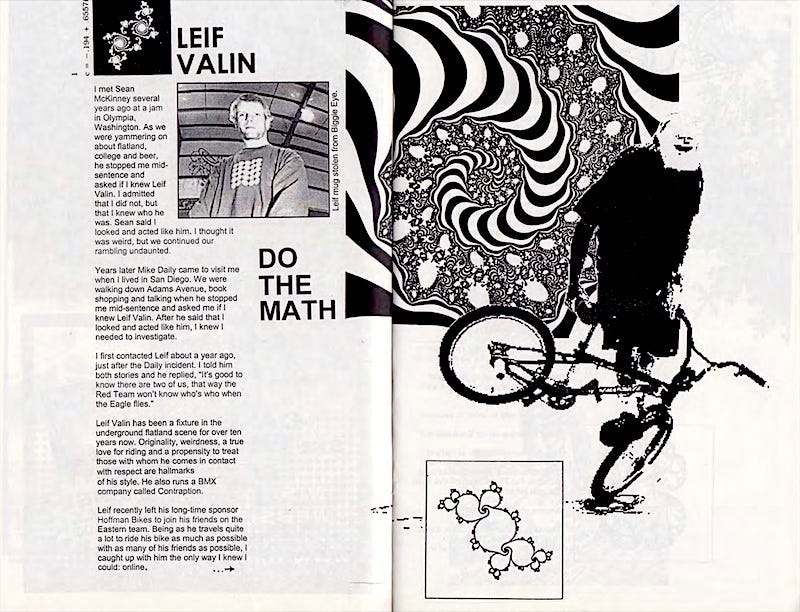
A spread from HEADTUBE featuring Leif Valin. [layout by me.]

HEADTUBE (2001) was my attempt to return to BMX zine-making while maintaining my other, newfound interests in the early 00s. Though I maintained the website for years after, the zine ended up as another one-off print publication. It features interviews with Seattle ripper Steve Machuga, flatland guru Leif Valin, and the band Milemarker, as well as reviews of books, records, and other media. I still have a few copies of the print version. Let me know if you’re interested.
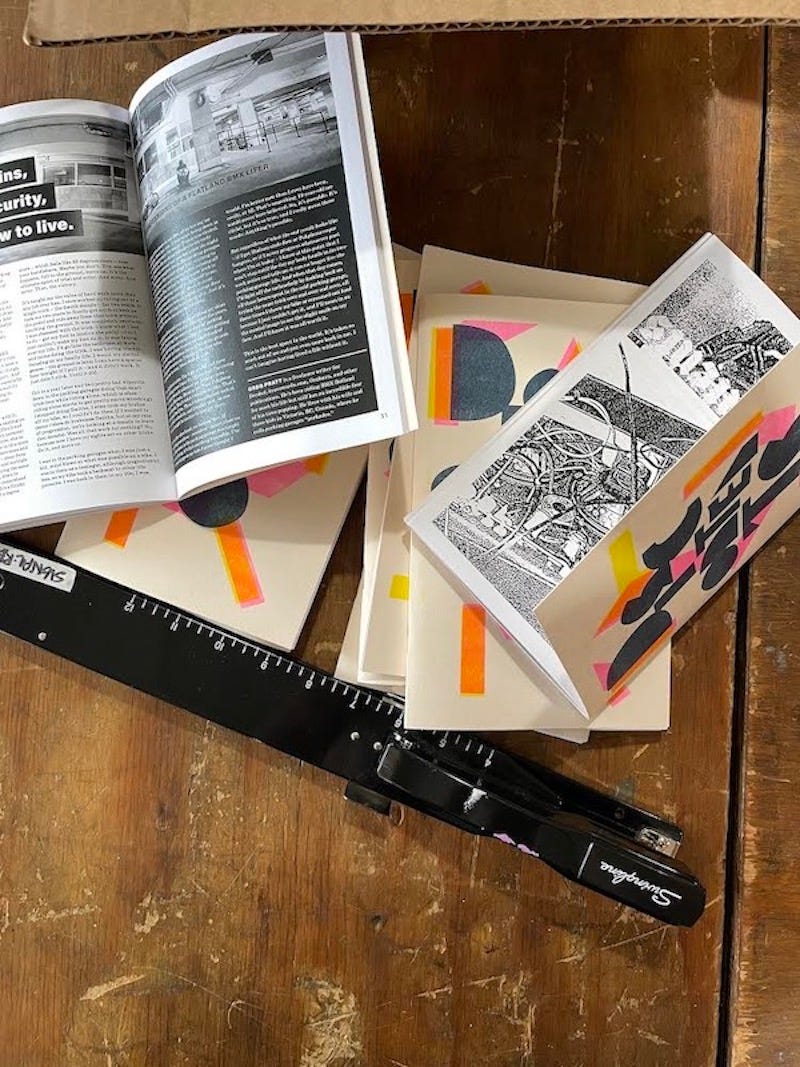
The pilot issue of discontents and the long-arm stapler: a zine-making essential.
Oh, and if you missed the pilot issue of discontents, the latest zine I worked on with my friends Patrick Barber and Craig Gates, we’re working on a proper debut issue. More on that soon!

Talk Your Talk

My dumb face.

I’m on Talk Your Talk with my man Alaska this week. I’m the first guest on this spin off from his usual show, Call Out Culture with Curly Castro and Zilla Rocca, on which I was also the first guest. I did the artwork for their Michael Myers/Nas-themed “Killmatic” episode, too.

In this new one, we talk about my books, new, old, and not-out-yet, as well as a few high-minded social-science theories… and the raps, of course.

You can listen to our brief discussion via the podcasting network of your choice.

R.I.P. Kelly Lum

Love is pure
1173 miles away

You know how every recipe online comes with a life story? Kelly Lum ran a site called Just the F*cking Recipe. She was very good at just that kind of finding and fixing a problem we all knew was there but never bothered to do anything about. If you look around online, you’ll see how much everyone who knew her loved and respected her.

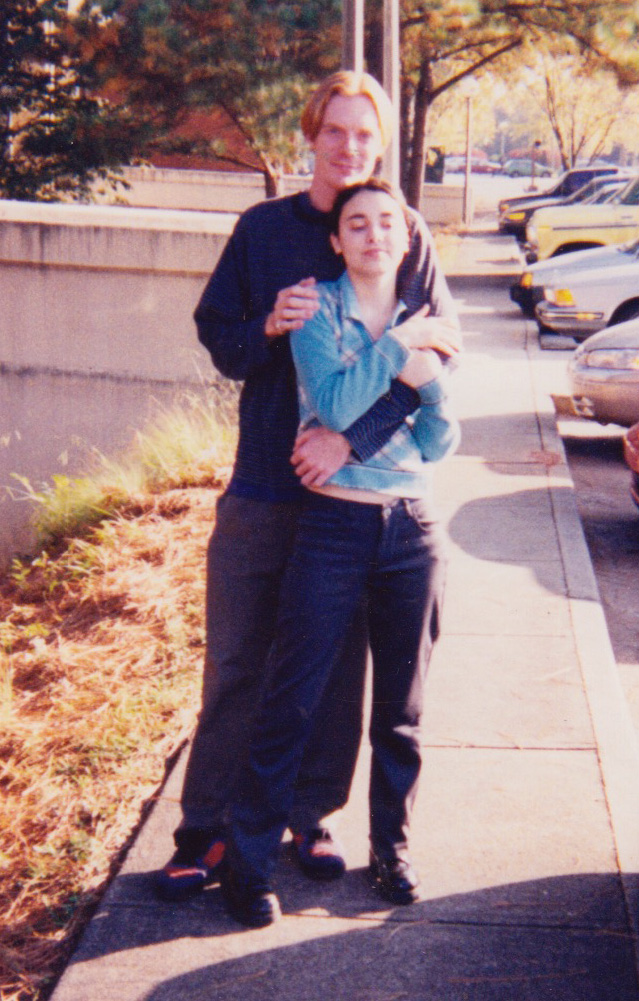
I found out this morning that Kelly passed away last week. It feels silly to say, but Kelly Lum was my first online girlfriend. We met through her website (spinsugar.com) in the late 1990s, and we stayed in touch for a long time thereafter. I hesitate to post anything like this, but given its online nature, I wanted to try to honor the memory appropriately.

Me and Kelly at UGA in the fall of 1999.

She called me Chris, and I called her Lummy. That is until she finally told me that she hated the name. She had a special way of being brash and bashful at the same time. She was a truly unique person with a talent, a genius, and a wit all her own. She was way smarter than I am, and I miss the way she kept me sharp.

Kelly used to do drawings and write poems for the zines I was making. We did a website together for a few years in the early 2000s. It was sort of an online journal that we both posted to. Sometimes we were talking to each other, sometimes we were just posting nonsense. We started it when I briefly attended the University of Georgia. She came to visit me in Athens while looking at schools. In a letter from her just after that visit, dated November 13, 1999, she asked, “Will you take over the world with me?” She didn’t end up going to UGA, and I moved to Atlanta and then San Diego not long after, but we continued the site even after I moved again, back to Seattle.

The early days of blogging: epithet.nu by Kelly Lum and me.

We kept in touch off and on over the years, but I hadn’t talked to her in a long time. Her passing has me thinking hard about the nature of online relationships, and how to honor and memorialize seemingly such a tenuous connection. She and I weren’t together that long, and we only met IRL the one time, but she had a profound impact on me. Her passing has me mostly thinking hard about her.

The Later Lum. [Photo by Zach Lanier]

She had a clarity of intent that sometimes came off as something else. The last book she posted about was The Cement Garden by Ian McEwan. The phrase on page 66 describing windows like eyes as intimating “not concentration, but heavy sleep” has new meaning now.

I lost a hard drive full of writings not long after we broke up. It contained a whole directory about her called “The Lum Diary.” I wish I could share something from that time.

Kelly Ann Catherine-Xavier Lum… Rest in peace, Lummy. I’m sorry I ever called you that.

discontents zine

Some of my old zine-making friends (namely Patrick Barber and Craig Gates) and I recently decided to return to our roots and make a new zine!

Cover art by Tae Won Yu.
Cover printed by Patrick Barber.

Table of Contents:

Features:

  • Ceremony by Roy Christopher
  • STILL: A Tribute to Hsi-Chang Lin by Roy Christopher
  • Secret Bike-Riding Club by Cynthia Connolly
  • Chipping Shins by Greg Pratt
  • Drawing Lines by Andy Jenkins
  • Michael Cooper by Spike Jonze
  • James Ward Byrkit Interview by Roy Christopher
  • Two Poems by Peter Relic

Columns:

  • Preface: This is the pilot by Roy Christopher
  • UNSUNG: Unwound by Roy Christopher
  • BILF: Charles Yu’s Interior Chinatown by Roy Christopher
  • Music Ruined My Life by Timothy Baker
  • 1Q with Fatboi Sharif
  • Exit Interview: Marnie Ellen Hertzler

We only did 100 copies of the folded-and-stapled version, but you can still get it as a perfect-bound book.

HEADTUBE zine

In the early 00s, I was trying to pull together a lot of influences. HEADTUBE [.pdf] was my attempt to return to BMX zine-making while maintaining my other, newfound interests.

The original idea driving HEADTUBE was to unify the bicycle-riding attitude across styles. Cyclists, mountain bikers, fixed-gear heads, and BMX all have different styles and terrains, but there’s still a view they all share. That shared space was where HEADTUBE was going to live.

I started a website for it around the same time as this first issue, and I ran that pretty diligently for a few years, then I moved on to other things. I never made another print issue, so here is a .pdf of the only one.

15/51

Inspired by Brian Tunney and his zine Larry’s Donuts is Dead, I’ve been wanting to restage this photo from a year-book shoot in 1986. Though you can’t tell from the background, I went back to the same church parking lot where the original was taken and did the barhop again.

Tunney does this with famous BMX photos and spots from old magazines. Despite my impeccable fashion sense, this picture didn’t even make the yearbook!

wow&flutter

In 1997 I put out a zine called wow&flutter [.pdf]. It was an attempt to merge two of my main musical interests at the time, turntablism and experimental noise. I interviewed DJ QBert, DJ Spooky, John Duncan, and Daniel Menche, and reviewed records from the rapidly expanding releases of ambient, noise, and turntable artists. I lived in Seattle at the time, and there was so much going on in all of these areas. There were regular live events and several specialty stores, and I tried to bring them all together under the banner of sound experimentation.

wow&flutter was intended as part of a series, but the second issue, attack&decay, featuring interviews with Jack Dangers of Meat Beat Manifesto and Warren Defever of His Name is Alive, among others, never made it to press. I still love the idea of noise and hip-hop coming together, and there are others who’ve merged them in the meantime better than I could have imagined (e.g., dälek, clipping., Ho99o9, Death Grips, Cloaks, Justin Broadrick and Kevin Martin, et al.)

It’s been 25 years since its release, but maybe it’s worth another look. Download this .pdf of the first issue, and you’ll see the seeds of my future projects like Dead Precedents and Boogie Down Predictions.