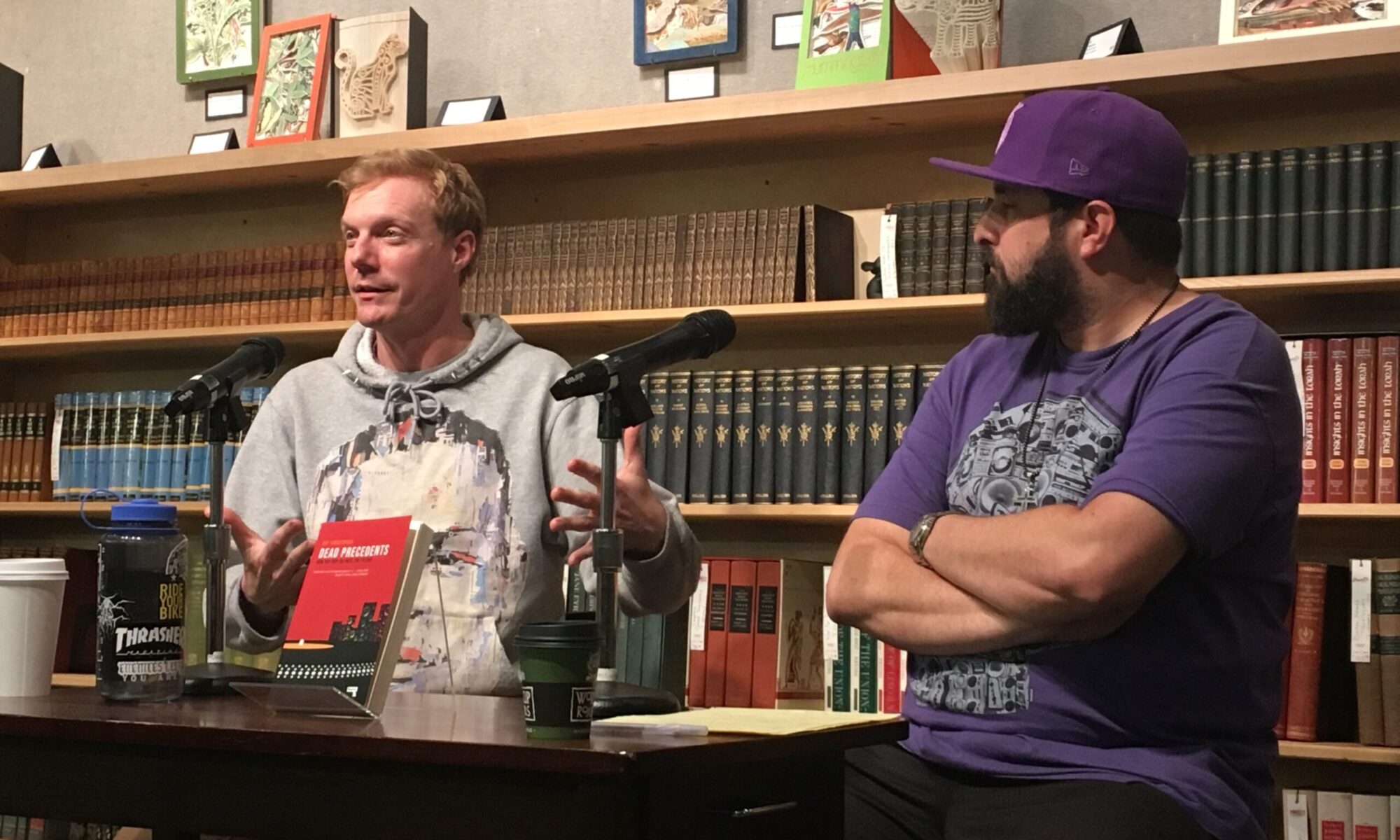

Ian MacKaye is a lot of things, but he’s best known as the co-founder of Dischord Records and the bands Minor Threat and Fugazi. One of the ways he came to punk practices was through skateboarding, which he describes as a discipline, a way to reinterpret the world. Punk, as he explains below, is also a way to reinterpret the world. If languages are our lenses, then these are his native tongues.

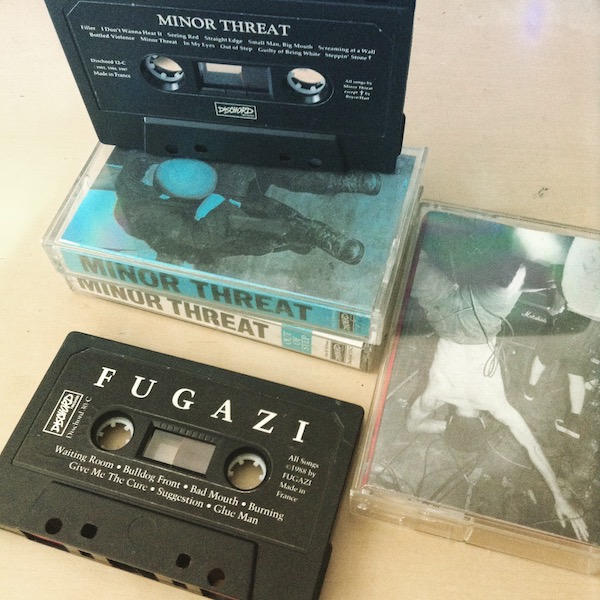
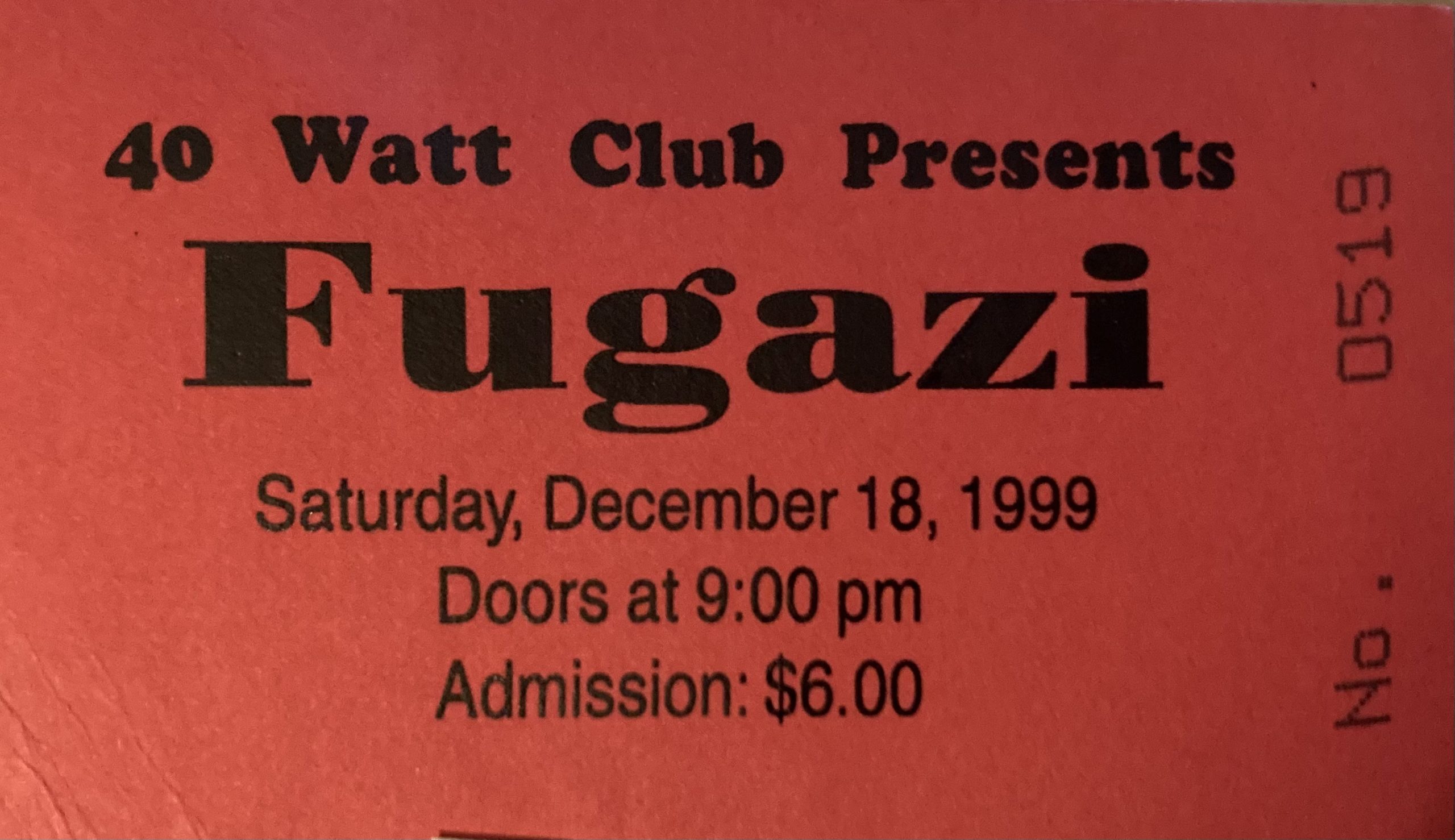
I found Minor Threat in high school, after they’d already broken up. I got both of their cassettes at a record store in a mall on a trip through in Huntsville, Alabama. From there, I followed Ian through string of bands—Egghunt, Embrace, Pailhead—but when Fugazi came together, it was clear that something else was going on. My friends and I didn’t know that their first self-titled EP was the beginning a phenomenal 15-year run, but we knew it was something special. Where Minor Threat helped define the genre of hardcore, Fugazi was beyond that, a little bit outside of the genres we knew at the time. I remember driving to the skatepark in my 1973 VW Beetle shortly after getting that first tape. My friend Sean Young sat in the passenger seat rewinding “Waiting Room” over and over the whole way there. The opening chords of that song sound as fresh now as they did then.
Fugazi went on an indefinite hiatus the same year that MySpace launched. The timing is significant because MySpace briefly became the online place for music, for bands and fans alike. In 2018 they lost 12 years of their users’ files in a server migration catastrophe. The lost files include everything uploaded between 2003 and 2015, over 50 million songs by 14 million artists, as well as countless photos and videos. As we offload and outsource our archives to these services, we run the risk of losing them without recourse.
If there’s a lesson there, it’s the same one MacKaye lives by: self-reliance. He’s been keeping his own archives all his life, but I’ll let him tell you about that.
Roy Christopher: You and I both came up and were introduced to this culture through skateboarding. How did you initially get into punk?
Ian MacKaye: It was around late ‘78 that I first encountered punk—really encountered it—meaning that I thought about it. I’d obviously seen it years earlier because the media was talking about it, but my friends in high school started talking about it, and I started to really have to give it a think. One of the dilemmas of punk for me at the time was that punk and skateboarding were opposite. So, the punks that I knew would never skateboard because that just seemed silly, and the skateboarders I knew just thought punks were freaks. Of course, the skateboarders were largely guys who were jocks or who just wanted to party, so it made sense that they would hate something new. I had to make this decision about wanting to be a punk or a skateboarder. Now the good thing about skateboarding, given that navigation was so central to the practice, is that it was like learning a language. They say that it’s easier to learn a language if you’ve learned another language, and I think it’s because you’ve gone through the process of reshaping sound already so you understand that it can be done, you can communicate with different sounds. So, I think in the same light, the time I spent skateboarding and looking at the world differently was perfect practice and preparation for punk. Because punk required looking at the world differently.
RC: Oh, yeah.
IM: It was actually in many ways a perfect way to enter it. Now, ironically, as we all know, punk and skateboarding became almost synonymous later on, which is not surprising to me, but at the time it was separate. It didn’t occur to me since I wasn’t living in Los Angeles where you had the first skaters who really got into punk. They picked up on the sort of the radicalness for the freedom of it or whatever. You have Steve Olson or Dwayne Peters, Tony Alva, Jay Adams, and that crew, once they got into it, then suddenly, like within a couple years, you had skate punks.
RC: Yeah, by the time I came in, which was during the Bones Brigade era, they were already merged.
IM: Right, exactly.
RC: I didn’t know this about you, but I found out recently that you don’t have any effects on your guitar, and you did that on purpose because you wanted to push those limits.
IM: Not only that, but I’m anti-option. I’ve been a vegan for 35 years and whenever somebody asks me why, I always say, ‘why not?’ Because there’s a million great reasons to think about what you put in your body. The primary one is convenience, which is of course the death of the world, but I think that one of the great silver linings for me, especially in the olden days—not so much now because now it’s become more common—but what was so wonderful was that I didn’t have to spend a lot of time looking at a menu because there was one thing, and I was going to eat.
I like simple things like just in general. I think options are designed to confuse and delay. Another reason that I think there are so many options in our marketplace especially is to create sort of brand obedience. For instance, if you go to a larger grocery store and you go to their bakery section and you want to buy some bread, there’s usually about, 25 different kinds of bread, which is a lot of different kinds of bread when you think about it! Or cereals. There’s like 50 cereals! Yeah. That’s a lot of cereals, but I think the only way that one can retain their sanity and navigate that many choices every time is to pick the one thing, right?
RC: Right.
IM: They pick the one kind of bread that they like. With the cacophony of options, they just reach in and grab the one, but here’s the thing: They’re all owned by one or two bakeries anyway.
The illusion is that we have all these choices we can make, but the net effect is that we don’t make choices because there are so many that they become incomprehensible. You can’t deal with it, so you just end up buying the one thing or getting the one kind of gas or the one whatever. I’m not suggesting that there were some evil geniuses thought this up [laughs]. I’m not like that. I’m not like a paranoid dude or a conspiracy guy, but—and this is a little bit like the skateboarding thing—I just learned how to look at things differently.
So, for me, options sort of get away from the beauty of a simple life. So, when you were talking about my guitar, yes, it’s true. I don’t like pedals. I never used them. I just thought it was interesting to just have one setup and then to use my body and the available volume knobs, the tone knobs, those things on my guitar and on the amp. What can I do to manipulate those things to create a variety of sounds, without having a computer just dial them up for me. I think one of the reasons that society is in a bit of a malaise is because of computers. The options provided by computers are completely overwhelming.
RC: How do you even know what you like?
IM: Right?! As a resource, it’s amazing. There’s a lot of times I’ll read some book about music, and they’ll mention some very obscure recording, and then I look and boom, I find it. I can’t believe it’s all there. So, I love the resource aspect of it, but I do think that that the relationship that I developed with music, maybe it’s harder. I don’t know. Because looking at my kid and other kids, they love music, but they’re kind of overwhelmed with options and choices.
So, I’m a little tongue-in-cheek when I say convenience is the death of the world, but I think options and convenience are cousins for sure.
RC: You could definitely make the argument.
IM: I like fewer options.
RC: I struggle with my students to get them to take notes or pay attention to things that they don’t need right at the moment because they live in such an on-demand kind of culture. You have created an archive—a Dischord archive, a Fugazi archive—and that’s one of the things that I’ve been trying to argue with them is that they need to be holding onto their own stuff and not relying on companies online. So, what was the impetus to build this massive archive of your stuff.
IM: Well, I mean, the Fugazi Live Archive is just one part of a much larger archive of Dischord- and Fugazi-related materials. I think the impetus starts with a very simple reality, which is I am 60 years old, and in my entire life I’ve only lived in three houses. I own two of them, and my dad still lives in the first one. As a result, I didn’t have to make that kind of painful choice about what I’m bringing and what I’m leaving or throwing away. So, there’s that. That’s just a reality. Then my mother was a journalist in the true sense of the word in that she kept journals for 60 of her 70 years. Not only did she keep journals, but she also typed them up and edited them. She kept filing cabinets of journals, letters, correspondence, genealogical work. She was an absolutely brilliant, brilliant person. She had a Panasonic cassette deck, and she would just leave it recording in a room. I used to think it was nice that mom liked to hear our voices when we were away, that she would record us. It wasn’t until she died that I realized, it wasn’t for her. It was for us, so we can hear her voice.
There was an emphasis on the idea of hanging on to things because they would take a different form as time passed. Maybe they would become more important, and you can always throw something away later. It’s not like you have to make that decision today. Later you can put it in the trash, but if you don’t need to throw it away now, then maybe don’t.
Then the next level is that I met Jeff Nelson in high school. He was in the Slinkees, and the Teen Idles. He’s my partner at Dischord Records. Jeff is a saver, a collector. I got hit by a car once and years later, I found that he went out and he scooped up all the pieces of the shattered headlight that broke. He still had that stuff. It’s just the way he is. He just has that kind of mentality, which I think resonated with my own tendency. So, both of us were just saving things because we thought they were important. I mean, you have to remember that this why Dischord Records was started: Not because we wanted to have a record label, but because we wanted to document something that was important to us. We didn’t think the world need to have a Teen Idles record. We wanted the Teen Idles record. It was important to us. So, things that were important to us, we hung onto, and we continue hang onto.
As a result of all those things I’ve just described you, these different circumstances, I essentially ended up with this massive collection of things. About 10 or 12 years ago, I had a number of friends die, and one of the friends who died, he had named a mutual friend to be the executor of his will. At some point, I asked our mutual friend how it went, and he said it was the greatest of gifts. Our late friend had basically identified, enumerated, and directed everything he had. I thought about it, and you know, my brain is big, and I know everything in Dischord House, but my brain stops when I die. So, I realized that I have all this stuff, but if I died and Amy and the others were going to have to contend with it, figure out what to do with it all. It was all mixed up because my life, my personal life and my musical life and the label life were all tied together. I know everything, but that’s what really got me thinking about time to start cleaning up and get things organized. I still have miles to go, but at least now things have been split.
I have all my personal correspondence at home, my other house: 40 years of correspondence. I saved all the letters that people sent me—90% of them or something. So, I had boxes of these letters in my eaves, and I sat for four years with an archivist named Nichole Procopenko, and we went through every letter. We put into a collection. We have a large collection that breaks down into different subsets, and now it’s researchable.
RC: Oh, that’s amazing.
IM: So, someone calls and says, ‘I’m looking for this early-eighties punk from Des Moines,’ and I’m like, ‘I can help you!’ [laughs] I freak people out because I can lay my hands on things almost instantly that are in the database. It’s all organized. Same with the tapes and fanzines and photos. That’s the archive. People keep saying, ‘aren’t you going to scan everything?’ No, I’m not. I have scanned the flyers because they’re the most liquid of things.
The other thing about it, which is interesting, is a part of what has affected your students is that… I can’t say this for sure, but I strongly suspect that the punk scene is probably the last youth movement that used paper. Like I know hip-hop came a little bit after punk, I just don’t think people are using as much paper. They weren’t corresponding as much. I think that there’s something really interesting about that. I think it’s important too, because the world that I’m a part of and was a part of back then was one that was beneath the radar of the industry, and since the industry controls history, that’s their job. The Rock and Roll Hall of Fame, they celebrate industry figures. The Grammys every year hand out awards for best Song of the Year, but every one of those songs, if not on an actual major label, it’s distributed by a major label. What are the chances that of all the songs that are being written in the, in the world on any given minute of any given day, that every single best song of the year happened to go through a major? Statistically impossible. But that’s the way it works. They own the history. So as a result, knowing that, I feel like it’s important to hang on to evidence of prior civilization, the pottery shards that let people know that they weren’t the first.
RC: Those are awesome stories, Ian. I won’t take up any more of your time. I appreciate it. I’m glad we finally got to do this.
IM: All right, my friend. Good talking to you. If you ever find yourself in Washington, drop me a line, and I’ll show you this madness. You’ll probably get a kick out of it.
The Wiregrass Local Podcast
This week I was a guest on The Wiregrass Local podcast with my dude Justin April. We talked about making zines, working on magazines, drawing logos, writing books, and other things we both learned growing up in skateboarding culture.

Reset Mercantile is located at 2407 Montgomery Highway in Dothan, Alabama. The First Friday Art Crawl is January 6th, from 5-8pm, but my drawings are up until the end of the month, so come through if you’re in the area.
Many thanks to Justin April at Reset and The Wiregrass Local for the opportunity, and everyone who’s come by to see my stuff.
Fallen Footwear Logo
Since I don’t have enough to do lately, I started working on another unsolicited logo design, this time for my friend Jamie Thomas’s company Fallen Footwear.
It started, as many of these do, with my waking up with part of it in my head. This time it was the middle Ls. As you can see in the rudimentary sketches on the left in the picture below, they form an arrow pointing down. That was to be the guiding visual concept for this design, which evolved over two weeks of intermittent sketches and doodles.

As it came together through the various versions above, I realized it needed some more space. This is what I ended up with:

Once I had that one drawn, it felt kind of empty, too sparse for this particular logo, so I tried filling it out a bit more, and I got this one:

Seeing them together like this, I actually like the spindley middle one best. I think the ideal version might be somewhere between it and the more organic one at the bottom. Maybe another iteration is in order.
Views and Interviews from a Few New Zines
When I started doing zines as a teenager, interviews were an easy way to get something no one else had. I could get in touch with a band, ask them questions, and write up an original piece of content. It was fun and it lead me to magazine writing. When I moved the operation online, my first site (frontwheeldrive.com) was almost all interviews.
Andy Jenkins and I have had a similar relationship with interviews. We both started off doing them for journalistic purposes, then moved away from them for various reasons. “Interviewing folks meant that I was drawing a line between myself and the interviewee,” he writes in the introduction. “So, instead of being a peer, I was sort of an outsider” (p. 3). For Bend #24: Questions (Bend Press, 2015), Andy returned to the interview format to check in with a bunch of people who’ve inspired him over the years: He asked 27 people the same 24 questions. Interview subjects include Johnny Knoxville, Megan Baltimore, and O; skateboarders Jerry Hsu, Ed Templeton, Tod Swank, and Marc Johnson; artists Lori Damiano, Ferris Plock, Kevin Wilkins, Thomas Campbell, and Evan Hecox; and one of my favorite character actors, Bob Stephenson; as well as many other creative folks. Questions is inspiring, entertaining, and funny. Andy’s introduction says he did these interviews “not feeling the line” because he knows all of these people in one way or another. His art and designs have always been inspiring to me, but this time it’s the minds he’s assembled that make me want to go do stuff.
Life from a window
I’m just taking in the view
Life from a window
Observing everything around you
— The Jam, “Life From a Window”
I met Tobin Yelland twice: once while I worked at SLAP Skateboard Magazine in San Francisco and once while I worked at Skateboard.com in San Diego. He’s a super-nice guy with a keen eye through the camera lens. Life From a Window (Deadbeat Club, 2014) is Clint Woodside and Tobin’s travel log from Asia, including pictures from Shanghai, Seoul, Hong Kong, and Guangzhou. Candid expressions, odd artifacts, and haunting cityscapes adorn its 40, full-color pages. It also comes with two 4×6″ prints, one from each photographer.
I picked up a copy of Bogus Rendition #9 from the merch table at a the Watain/Mayhem Black Metal Warfare tour stop at the Bottom Lounge in Chicago earlier this year. Split between hopping trains and black metal, Justin Curtsinger tells great stories and does solid interviews. He’s traversed the US by train several times and toured with Watain and many other black metal acts, so his stories and interviews (with members of Watain, The Devil’s Blood, Soulgrinder, et al.) come from a far more personal place. The lengthy transcribed talks in BR #9 are as meandering as they are interesting. These are not promo-copy fodder. They’re just regular chats with the guys behind the set and sound. It’s a welcome change from magazine interviews. Reflecting on Watain’s 2013 tour for The Wild Hunt, Curtsinger writes, “I’ve found it harder and harder as time has gone on to write about other people who happen to be friends as if they are ‘characters’ in a story.” Though he admits that he’s not the biggest Watain fan, he acknowledges their importance, writing, “The reminder that life is whatever the fuck we want to make it and that following one’s heart on whatever obscure path one wants to take is not a pipe dream.” The 108 pages of Bogus Rendition #9 document parts of Curtsinger’s obscure path(s), and the world is better off for the glimpses it provides.
A member of both the black metal band, Light Bearer, and the hardcore band, Momentum (two of my recent favorites), Gerfried Ambrosch is also a prolific writer. Not surprisingly, his writing is ideologically in-line with his music. Among his zines are Atheist Morality: Why We Don’t Need Religion to Be Moral (Active Distribution, 2013) and Vindication of a Vegan Diet (Active Distribution, 2013). We Want Something More: The Poetry of Punk Rock (Active Distribution, n.d.) is a 100-page pamphlet-style zine that could easily double as a master’s thesis. It’s also informed by interviews — with some of the most important people in punk rock. Its back copy reads,
We Want Something More is an extended essay about punk lyrics. It features exclusive interviews with well-known punk rock and hardcore artists such as Ian MacKaye (Minor Threat, Fugazi), Jello Biafra (Dead Kennedys), Henry Rollins (Black Flag), Ray Cappo (Youth of Today, Shelter), Greg Bennick (Trial), Brian D. (Catharsis), Dan Yemin (Kid Dynamite, Paint It Black), Chris Hannah (Propagandhi), and others. The essay investigates the connections between song lyrics, poetry, visual and acoustic aesthetics, musical conventions, the D.I.Y. ethos, and radical politics in the context of punk and hardcore. Its goals are to demonstrate that punk rock and hardcore song lyrics are a fascinating literary art form and to give punks and hardcore ‘kids’ an understanding of lyric analysis and close reading by reference to some of the songs that have changed their lives. Moreover, the essay discusses the particularities of punk culture and the things that set it apart from other subcultures. Given its focus on radical politics, is punk a serious counterculture, or at least part of a wider countercultural movement? This essay attempts to answer such questions by looking at song lyrics and how they have both reflected and affected the political discourse of punk and hardcore. If you have a passion for punk culture and/or the written word, there is a good chance that you will find We Want Something More to be a very interesting read.
I don’t do as many interviews as I used to, but I’m still biased toward them and read them regularly. I mean, I do teach a class on interviews now, and my first book is a collection of them. Interviews can be weird and indulgent, but they can provide keys to someone’s work you admire. They also let that someone know that you admire them. In Bend #24, Andy Jenkins asks, “Do you like answering questions?” Ed Templeton sums it up, saying, “Yeah. It means someone is asking.”

Paradigms Crossed: Building and Burning Bridges in Skateboarding’s Disposable History
Ever since I first saw Wes Humpston’s Dogtown cross on the bottom of a friend’s skateboard in 6th grade, I knew the wood, the wheels, and the art were going to be a part of my world. Like Alex Steinweiss and the album cover, skateboard graphics created the look of skateboarding. There were years where the only thing one knew about a particular skateboarder was the image on the bottom of his (rarely her) board. In the pre-internet world of skateboards, there were only a few companies, fewer videos, and only a few people who controlled almost everything. If you know anything from this era, it’s probably tied in some way to Powell and Peralta’s Bones Brigade.

Only a few professional skateboarders outside of those pictured above mattered on as large a scale during the 1980s. Arguments could easily be made for Christian Hosoi, Gator Rogowski, Mark Gonzalez, and Natas Kaupas among others (my favorites from the era are Neil Blender and Jason Jessee), but The Bones Brigade defined the times. Stacy Peralta, already a skateboarding veteran from the Zephyr Team and the Dogtown of the 1970s, handpicked an iconic group of guys. From the household name of Tony Hawk to the kooky innovations of Rodney Mullen, from the longevity of Steve Caballero to the fierce fun of Lance Mountain, The Bones Brigade is the most legendary team in skateboard history. The empire they built only crumbled when it grew too big to feel or follow the zeitgeist.
“While other companies scrambled to reinvent themselves with fresh, young teams and a more street-oriented direction,” Sean Cliver (2004) writes, “Powell Peralta remained steadfast in sticking to its guns but floundered in exactly how to go about bridging the old and new generations–especially when it came to graphics” (p. 50). Two main people bridge the genetic fallacy of the Big Five of the 1980s to the populist era of the early 1990s: Rodney Mullen and Sean Cliver. The former invented many of the maneuvers that make up modern street skating, and the latter designed the graphics and artwork. All credit due to Steve Rocco, Craig Stecyk, Mark Gonzalez, and Marc McKee, but those guys all remained in separate and largely opposing camps. Mullen and Cliver are the only ones who worked under the Bones Brigade banner at Powell Peralta as well as the Jolly Roger at Rocco’s Word Industries (Mike Vallely notwithstanding, who was more of a pawn than a player and who didn’t seem to want any part of it).
Skateboarding pro-cum-team manager Steve Rocco was once told by a company owner that skateboarders couldn’t run companies. After getting fired as a team manager, Rocco decided to do just that. He sniped team riders, pirated images for graphics, and concentrated on a street-smart street style that immediately connected with the kids of the time. The intense intricacies of freestyle were dead and the barriers to entry for riding monolithic vert ramps were prohibitive to most. Street skating was anyone’s game. Walk out the door, jump on your board, grind a curb: you’re street skating. Focusing on that and the irreverence of youth garnered Rocco unmitigated hate from the established skateboard companies, cease-and-desist orders from copyright holders he violated, and millions of faithful followers.
A lot of what Rocco did for skateboarding was no different from what Marcel DuChamp and, later, Andy Warhol, did for art. It’s also no different from what sampling and Napster did for music. In his book Disrupt (FT Press, 2010), Luke Williams writes, “Differentiate all you want, but figure out a way to be the only one who does what you do, or die” (p. 2). The irony in skateboarding is that the products don’t differ very much from brand to brand. The subtleties of one board, wheel, or truck are infinitesimal. A world like that needs a Kuhnian shaking-up once in a while, and a lot of the shaking Rocco did back then is still reverberating today: Most skateboard companies are run by current and ex-skateboarders, most BMX companies are run by BMXers, street is the largest genre of either sport, and, thanks in large part to Rocco’s Big Brother Magazine, Jackass is still a thing. As the founder of Foundation and Tum Yeto, Tod Swank, put it to me (2007),
…when Rocco started World Industries, what he really did was liberate skateboarding so that it could move forward. He helped a lot of people start companies, not just me. He lent money and gave advice to a lot of other skateboarders who wanted to start companies. He wanted to see the industry run by skateboarders (p. 274).
“The life of an oppositionist is supposed to be difficult,” wrote Christopher Hitchens (2001, p. 3). Conformity is its own reward, dissent is not (Sunstein, 2003), so by upending the established order, Rocco brought a lot of grief upon himself. There’s the world the way you want it to be, and there’s the way that it is. George Powell and Stacy Peralta depicted skateboarding as they wanted it to be. Steve Rocco was more of a mirror of what it was becoming. For better or worse, it’s still going and growing in that direction.
References:
Christopher, Roy (2007). Tod Swank: Foundation’s Edge. In R. Christopher (Ed.), Follow for Now: Interviews with Friends and Heroes (pp. 269-276). Seattle, WA: Well-Red Bear.
Cliver, Sean. (2004). Disposable: A History of Skateboard Art. Ontario, Canada: Concrete Wave.
Cliver, Sean. (2009). The Disposable Skateboard Bible. Berkeley, CA: Gingko Press.
Hill, Mike (Director). (2007). The Man Who Souled the World [Motion picture]. Los Angeles: Whyte House Entertainment.
Hitchens, Christopher. (2001). Letters to a Young Contrarian. New York: Basic Books.
Peralta, Stacy (Director). (2012). Bones Brigade: An Autobiography [Motion picture]. Santa Monica, CA: Nonfiction Unlimited.
Sunstein, Cass R. (2003). Why Societies Need Dissent. Cambridge, MA: Harvard University Press.
Williams, Luke. (2010). Disrupt: Think the Unthinkable to Spark Transformation in Your Business. Upper Saddle River, NJ: FT Press.
B-Side Wins Again: Punk Aesthetics
From an early age it was instilled in me that people judge you by how you look, how you dress, how you wear your hair, how you carry yourself. My dad won’t leave the house to do business or see someone without styling and dressing appropriately. We communicate something through every stylistic choice we make. As Umberto Eco (1973) writes, “I speak through my clothes.” To wit, I have seen firsthand many books misjudged by their covers. Still, coming up with this stress on conformity alongside the drive for expression inherent in art, skateboarding, and punk rock, I can’t help but toy with the conflict. In the Summer 1988 issue of Homeboy Magazine, pro BMXer R. L. Osborn wrote,
My girlfriend doesn’t dig my Megadeth t-shirt. ‘You’re going to shave one side of your head? Holey Levi’s? Throw ’em away. Your hair’s too long. Your hair’s too short. Why does your hair look like a rainbow?’ Everyone feels the heat from friends, family, and whoever else about independent style, yet I can’t help feeling that sometimes envy is covered up with uncool remarks. Hey. let’s be straight about this, it’s your life, your feelings, and your own personal way of expressing yourself and showing the true you (p. 81).
The piece was accompanied by photos of street kids with wacky hair with odd angles and colors, leather jackets with lots of zippers, spikes, chains, and other scary accessories. I was 17 when that issue came out, and though Osborn’s proselytizing wasn’t the first time I’d been exposed to punk aesthetics, it stuck with me. So, when I saw my DIG BMX Magazine colleague Ricky Adam‘s new zine, I immediately thought of R. L.’s words.
Ricky Adam’s zine, Glad to See the Back of You (Trajectories, 2013), is full of tattooed attitude. It’s a compendium of punk self-expression mostly in the form of custom jackets with back patches.
Back patches are largely the domain of bikers or crust punks, the latter of whom fill this zine’s pages. Punk back patches are often cut from old screen-printed t-shirts and hand sewn onto denim or leather jackets or vests along with other patches. The hand-done aspect of them is rarely disguised and gives the look a D.I.Y., provisional feel, and their literal patchwork lends them to subversive bricolage (see Hebdige, 1979). By mixing patches as signs together, punks engage in what Eco (1972) calls “semiotic guerilla warfare.” They express their lack of desire to reunite with the parent culture and celebrate, even parody, the alienation that causes it so much concern (Hebdige, 1979). The crust-punk style takes this alienation to the extreme. Its a war is waged against the established look via its sardonic and scathing rejection thereof (Brummett, 2008; Hebdige, 1979).
Greil Marcus (1989) outlines the complexities of punk’s signification this way:
[A] load of old ideas sensationalized into new feelings almost instantly turned into new clichés, but set forth with such momentum that the whole blew up its equations day by day. For every fake novelty, there was a real one. For every third-hand pose, there was a fourth-hand pose that turned into a real motive (p. 77).
None of this is new, and it might still seem juvenile, but the underlying sentiments haven’t changed. Who cares what’s been co-opted? And who knows what authenticity means anymore? My friend Mark Wieman recently observed how thick and long The Long Tail™ has become. There’s simply no real mainstream anymore, and when it comes to punk and authority, I still feel like my 17-year-old self. I don’t own a pair of dress shoes.
The punk aesthetic of doing it yourself isn’t about doing it like everyone else. It’s about liberating what’s unique about yourself, exposing what makes you you. As Osborn concludes, “Show us who you really are.”
——————–
Ricky Adam’s Glad to See the Back of You is out in a limited run of 300 (mine’s #154), so get yours now.
References:
Adam, Ricky. (2013). Glad to See the Back of You. Leeds, UK: Trajectories.
Brummett, Barry. (2008). A Rhetoric of Style. Carbondale, IL: The University of Southern Illinois Press.
Eco, Umberto (1972). Towards a Semiotic Enquiry into the Television Message. WPCS, 3, University of Birmingham.
Eco, Umberto. (1973). Social Life as a Sign System. In D. Robey (Ed.), Structuralism: The Wolfson College Lectures, 1972. New York: Oxford University Press, pp. 57-72.
Hebdige, Dick. (1979). Subculture: The Meaning of Style. New York: Routledge.
Marcus, Greil. (1989). Lipstick Traces: A Secret History of the Twentieth Century. Cambridge, MA: Harvard University Press.
Osborn, R. L. (1988, Summer). Page 65. Homeboy Magazine, 80-81.
Faith Skate Supply Logo Design
As I do most summers, I recently visited my parents in Alabama. Inspired by the new socks I got from Faith Skate Supply in Birmingham, I decided to attempt a logo design.

It’s been a while, so I’m kinda rusty. I had tried once before to come up with a black-metal style, ambigram logo for Faith to no avail (see the two thin-lined attempts in the photo below), but something clicked this time around, and I knew it was possible. So I broke out the Sharpies and went to work.

The line through the middle was the first breakthrough, and once I found the complementary lines in the A and the H (see the bottom two sketches above), I knew I had it. Below is the final, raw Sharpie version.

Plenty more could be done to this (e.g., background, color, embellishments, etc.), and a few of the lines need some adjustment, but I stopped once I got the basic concept on paper. Stoked. I think T-shirts and stickers with this on them would be sick.
Oh, I should add that Faith Skate Supply didn’t commission this design from me. It was purely a personal exercise.
Mise-en-Zine: Adolescent Anthologies
Zines, well, mostly skateboard and BMX zines, defined my formative years. They were our network of news, stories, interviews, events, art, and pictures. It’s very difficult to describe how an outmoded phenomena like that worked once such epochal technological change, one that uproots and supplants its cultural practices, has occurred. FREESTYLIN’s reunion book, Generation F (Endo Publishing, 2008), has a chapter called “The Xerox was Our X-Box,” and that title gets at the import of these things. As I said in that very chapter, “Making a zine was always having something to send someone that showed them what you could do, what you were up to, and what you were into. Ours was the pre-web BMX network” (p. 116, 122). All nostalgia aside, zines are making a comeback, albeit in book-form. Anthologies of old, DIY photocopied publications are making their way through the labyrinth of quasi-traditional publishing.
The true gems of skateboarding zines include Andy Jenkins‘ Bend, Tod Swank‘s Swank Zine, Joe Polevy’s Rise Above, Rodger Bridges‘ Dancing Skeleton, Grim Ripper, and Power House, and Garry Scott Davis’s Skate Fate, the latter of which has just been collected into a fierce 320-page book, Skate Fate: The Best of Skate Fate: 1981-1991 (Blurb, 2011). In one of my own zines a while back, Rodger Bridges said of Garry Scott Davis,
GSD changed my life. He taught me design. Post-zine design. Pre-computer design. He made me perform leading on long-ass articles by hand, and checked my accuracy by pica. The progenitor of skeleton-less moves that changed skateboarding, skate zine and grunge typography/design. Way before what’s-his-name. In my book at least. And it don’t stop. He don’t stop. I’ve received multiple packages in multiple mailboxes due to multiple relocations over the years since our physical paths diverged. All of them filled with evidence of his creative continuum. CARE packages stocked with vinyl and plastic from his band CUSTOM FLOOR, back issues of Arcane Candy, and thick-ass zines chronicling life, Stingray obsession, and ongoing brilliant collaborations. My Skate Fate collection has survived hurricanes and flooded garages, sacredly stored in boxes and solidly kept dead-center. I can remember how it sounded when I shot Garry from deep within Mt. Baldy Pipeline — 10 o’clock or so at 4 p.m. some Friday (probably) approaching two decades in the rear-view and dead set on forward momentum.
![GSD at Mt. Baldy [photo by Rodger Bridges]](http://roychristopher.com/wp-content/uploads/gsd-by-rodger-bridges.jpg)
A little closer to home, Greg Siegfried’s zine Need No Problem was a mainstay of our quaint, little Southeast Alabama skate scene. Hailing from Ozark, Greg was the first of us to skate and is still going strong. Need No Problem chronicled the comings and goings of ramps and spots and those who rode them not only in Ozark, but all over the Southeast.

Inspired by GSD’s The Best of Skate Fate book, Greg recently compiled all of the issues of Need No Problem into one volume. Like all of these collections, it’s a compilation of snapshots from an era that has long passed, the current incarnations of same having moved online years ago.
I have toyed with the idea of compiling my zines into a single volume, but alas having not been as diligent as Rodger Bridges, I am missing many issues. Mike Daily is putting together an Aggro Rag collection, which will totally rule… Anyway, I cannot overstate the importance of the experience of trading and making zines. As I said in Generation F, “Those first issues were the first steps on a path I still follow” (p. 117). Still true.
Zine Show in Torrance, CA
The skate zine show There Is Xerox On The Insides Of Your Eyelids is headed to Southern California at the Torrance Art Museum. The show opens July 24th and runs until September 4th.
I need to get in on this…
With thanks to Andy Jenkins and The Skateboard Mag.
Spike Jonze’s Twizzler Lakai Commercial
Directed by Johannes Gamble and Federico Vitetta, this one-minute clip of Rick Howard, Mike Carroll, and Spike Jonze quickly captures the spirit of skateboarding with your friends. Its handful of brief vignettes illustrate how sessions out on the board are as much about clowning on each other and dorking around as they are trying to land genetically enhanced, “molecular” kickflips — even though the latter is what people will be talking about. Continue reading “Spike Jonze’s Twizzler Lakai Commercial”


My girlfriend doesn’t dig my Megadeth t-shirt. ‘You’re going to shave one side of your head? Holey Levi’s? Throw ’em away. Your hair’s too long. Your hair’s too short. Why does your hair look like a rainbow?’ Everyone feels the heat from friends, family, and whoever else about independent style, yet I can’t help feeling that sometimes envy is covered up with uncool remarks. Hey. let’s be straight about this, it’s your life, your feelings, and your own personal way of expressing yourself and showing the true you (p. 81).
