This one’s kind of weird as a .pdf. It had two covers, so originally half the zine was oriented one way, then at the centerfold, you’d close it, flip it, and start again from the other side. I scanned it all the right way up though.
I present the following with more than a little embarrassment, but history is history and youthful folly has its way with all of us.
One day during the summer after our ninth-grade year, I went over to my friend Matt Bailie’s house to ride bikes and listen to music. There’s nothing unique about that. That’s what we did most days during those summers, but the latest Freestylin’ Magazine had just come out, and inside was a two-age spread on ‘zines.
Opening the magazine to those pages, Matt said, “We could do this.”
So, we did.
Rad Rag, our first attempt, was done on a coin-operated copy machine at a local drug store. I walked up and down the strip mall it was in changing ones for dimes from sympathetic merchants to pay for it. As such, we couldn’t do two-sided copies, so every page is blank on the back (also hence the odd number of pages).
Anyway, here’s where it all started: the first zine we ever made as teenagers.
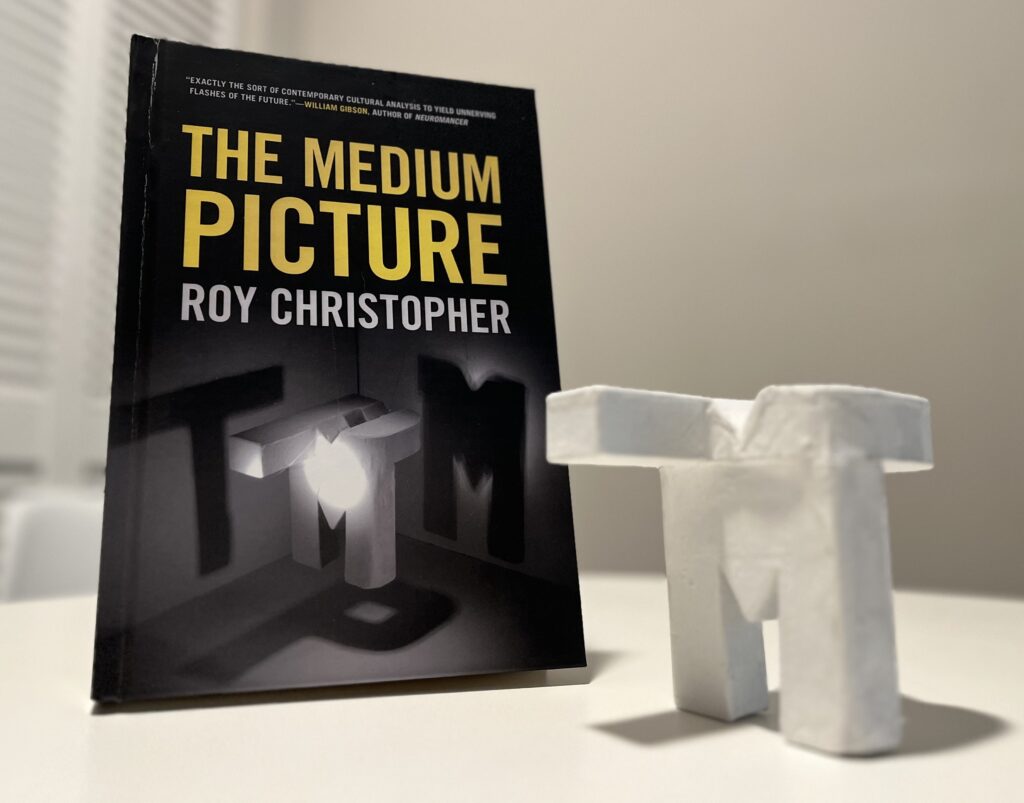
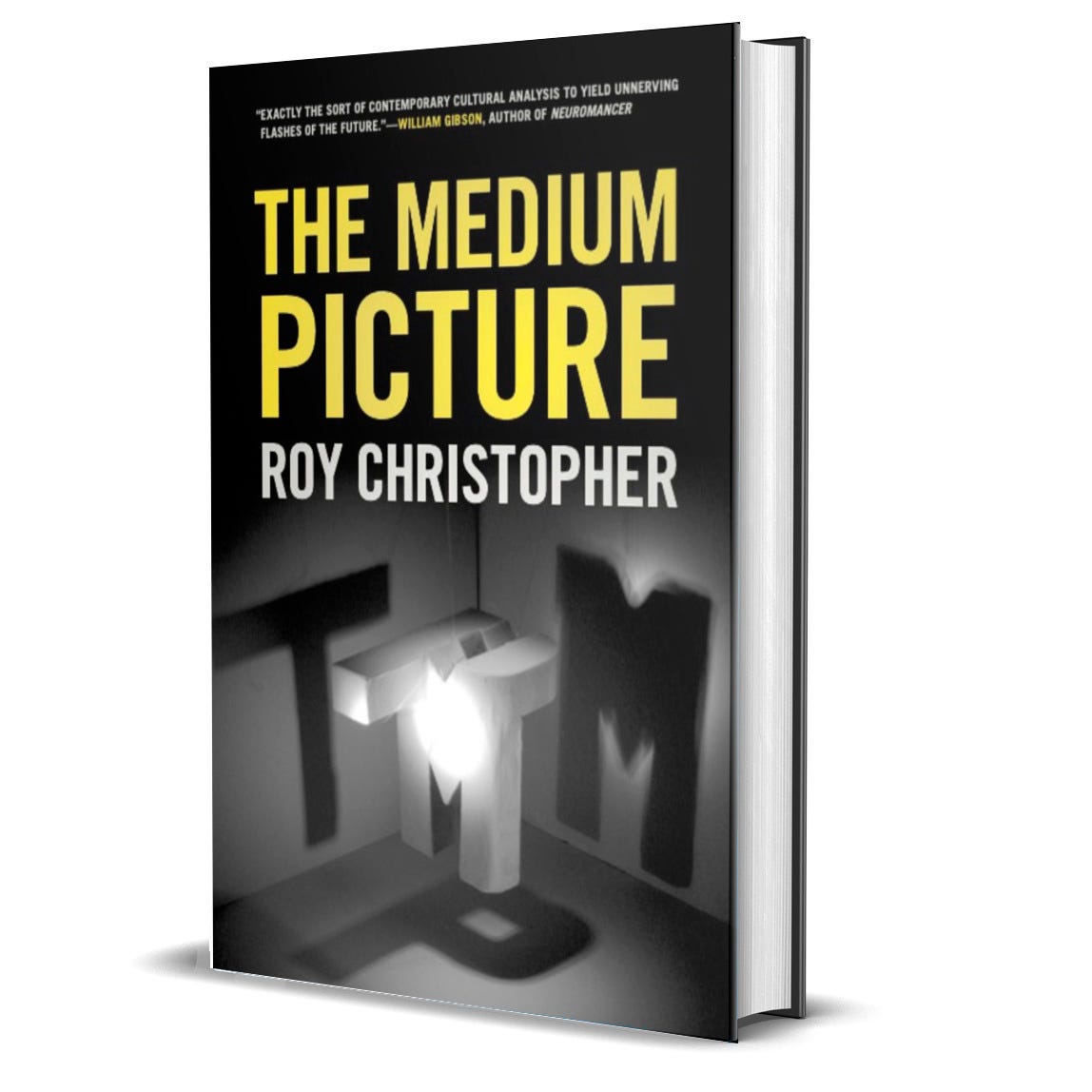
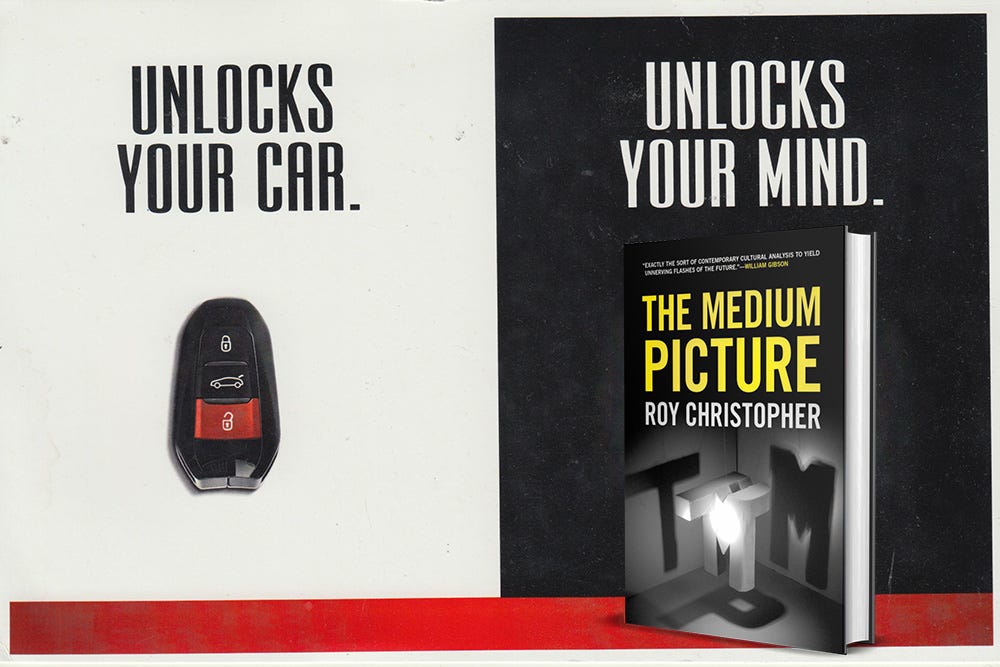
In a mode appealing to members of any subculture, Roy Christopher’s dense but slim The Medium Picture charts the changes in culture as dictated by technology on both a personal and intellectual level. Like the history of our media itself, he first references large monolithic examples — radio/music and television shows — that have become embedded in our culture, then complicates and fragments our relationship to them. One example focuses on how the change from record to tape in the music industry helped to alter our cultural expressions and how we synthesize information. He moves through post-modern history and shows how more technology can create corrosive representations and information, like a copy of a copy of a copy.
A sort of punk rock luddite — Christopher has never owned a TV and hasn’t had a car since the 1990s — he draws from subculture crossover icons like Gang of Four, Laurie Anderson, and Ian MacKaye as well as well-researched academic theories from people like Marshall McLuhan to show how things like zines and mixtapes led to the tiny screens of today. The theory is sprinkled in references; I personally was drawn in with the often-cited works of William Gibson, a robust establishing of skateboarding’s relationship to his topic, and the dozens of chapter-opening quotations from films, poems, music, or authors like Kim Stanley Robinson.
Spike Jonze making marks in The Medium Picture. Photo by Rodger Bridges.
This vast collection of references is supported by well-referenced theory and research that mesh with the book’s easily readable format. Christopher’s claim of lifelong journaling seems very likely given the easy, conversational manner in which he delivers so much information. It is our insights into his own relationships to the theories at hand that make this book most compelling, and Christopher exudes a real love for the things he talks about. I maintained interest through loftier, hard-to-grasp ideas with clearly illustrated connections between seemingly disparate topics like metaphor and technology, while receiving new insight into everyday things such as walking.
The Medium Picture probes many of the questions and desires that we feel as people and may not have words for. The extremely clever title gives a very accurate idea of what the book is about — a play on words that folds in on itself from multiple angles. There is even a nicely designed title page logo calling attention to these interlocking angles, not to mention the pleasing chapter and section headers. Importantly, at only 162 pages, Christopher makes a seemingly intimidating topic appear tackleable and packs a lot into his punch. Perhaps the best thing The Medium Picture does, though, is recognize that it is a piece of a larger whole — a very important and often forgotten thing for cultural theory to do. For that and much more, it is worth your read.
I am proud to announce that the University of Georgia Press has deigned to publish The Medium Picture. To wit, I was born in Georgia, and I attended UGA briefly during my first attempt at grad school. This project is very close to my heart, and I am stoked to have the UGA Press putting it out.
Here’s the brief overview:
The ever-evolving ways that we interact with each other, our world, and our selves through technology is a topic as worn as the devices we clutch and carry everyday. How did we get here? Drawing from the disciplines of media ecology and media archaeology, as well as bringing fresh perspectives from subcultures of music and skateboarding, The Medium Picture illuminates aspects of technological mediation that have been overlooked along the way. With a Foreword by Andrew McLuhan, itshows how immersion in unmoored technologies of connectivity finds us in a world of pure media and redefines who we are, how we are, and what we will be.
The book uses ideas from William Gibson, Marshall McLuhan, and Brian Eno, examples from Fugazi, Radiohead, Gang of Four, and Run the Jewels, and artists like Christian Marclay, Richard Long, and Laurie Anderson. It’s post-punk media-theory!
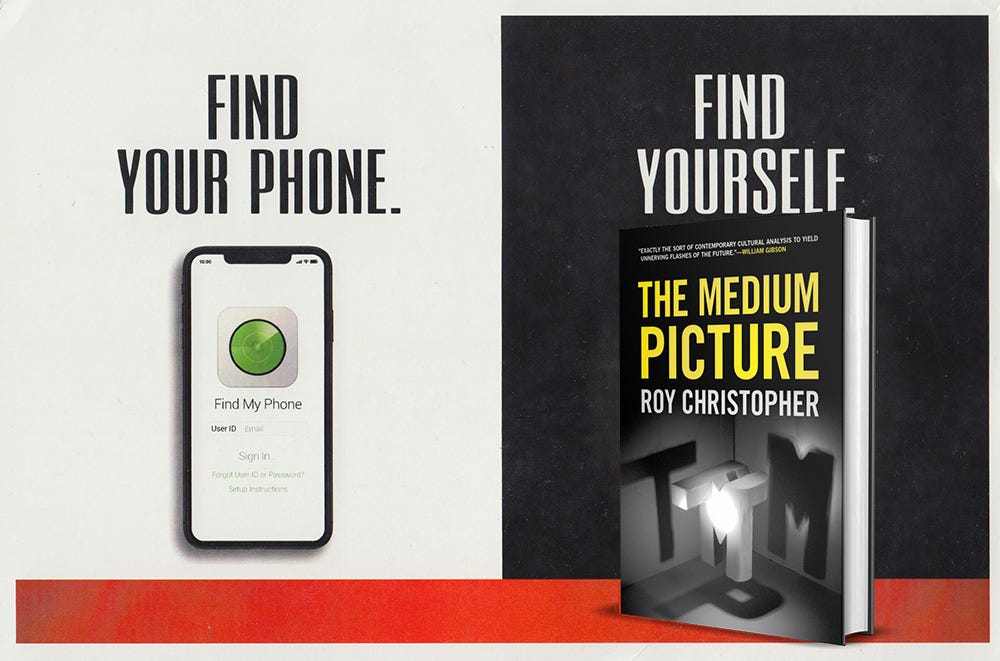
My post-punk media-theory book, The Medium Picture, is now available for preorder from all of your favorite places: UGA Press, Bookshop, Barnes & Noble, and even Amazon! Preorders mean more than you think. They’re very important for the life and success of the book. If you know you’re going to buy it, please consider snagging a copy early.
Preorders serve as an early indicator of a book’s potential success. They signal to publishers and retailers that there is interest in the book, which can lead to increased marketing efforts and larger print runs. For authors, preorders can be crucial in boosting their book’s visibility on platforms like Amazon. This can improve their sales rankings and increase exposure. On Amazon, preorders can affect the sales ranking before release, which might influence the platform’s promotional efforts. If you’re not sure, read on! Thank you!
Of all of my books, this is the one I’ve worked on longest and hardest. It’s the closest to my heart.
Here’s what other people are saying about it:
“Exactly the sort of contemporary cultural analysis to yield unnerving flashes of the future.” — William Gibson
“Like a skateboarder repurposing the utilitarian textures of the urban terrain for sport, Roy Christopher reclaims the content and technologies of the media environment as a landscape to be navigated and explored. The Medium Picture is both a highly personal yet revelatory chronicle of a decades-long encounter with mediated popular culture.” — Douglas Rushkoff
“A synthesis of theory and thesis, research and personal recollection, The Medium Picture is a work of rangy intelligence and wandering curiosity. Thought-provoking and a pleasure to read.” — Charles Yu
If you’re so inclined, you can post one these on the social medium of your liking. Link ‘em to your favorite online book outlet or just to http://www.themediumpicture.com
You don’t know the name Angela Britt, but if you were familiar with the deepest details her story—from runaway to ranch hand—you might recognize her as a dozen or so characters in the novels of Cormac McCarthy. She was the model for both the bumbly bum Gene Harrogate and the young and doomed Wanda from Suttree for instance. As I read Vincenzo Barney’s article in Vanity Fair, not only was I surprised that McCarthy didn’t have all of that horse knowledge firsthand—like all of his writing, the bits about ranching are very convincing, rife with expert detail—but also how many times the number 47 kept popping up.
Forty-Seven
I was interested in the story because of how frequently and thoroughly McCarthy had alluded to Britt in so many characters in so many of his novels. I thought the allusions to a living yet unknown person was an interesting angle on the figurative phenomenon. Britt knew McCarthy for 47 years. Coincidentally, she has 47 extant letters from him. McCarthy didn’t send her one letter a year, but she managed to keep the same number of letters.
Sometime last century students at Pamona College in California noticed the number 47 popping up around campus. For one, the college is just off exit 47 of I-10. In her article, “The Mystery of 47,” from the October 1, 2000 issue of Pomona College Magazine, Sarah Dolinar writes,
Depending on your point of view, you might call it a tradition built around trivia, or you might call it Pomona’s link to the deep structure of the universe. For instance, were you aware that the organ case in Lyman Hall has exactly 47 pipes? Or that Pomona’s traditional motto, “Pomona College: Our Tribute to Christian Civilization,” has 47 characters? Did you know that at the time of Pomona’s first graduating class in 1894 there were 47 students enrolled? And if you want to go deeper into the mystery, did you notice that the last two digits in that year equal 47 times two?
Many Pomona alumni have deliberately inserted 47 references into their work. Joe Menosky, class of 1979, a writer for Star Trek: The Next Generation, inserted 47 mentions into nearly every episode of the show. Starting on Star Trek, continuing with Menosky on TNG, and through all of J.J. Abrams’s work (e.g., Alias, Lost, Fringe, the Star Trek reboots, etc.), the number 47 has a long history on the screen. Wherever there’s a stray number in the dialog of one of these shows—a time-stamp, an evidence tag at a crime scene, an apartment number—47 does its numerical duty, threading through and connecting the pieces to a larger whole.
David Lynch’s last feature film, Inland Empire from 2006, partially takes place during the filming of a movie. The movie within the movie is called On High in Blue Tomorrows. After an unnerving disturbance during a table read on set, producer Freddie Howard (Harry Dean Stanton) and director Kingsley Stewart (Jeremy Irons) confess to the two leads — Nikki Grace (Laura Dern) and Devon Berk (Justin Theroux) — that they are shooting a remake of an unfinished German production called Vier Sieben — 47, which was itself based on a cursed Polish folktale. The previous project was abandoned after the two leads were found murdered “inside the story.”
Before that revelation, we are treated to a surrealist sitcom featuring a rabbit family going about their day in their living room. Later on in the movie, after an altercation with a some sort of phantom, Nikki flees into Room 47, which, unbeknownst to her, is the living room of the rabbits from television. These allusions start out unbeknownst, but soon they seem ubiquitous. For instance, after the earth’s human population reached 2 billion people in 1928, it took 47 years for it to reach 4 billion in 1975, and another 47 years to double again in 2023.
Let’s look at another one.
Forty-Three
It started as an amount of change.
Once upon a time in the early 1980s, the father of one of the Curb Dogs—a loose-knit crew of skateboarders and BMXers in the Bay Area scene that included Maurice Meyer, Dave Vanderspek, Marc Babus, and future Bones Brigade member Tommy Guerrero—walked from the local convenience store into a house party with 43 cents jingling in his pocket: a quarter, a dime, a nickel, and 3 pennies. In a wacky accent, he said to those assembled, “How come every time I come home from the store, I always have 43 cents in my pocket?!” Everyone laughed it off, but the idea was incepted.1 For this group of skateboarders and BMXers, the number 43 was suddenly very important, and they started seeing it everywhere.
BMX nostalgia. Illustration by Roy Christopher.
Maurice “Drob” Meyer, the NorCal BMX local some call the Godfather of 43, says it was Rob “Orb” Fladen’s dad who started the 43 phenomenon. In 1986 (which Drob points out is two times 43), a bunch of those NorCal guys visited Wizard Publications in Los Angeles, the home of BMX Action, Freestylin’, and later Homeboy and Go magazines. These publications were our news networks, and they were all helmed by three hyper-creative dudes known as the Master Cluster: Andy Jenkins, Mark Lewman, and Spike Jonze. If skateboarding was a relatively small subculture in the mid-1980s, then BMX freestyle was even smaller. These guys documented it with an energetic blend of wisdom and whimsy that included not only the adjacent action of skateboarding but also street art, underground music, and BMX mythology.
Soon the lore spread, and the numerology followed. Forty-three started showing up in the magazines, zines, and videos. It was known as the coincidence number. We saw it in receipts and change, bank signs and temperatures, longitudes and latitudes, mile markers and measurements. In the late 1980s, skateboard pro-cum-photographer Bryce Kanights had a warehouse ramp in the Bay Area called Studio 43. Ron Wilkerson’s legendary Enchanted Ramp was just off the 5 interstate at exit 43. Though the letters D and C in DC Shoes stand for Droors Clothing, Drob points out that D and C are the fourth and third letters of the alphabet. In Eddie Roman’s 1991 video Headfirst, Mat Hoffman, who is widely considered the Michael Jordan of BMX, mentions the number, exposing a new decade of riders to the cult of 43.
By the early 1990s, the Master Cluster had moved on from BMX, into magazines for young men (Dirt) and the Beastie Boys (Grand Royal). Soon, they moved into other areas entirely. Jenkins went into skateboard art (for Girl and Chocolate Skateboards), Lewman went into advertising (for companies like Lambesis and Nemo Design), and Jonze, as a music video director (for the Beastie Boys, Weezer, Björk, and many others), was already on his way to fame and acclaim in Hollywood. In 1995 they were the subject of a one-page profile in Wired Magazine. The page number? 43.
Have you ever learned a new word and then started seeing it everywhere? This is what the literary theorist Kenneth Burke called “terministic screens.” Burke would say that the word was always there, but you were filtering it out, obscuring it with ignorance. Once it became a part of your terministic screen, only then did you start seeing it. Forty-three is a prime number. As an angel number, 43 is highly positive and gives you hope anything is possible if you believe and pursue it. Says a popular angel number website, “People who regularly see number 43 should trust their own inner voice in all things they do.” Everyone knows you can do this with any number, but when you share that number with a group of like-minded people, the power is undeniable.
“Today, you can see and hear references to 43 in movies by Eddie Murphy, Adam Sandler, and TV shows by Dave Chapelle,” the flatland BMX professional Dave Nourie writes. In Spike Jonze’s 1999 feature film, BeingJohn Malkovich, Malkovich’s apartment number is 43, a nod to Jonze’s BMX roots. Nourie calls these planted 43s “acts of agriculture,” intentional allusions to an inside joke held by a few practitioners of a niche action sport, but the number has leaked into the larger world. Growing up, the novelist Rachel Kushner ran with Tommy Guerrero and others in the NorCal skateboard and BMX scene. As she writes in her essay, “The Hard Crowd,” “Forty-three was our magic number. I see it and remember that I’m in a cult for life.”
I wrote a piece about skateboarding for the Summer/Fall 2024 issue of the Henry Ford Magazine. “Mining Affordances” explores the way that riding a skateboard reshapes one’s relationship with the world, the environment, and oneself.
“How do you like your metaphors mixed? This work of psy-fi docutainment, best ingested by first grinding it into Bookpowder, follows Rocco Atleby’s kudzu plots in the pursuit of fluctuation on the horizon of the Patasphere. Flitting and flirting with spacetimeconsciousness dimensionzzzzz, deep down, heinleined under there somewhere, Chase Griffin and Christina Quay have committed some really serious satire. So pack your pestle and mortar and get ripping!”
Thanks to Chase’s insightful questions, he and I cover quite a lot in this short but wide-ranging discussion.
Chase Griffin: Is there a circuit for you between BMXing/skateboarding and media theory? If so, what’s that sparking thing?
Roy Christopher: Well, in the broadest sense, one of my main research interests is the influence of technology on culture. The study of media—and even that in my mind is quite broad—somewhat narrows the research to where the results of this collision play out. I’m focused on the domains of various youth cultures, so BMX and skateboarding media is where bikes, boards, digital cameras, video cameras, writing, riding, music, and the like converge and capture it all. When you watch a video or see a magazine from a certain era, you’re seeing a snapshot of a culture at that time.
So, yes. I started making zines in the summer of 1986. Ten years later, I started messing around with HTML, and I saw the web as another level in zine-making. Though I was still doing print zines, I learned some basic code, bought some domain names, and starting building websites. The blogs (a term I am still hesitant to own) of the 2000s might’ve been the last era during which I felt like my approach to indie discourse thrived. The social-media silos killed all of that.
CG:Is the feedback loop the only way to go? Is this what makes today’s media such an anxiety inducing place? It feels like it’s not just the geopolitics and climate change? The loops, content aside, can be wholly crippling for many. It feels conspiratorial at times, in a divide and conquer kind of way, to get us all to stop acting in meatspace and live in this anxiety box so that the robber-barons can go on robbing the poor and raping the earth. Is there an alternative to this? Is there a way to create a more positive media?
RC: Last year, I went back to a bar I used to frequent in Chicago, and the same few people were there, sitting in the same places, having the same conversations. That’s what social media looks like after you take a break. It’s always baffling to see the same people posting the same stuff months later.
So, my first inclination is retreat. I’ve left every major social media platform and flirted with a few new ones, but I get fed up and deactivate them every few weeks. It makes for an inconsistent online presence, but I can’t be more consistent with it and still feel human.
Anxiety is lucrative. Once the social media platforms saw the goldmine of outrage, their steering users toward anxiety of one sort or another was inevitable. This has spread to every other kind of media. The goals are not information or entertainment as much as they are to elicit a reaction—any reaction. It’s turned journalists into trolls and the rest of us into dupes. There’s just more money in making people feel shitty than there is in making them feel good.
CG:What is the best way to help others?
RC: Fund their creative pursuits. Every problem I see my artist and writer friends and colleagues having is because there’s no money to do the cool things they want to do. I have the same problems, but I’ve sacrificed things and adjusted my lifestyle to facilitate the creative work I want to do, and subsequently I get to do some of it. The internet democratized and simultaneously demonetized everything.
To put it simply in a slogan: pay for art.
CG:I feel like we should all get together and create a better media. I miss the promise of the user-generated utopia. Do you think coding and computer engineering should be taught in public school widespread and starting at an early age? Do you think that if everyone speaks the new Latin, we can jumpstart society and get along without the new greedy and incompetent priest class?
RC: I can’t help but be cynical about the state of media at this point. The promise of the user-generated world has been fulfilled, but it’s no utopia. Computers, the internet, and ubiquitous cameras and screens have democratized every form of creativity. If one can be a “content creator” simply by aiming a lens, we’re not exactly honoring human creativity. DJ Scratch once said that the reason we respect something as an art is because “it’s hard as fuck to do.” Is the bar getting higher or lower?
A lot of my current students have majors that you would think would help (e.g., computer science, data science, information science, etc.), but the truth is that not everyone should be doing this stuff. The barriers to entry that existed before the internet were not tuned properly, but take a quick look at your feed, and you’ll see that we need some of them.
I think it’s all going to get a lot worse before there’s even a chance of it getting better.
CG:What does your ideal virtual community look like?
RC: A real-life secret salon. An invisible, intellectual speakeasy. I know a lot of smart, creative people. If I had a place to meet all of them on a regular basis and exchange ideas and collaborate on projects, that would be the ideal virtual community. If you went looking, you’d never find us.
Many thanks to Chase Griffin for doing this interview, Metapsychosis for publishing it, and you for reading and sharing it.
Skateboard and BMX zines defined my formative years. Those handmade, photocopied publications were our network of news, stories, interviews, events, art, and pictures. It’s very difficult to describe how an outmoded phenomena like that worked once such epochal technological change, one that uproots and supplants its cultural practices (i.e., the internet), has occurred. FREESTYLIN’ Magazine’s reunion book, Generation F (Endo Publishing, 2008; flip through it at the link), has a chapter called “The Xerox was Our X-Box,” and that title gets at the import of these things. As I said in that very chapter, “Making a zine was always having something to send someone that showed them what you could do, what you were up to, and what you were into. Ours was the pre-web BMX network.”
A small sample of my zines over the years.
At best, zines represent a hidden circuit of media, a grassroots exchange of information and ideas that slips through the cracks of popular culture. Zines are power in the hands of the fans. As Mark Lewman, editor of FREESTYLIN’ Magazine and head of Club Homeboy, as well as “Chariot of the Ninja” zine, points out, “The first zine I did once I moved to California was called ‘Homeboy’. I did one issue and some stickers, and it ballooned into a mail-order lifestyle company with 15,000 members, and became one of the first youth culture magazines, a pastiche of art and sport and randomness. So, the power of zines is pretty unlimited as far as I can tell.”
In spite of the proliferation of the internet, zines are not entirely a thing of the past. Every time we do something on our own instead of just taking what’s given to us, we strike a blow to the massive media machine that constantly shoves products and personality down our throats. Making your own zine is not only immeasurably rewarding (ask anyone who’s ever done one), but it gets your point of view out there and incites dialog between readers, riders and other zine-makers that wouldn’t necessarily take place.
Independent journalists wield the power to expose local underground talent as well. There were always obscure riders in sporadic locales ripping like top pros. There are always great bands no one has heard. The way to get them noticed was not to bug out about major magazines’ lack of attention, but to give the magazines a reason to pay attention. As ex-editor of Faction BMX Magazine John Paul Rogers puts it, “Quit bitching and get off your ass and do something about it.”
So, though they’re as much a part of the process anymore, I cannot overstate the importance of the experience of trading and making zines. There’s something to the physicality of the pages in your hand and the focus on those pages that pixels on screens don’t afford. As I said in FREESTYLIN’ Generation F, “Those first issues were the first steps on a path I still follow.”
Still true.
Portable Document Formats:
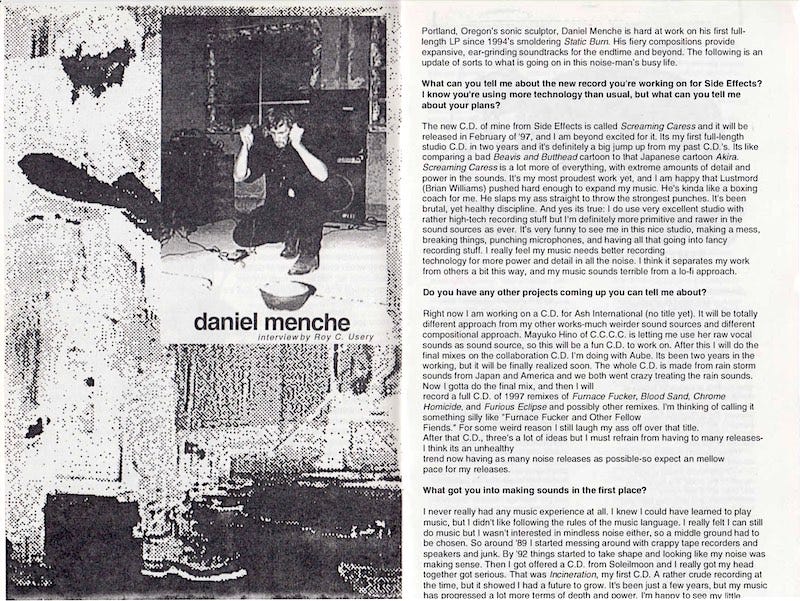
My Daniel Menche interview from wow&flutter.
If you’re interested, I scanned and uploaded a couple of my later zines as .pdfs. wow&flutter (1997) was an attempt to bring together experimental noise of all kinds and featured interviews with Daniel Menche, John Duncan, and a cover story about turntablism. It was intended as part of a series, but the second issue, attack&decay, featuring interviews with Jack Dangers of Meat Beat Manifesto and Warren Defever of His Name is Alive, among others, never made it to press. I still love the idea of noise and hip-hop coming together, and there are others who’ve merged them in the meantime better than I could have imagined (e.g., dälek, clipping., Ho99o9, Death Grips, Cloaks, Justin Broadrick and Kevin Martin, et al.)
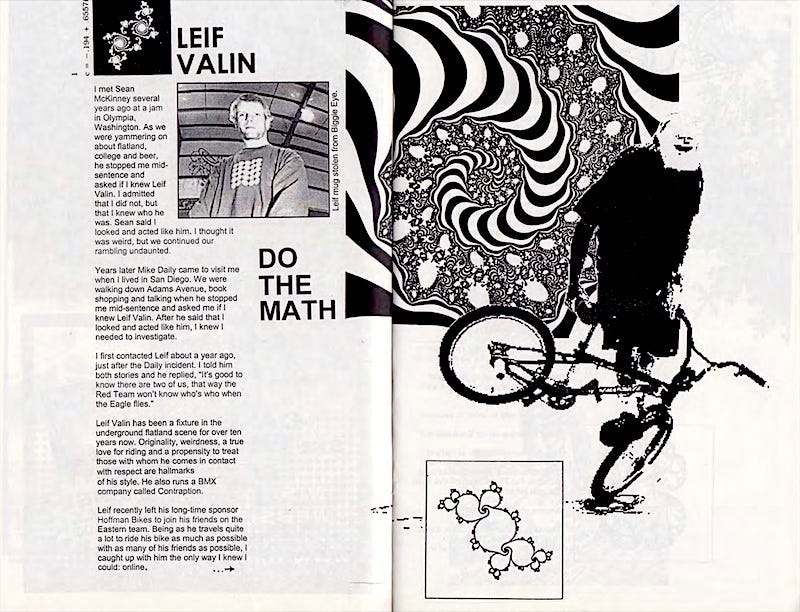
A spread from HEADTUBE featuring Leif Valin. [layout by me.]
HEADTUBE (2001) was my attempt to return to BMX zine-making while maintaining my other, newfound interests in the early 00s. Though I maintained the website for years after, the zine ended up as another one-off print publication. It features interviews with Seattle ripper Steve Machuga, flatland guru Leif Valin, and the band Milemarker, as well as reviews of books, records, and other media. I still have a few copies of the print version. Let me know if you’re interested.
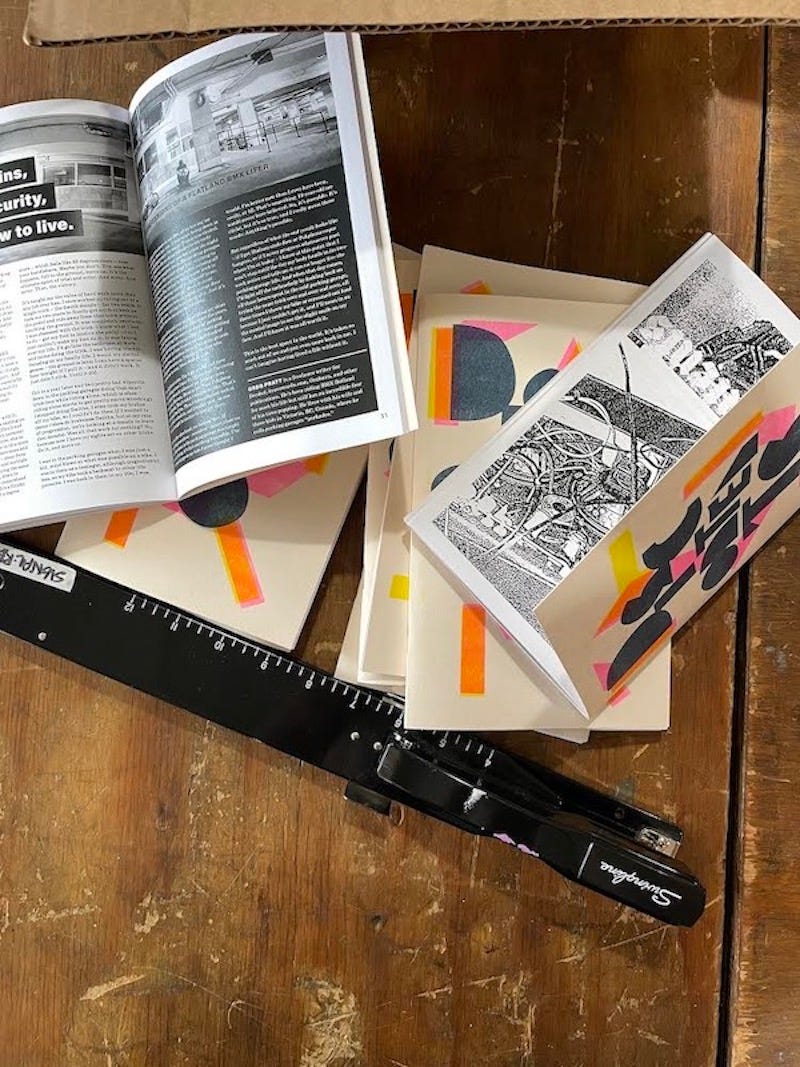
The pilot issue of discontents and the long-arm stapler: a zine-making essential.
Oh, and if you missed the pilot issue of discontents, the latest zine I worked on with my friends Patrick Barber and Craig Gates, we’re working on a proper debut issue. More on that soon!
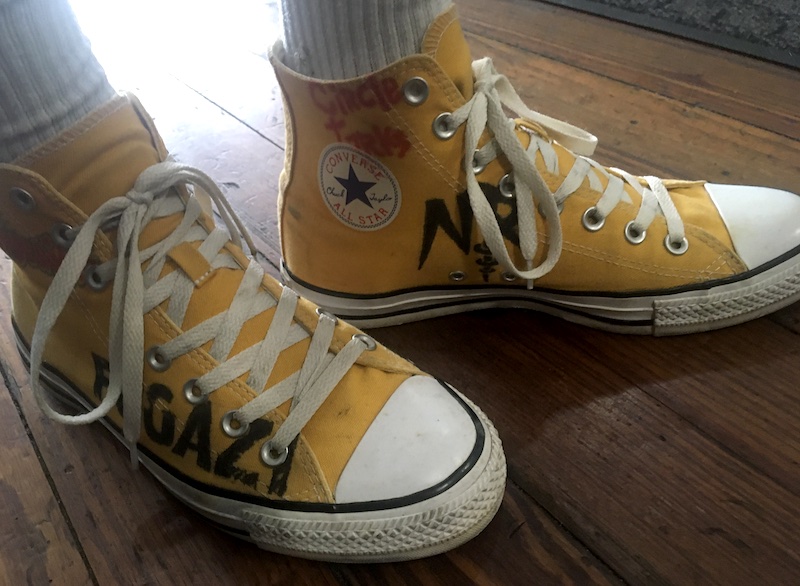
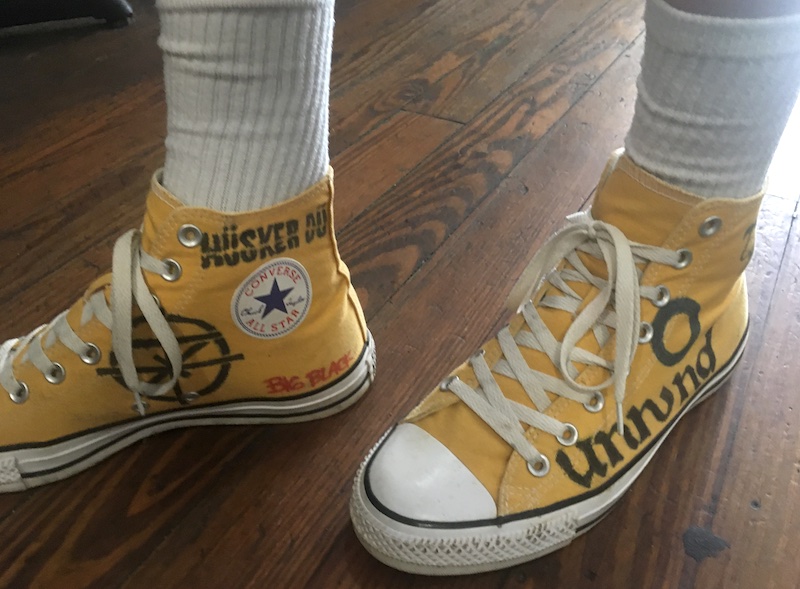
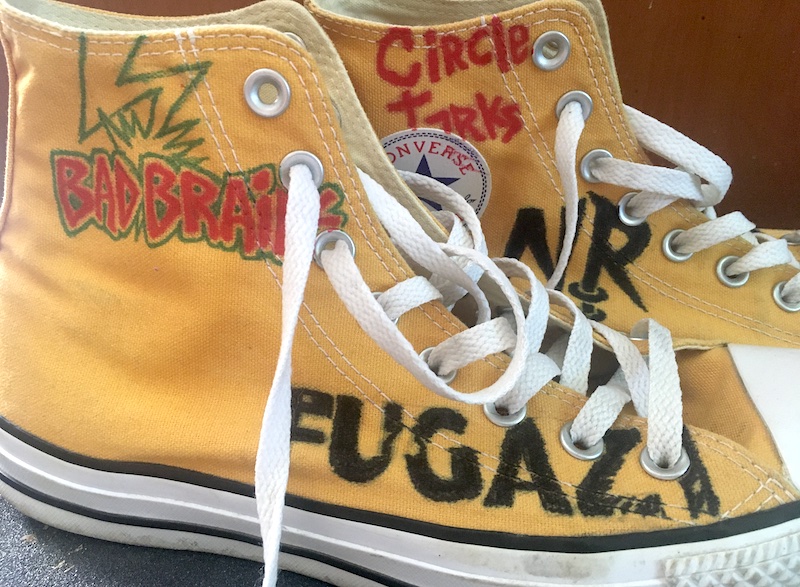
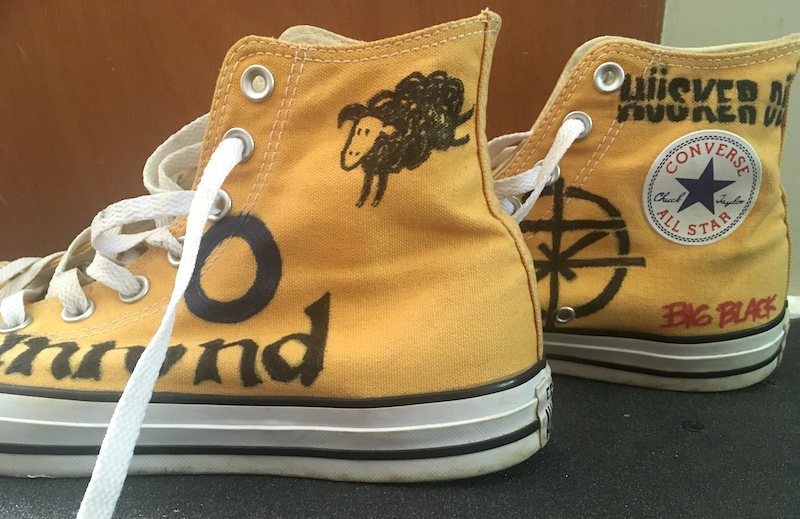
The first time I got to hang out with the Big Kids, the runt of their already established clique stuck with me. He wasn’t the Cool One. Everyone else was making fun of him, but I was unimpressed by them. First of all, he had a skateboard. To me in the eighth grade, there was little else that was cooler than a skateboard. He had longish hair, a baseball cap, a short-sleeve button-up shirt unbuttoned over a t-shirt, board shorts, and teal Chuck Taylors with band names written all over them. Chuck Taylors are the link between punk-rock and skateboarding. You can’t skate in Doc Martins, but you can mosh in Chucks.
Now, I’d had Chucks before, but the audacity of personalizing them hadn’t occurred to me. Soon, I sprayed my red pair with bleach, leaving a yellow splatter pattern. I added yellow laces to set them off. I took a Sharpie to another pair, and added black laces to match my doodles of zine logos.
Recently, my sister found me a new yellow pair at a thrift store, and I immediately thought of that guy from eighth grade with his crude band-name scribbles.
I took mine a step further by trying to draw the band logos as accurately as possible.
Bands represented include Fugazi, Bad Brains, Unwound, Germs, Circle Jerks, Hüsker Dü, Naked Raygun, 7Seconds, Minor Threat, and Big Black.
Still banned in DC.
Out of Step with the world.
I can only hope I made the bands proud. Impressing the Big Kids is always a lost cause.