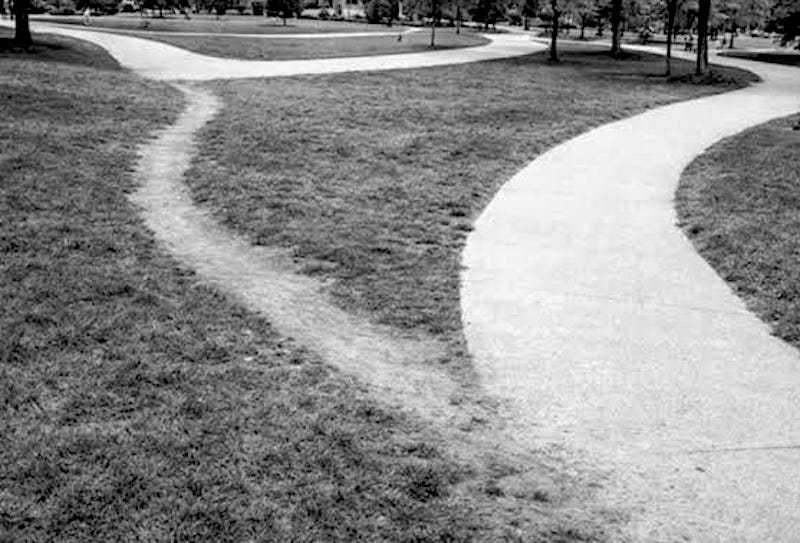
Trails meander from paved walkways, wearing grass into new paths. In contrast to sidewalks, desire lines show where we’d rather walk. My friend Charles Mudede recently wrote a piece about them in Seattle for The Stranger. Charles is a brilliant post-Marxist, and his theories and thinking are always grounded in the urban center of the Pacific Northwest, which was my home for nearly a decade off and on between 1993 and 2007.
“Walk This Way” by Charles Mudede in The Stranger. [Photo by Mark Wieman]
In the piece, Mudede writes,
Ultimately, what a desire path presents is the workings of a social mind. These trails have no pioneers, no discoverer, no glory-seeking Christopher Columbus. No one can really claim them as their own. The path was made by you and a whole bunch of people you’ll likely never see in your life. The way from A to B is visible, but all of the feet that collectively made it are as invisible as ghosts.
The design critic Donald Norman calls desire lines “social signifiers, a clear indication that people’s desires do not match the vision of the planners.”1 Tim Ingold writes, “Footprints are individual; paths are social.”2 For Mudede, the desire line is the indexical trace of all the souls that drifted this way and all the soles that stepped there, the earthbound patina of human and animal locomotion. He concludes,
[O]ne who loves desire paths is fine with those that are functional and those that are dysfunctional, those that are worldly and those that are metaphysical or superstitious or aesthetic. One even loves paths that emerge from the desire of squirrels and other synanthropic animals. A true philosophy of desire paths must be as democratic as all of the feet that made and went their way.
Mudede’s emphasis on the democracy of desire lines is tantamount. If we align technology and fascism, then the desire line represents a foot-trodden rebellion.
In step with that spirit, here’s a bit more about desire lines.
A Footpath Named Desire
“I’m not interested in legacy in terms of my reputation. I am, however, interested in leaving a trail.” —Ian MacKaye
“The ground on which you walk is the tongue with which I talk.” —Saul Williams, “Elohim (1972)”
Campus sidewalks meander between places of interest, connecting buildings and parking lots in a maze of concrete stripes. Often where their right angles turn near grassy areas, arrowed toward another building or parking lot, there are paths leading off diagonally. These forking paths are called desire lines, so named because they show where people would rather walk.3 The folklore of desire lines says that good engineers—or lazy ones, depending on who tells the story—put sidewalks in last so as to follow the paths in use and avoid wear on the grass.4 The story is suspect, not only because it makes too much sense but also because it runs counter to the bureaucratic grain. Construction contracts and fiscal funding don’t last long enough for engineers to wait and see where people want to walk. The time constraints wouldn’t allow much in the way of paths.5 However, there are cases of rogue paths being “legitimized” with pavement after the ones in place proved insufficient.6 Impressions of desire take time.
Desire lines are the earth’s memory, physical graffiti drawn with feet and tires.7 Some are deviations from the built environment, and some precede the building. Some show what users of a system would rather do, and some show which procedures they perform the most. That is, sometimes the “desire” refers to a transgression of the system, and sometimes it refers to normal but frequent use. Urban planner Kevin Lynch wrote, “Paths can link places of contrasting episodic quality, as in the stroll garden. On more formal occasions, as on an educational trip, the journey in space may deliberately symbolize a journey in time.”8 The “well-worn ribbons of earth” walkers leave behind symbolize “yearning,” in the view of traffic engineer John La Plante.9 The earth remembers the walks written out by soles.
Desire vs design.
It is not only about the relationship between walking, body, world, and each other but also between walking and design.10 If the built environment is the external manifestation of our thinking brains, if the urban system is our cognitive system extended in urban form, then desire lines are its deviant thoughts.11 If pavement formalizes the “historical layers of a city,” then desire lines are its marginalia.12 “The design of an office space, or a university, or a prison, or a factory, is likely to embody the power relations that structure its activity,” writes the historian Stuart Ewen. “It will tell us, silently, who is powerful, who is not; who watches, who is watched; who dictates, who takes dictation.”13 Silent acts of resistance, desire lines are the transcripts of everyday defiance.14 The architect Christopher Alexander wrote, “When large buildings are built, people and departments are treated like objects, and bundles of them are allocated to holds inside a cargo ship. Under such conditions, how is it possible to feel any sense of ownership and responsibility? How is it possible to care for one’s environment, and make plans to change it?”15
Desire lines illustrate the tension between the built environment and our relationship to it. Desire lines are where the system—the system of people in conjunction with their built environment—asserts itself. Designing and laying sidewalks are predictive behaviors. They anticipate the future. Desire lines are signs of past and present use. They are the site of discrepancies between designers’ intentions and our actual behaviors, and they are the best guide for path-building.16 In a passage worth quoting at length, Kevin Lynch and Gary Hack describe lines flowing through the city:
The character of the line should depend on the speed with which it will be traversed. A footpath responds nervously to minor changes in terrain; a highway takes a sweeping line. Pedestrian motion, like the flow of water, has an apparent fluid momentum. It follows the lines of least resistance, shortening distances by cutoffs. The flow may be smooth or turbulent, purposeful or meandering. It can be deflected, or encouraged by visual attractions, by levels, openings, and the character of the floor. A walk may be arcaded, heated, cooled, or its floors warmed to melt the snow. It can be provided with benches, plants, kiosks, cafes, display cases, or information devices. As a fine highway expresses the nature of vehicular movement, so a good walk system reflects the pleasures and characteristics of motion on foot.17
As Lynch and Hack describe it, design should be tempered by the act of walking, but the system itself determines the tone of the walk.
Before they were the slang of the pattern language, a blight on the urban planner’s finished project, desire lines prefigured roads and maps. Before the first roads were paved, they were dirt paths worn by hooves and wooden wheels.18 Before that, they were trade routes trampled by footfall.19 And before that, they were simply paths indicating a desire to find a way. Writer Peter Turchi explains, “Tens of thousands of years ago, before the first trails were etched into mud with the point of a stick, before the first pictures were scratched into stone, and long before the first graphic depiction of places on anything like paper, there must have been something we might call premapping: the desire, and so the attempt, to locate oneself.”20 Desire lines can be the path we make or the path we follow, wayfinding and wayfaring, making our way in the world.
“Our dealings with Nature are just lines in innumerable directions.” — William James
“Make straight paths for your feet.” — Hebrews, xii, 13.
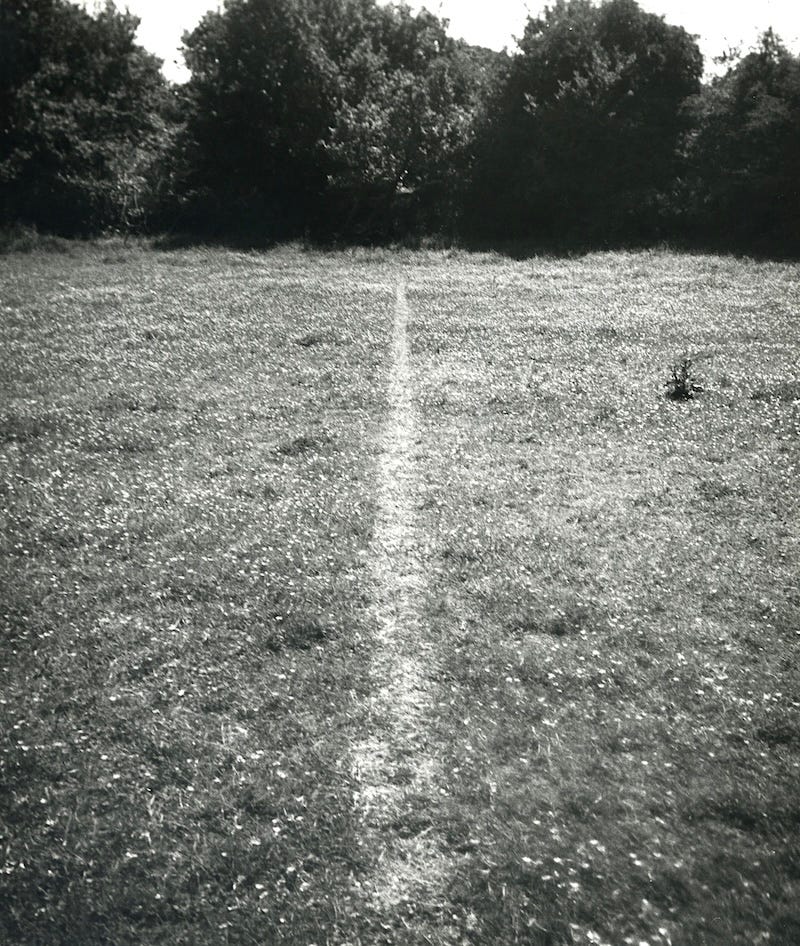
“My first work made by walking,” explains artist Richard Long, “in 1967, was a straight line in a grass field, which was also my own path going ‘nowhere.’”21 While a student at Saint Martin’s School of Art in London, Long wore a single, straight line on a rural field outside of London. His single photograph of the line wore his name into the annals of art like so many footsteps on that field. About the piece, dubbed “A Line Made by Walking,” Dieter Roelstraete writes that it “equally belongs to the histories of early Conceptual art, Land art . . . performance or body art . . . and conceptually inflected experimentation in photography.”22 It was Long’s first recognized piece of art and set in motion a career that took art out of the gallery and into the landscape. Long says of the piece, “It’s made of nothing and disappears to nothing. It has no substance, and yet it’s a real artwork.”23
Richard Long’s “ A Line Made by Walking” (1967).
The line is “a simple metaphor for life,” says Long. “A walk marks time with an accumulation of footsteps,” he asserts in the 1982 statement “Words After the Fact.” “It defines the form of the land.”24 Contextualizing his walking works on a planetary scale, he adds, “The surface of the earth is covered with endless patterns of humans and animals [that have accrued] for millions of years. Each trail and footprint is slightly different, and mine is just one more layer.”25 With these layers, we define our space, our communities, our nations. Ingold writes in The Life of Lines, “Walking the roads and paths is to trace a portrait of the country.”26 Roads and paths portray our social and business connections and their historical ebbs and flows.27 Human history is made of lines and paths and roads.
As Karen O’Rourke puts it, “contemporary artists have returned time and again to the walking motif, discovering that, no matter how many times it has been done, it is never done.”28 Long claims that walking is his medium of choice.29 His pieces that aren’t created directly by his putting one foot in front of the other are made from things found while walking (mud, stones, etc.), by documenting the conditions of his walks (wind direction, walk duration, length, etc.), or by planning routes on maps beforehand. Sometimes drawing a straight line on a map and then attempting to follow it in the physical world, Long scarcely shares the politics of the Situationists, but his performative use of walking and mapping is quite similar to their ideas of drifting and seeking authenticity in everyday life.30 Where the Situationists performed the dérive in nomadic groups in urban environments, Long walks alone in remote locales. Also, unlike them, Long says that his work is not a reaction to society: “My work is about ideas and actions, it is a balance of the mental and physical.”31 He simply enjoys walking, finding campsites, and just being in the world. The simple spirit of walking, drifting from one point of interest to another, is evident in both.
Where our world and its media used to show the marks of footprints and fingerprints, now their marks are moving out of our hands, in the clouds, in our heads—invisible, ephemeral gestures. Maybe that is the real difference between old and new media: the way they show use. Richard Long once posited, “I think that the surface of the world anywhere is a record of all its human, animal, and geographical history.”32—what Mudede parenthetically calls “the world lines of life.” Whether designed from the top down or emerging from the bottom up, the texture of that history is up to us.
Notes:
Norman, Living with Complexity, 2010, 126.
Ingold, The Life of Lines, 2015, 63.
Desire lines are also known less poetically as “desire paths” and “social trails.” See Lidwell, Holden, and Butler, Universal Principles of Design, 2010.
See Brand, How Buildings Learn, 1994, 187; Lidwell, Holden, and Butler, Universal Principles of Design, 2010, 76–77; Norman, Living with Complexity, 2010, 126–31; and Merholz, “Metadata for the Masses,” 2004. Other examples include Australian engineers spreading flour and using the resultant immediately visible trails to improve path planning, as well as what Aaron Naparstek, a visiting scholar at MIT’s department of urban studies and planning, calls “sneckdowns”: the edges of paths left in snow. See P. H., “Undriven Snow,” 2014; and Mars and Kohlstedt, The 99% Invisible City, 2020.
Norman, Living with Complexity, 2010, 128.
Smith and Walters, “Desire Lines and Defensive Architecture,” 2018. See also Rogers, Rebuilding Central Park, 1987, 35.
Ingold, Lines, 2007, 43.
Lynch, What Time Is This Place?, 1972, 186.
“Well-worn ribbons of earth”: Shepard and Murray, “Introduction: Space, Memory and Identity,” in Murray, Shepard, and Hall, Desire Lines, 2007, 1. “Yearning”: La Plante quoted in “Whose Sidewalk Is It, Anyway?” by Brown, 2003. La Plante, chief traffic engineer for engineering firm T. Y. Lin International, adds, “When sidewalks are provided, people do walk.” Brown also touts the importance of the social encounters sidewalks enable, quoting Jane Jacobs’s classic The Death and Life of Great American Cities, “Lowly, unpurposeful and random as they appear, sidewalk contacts are the small change from which a city’s wealth of public life may grow.” Brown, “Whose Sidewalk Is It Anyway?,” 72. Brandon LaBelle notes, “The sidewalk is a threshold between an interior and an exterior, between different sets of rhythms that come to orchestrate the dynamic passing of exchange each individual body instigates and remains susceptible to.” LaBelle, Acoustic Territories, 2010, 88.
Brighenti, “New Media and the Prolongations,” 2010, 475. See also O’Rourke, Walking and Mapping, 2013.
See Byrne, Bicycle Diaries, 2009.
“Historical layers”: Lynch, What Time Is This Place?, 1972, 186.
Ewen, All Consuming Images, 1988, 114.
See Scott, Domination and the Arts of Resistance, 1990.
Alexander et al., The Oregon Experiment, 1975, 65–66.
Theil, People, Paths, and Purposes, 1997. Norman, Living with Complexity, 2010, 126. See also Rapoport, The Meaning of the Built Environment, 1982.
Lynch and Hack, Site Planning, 1984, 205–6.
Scott, Seeing Like a State, 1998, 53.
Ibid., 73; Ingold, Lines, 2007, 116.
Turchi, Maps of the Imagination, 2004, 28. See also O’Connor, Wayfinding, 2019, esp. 98–127. Bruce Chatwin wrote, “Our early explorations are the raw materials of our intelligence.” Chatwin, Anatomy of Restlessness, 1996, 100.
Long, Walking the Line, 2002, 68.
Roelstraete, A Line Made by Walking, 2010, 2. Rudi H. Fuchs calls it “a fundamental interruption of the history of art.” See Fuchs, Richard Long, 1986, 43.
Quoted in Craig-Martin, “The Artist Michael Craig-Martin Talks with Richard Long,” 2009.
In Long, Heaven and Earth, 2009, 172.
Long, Selected Statements and Interviews, 2007, 25.
Ingold, The Life of Lines, 2015, 66.
Marshall McLuhan wrote, “The road is our major architectural form.” McLuhan, Culture Is Our Business, 1970, 132. Laurie Anderson says, “A road is always a good metaphor for a plot.” Quoted in King, “Laurie Anderson in Conversation,” 2018, 14.
O’Rourke, Walking and Mapping, 2013, xvii.
Long, Selected Statements and Interviews, 2007, 25.
Long, Walking the Line, 2002; Nicholson, The Lost Art of Walking, 2008.
Long, Selected Statements and Interviews, 2007, 73.